Property management is the professional oversight of residential or commercial real estate on behalf of owners, covering operations, tenant relations, maintenance, rent collection, and legal compliance. It is the system that turns a passive asset into a functioning income source. Platforms like Buildium and Avail have digitized parts of this process, but the core function remains the same: someone qualified handles the day-to-day demands of a rental property so the owner does not have to. For a newcomer investor, understanding what this role actually covers is the first step toward making sound decisions about your portfolio.
What is property management and what does it actually cover?
Property management is the organized administration of real estate assets, typically performed by a licensed professional or a dedicated firm on behalf of the property owner. The industry term used in real estate circles is “asset management” when referring to portfolio-level decisions, but “property management” describes the ground-level operational work: keeping units occupied, maintained, and legally compliant. Effective property management involves multidimensional tasks beyond rent collection, including lease enforcement, financial reporting, and local law compliance.
The scope covers both residential properties (single-family homes, apartments, condominiums) and commercial properties (office buildings, retail spaces, industrial units). A property manager acts as the operational layer between the owner and the tenant. They handle the friction so the owner can focus on higher-level decisions, or simply on their primary career.

Software tools like Buildium, TenantCloud, and Avail have made it easier for individual landlords to self-manage, but technology does not replace judgment, legal knowledge, or the time required to respond to a burst pipe at midnight.
What does a property manager do?
The role of a property manager covers far more ground than most owners expect before they hire one. Core responsibilities fall into five categories.
- Tenant screening and leasing: Property managers advertise vacancies, vet applicants through background and credit checks, and execute lease agreements. Strong screening is the single biggest factor in long-term profitability. A single problem tenant can cost $8,000 or more over five years, which makes rigorous screening a financial priority, not just an administrative one.
- Rent collection and financial management: Managers collect rent, enforce late fees, and produce monthly financial reports. Consistent collection protects cash flow and creates the documentation owners need at tax time.
- Maintenance coordination: Routine inspections, vendor relationships, and emergency repairs all fall under this function. Preventative maintenance programs implemented by professional managers extend asset lifespan and reduce emergency costs significantly.
- Legal compliance and eviction management: Landlord-tenant law, Fair Housing regulations, and local ordinances change regularly. Professional firms stay current on these requirements, providing a critical buffer against costly litigation for owners.
- Financial reporting and owner communication: Monthly statements, year-end summaries, and capital expenditure recommendations keep owners informed without requiring them to be involved in daily operations.
Pro Tip: Before hiring a property manager, ask specifically how they handle maintenance requests and what their average response time is. Slow maintenance response is the leading cause of tenant turnover, and turnover is where most rental income disappears.
The difference between self-management and professional management is not just time. It is the difference between reactive crisis fixing and proactive asset oversight that extends property lifespan and reduces emergency costs.
What types of property management exist and when should you get help?
Property management divides into four main categories, each with distinct operational demands.
- Residential property management covers single-family homes, multi-family buildings, condos, and vacation rentals. This is the most common entry point for individual investors and the category where the DIY-versus-hire decision is most frequently debated.
- Commercial property management handles office buildings, retail centers, and mixed-use developments. Lease structures are more complex, tenant relationships are longer-term, and compliance requirements are more demanding.
- Industrial property management covers warehouses, distribution centers, and manufacturing facilities. Specialized knowledge of zoning, environmental regulations, and infrastructure requirements is non-negotiable here.
- Special-purpose property management applies to properties like hotels, self-storage facilities, and senior housing, where operational complexity goes well beyond standard landlord duties.
For most individual owners, the decision point is operational load. Managing five or more units typically requires 25 to 50 hours per month, which exceeds most part-time capabilities. Owners managing one to three nearby units can often self-manage effectively, especially with software support. Once you cross five units, or once you are spending more than 5 to 10 hours monthly on management tasks, professional help becomes financially rational rather than optional.
A hybrid management approach is common among owners with three to seven units. They manage local properties themselves and outsource distant or more demanding ones. This strategy maximizes personal oversight where it is practical and reduces deferred maintenance and turnover where it is not.
The trigger for hiring professional help is rarely a single event. It is usually the accumulation of missed maintenance calls, late rent disputes, and the slow realization that the portfolio is running the owner rather than the other way around.
What are the financial benefits of hiring a property management company?
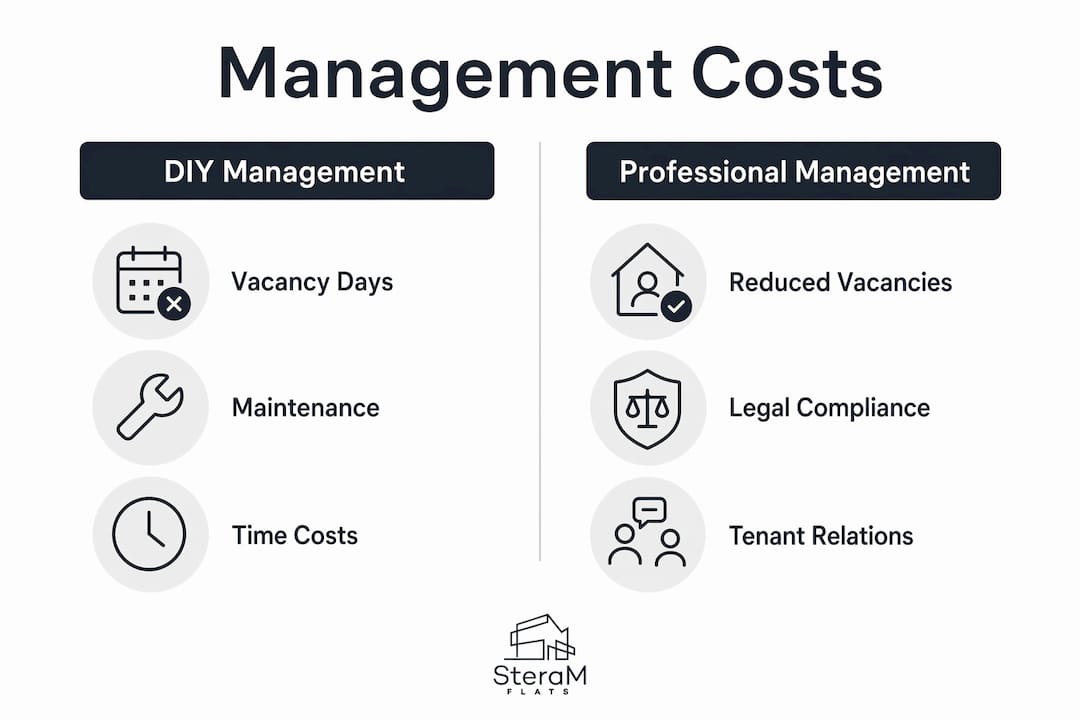
The financial case for professional management is stronger than most owners initially assume, particularly when you account for the full cost of vacancies, legal exposure, and owner time.
| Cost factor | DIY management | Professional management |
|---|---|---|
| Vacancy duration | 30 to 60 days average | 14 to 25 days average |
| Monthly management fee | None | 8% to 12% of monthly rent |
| Leasing fee | None | 50% to 100% of one month’s rent |
| Legal risk exposure | High without expertise | Reduced through compliance systems |
| 5-year loss potential | $36,000+ (vacancies, repairs, legal) | Significantly lower with proactive management |
Professional management fees typically range from 8% to 12% of monthly rent, with leasing fees averaging $555 to $670 in competitive markets. On a $2,000 per month unit, that is $160 to $240 monthly. That figure looks different when you compare it to the cost of a 30-day vacancy.
Reducing vacancy by two weeks on a $2,000 per month unit saves $1,000 per vacancy cycle. Professional managers achieve this through syndicated listing tools, faster tenant screening, and established applicant pipelines that individual landlords simply do not have. Properties with structured resident retention programs see 15% to 25% better tenant stability and renewal rates than those managed without formal retention systems.
The opportunity cost argument is equally compelling. If your professional time is worth $100 or more per hour, spending 10 hours monthly on self-management costs $1,000 in lost productivity. The opportunity cost of self-managing frequently exceeds the management fee itself, which reframes the decision entirely.
Pro Tip: Run a simple annual cost comparison before deciding. Add up your vacancy days, maintenance hours, and time spent on tenant communication. Then compare that total to the annual management fee. Most owners are surprised by the result.
Self-managing vs. hiring a property manager: which makes sense for you?
The right choice depends on your portfolio size, location, available time, and personal tolerance for confrontational situations. Management is an operational choice based on time and emotional discipline. Delegating confrontational tasks, like rent enforcement and eviction proceedings, often improves returns because owners who avoid conflict let problems compound.
Self-management works well when:
- You own one to three units within easy driving distance
- You have construction or maintenance skills that reduce vendor costs
- You have time to respond to tenant issues within 24 hours
- You understand local landlord-tenant law and stay current on changes
Professional management makes more sense when:
- You own five or more units, or properties in multiple locations
- Your primary income comes from a career that demands full attention
- You have experienced a costly vacancy, eviction, or legal dispute
- You want to scale your portfolio without scaling your personal workload
Software tools like Buildium, TenantCloud, and Avail offer a middle path for owners who want to self-manage with structure. These platforms centralize rent collection, maintenance tracking, and tenant screening in one place. They reduce administrative friction but do not replace the judgment calls that define good property management. For owners considering when to outsource, the threshold is usually clearer in hindsight than in real time.
The honest answer is that most owners underestimate how much time and expertise good management requires until they have already paid for the lesson.
Key takeaways
Property management is the operational and financial backbone of any rental portfolio, and the decision to self-manage or hire a professional is fundamentally a calculation of time, risk, and scale.
| Point | Details |
|---|---|
| Core definition | Property management covers operations, tenant relations, maintenance, rent collection, and legal compliance. |
| Financial threshold | Managing five or more units typically requires professional help to stay efficient and profitable. |
| Vacancy cost savings | Professional managers reduce vacancy from 30 to 60 days down to 14 to 25 days, saving $1,000 or more per cycle. |
| Fee vs. opportunity cost | Management fees of 8% to 12% often cost less than the owner’s own lost productivity from self-managing. |
| Hybrid strategy | Owners with three to seven units often benefit most from managing local properties and outsourcing distant ones. |
Why I think most owners get this decision backwards
Most property owners I have observed approach the management question the wrong way. They ask, “Can I afford a property manager?” when the real question is, “Can I afford not to have one?” The math almost always favors professional management once you account for vacancy losses, legal exposure, and the compounding cost of deferred maintenance.
The mistake I see most often is owners who self-manage well at one or two units and then assume the same approach scales to five or six. It does not. The complexity does not grow linearly. It multiplies. One difficult tenant across a small portfolio is manageable. One difficult tenant in a five-unit building while you are also handling a maintenance emergency at another property is a different situation entirely.
Local market knowledge matters more than most guides acknowledge. A property manager in Torremolinos who understands seasonal rental demand, local tenant law, and the specific maintenance challenges of coastal properties is worth considerably more than a generic management fee suggests. That local expertise is what separates a well-run portfolio from one that slowly erodes in value.
My honest recommendation: run a real cost-benefit analysis before deciding. Include your time at its actual hourly value, your vacancy history, and any legal or maintenance costs from the past two years. The number that comes out usually settles the debate.
— Steramflats
How Steramflats supports property owners in Spain
Steramflats operates as a full-service real estate and property management platform focused on southern Spain, with particular depth in markets like Torremolinos. Whether you own a single vacation apartment or a multi-unit residential portfolio, Steramflats handles rental agreements, legal documentation, tenant relations, and property maintenance so you can focus on the investment, not the operations.

If you are ready to put your property to work without managing every detail yourself, Steramflats makes it straightforward. You can list your property for free and connect with a team that understands both the local market and the legal requirements that protect your investment. For owners who want to go deeper, the property management best practices guide covers the strategies that consistently produce the best long-term results.
FAQ
What is property management in simple terms?
Property management is the professional administration of a rental property on behalf of its owner, covering tenant relations, rent collection, maintenance, and legal compliance. It is the operational layer that keeps a property profitable and legally protected.
Why hire a property manager instead of self-managing?
Professional property managers reduce vacancy periods, handle legal compliance, and manage tenant issues more efficiently than most individual owners can. The financial benefits, including shorter vacancies and lower legal risk, typically outweigh the 8% to 12% monthly fee.
How much do property management services cost?
Management fees typically range from 8% to 12% of monthly rent, plus a leasing fee of 50% to 100% of one month’s rent when a new tenant is placed. In competitive markets, leasing fees average $555 to $670.
When should a landlord consider hiring a property manager?
Owners managing five or more units, or spending more than 5 to 10 hours monthly on management tasks, are at the operational threshold where professional help becomes financially rational. Distance from the property and limited legal knowledge are also strong triggers.
What is the difference between a property manager and a property management company?
A property manager is an individual who handles day-to-day operations for one or more properties. A property management company is a firm that employs multiple managers and typically offers broader services, including legal support, financial reporting, and maintenance coordination across larger portfolios.