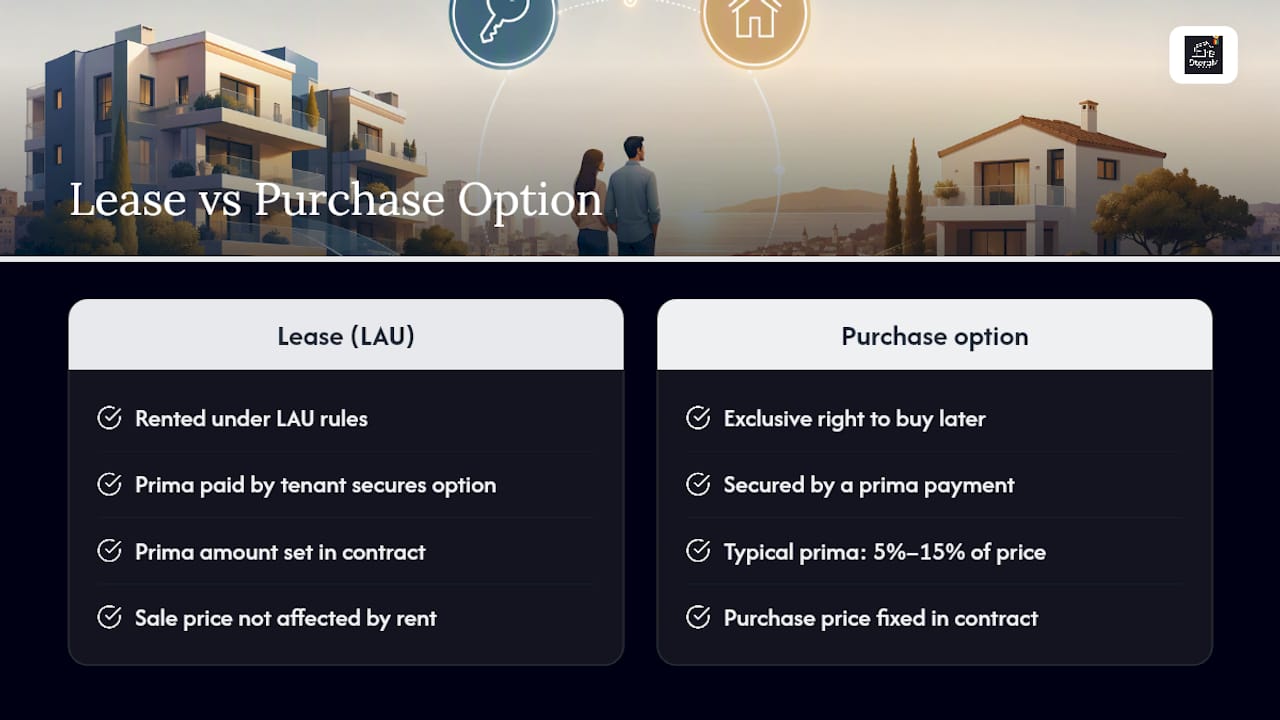
An alquiler con opción a compra is a lease that gives the tenant the right, but not the obligation, to buy the home later at a price fixed today, usually after paying a deposit called a prima and crediting part of the rent toward the future price. It fits people who need a year or two to save a down payment or want to lock in a price before it rises further. Before you sign anything, check four things in the draft contract right now:
- The exact purchase price and whether it can change
- The prima amount and whether it’s deductible from the price or forfeited if you walk away
- The rent discount clause and how it’s calculated
- The option period: when it starts, when it ends, and how you notify the seller you’re exercising it
If any of these four are vague or missing, that’s a red flag worth pausing on. Steramflats works with tenants and owners across southern Spain who use this structure, and reviewing a contract before signature is one of the most common requests we get.
Key Takeaways
A rent-to-own contract in Spain works only when the price, prima, rent-credit formula, and registration are spelled out in specific written terms rather than left to good faith.
| Point | Details |
|---|---|
| Dual legal structure | The lease follows LAU rules while the purchase option follows Código Civil contract freedom, so the option terms depend entirely on negotiation. |
| Prima range | Deposits typically run 5% to 15% of the agreed price; confirm in writing whether it’s deductible or forfeited. |
| Rent credit varies widely | Some contracts credit up to 100% of rent toward the price, others credit far less; get the percentage in numbers, not promises. |
| Registration protects you | Registering the option at the Registro de la Propiedad guards against the owner selling to a third party mid-lease. |
| Get a professional review | Steramflats reviews contract clauses, verifies title, and manages registration before you commit to a prima. |
Table of Contents
- How Alquiler Opción Compra Works: The Dual Contract Structure
- What Does a Rent-to-Own Contract Cost in Spain?
- Legal Framework: LAU, Código Civil, and the Registro de la Propiedad
- Is Rent-to-Own Worth It for Tenants and Owners?
- Negotiation Checklist: What to Insist On Before You Sign
- Red Flags That Signal a Bad Rent-to-Own Deal
- Where to Find Rent-to-Own Listings in Spain
- What Owners and Buyers Get Wrong About This Contract
- How Steramflats Helps You Navigate an Alquiler Opción Compra
- Frequently Asked Questions
- Sources
How Alquiler Opción Compra Works: The Dual Contract Structure
This isn’t one contract. It’s two agreements stitched into a single document, and understanding that split explains most of the confusion people run into.
The first layer is a standard lease governed by the Ley de Arrendamientos Urbanos (LAU), Spain’s urban leasing law. It sets baseline rules on deposits, notice periods, and repair obligations, the same as any rental. The second layer is a purchase option, a private clause negotiated freely between landlord and tenant under the general contract freedom recognized in the Código Civil. That second piece is where most of the real negotiation happens, because Spanish law doesn’t dictate its terms the way it dictates lease terms.
A contract worth signing spells out five things clearly:
- The agreed purchase price and whether it’s fixed or subject to a future appraisal or index adjustment.
- The option period, meaning the window (often one to five years) during which the tenant can decide to buy.
- The prima, a nonrefundable or partially refundable payment that secures the tenant’s exclusive right to buy.
- The rent discount mechanism, describing what portion of monthly rent, if any, gets credited toward the final price.
- Who covers ongoing charges like community fees, IBI (property tax), and repairs during the lease term.
Exercising the option formally usually means sending a burofax (a certified, legally traceable communication) to the owner within the agreed window, followed by a notarial deed once both sides agree to complete the sale. Some contracts also require registering the option itself at the Registro de la Propiedad, which we’ll get into below, because that step protects the tenant if the owner tries to sell to someone else mid-lease. Reading through rental agreement rules in Spain before you negotiate the option clause helps you separate what LAU already guarantees from what you still need to negotiate yourself.
What Does a Rent-to-Own Contract Cost in Spain?
The prima is the number that decides whether a deal is fair or lopsided, and it’s worth understanding before you look at any listing.
Spanish practice generally places the prima between 5% and 15% of the agreed sale price, paid upfront when the option contract is signed. Some contracts may deduct this amount from the final purchase price if the tenant exercises the option, while others treat it as a nonrefundable fee that secures the exclusive right to purchase, separate from the eventual sale price. That distinction should be clearly stated in the contract.
By the numbers: On a home priced at €200,000, a 10% prima works out to €20,000 paid at signing, a sum that either gets subtracted from the final price at closing or is lost entirely if the tenant decides not to buy.
Rent discounts work on a separate sliding scale, and there’s no single standard. Some contracts credit 100% of monthly rent toward the purchase price; others credit half, or none beyond a token symbolic amount. A tenant paying €900 a month for three years under a 50% credit clause would accumulate roughly €16,200 toward the final price, a meaningful dent in a down payment, but only if the formula is stated in writing and tied to actual payments made, not an intention that can be revised later.
On costs during the lease, contracts typically assign:
- IBI (the annual property tax) to the owner, since they hold legal title until the sale closes
- Community fees to whichever party the contract names, often split by negotiation
- Minor repairs to the tenant, structural repairs to the owner, mirroring standard LAU practice
Run the math on any offer before you commit. A prima that isn’t deductible plus a rent-credit clause with no real percentage attached is a warning sign that the numbers favor the seller far more than the buyer.
Legal Framework: LAU, Código Civil, and the Registro de la Propiedad
Spain doesn’t have a single law dedicated to rent-to-own contracts. Instead, the structure sits at the intersection of two legal frameworks, and knowing where one ends and the other begins protects you from assuming rights you don’t actually have.
The LAU governs everything about the lease itself: minimum notice periods, deposit caps, and grounds for eviction or non-renewal. The purchase option, by contrast, falls under the general contract principles of the Código Civil, meaning its terms come almost entirely from what the two parties negotiate and put in writing. There’s no statutory minimum prima, no mandated rent-discount percentage, and no default option period. Everything is up for negotiation, which is exactly why a poorly drafted contract can leave a tenant with far less protection than they assume.
- Registering the purchase option at the Registro de la Propiedad gives it public standing, meaning a buyer can’t simply sell the property to someone else and claim they didn’t know about the tenant’s right.
- Registration matters even more when the property carries an existing mortgage, since it establishes priority against other claims on the title.
- Exercising the option formally requires clear, documented notice, typically a burofax, sometimes escalating to a notarial act if the seller doesn’t respond.
- If the property has a mortgage, the contract should state explicitly whether the seller will cancel or subordinate it before the sale closes.
Pro Tip: Ask for a “nota simple” from the Registro before signing anything. It’s a short, inexpensive document that shows exactly who owns the property and whether it carries a mortgage or lien, and it takes the guesswork out of trusting a verbal promise.
A notary and a real estate lawyer aren’t optional extras here. Reviewing what a real estate agreement actually covers before your first meeting with either professional means you walk in asking sharper questions instead of learning terminology on the spot.

Is Rent-to-Own Worth It for Tenants and Owners?
The appeal cuts both ways, but so does the risk, and it’s worth being honest about both sides before assuming this structure is automatically better than a straight purchase or a standard lease.
For tenants, the biggest draw is locking today’s price while spending a year or more assembling a down payment or waiting on a mortgage approval that isn’t quite ready yet. Rent credits, when written clearly, chip away at that gap month by month. The BBVA analysis of when rent-to-own makes more sense than a direct purchase points to buyers awaiting the sale of another property as a textbook case. The risk sits on the other side of that coin: lose the prima if plans fall through, or watch the local market drop below your locked-in price.
Owners benefit from steady rental income plus a higher probability of an eventual sale to someone already living in and caring for the property. Their risk is the mirror image of the tenant’s advantage: if the local market rises sharply during the option period, they’re stuck selling at yesterday’s price.
- Tenants gain: price certainty, time to save, partial rent credit toward the purchase
- Tenants risk: losing the prima, a falling market, mortgage approval that never comes through
- Owners gain: guaranteed occupancy, rental income, a motivated future buyer
- Owners risk: missing out on market appreciation, extra administrative and legal cost upfront
Negotiation Checklist: What to Insist On Before You Sign
A contract that protects both sides has a handful of nonnegotiable elements, and walking into a negotiation with this list already in hand changes the conversation.
- A fixed price, or a clear formula for adjusting it, so neither side can move the number later without both parties agreeing.
- An exact prima figure with a written statement of whether it’s deductible or forfeited.
- The precise rent-credit percentage and how it’s calculated, month by month, not as a vague future promise.
- A defined exercise deadline and the exact method (burofax, registered letter, notarial notice) for triggering it.
- A registration clause committing the owner to formalize the option at the Registro de la Propiedad.
- A seller warranty confirming the property carries no undisclosed liens or third-party claims.
- Mortgage-subordination language if the property isn’t fully paid off.
Pro Tip: Tie your option’s exercise date to your mortgage pre-approval timeline, not the other way around. Sellers who resist that flexibility are usually more interested in the prima than in actually selling.
Keep every receipt, every burofax confirmation, and every signed addendum. Verbal side agreements about rent credits or price adjustments carry no weight if the deal ever ends up in dispute.
Red Flags That Signal a Bad Rent-to-Own Deal
Some warning signs show up before you sign, if you know where to look. An unregistered option on a mortgaged property is the biggest one: without registration, a lender or a third-party buyer can potentially override your right entirely.
Watch for a rent-discount clause that says something like “a percentage of rent may be applied,” with no number attached. Watch for exercise windows under six months, which barely give a tenant time to secure financing. And watch for owners who keep the property listed with agents elsewhere while collecting your prima, since common prima practice runs 5% to 15% of the sale price, and a seller taking that money while still shopping the property to other buyers has misaligned incentives from day one.
- Request the nota simple yourself; don’t take the seller’s word on title status
- Insist on registration in writing, with a deadline for completing it
- Walk away from any contract that won’t put the rent-credit formula in numbers
Where to Find Rent-to-Own Listings in Spain
Genuine rent-to-own listings are scarcer than standard rentals or sales, largely because Spain’s housing market still skews heavily toward ownership rather than alternative tenure structures common elsewhere in Europe. Search using terms like “alquiler con opción a compra” or “cláusula opción compra” directly in listing filters, and set alerts on portals that let you search by contract type rather than just price and location.
A genuine offer usually states the prima amount, the option period, and references an explicit purchase-option clause somewhere in the ad copy, not just a vague mention of “possible future purchase.” Listings that dodge specifics on price or duration are often just testing tenant interest.
- Filter searches by region, since availability varies significantly between provinces and even between neighborhoods within the same city
- Look for ideal rental property matches in Spain as a starting point, then ask directly whether an option-to-buy clause can be added
- Involve an agent early to validate title and confirm the seller’s registration commitments before you pay any prima
What Owners and Buyers Get Wrong About This Contract
The people who benefit most from a rent-to-own structure tend to fit a narrow profile: buyers waiting on the sale of a current home, or tenants a mortgage lender has told to come back in twelve to eighteen months once their financials look stronger. It’s a bridge, not a long-term housing strategy, and treating it as anything else usually leads to disappointment.
What gets underestimated is how much the prima negotiation reveals about a seller’s real intentions. A seller who resists writing a deductible prima or a specific rent-credit percentage is often more interested in collecting fee income than in actually selling. Steramflats has reviewed contracts across the Costa del Sol where the difference between a fair deal and a lopsided one came down to two sentences buried in a private clause, not the headline price.
How Steramflats Helps You Navigate an Alquiler Opción Compra
If you’ve read this far, you already know the fine print is where these deals succeed or fail. Steramflats is the local alternative to signing blind or relying on a seller’s own paperwork. We review the prima terms, confirm the rent-credit formula matches what’s actually promised, check title and mortgage status through the Registro de la Propiedad, and handle the registration of the option itself so it holds up if the property ever changes hands mid-lease.

Our fees work on the same basis as any real estate service we provide: a commission tied to the completed transaction, not a flat charge for simply looking at a contract. If you’re comparing a rent-to-own offer against a straight purchase, our real estate advisory services for Spain walk through financing and timing so you’re not choosing blind. And if you want a plain explanation of what a purchase-option clause should legally include before you sign, our guide to real estate agreements is the right starting point. For buyers weighing a full mortgage path instead, Ben Cook Real Estate’s 2026 buying guide covers the financing side in more depth. Reach out to Steramflats before you sign the option clause, not after.
Frequently Asked Questions
What is alquiler con opción a compra exactly?
It’s a lease combined with a purchase option: you rent the home under normal LAU rules while holding an exclusive right, secured by a prima payment, to buy it later at a price fixed in the contract.
How much is the prima usually in Spain?
Common practice places it between 5% and 15% of the agreed sale price, though the exact figure and whether it’s deductible depend entirely on what the contract states.
Can the owner sell the property to someone else during the option period?
Not legally, if the option is registered at the Registro de la Propiedad. Without registration, a tenant’s right can be harder to enforce against a new buyer.
What happens if I don’t exercise the option?
Typically the prima is forfeited, and the lease either ends or continues as a standard rental, depending on what the contract specifies for that scenario.
Do I need a lawyer to sign one of these contracts?
Given how much of the option terms rest on private negotiation rather than statutory minimums, a lawyer or notary review before signing is strongly advisable, not just a formality.
Sources
- Alquiler con opción a compra: cómo funciona, ventajas y desventajas — CaixaBank
- ¿Cómo funciona un alquiler con opción a compra? | LawAndTrends
Recommended
- SteraM Flats | Rental agreements in Spain: Know your rights before signing
- SteraM Flats | Rental Agreement Types in Spain: Guide for Landlords
- SteraM Flats | Rental agreements in Spain: Legal tips and income strategies
- SteraM Flats | Rental agreements in Spain: Essential rules for tenants and landlords