That rate covers the vast majority of new-build purchases from a developer. Two exceptions matter: 4% applies to certain officially protected housing (VPO) under the special regime or public promotion, and the Canary Islands use IGIC instead of IVA entirely.
- The buyer pays IVA to the developer at the signing of the public deed (escritura pública).
- The developer, not the buyer, is responsible for declaring and remitting that tax to Hacienda.
- If you’re buying a resale instead of new construction, you’ll pay ITP, not IVA. That distinction runs through the rest of this guide.
Key Takeaways
| Point | Details |
|---|---|
| Standard rate is 10% | Applies to first deliveries of new residential property sold by a developer. |
| VPO exception is narrow | Only special-regime or public-promotion VPO gets the 4% rate, not all protected housing. |
| Payment happens at signing | The buyer pays IVA to the developer at the escritura; the developer remits it to Hacienda. |
| IVA and ITP are mutually exclusive | Use the AEAT Calificador inmobiliario to confirm which tax applies to your case. |
| Steramflats supports documentation review | Helps buyers and sellers verify tax treatment and prepare paperwork before signing. |
Table of Contents
- IVA Vivienda Nueva España: What Counts as a First Delivery
- IVA Rates on New Homes and the Main Exceptions
- When and How You Actually Pay the IVA
- IVA or ITP: How to Tell Which Tax Applies to Your Purchase
- A Worked Example: Calculating IVA on a New Home
- Other Costs to Budget Beyond the IVA Line
- Confirming Whether Your Property Qualifies as VPO
- Official Resources to Confirm Your Rate
- Expert Tax Tips That Prevent Notary Surprises
- Why Getting This Right Changes Your Negotiating Position
- How Steramflats Helps You Navigate New-Build Tax Rules
- Frequently Asked Questions
- Sources
IVA Vivienda Nueva España: What Counts as a First Delivery
Not every “new” home qualifies for IVA treatment, and this is where a lot of buyers get tripped up. The legal trigger isn’t how the property looks or how it’s marketed. It’s whether the sale qualifies as a first delivery by a developer acting in the course of business, per Law 37/1992 and Agencia Tributaria guidance.
If the seller is a promoter and the home has never been occupied, IVA applies. But occupation for two continuous years or more generally converts a later resale into an ITP-taxed transaction, even if the building is only a few years old. A property doesn’t need a formal habitability certificate to qualify either. Spain’s Supreme Court has confirmed that other legally admissible proof of residential aptness can suffice, per Interforo Abogados.
Pro Tip: Don’t take “obra nueva” in a listing at face value. Ask directly whether the seller is a developer selling in a first transfer, and whether the unit has ever been lived in. Those two facts decide your tax bill more than the building’s age does.
IVA Rates on New Homes and the Main Exceptions
Most buyers will pay one of two rates, and knowing which one applies before you sign a reservation contract saves budgeting headaches later.
- 10% is the general IVA rate for first deliveries of residential property, per AEAT.
- 4% applies only to VPO housing under the special regime or public promotion, not to every unit labeled “protegida.” General-regime protected housing usually still falls under the 10% rate.
- 21% applies to garages sold separately from the home (beyond the first two spaces), standalone commercial premises, and undeveloped land.
- The Canary Islands operate under IGIC rather than mainland IVA rules, with a lower rate structure specific to that region, according to Fotocasa.
| Property type | Applicable tax | Rate |
|---|---|---|
| New residential home (general) | IVA | 10% |
| VPO, special regime/public promotion | IVA | 4% |
| Garage (beyond 2 spaces), commercial, land | IVA | 21% |
| New home in the Canary Islands | IGIC | Lower regional rate |
On top of whichever IVA rate applies, you’ll also owe AJD (stamp duty), which varies by autonomous community, usually a small percentage.

When and How You Actually Pay the IVA
IVA on a new-build isn’t paid in installments or filed separately by the buyer. It’s settled in one move, at the notary, as part of closing.
- IVA is normally paid at the signing of the escritura pública, directly to the developer as part of the total purchase price.
- The developer then bears responsibility for declaring that VAT and entering it with the Tax Agency, according to BBVA’s guidance.
- Before signing, confirm the sales contract or deed itemizes the IVA amount separately from the base price. Some advertised prices exclude IVA entirely, which is exactly why buyers get blindsided at the notary, per Unicaja Banco.
- Check the developer’s tax ID and confirm the invoice or deed shows the VAT breakdown in writing.
- After signing, the developer files the corresponding VAT return with Hacienda. You don’t need to do this yourself, but keep your copy of the deed as proof of payment.
For the registration steps that follow signing, our guide to property registration in Spain walks through what happens after the notary appointment.
IVA or ITP: How to Tell Which Tax Applies to Your Purchase
Every property sale in Spain falls under one of two tax regimes, never both. Getting this wrong before you make an offer can throw off your entire budget.
- Is the seller a developer or promoter acting in a business capacity? If yes, lean toward IVA.
- Is this the first transfer of the finished property? A yes here points strongly to IVA.
- Has the home been occupied for two continuous years or more? If so, it likely falls under ITP even if it was originally new construction.
- Is the seller a private individual selling a previously owned home? That’s an ITP transaction, full stop.
A first transfer by a developer means IVA plus AJD; a resale means ITP set by the autonomous community, and the two never overlap on the same sale, according to Invest Spain Property. When you’re unsure, the AEAT Calificador inmobiliario is the official tool built for exactly this question. Enter the property details and it tells you which regime applies.
A Worked Example: Calculating IVA on a New Home
Numbers make this concrete. Say you’re buying a new apartment in Málaga province listed at €280,000 before tax.
| Item | Amount |
|---|---|
| Base price (escritura) | €280,000 |
| IVA rate | 10% |
| IVA amount | €11,200 |
| Subtotal before AJD | €291,200 |
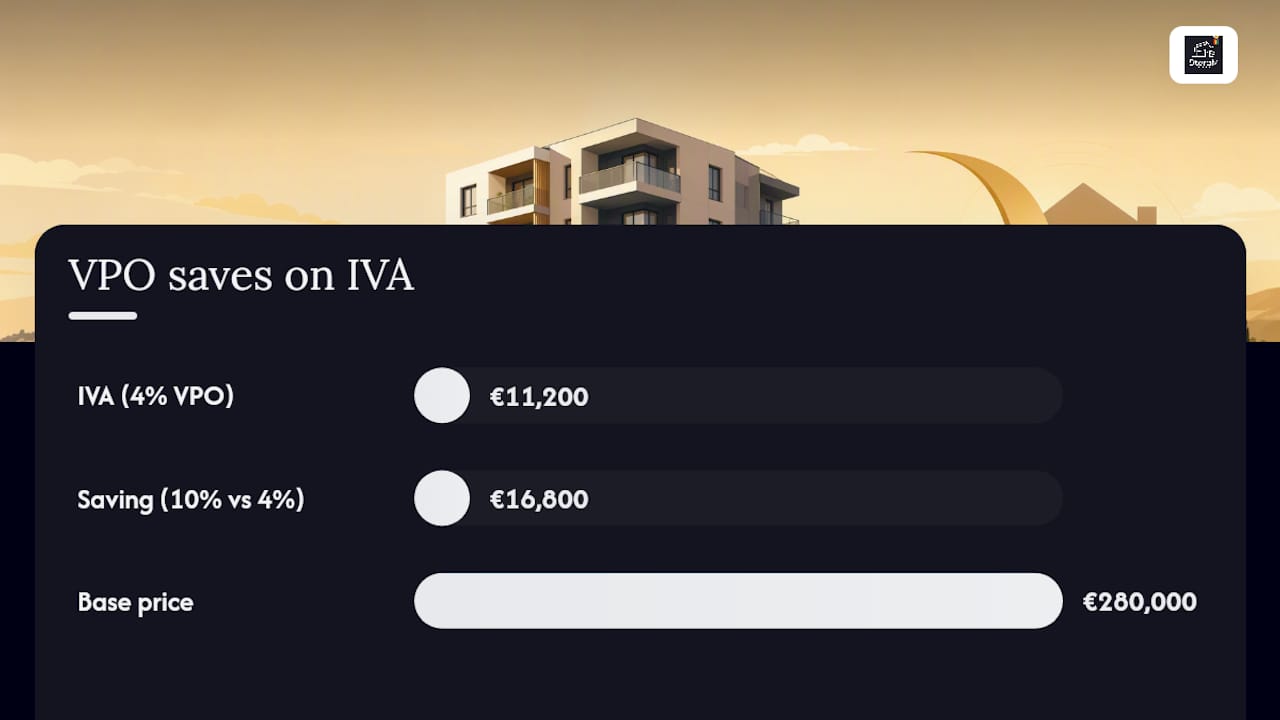
If that same unit qualified as VPO under the special regime, the math changes sharply: 4% IVA on €280,000 comes to €11,200, bringing the subtotal to €291,200 before AJD. That’s a difference of nearly €16,800, which is why confirming VPO status before signing is worth the extra phone call.
Other Costs to Budget Beyond the IVA Line
IVA is the headline number, but it’s not the only cost stacked onto a new-build purchase. Treat these as a package when you’re setting your total budget.
- AJD (stamp duty): Charged on new-build purchases in addition to IVA, typically 0.5% to 1.5% depending on the autonomous community.
- Notary fees: Set by regulated tariffs, generally a few hundred euros depending on the deed’s value.
- Land registry fees: Also tariff-regulated, usually smaller than notary costs.
- Gestoría and legal fees: Cover paperwork processing and, if you hire one, independent legal review before signing.
- Agency commission: Structures vary; our breakdown of real estate agency fees in Spain explains typical shapes and what’s usually included.
As a rough planning shortcut, add IVA plus AJD together and compare that combined percentage against the ITP rate you’d pay on an equivalent resale in the same region. For a deeper walkthrough of the full IVA versus ITP cost comparison, see our property taxes in Spain guide.
Confirming Whether Your Property Qualifies as VPO
If a listing claims VPO status and the 4% rate, verify it before you rely on that number.
- Ask the developer for the official administrative qualification document for the VPO regime.
- Check that the deed itself references the specific VPO classification, not just marketing language.
- Request the formal certificate or resolution from the relevant housing authority confirming the special regime or public promotion status.
- When documentation is unclear, contact your autonomous community’s housing department or consult AEAT directly before signing anything.
Official Resources to Confirm Your Rate
Skip the guesswork and check directly against the source.
- AEAT — Compro una vivienda ¿tengo que pagar IVA o ITP? explains the legal framework in detail.
- The Calificador inmobiliario gives you a transaction-specific answer, not a general rule.
- Fotocasa’s IVA calculator and BBVA’s guidance page are useful for quick budgeting math.
Use the calculator for a fast estimate while you’re comparing listings. Save the Calificador result for your notary appointment, since it’s the document that actually settles the question if it’s ever disputed.
Expert Tax Tips That Prevent Notary Surprises
Tax advisors see the same mistakes repeat across new-build purchases. Three stand out.
- Buyers often assume the advertised price already includes IVA. Confirm this in writing before you sign a reservation contract.
- Legal experts emphasize verifying both the administrative VPO qualification and the exact statutory regime, since that’s what actually determines the 4% eligibility, according to El País’s legal Q&A.
- AJD rates differ meaningfully by region, and advisors recommend checking your specific autonomous community’s rate rather than assuming a national figure, per Corelex Global.
Pro Tip: Get a short legal or tax review before the escritura appointment, not after. A one-hour consultation costs far less than discovering at the notary that your “VPO” unit doesn’t actually qualify for 4%.
Why Getting This Right Changes Your Negotiating Position
Understanding IVA versus ITP before you make an offer isn’t academic. It changes what you can actually afford and what you can push back on. A price that looks competitive can quietly assume IVA is included when it isn’t, throwing off your mortgage math by thousands of euros.
Your autonomous community often shapes the final cost more than the IVA rate does, since AJD swings the total. Verify your case with AEAT and a qualified advisor before you sign anything at the notary.
How Steramflats Helps You Navigate New-Build Tax Rules
Steramflats gives buyers in southern Spain something the AEAT calculators can’t: someone checking your specific paperwork before you’re standing at the notary table.

Steramflats reviews the developer’s documentation, confirms VPO classifications when claimed, and flags AJD exposure specific to your region before you commit to a reservation contract. For sellers and developers listing new-build units, Steramflats also helps position your property clearly so buyers understand upfront whether IVA is included in the asking price, avoiding disputes later in the process. If you’re ready to list a new-build property or want documentation support before a signing date, publish your property listing with Steramflats and get started today.
Frequently Asked Questions
No.
Do I pay IVA or ITP if I buy a resale property?
Resales from a private seller are taxed under ITP, set by each autonomous community, not IVA. The two taxes never apply to the same sale.
Who pays the IVA to the tax authorities, me or the developer?
You pay IVA to the developer as part of the deed price at signing. The developer is then responsible for declaring and remitting it to Hacienda.
Does the Canary Islands use the same IVA rates as the mainland?
No. The Canary Islands apply IGIC, a separate regional indirect tax with its own rate structure, instead of mainland IVA.
Request the official administrative qualification document from the developer and verify the deed references the special regime or public promotion classification directly.
This article is general information, not a substitute for advice from a qualified financial advisor. Consult a qualified financial professional about your own circumstances before acting on anything here.
Sources
Bookmark these before your notary appointment rather than relying on secondhand summaries.
- Agencia Tributaria — Compro una vivienda ¿tengo que pagar IVA o ITP?
- BBVA — IVA vivienda nueva (guide)
- Fotocasa Life — Calculadora IVA vivienda nueva
- Invest Spain Property — Spain Property Transfer Tax: ITP vs IVA vs AJD
- AEAT — Calificador inmobiliario
Use AEAT for the legal definition, the calculator for quick math, and keep the Calificador result on hand for the day you sign.