A residential lease in Spain must run for a minimum of five years when the landlord is a private individual, or seven years when the landlord is a company or other legal entity, even if the contract on paper says otherwise. If the written term is shorter, the law simply stretches it out year by year until it hits that floor.
Here’s what else you need to check before assuming that rule applies to your situation:
- The clock starts on the contract date, or on the date the tenant actually got the keys, whichever comes later.
- Once the statutory minimum is reached, the contract keeps renewing automatically in one-year blocks, for up to three more years, unless someone gives proper notice.
- Seasonal or temporary rentals don’t follow this 5/7-year rule at all, but they must genuinely document why the stay is temporary.
Everything below comes from Articles 9 and 10 of the Ley de Arrendamientos Urbanos, backed up by the Ministerio de Vivienda y Agenda Urbana’s own FAQ.
Key Takeaways
Spanish law sets a rental contract’s minimum duration at five years for private landlords and seven for legal entities, with automatic extensions and notice deadlines governing everything that follows.
| Point | Details |
|---|---|
| Statutory minimums | Private landlords must honor 5 years; legal-entity landlords must honor 7 years, regardless of the written term. |
| Automatic extension | Any shorter agreed term is extended annually by law until the statutory minimum is reached. |
| Tacit renewal window | After the minimum ends, silence renews the lease annually for up to 3 more years. |
| Notice deadlines differ | Landlords need 4 months’ notice before the minimum ends; tenants need 2 months, or 1 month during tacit renewals. |
| Seasonal leases are different | Temporary rentals skip the 5/7-year rule but need a documented cause and, since July 2025, an NRU registration. |
Table of Contents
- Duración contrato alquiler: what the LAU actually requires
- When must you give notice, and what happens if you’re late?
- Exceptions: when the 5/7-year rule doesn’t apply
- What happens when someone breaks the rules
- A practical checklist before you sign or renew
- Getting the paperwork right the first time
- Why the label on the contract matters more than the term
- Frequently Asked Questions
- Sources
Duración contrato alquiler: what the LAU actually requires
Spanish law lets landlords and tenants agree to almost any lease term they want on paper. What it doesn’t let them do is agree to something shorter than the statutory floor and have that stick. If your written contract says two years, the law overrides it and extends the term automatically, year after year, until five years have passed (private landlord) or seven years have passed (company landlord).
This is the core mechanic behind duración contrato alquiler questions in Spain: the written term and the legal term are often two different numbers, and the legal number always wins when it’s longer.
For contracts signed from March 6, 2019 onward, the Ministerio de Vivienda confirms that a lease shorter than five or seven years gets extended annually until it reaches that minimum. After the minimum period ends, the contract doesn’t just terminate. It rolls into what’s called tacit prórroga, tacit renewal, for up to three additional one-year periods, unless landlord or tenant formally opts out in time.
The Ministry’s own guidance puts it plainly:
That means a lease signed for one year with a private landlord can, in practice, run for the combined length of the mandatory minimum period plus any additional tacit renewals allowed by law, which vary by landlord type. Neither side has to want this outcome. It happens by default unless someone acts.
When must you give notice, and what happens if you’re late?
Missing a notice deadline is the single most common way Spanish tenants and landlords end up locked into a lease neither side planned for. The timeline runs in layers, and each layer has its own deadline.
- Tenant’s early exit right: after living in the property for at least six months, a tenant can walk away early by giving 30 days’ notice, if that option was written into the contract.
- End of the minimum period: the landlord must notify the tenant at least four months before the minimum term ends if they don’t want to renew. The tenant only needs to give two months’ notice.
- During tacit annual renewals: once the contract has entered its year-by-year renewal phase, the tenant can end it with just one month’s notice before any given annual anniversary.
Miss any of these windows, and the default answer is renewal, not termination. The Ministerio’s guidance is explicit that the burden of proving when possession started, and therefore when these deadlines fall, sits with the tenant. That’s worth remembering if a dispute ever lands in front of a judge.
Picture a five-year contract that started on January 1, 2022. The minimum term ends December 31, 2026. If the landlord wants out, that notice needed to land by August 31, 2026, four months early. Miss it, and the contract slides into its first tacit annual renewal, running to December 31, 2027.

Pro Tip: Never rely on a phone call or a text message to send a non-renewal notice. Use a burofax or registered mail with signed acknowledgment of receipt. Spanish courts treat undocumented notice as no notice at all, and that single oversight has cost landlords an extra year of tenancy more than once.
Exceptions: when the 5/7-year rule doesn’t apply
Not every lease in Spain follows the habitual-residence playbook. Three situations sit outside the standard minimums, and mixing them up is where most disputes start.
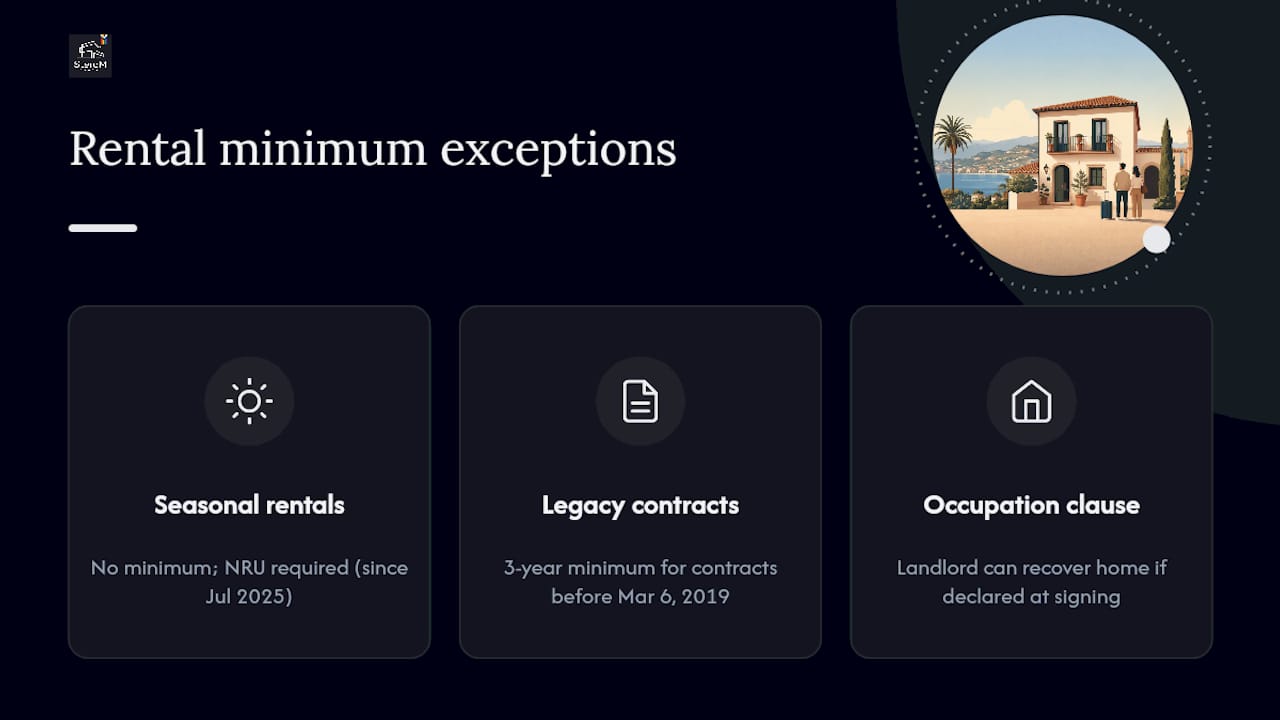
Seasonal or temporary rentals carry no statutory minimum duration at all. A student renting for an academic year, or a professional on a three-month posting, can sign a lease with no five-year exposure. But the exemption isn’t automatic just because you write “temporada” at the top of the page. Since July 2025, these properties must also carry a Unique Registration Number, or NRU, through the government’s Ventanilla Única portal.
Legacy contracts signed before March 6, 2019 operate under a different, older minimum of three years rather than five or seven. If your lease predates that date, don’t apply the current rules retroactively.
Occupation-need clauses let a landlord recover the home partway through the minimum term if they declared, in the contract itself, a genuine need to house themselves or close family. Miss that declaration at signing, and the clause has no legal effect later.
Lawyers who handle these disputes stress the real risk hiding inside the seasonal exception:
That single distinction is why documenting your rental agreement type correctly from day one matters more than the label on the cover page.
What happens when someone breaks the rules
When a landlord tries to end a lease without proper notice, or a tenant disputes an unlawful rent hike, the contract terms don’t just evaporate. The LAU treats a missed non-renewal deadline as an automatic extension, full stop. There’s no gray area to argue over.
Property sales complicate things further. If ownership transfers hands during the statutory minimum period, the LAU’s subrogation rules require the buyer to step into the seller’s shoes as landlord and honor the lease for whatever’s left of the five or seven years, unless the sale was recorded in the Property Registry ahead of the lease.
If a deadline gets ignored or a rent increase looks unlawful, start with a written rectification request. From there, tenants and landlords can escalate to a municipal consumer office (OMIC), a local housing office, or civil courts for larger disputes. Before any of that, gather your signed contract, proof of the possession date, and copies of every notice sent or received.
A practical checklist before you sign or renew
Getting the paperwork right at signing avoids nearly every dispute described above. Landlords and tenants each have their own short list to run through.
- Duration clause: state the exact start and end dates, and if the lease is seasonal, spell out the specific temporary cause in the text itself, not just the label.
- Rent-update clause: reference the IRAV index published monthly by the INE for contracts signed after May 26, 2023, and confirm the update figure using the Ministry’s rent-increase calculator before applying it.
- NRU registration: if the property is marketed for short-term or seasonal use, confirm it carries a valid Unique Registration Number through Ventanilla Única before listing it anywhere.
- Proof of possession date: tenants should keep the handover report, key receipt, or any dated communication that fixes when the tenancy actually began.
- Occupation-need language: landlords who might need the property back for family use must write that intention into the contract at signing, not add it later.
Pro Tip: Keep a single folder, physical or digital, with the signed lease, the handover report, every notice you’ve sent or received, and your rent-update calculations. When a dispute reaches a housing office or a court, whoever produces a clean paper trail usually wins.
Landlords managing several properties often find this easier to sit outside their own workload. Our rental management checklist for landlords in Spain breaks these steps down property by property.
Getting the paperwork right the first time
Contracts that clearly separate duration, notice deadlines, and rent-update mechanics from day one rarely end up in dispute. Confusion almost always traces back to one thing: a lease that never spelled out which regime it belongs to.
If you’re a landlord juggling the 5/7-year minimums, an NRU registration for a seasonal unit, and the IRAV update on a different long-term lease, that’s exactly where a document mistake tends to happen. Steramflats handles lease drafting, legal documentation, and rent-update calculations for landlords across southern Spain, and can walk you through what a legally sound real estate agreement should actually contain before you sign anything. For owners who’d rather hand off notice deadlines, tenant communication, and registration compliance entirely, our property management guide for owners covers what that support looks like in practice.
Why the label on the contract matters more than the term
Most disputes over lease duration in Spain don’t come from anyone misreading the five or seven year rule. They come from a contract that never clearly says what kind of lease it is. A “temporary” rental with no documented cause, or a habitual residence lease dressed up as seasonal to dodge the minimum, both invite the same outcome: reclassification, back pay, or a tenant who stays years longer than either side expected.
The conventional advice, just check the years, undersells how much weight the cause of the tenancy carries in front of a judge. Courts look at empadronamiento records, utility bills, and how the tenant actually lived, not just what the cover page says. If you’re drafting or reviewing a lease this year, spend less time debating whether five years feels long and more time making sure the contract’s stated purpose matches reality. That’s the detail that decides these cases, not the calendar.
Frequently Asked Questions
What is the minimum duration for a rental contract in Spain?
A minimum duration applies depending on whether the landlord is a private individual or a company or other legal entity, with private landlords having a shorter statutory minimum than companies. Any shorter written term gets automatically extended to reach that minimum.
Does the duración mínima alquiler apply to seasonal rentals?
No. Seasonal or temporary leases fall outside the 5/7-year statutory minimum, but the contract must document a genuine temporary cause, and since July 2025 the property needs a valid NRU registration.
Can a landlord end the lease before five years are up?
Only through the occupation-need clause, and only if that need was declared in the contract at signing, with proper notice given before recovery.
What happens if I sign a one-year lease with a private landlord?
The law automatically extends it, year by year, until it reaches five years. After that, it can keep renewing tacitly for up to three more years unless someone gives proper notice.
How much notice does a tenant need to give before moving out?
Two months before the end of the minimum term, or just one month during the tacit annual renewal phase.
Do older contracts follow the same 5/7-year rule?
No. Leases signed before March 6, 2019 follow the older three-year minimum that was in force at the time.
This article is general information, not a substitute for advice from a qualified lawyer. Consult a qualified legal professional about your own circumstances before acting on anything here.
Sources
The full LAU text on the BOE is the actual law behind every rule above. The Ministerio de Vivienda’s FAQ translates it into plain language, and its rent calculator applies the correct formula to your contract date. The INE’s IRAV page publishes the monthly index for rent updates, and the Ventanilla Única portal handles NRU registration for temporary lets.
Officials designed the NRU system as a transparency measure, so property managers registering through Ventanilla Única avoid fines and platform delisting down the line.
- Preguntas frecuentes | Ministerio de Vivienda y Agenda Urbana
- Ley 29/1994, de 24 de noviembre, de Arrendamientos Urbanos
- INE — Índice de Referencia para la Actualización de Arrendamientos de Vivienda (IRAV)