Yes, you can buy a home in Spain using a power of attorney, as long as it’s a public document that explicitly grants the power to purchase, mortgage, or dispose of property, and it’s still valid on signing day. Grant it wrong, and a notary or the Registro de la Propiedad can suspend the whole transaction.
Before you draft anything, know what gets checked at the notary’s table:
- Identity of both the grantor and the person you’re appointing (your attorney-in-fact)
- Sufficiency of powers, meaning the document must say, in plain terms, that it covers buying this specific property
- No revocation, verified through the Council of Notaries’ database
Two lead-time reminders matter more than anything else in this guide: apostille and consular paperwork rarely move fast, and you should have an independent Spanish lawyer draft or review the text before you sign it anywhere, at a consulate or otherwise. You’ll also need a NIE (foreigner tax ID number) before the deed can be registered, so start that process in parallel.
Key Takeaways
A power of attorney lets you buy a Spanish home without traveling, but only when the document is a public deed with explicit dispositive language and current validity.
| Point | Details |
|---|---|
| Use a special power | A narrow special power naming the property and setting a price cap reduces risk far more than a general power. |
| Draft before you sign | Have a Spanish lawyer approve the minuta before signing anywhere, at a consulate, abroad, or in Spain. |
| Budget for extras abroad | Special powers often cost tens to low hundreds of euros, plus apostille and sworn translation fees if granted abroad. |
| Start weeks early | Consular appointments and apostille processing commonly create delays, so begin 4 to 6 weeks before closing. |
| Digital signing has limits | Ley 11/2023 permits some electronic notarial acts, but many notaries aren’t yet integrated for complex property deals. |
| Local support helps | SteraM Flats connects remote buyers with independent Spanish lawyers and handles document logistics on the ground. |
Table of Contents
- What Is a Power of Attorney and Why Buyers Use One in Spain
- Which Type of Power of Attorney Should You Use to Buy?
- How Does a Power of Attorney Work During a Spanish Purchase?
- How Do You Grant the Power From Abroad?
- What Must the Power Include to Be Accepted?
- What Documents and Costs Should You Budget For?
- What Risks Come With Buying by Power of Attorney?
- What Do the Notary and Land Registry Actually Check?
- What’s a Realistic Timeline From Granting the Power to Closing?
- Can You Sign a Power of Attorney Fully Online in 2026?
- Need Local Help Arranging Your Purchase by Power of Attorney?
- Frequently Asked Questions
- Sources
What Is a Power of Attorney and Why Buyers Use One in Spain
A poder notarial is a public document, an escritura pública, signed before a notary, in which one person (the grantor) gives another (the attorney-in-fact, or apoderado) legal authority to act on their behalf. It’s not a private letter or an email confirmation. It carries the same legal weight as if you’d shown up and signed yourself, provided the wording matches the act being performed.
Foreign buyers use this constantly, and for good reason. Flying to Spain for a signing that might get rescheduled, delayed by a mortgage approval, or pushed back because a seller hasn’t cleared a lien yet, is expensive and impractical. A properly drafted power lets your lawyer or a trusted representative step in at the notary’s office while you stay wherever you are.
Once the power is granted and includes the right language, your representative can:
- Sign the arras (reservation deposit) contract
- Sign the deed of sale (escritura de compraventa) itself
- Handle registration at the Land Registry and pay associated taxes
None of that works, though, if the power doesn’t spell out these acts explicitly. A power that merely says “administer my affairs” won’t cut it. Spanish notaries treat property disposition as a category requiring express, written authorization, not something implied by general wording.
Which Type of Power of Attorney Should You Use to Buy?
Not every power of attorney is built the same way, and picking the wrong one is where most remote buyers run into trouble.
Special power (poder especial) is the one you want for a single property purchase. It’s narrow by design: it names the specific property, sets a price ceiling, and lists only the acts required, signing the arras, signing the deed, registering title, maybe authorizing a mortgage. Because it’s limited, there’s less for anything to go wrong, and less exposure if your attorney-in-fact turns out to be less trustworthy than you assumed.
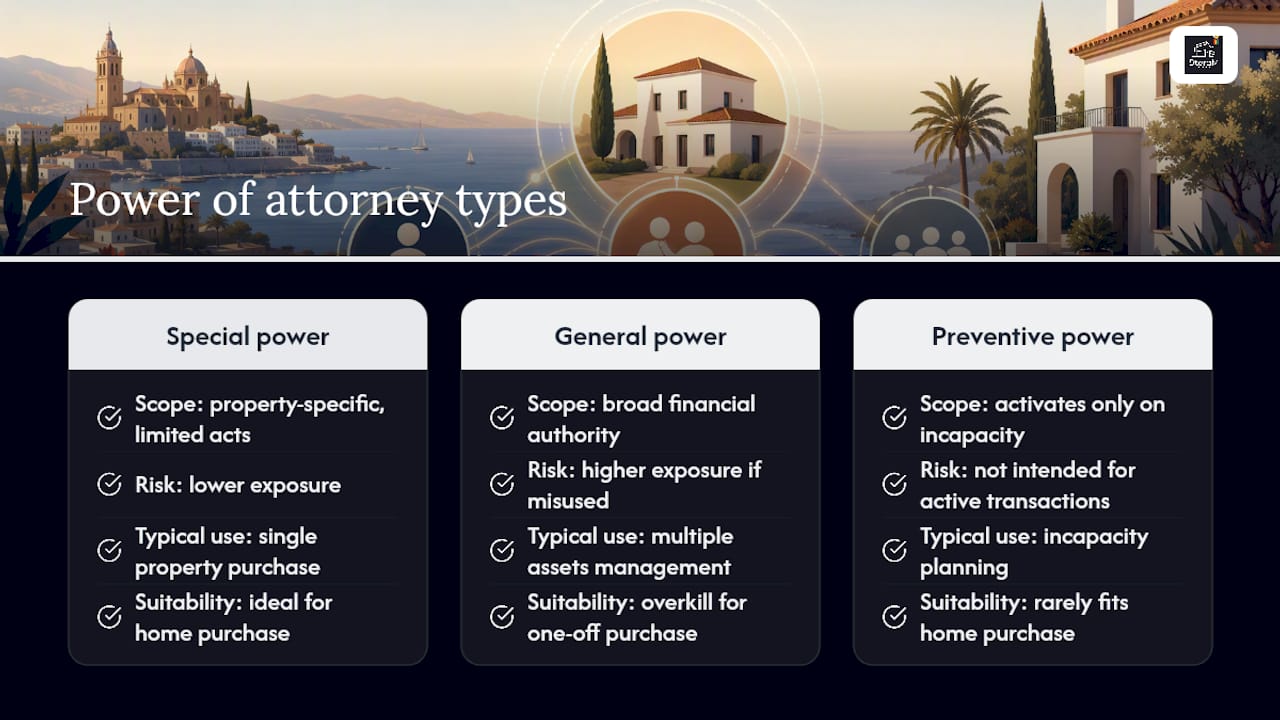
General power (poder general) hands over broad financial authority, sometimes covering bank accounts, other properties, tax filings, and more. It’s occasionally used by people who plan to buy multiple assets or manage ongoing affairs in Spain, but for a one-off home purchase it’s overkill and it multiplies your risk if the document falls into the wrong hands or is misused.
Preventive power (poder preventivo) is designed for a different situation entirely, usually incapacity planning, where the power only activates if the grantor becomes unable to manage their own affairs. It’s not built for an active, time-sensitive transaction like a home purchase, so it rarely fits here.
Experienced buyers avoid general powers for exactly this reason: a tightly worded special power that names the property, caps the price, and lists only necessary acts protects the grantor from unauthorized transactions far better than broad authority ever could.
Pro Tip: Ask your lawyer to write the special power so narrowly that it would be useless for anything except this one purchase. If someone stole the document, they couldn’t do much with it.
How Does a Power of Attorney Work During a Spanish Purchase?
The mechanics follow a fairly predictable sequence, even though the paperwork can feel intimidating the first time through.
- Draft and approve the minuta. Your Spanish lawyer prepares the exact wording of the power (the minuta) before anyone signs anything. This step gets skipped too often, and it’s the one that causes the most rejections later.
- Sign the power before a notary or consul. This happens either at a notary in Spain, a Spanish consulate abroad, or a local notary in your country followed by apostille.
- Obtain a certified authorized copy. You’ll need at least one official copy (copia autorizada) to present at the closing.
- Your attorney-in-fact signs on your behalf. On closing day, they appear before the notary and sign the arras contract and/or the deed using the power as their authority.
- The notary performs the juicio de suficiencia. This is the notary’s formal judgment that the power is valid, current, and covers this exact act, recorded directly in the deed.
- The deed goes to the Land Registry. The notary sends the signed deed for registration, and the registrar reviews whether the power itself supports that registration.
Every one of those steps depends on the previous one being airtight. A vague clause in step 1 shows up as a rejected registration in step 6, months after you thought the deal was closed.
How Do You Grant the Power From Abroad?
You’ve got three real options if you’re outside Spain when it’s time to sign, and each comes with its own trade-offs.
Option A: Grant it at a Spanish consulate. Consular officials abroad can perform notarial functions and issue a power that’s valid in Spain immediately, without needing an apostille. You send the minuta ahead, book an appointment, and sign before the consul. This is often the cleanest route, but consular calendars fill up fast in some cities, and appointment availability varies a lot by office.
Option B: Sign before a local notary, then apostille and translate. You sign in your own country before a local notary, get the document apostilled under the Hague Convention, then have it translated by a sworn translator in Spain. This tends to be faster to schedule than a consular slot, but it adds steps, and any mismatch between your local notary’s wording and what a Spanish registrar expects can cause problems.
Option C: Travel to Spain and sign before a Spanish notary. This is the most straightforward for making sure the wording lines up correctly the first time, since you’re working directly with the notary who’ll likely process the eventual deed. It just requires a trip.
Whichever path you take, start early. Apostille processing and sworn translation can take anywhere from several business days to a few weeks depending on your country, and consular appointments frequently run behind schedule. International advisers consistently recommend starting these steps weeks, not days, before your intended closing date, because bottlenecks tend to show up right when you can least afford them.
Pro Tip: If you’re signing abroad under Option B, send your Spanish lawyer the exact draft your local notary plans to use before you sign it. Fixing wording after the apostille is stamped means starting the whole process over.
What Must the Power Include to Be Accepted?
This is the section worth reading twice, because missing clauses are the single biggest reason powers get rejected at the registry.
A properly drafted special power needs:
- Full identification of both grantor and attorney-in-fact: name, NIE or DNI, or passport number
- Exact identification of the property, ideally by registry data and cadastral reference, not just a street address
- Explicit dispositive language: words like enajenar (dispose of), gravar (encumber), vender (sell), or hipotecar (mortgage), spelled out rather than implied
- A price ceiling or minimum, if the transaction has financial limits you want enforced
- Authorization to sign mortgage documents, if financing is part of the deal
- Authorization to obtain a NIE and open a bank account, if your attorney-in-fact needs to handle those on your behalf
- Duration and revocation terms, so everyone knows when the authority expires
To be valid for a real estate purchase, the power must be a public document and explicitly detail these dispositive powers; notaries run a strict sufficiency check, and generic administrative language routinely fails it, sometimes suspending the entire registration.
Pro Tip: Never sign a power your lawyer hasn’t personally reviewed, even if a notary abroad tells you the standard template is “fine for Spain.” Apostille and sworn translation fix the paperwork trail. They don’t fix a missing dispositive clause.
What Documents and Costs Should You Budget For?
Gather these before you start the clock on any of the above:
- Copy of your passport and NIE
- The original power or a certified copy
- Nota simple (registry extract) for the property
- The minuta your lawyer prepared
- Identification for your attorney-in-fact
- Bank certificates, if the seller or notary requires proof of funds
On cost, expect the power itself to be relatively cheap compared to the transaction it enables. Typical notarial and consular fees for a special power run modest, often in the low tens to low hundreds of euros, with figures around €50 to €150 common for a straightforward special power signed in Spain or at a consulate. If you’re granting it abroad, add apostille fees, sworn translation costs, and possibly a gestoría fee for handling paperwork locally, these can range from tens to a few hundred euros depending on your country and translator rates.
Keep this separate in your head from the taxes tied to the purchase itself, transfer tax, notary fees for the deed, and registration fees. Those scale with the property’s price and have nothing to do with what the power of attorney costs.
What Risks Come With Buying by Power of Attorney?
The biggest risk isn’t fraud, it’s sloppy drafting. Still, both matter.
Common problems: an overbroad power that lets your attorney-in-fact do more than you intended; an agent who acts outside the mandate; a forged or already-revoked power; a delayed apostille or consular appointment that pushes back your closing; or a mistranslated clause that changes the legal meaning without anyone noticing until the registrar flags it.
Reduce your exposure with a few concrete moves:
- Use a narrow special power with explicit price caps and a list of forbidden acts
- Hire an independent Spanish lawyer, not one suggested by the seller or the seller’s agent
- Require clause-by-clause translation and written legal advice before you sign
- Bring recent, certified copies of the power to the signing, not an old or expired one
Watch for red flags in whoever you’re appointing: a family member or friend of the seller acting without independent written instructions from you, reluctance to share copies of the power in advance, or a last-minute request to broaden its scope right before closing.
Pro Tip: If anyone asks you to widen the power’s scope days before signing, treat that as a reason to slow down, not speed up.
What Do the Notary and Land Registry Actually Check?
The notary checks three things before letting a deed proceed: identity of the parties, whether the power is sufficient for this specific act, and whether it’s still valid, meaning not revoked. Many notaries now run a telematic check against the Council of Notaries database to confirm revocation status in real time.
The registrar, working after the deed is signed, looks for different things and will suspend registration if it finds:
- A missing explicit dispositive clause
- Inadequate identification of the property
- A foreign power that wasn’t properly legalized or translated
The juicio de suficiencia is the notary’s own formal judgment, recorded directly in the deed, that the power passes all three tests. If the notary isn’t satisfied, they can refuse to proceed at all, regardless of how much time or money you’ve already spent getting to that point.
What’s a Realistic Timeline From Granting the Power to Closing?
Here’s a schedule that keeps most remote purchases on track:
- Search stage: hire your Spanish lawyer as soon as you’re seriously looking at properties, not after you’ve found one.
- 4 to 6 weeks before closing: instruct the lawyer to draft the minuta.
- 3 to 4 weeks before closing: book your consular appointment, or arrange the local notary signing plus apostille and translation.
- 1 to 2 weeks before closing: secure certified copies of the finished power.
- 1 week before closing: final checks with the notary and confirm your funds transfer plan.
Run your NIE application and bank account setup in parallel with the power process, they don’t depend on each other, and there’s no reason to let one delay the other.
A short checklist to tick off as you go: lawyer has reviewed the draft, power text is approved and signed, certified copies are in hand, NIE application is filed or complete, and your bank transfer plan is confirmed with your bank’s timelines in mind.
Pro Tip: Print your checklist and treat every item as a hard gate. A missing certified copy on closing day can push the whole signing to another date, and rebooking a notary slot in busy season isn’t always quick.
Can You Sign a Power of Attorney Fully Online in 2026?
Not entirely, at least not in every case. Ley 11/2023 opened the door to certain electronic notarial acts, including remote signatures under strict safeguards, and that’s a real shift from where things stood before.
In practice, though, implementation is uneven. Some notaries and registries aren’t yet fully integrated into the digital platforms, particularly in smaller towns, so a fully remote grant for a complex property transaction isn’t guaranteed to work everywhere.
Before assuming you can skip the consulate or a trip to Spain, confirm two things directly with your chosen notary: whether they support fully digital granting or videoconference notarization, and whether they’ll accept a remote grant for your specific transaction. Many still won’t, especially for property purchases involving mortgage authorization.
A Short Note From SteraM Flats on Why Local Advice Matters
We’ve seen enough remote-buying files delayed by a single drafting error to know it’s rarely the buyer’s fault, it’s usually a power that was signed too fast, without a Spanish lawyer checking the exact wording first. Hiring independent legal counsel early, before the minuta is even drafted, is the cheapest insurance in the entire process. Our local partners tend to move faster through registry checks simply because they’ve seen these documents rejected before and know what a registrar is actually looking for.
Need Local Help Arranging Your Purchase by Power of Attorney?
If you’re buying from abroad and don’t have a lawyer or local contact lined up yet, that’s the exact gap SteraM Flats fills, on the ground in southern Spain, coordinating the people and paperwork a remote buyer can’t easily manage alone. We connect buyers with independent Spanish lawyers who can draft or review your power’s exact wording, help coordinate document exchange between your notary or consulate and the seller’s side, and stay involved after closing if you need property management once the deed is signed.

We’re not a substitute for your own legal counsel, and we won’t pretend to be, but we know which local partners move fast and which registry offices are stricter about paperwork than others, and that knowledge saves buyers real time. If you’re weighing a purchase in the Torremolinos area or elsewhere along the Costa del Sol and want a local team coordinating the moving pieces, publish your property search or request local assistance and we’ll help you line up the right people before you commit to a closing date.
Frequently Asked Questions
Can a foreigner buy property in Spain using a power of attorney?
Yes. Foreign buyers use powers of attorney routinely, provided the document is a public deed, includes explicit authorization to buy and sign the deed, and the attorney-in-fact holds valid identification, including their own NIE if required for related steps like opening a bank account.
Do I need to travel to Spain to grant the power?
No. You can grant it at a Spanish consulate abroad, or sign before a local notary in your country and have it apostilled and translated for use in Spain. Traveling to sign before a Spanish notary directly is a third option, mainly useful for ensuring the wording matches exactly what the notary expects.
How long does the whole process take, from granting the power to closing?
Plan for at least 4 to 6 weeks if you’re granting the power from abroad, accounting for drafting, consular or apostille scheduling, sworn translation, and obtaining certified copies before the closing date.
What happens if the power is missing a required clause?
The notary may refuse to proceed, or the Land Registry may suspend registration after the deed is signed, sending you back to fix the wording and start part of the process over.
Is a general power of attorney a bad idea for buying one property?
It’s not illegal, but it grants broader authority than a single purchase needs, which increases your exposure if the document is misused or falls into the wrong hands. A special power limited to the specific property and price is the safer, more common choice.
Sources
- Firmar Compraventa con Poder Notarial: Requisitos y Validez
- Comprar una vivienda en España sin viajar: cómo funciona realmente el poder notarial · Buvivo
- Poder notarial compraventa vivienda: tipos, coste y cómo otorgarlo – Trustin
- La firma de poderes online. ¿Qué establece la Ley 11/2023 de Digitalización?
Rules and local practice vary by notary and by region, so confirm specifics with whichever notary or consulate you plan to use.