You can get a mortgage in Spain as a non-resident, but the terms are noticeably tighter than what a Spanish tax resident sees. Expect a loan-to-value of roughly 50% to 70% of the property’s value, a higher interest rate than a resident would pay, and a longer document checklist. Spanish law defines a non-resident using a straightforward test: anyone who spends fewer than 183 days a year in the country falls outside tax residency, and that status is exactly what triggers the non-resident mortgage rules.
- Down payment: budget 30% to 50% of the purchase price, since banks rarely finance more than 70%.
- Pre-contractual paperwork: lenders must hand you a FIPRE and later a FEIN before you sign anything.
- Timeline: figure on roughly six to ten weeks from application to signing, longer if documents need translation or apostille.
A non-resident mortgage in Spain is not a scaled-down version of a resident loan. It’s a different product, with a different guarantee structure, built around the assumption that the bank’s main recourse is the property itself.
Key Takeaways
Non-resident mortgages in Spain work, but they demand a bigger down payment, more paperwork, and a longer timeline than resident financing.
| Point | Details |
|---|---|
| LTV expectations | Plan for 50% to 70% financing, meaning a 30% to 50% down payment in most cases. |
| Residency threshold | The 183-day rule determines non-resident status and which mortgage terms apply to you. |
| Mandatory documents | Request the FIPRE early and review the binding FEIN during its ten-day mandatory window. |
| Full budget | Set aside an extra 10% to 15% of the purchase price for taxes, notary, registry, and valuation fees. |
| Local support | Steramflats coordinates documentation, broker introductions, and notary logistics for non-resident buyers. |
Table of Contents
- How Banks Assess Non-Resident Mortgage Applications in Spain
- What Documents Do You Need for a Spanish Mortgage as a Foreigner?
- How Does the Mortgage Application Process Work for Foreign Buyers?
- What Does a Non-Resident Mortgage Actually Cost in Spain?
- How Can You Improve Your Chances of Mortgage Approval?
- What Are the Legal and Financial Risks of a Spanish Mortgage?
- What Does the Full Mortgage Timeline Look Like From Start to Finish?
- Getting Local Support Through the Mortgage Process
- Steramflats Makes Non-Resident Financing Less of a Guessing Game
- Where to Verify Mortgage Rules and Lender Terms
- Frequently Asked Questions
- Sources
How Banks Assess Non-Resident Mortgage Applications in Spain
Spanish lenders don’t evaluate a non-resident applicant the way they evaluate a local one. Bankinter notes that banks apply a stricter risk analysis to foreign buyers and generally treat the property itself as the primary guarantee, since chasing wages or seizing assets abroad is far harder than doing the same domestically. That single fact explains almost every other difference in a non-resident hipoteca: the lower LTV, the higher rate, and the heavy weight placed on where the property sits.
Location and liquidity matter more than people expect. A flat in a well-established coastal town with steady resale demand gets viewed differently than a rural property with a thin buyer pool, because the bank is effectively underwriting the asset’s resale value, not just your income. This is one reason working with a broker who understands the property search process in Spain can shape your financing outcome before you ever submit a formal application.
Income and currency get scrutinized closely too. If you earn in US dollars, British pounds, or another non-euro currency, banks apply a conservative exchange buffer to your income when calculating debt-to-income ratios, since currency swings affect your ability to keep paying in euros. Credit history gets checked both in Spain (where you likely have no file yet) and, increasingly, through documentation you supply from your home country. Some banks, including Banco Santander, now assign international clients a dedicated manager specifically to smooth this cross-border verification process.
What Documents Do You Need for a Spanish Mortgage as a Foreigner?
The paperwork list for a non-resident hipoteca is longer than most first-time buyers anticipate, and missing even one item can stall your file for weeks. Start with identity: you’ll need your NIE (Número de Identidad de Extranjero), the tax ID number every foreign property buyer in Spain must hold, along with a valid passport. If you haven’t obtained yours yet, it’s worth understanding the difference between an NIE and an NIF before you begin, since banks and notaries reference both terms.
Beyond identity, lenders typically ask for:
- A certificate of fiscal residence from your home country’s tax authority, proving where you actually pay taxes.
- Recent payslips or tax returns (usually the last two years) showing stable income.
- Three to six months of bank statements from your home account.
- A credit history report or equivalent from your country of residence.
- Proof of the origin of funds for your down payment, which anti-money-laundering rules make mandatory.
Anything not issued in Spanish typically needs a certified sworn translation, and some banks also want documents apostilled depending on your home country. Gather these early. A mortgage broker or advisor who has handled non-resident files before can flag which specific bank wants which format, since requirements vary more between lenders than most buyers assume.
How Does the Mortgage Application Process Work for Foreign Buyers?
The path from first inquiry to signed mortgage follows a fairly fixed sequence in Spain, and two documents anchor it legally. Early on, once you’ve shared basic financial details, the bank issues a FIPRE (Ficha de Información Precontractual), a simple, non-binding sheet outlining general loan conditions so you can compare offers across lenders. Banco Sabadell describes this as the first formal step once a lender has enough information to size up your case.
Once you’ve chosen a property and the bank has completed its underwriting, including a mandatory valuation (tasación) of the home, it issues the FEIN (Ficha Europea de Información Normalizada). This is the binding offer: exact interest rate, term, fees, and linked products, and Spanish law requires the bank to hold these terms for at least ten calendar days before signing, giving you time to review with independent counsel.
Most banks also run a mortgage simulator early in the process, letting you plug in income and property price to get a rough sense of viable LTV before committing to a full application. Treat that simulator output as directional, not final. From initial inquiry to notary signing, non-resident applications commonly take six to ten weeks, longer if valuation scheduling or document translation causes delays.
What Does a Non-Resident Mortgage Actually Cost in Spain?
Budget beyond the mortgage itself. Non-residents face the same purchase taxes as Spanish residents: the ITP (transfer tax) on resale homes, which varies by region, or IVA plus AJD on new-build properties. Layer in notary fees, land registry fees, valuation costs, and bank arrangement fees, and total extra costs commonly land between 10% and 15% of the purchase price, on top of your down payment.
Here’s how that typically breaks down on a purchase:
| Cost Item | Typical Range |
|---|---|
| Down payment | 30% to 50% of purchase price |
| Transfer tax (ITP) or IVA + AJD | Varies by region and property type |
| Notary and land registry fees | Part of the 10% to 15% total |
| Bank valuation (tasación) | Required before FEIN issuance |
| Gestoría and translation fees | Varies by document volume |
One line item worth double-checking: linked insurance. Some non-resident mortgage offers bundle in life, home, or payment-protection insurance as a condition of the rate quoted. Caser Expat Insurance points out that Spanish consumer rules make these products negotiable, and shopping for coverage outside the bank frequently cuts the total. Reviewing property tax obligations before you make an offer avoids budget surprises at the notary table.
Pro Tip: Ask your bank to quote the mortgage rate with and without their bundled insurance. If the gap is large, that’s your negotiating leverage to buy coverage independently.
How Can You Improve Your Chances of Mortgage Approval?
A larger down payment does more than lower your monthly payment. Because non-resident loans lean so heavily on LTV limits, offering 40% or 50% down instead of the bare minimum often unlocks a better rate and smoother underwriting, since it shrinks the bank’s exposure on a borrower it already views as higher risk.

Opening a Spanish bank account before you apply helps too. It signals commitment, simplifies setting up the direct debit Spanish banks require for mortgage payments, and gives the lender a local transaction history to review alongside your foreign statements. Several banks that serve non-residents, including CaixaBank and Banco Sabadell, streamline this by letting you open the account remotely as part of the mortgage onboarding.
Working with an independent Spanish mortgage broker is often the single highest-leverage move you can make. A broker who works across multiple banks, rather than a single branch pushing its own products, can compare FIPRE terms side by side and steer your file toward the lender most comfortable with your specific income profile, whether that’s foreign self-employment, a pension, or rental income from another country. Readers weighing visa or residency questions alongside financing may also find it useful to review residency and legal pathways that intersect with tax residency status, since your visa category can affect how a bank classifies your file.
What Are the Legal and Financial Risks of a Spanish Mortgage?
Spanish mortgage law does not treat default lightly, and non-resident borrowers face the same foreclosure exposure as anyone else, sometimes with fewer practical defenses. If payments stop, the bank can pursue judicial foreclosure (ejecución hipotecaria), and Spanish mortgages generally carry full personal recourse, meaning the debt doesn’t necessarily end if the sale proceeds fall short of what you owe. That risk is worth weighing seriously against the size of your down payment.
Currency risk deserves equal attention. If your income arrives in dollars, pounds, or another non-euro currency while your mortgage payment is fixed in euros, a sustained currency swing can quietly erode your repayment capacity over a 20 to 25 year term, even if nothing about your job or income changes. Building in a buffer, rather than budgeting to the exact euro, is the more resilient approach.
Tax and residency status also carry consequences beyond the mortgage itself. Buying property doesn’t automatically change your tax residency, but spending extended time in the home each year might, especially once you approach that 183-day threshold. Non-resident property owners also face annual non-resident income tax obligations on the property regardless of whether they rent it out. Anyone planning to lean on the property for rental income later should understand long-term rental rules and tenant rights in Spain before assuming rental income will offset the mortgage.
What Does the Full Mortgage Timeline Look Like From Start to Finish?
Breaking the process into stages makes a six to ten week estimate feel less abstract:
- Weeks 1 to 2: Initial bank consultation, income and document review, FIPRE issued for comparison across lenders.
- Weeks 2 to 4: Formal application submitted with full documentation; bank orders the property valuation (tasación).
- Weeks 4 to 6: Underwriting completes; FEIN issued with binding terms; mandatory ten-day review period begins.
- Weeks 6 to 8: Notary appointment scheduled; buyer and, if needed, a power-of-attorney representative attend signing.
- Weeks 8 to 10: Mortgage funds disburse; deed registers with the property registry, completing the transaction.
Delays cluster around two points: document translation and valuation scheduling, especially in high-demand coastal areas during peak buying season. Buyers who can’t travel for the signing itself should ask early about notary procedures and power of attorney options, since arranging this after the FEIN is issued can add avoidable delay to an otherwise predictable process.
Getting Local Support Through the Mortgage Process
Helping non-resident buyers navigate this process is a regular part of our work at Steramflats. We coordinate document checks, connect clients with brokers who specialize in non-resident lending, and liaise with notaries on timing and power of attorney when a buyer can’t be in Spain for signing. None of this replaces independent legal advice, but it does mean you’re not piecing the process together alone. If you want a second set of eyes on your file, a case review is a good place to start.
Steramflats Makes Non-Resident Financing Less of a Guessing Game
Getting a mortgage as a foreign buyer usually means juggling a bank in one country, income documents in another, and a notary’s schedule that doesn’t bend for time zones. Steramflats shortens that gap by handling the pieces that typically cause delay: gathering and translating your documentation, helping with NIE arrangements, introducing you to brokers who already work with non-resident lending, and coordinating directly with the notary so signing doesn’t stall over a missing form.

Where a DIY approach means learning FIPRE, FEIN, and Spanish underwriting rules from scratch, Steramflats’ advisory and financing support gives you someone who already knows which bank fits which income profile, and pushes your file forward instead of letting it sit in a queue. If you’re planning a purchase and want to know exactly where your finances stand before you approach a bank, reach out for a case review and get a clear read on your options before you commit to anything.
Where to Verify Mortgage Rules and Lender Terms
Cross-check anything a broker or bank tells you against primary sources before signing.
- Residency status: confirm the 183-day tax residency rule applies to your specific situation, since dual-residency cases get complicated.
- Lender product pages: Banco Santander, CaixaBank, Banco Sabadell, and Bankinter all publish dedicated non-resident mortgage terms worth comparing directly.
- Insurance terms: review whether bundled insurance products are truly required or simply the bank’s default offer.
Always request the FIPRE and FEIN in writing, and get at least two bank simulations before committing to any offer.
Frequently Asked Questions
Can a non-resident really get a mortgage in Spain without a Spanish income?
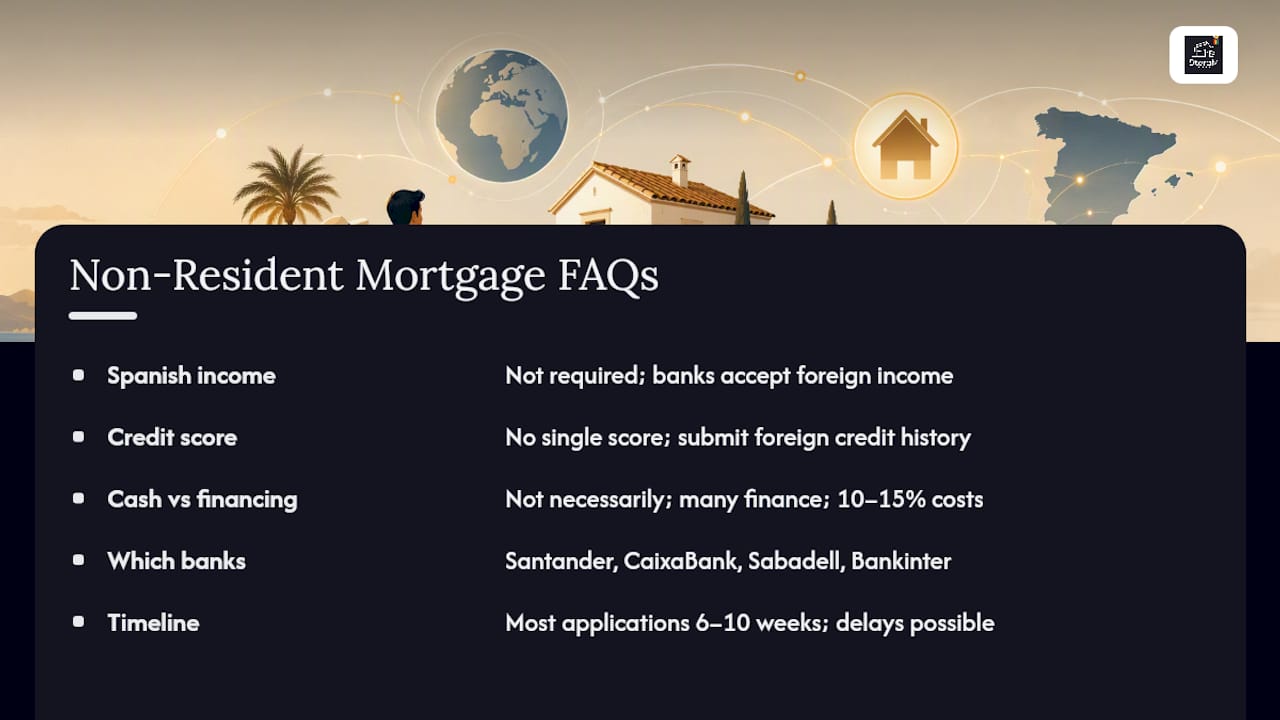
Yes. Banks evaluate foreign income directly, applying currency buffers and requiring proof of stability through payslips, tax returns, or pension statements rather than requiring Spanish-sourced earnings.
What credit score do I need for a non-resident mortgage in Spain?
Spain doesn’t use a single national credit score like the US or UK. Banks instead review your foreign credit history documentation alongside income and asset verification, so a clean payment record from your home country matters more than any specific number.
Is it cheaper to buy a Spanish property in cash instead of financing as a non-resident?
Not necessarily cheaper overall, but it avoids interest costs and the LTV limitations non-residents face. Many buyers still finance a portion to preserve liquidity, especially given the 10% to 15% in additional purchase costs.
Do all Spanish banks offer mortgages to non-residents?
No. Several major lenders, including Banco Santander, CaixaBank, Banco Sabadell, and Bankinter, publish dedicated non-resident products, but smaller regional banks often don’t, so it pays to check lender pages directly rather than assume availability.
How long does the entire process take from application to owning the property?
Most non-resident mortgage applications close within six to ten weeks, though translation requirements or valuation delays in high-demand areas can extend that timeline.
This article is general information, not a substitute for advice from a qualified financial advisor. Consult a qualified financial professional about your own circumstances before acting on anything here.
Sources
- Spain tax residency: 183 days rule | Wise
- ¿Cómo son las hipotecas para extranjeros o no residentes? | Bankinter
- Hipotecas
- Hipotecas para no residentes, ¿cómo comprar una casa en España? | Banco Sabadell