Many tenants and landlords in Spain assume that whatever they write into a rental contract becomes the law of their arrangement. That assumption is wrong, and it causes real problems. Spanish rental law sets a firm legal framework that overrides countless informal clauses, handshake deals, and even signed agreements that conflict with national rules. Whether you are a foreign investor renting out a flat in Torremolinos or a tenant signing your first Spanish lease, understanding the Urban Leases Act (Ley de Arrendamientos Urbanos, or LAU) is not optional. It is the foundation of every valid rental relationship in the country.
Table of Contents
- Understanding rental agreements in Spain
- Duration, renewal rules, and notice periods
- Security deposit (fianza): What tenants and landlords must know
- Assignment, subletting, and restricted actions
- Best practices for long-term leases in Spain
- What most guides miss: The uncomfortable truth about Spanish rental agreements
- Get expert help for your Spanish rental needs
- Frequently asked questions
Key Takeaways
| Point | Details |
|---|---|
| LAU governs all leases | Spanish housing rental contracts must comply with the Urban Leases Act, which overrides private deals. |
| Mandatory durations | Residential leases must be renewed annually until reaching at least 5 years, or 7 years if the landlord is a legal entity. |
| Deposit is regulated | The minimum security deposit is one month’s rent for housing, paid in cash and held by an official body. |
| Written consent required | Tenants must obtain landlord’s written permission for assignment or partial subletting; informal arrangements are risky. |
| Best practices matter | Prioritize formal legal terms, proper notice, and compliance with LAU rather than informal agreements. |
Understanding rental agreements in Spain
A rental agreement in Spain is not simply a private document between two willing parties. In Spain, a rental agreement for housing is the contract of “arrendamiento” governed primarily by the Urban Leases Act (LAU). This law sets the floor for tenant protections and landlord rights, and many of its provisions cannot be waived, even if both parties agree in writing to do so.
The LAU draws a critical distinction between two contract types: leases for a tenant’s habitual residence (vivienda habitual) and leases for other uses, such as vacation rentals or commercial purposes. The rules differ significantly between these two categories. Habitual residence leases receive the strongest legal protections. Other use contracts operate under somewhat more flexible terms, though the LAU still governs them in important ways.
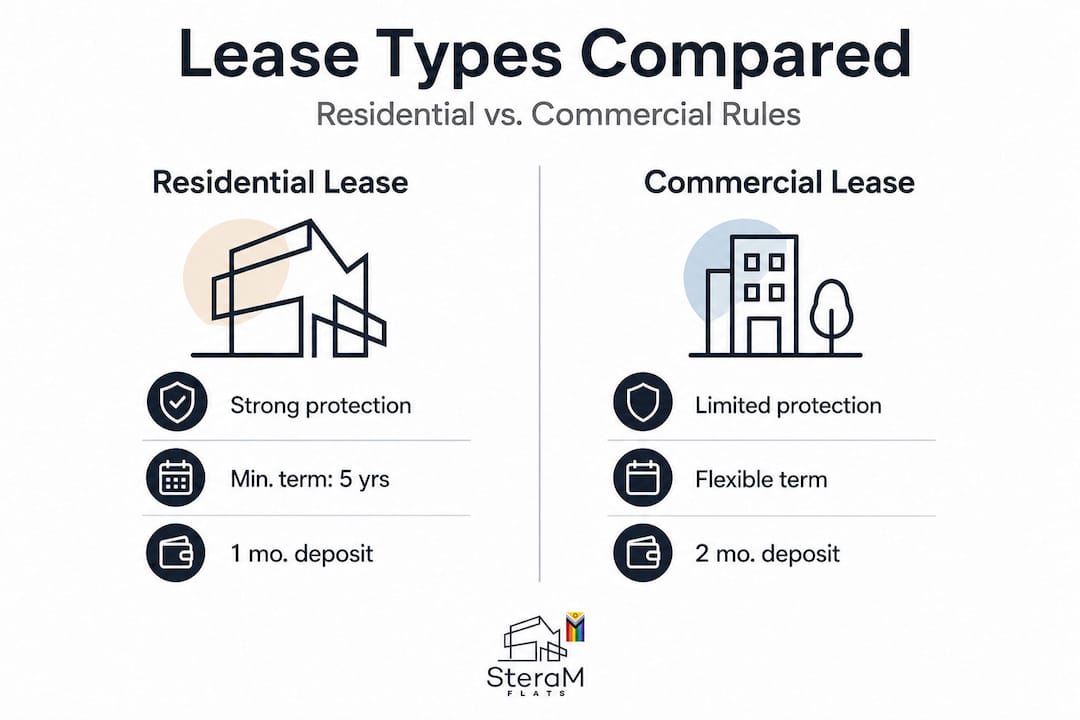
Here is a quick comparison of how the two primary lease categories differ:
| Feature | Habitual residence lease | Other use / commercial lease |
|---|---|---|
| Minimum legal protection | Strong, tenant-favored | More flexible |
| Mandatory renewal | Yes, up to 5 or 7 years | Not mandatory |
| Security deposit | 1 month rent | 2 months rent |
| Notice for non-renewal | 30 days (tenant) | Agreed by parties |
| LAU applicability | Fully applicable | Partially applicable |
Verbal agreements exist in Spain, but they are a legal minefield. Without written documentation, proving the agreed rent, duration, or conditions becomes nearly impossible in court. If you explore the different rental agreement types available under Spanish law, you will quickly realize that written contracts are not just good practice. They are essential for enforcing your rights.
Key legal points to understand before signing anything:
- The LAU governs habitual residence leases regardless of what the contract says
- Clauses that reduce tenant rights below the LAU minimum are generally void
- Both parties must keep signed copies of the full agreement, including any addendums
- Foreign-language contracts are valid, but Spanish courts will use the Spanish version in disputes
Duration, renewal rules, and notice periods
The duration section of a Spanish rental contract is where many landlords and tenants get into trouble. You might sign a one-year contract and assume that either party can simply walk away at the end of it. Spanish law says otherwise.
For residential leases under the LAU, the contract duration is governed by mandatory renewal rules rather than just whatever the parties write in the document. If the landlord is a private individual, the lease must be renewed annually until the tenant has enjoyed at least five full years of tenancy. If the landlord is a legal entity, such as a company or investment fund, that minimum extends to seven years. The tenant can choose not to renew by giving proper notice, but the landlord cannot simply refuse to renew until those thresholds are met, with limited exceptions.
Here is a clear comparison of mandatory minimum durations:
| Landlord type | Minimum protected duration | Annual renewals required? |
|---|---|---|
| Private individual | 5 years | Yes, if under 5 years |
| Legal entity (company, fund) | 7 years | Yes, if under 7 years |
| Both | After minimum, 3-year extensions | Yes, unless either party gives notice |
The notice requirements are equally strict. If neither party communicates intent to end the lease after the mandatory period, Spanish law generally extends the contract automatically in three-year increments. The steps to properly end or not renew a lease are:
- Confirm the lease expiration date in writing
- Check whether the mandatory minimum period has been completed
- Send notice by burofax (a certified Spanish postal service with legal record) or another provable method
- Tenants must give at least 30 days’ notice before the relevant renewal date
- Landlords must give at least four months’ notice if they do not intend to renew after the mandatory period
- Store all correspondence with timestamps and delivery confirmation
Pro Tip: Always use burofax to send renewal or termination notices in Spain. It creates a legally recognized paper trail that standard email or text messages do not provide.
Important: If a landlord needs the property back for their own primary residence or that of a first-degree relative, they can end the lease before the five-year minimum. But this exception requires explicit mention in the original contract and proper advance notice. Without those elements, this exception does not apply.
Staying on top of renewal timelines is part of any solid landlord management checklist. Before you sign anything, make sure you know your rental rights and understand exactly when notice deadlines fall.
Security deposit (fianza): What tenants and landlords must know
The fianza is the Spanish term for the security deposit, and it is one of the most regulated aspects of any residential rental. A lot of tenants hand over cash and hope for the best. That approach creates unnecessary risk for everyone involved.

The security deposit (fianza) is regulated in the LAU, which specifies both the minimum amount and the official process for handling it. For habitual residence leases, the minimum deposit is one month’s rent. For leases covering other uses, including commercial or non-residential purposes, the minimum rises to two months.
Here is a breakdown of deposit requirements:
| Lease type | Minimum fianza | Payment method | Deposit obligation |
|---|---|---|---|
| Habitual residence | 1 month’s rent | Cash | Must be lodged with regional authority |
| Other uses | 2 months’ rent | Cash | Must be lodged with regional authority |
| Additional guarantees | Negotiable (often 1-2 months extra) | Various | Private arrangement between parties |
The landlord is legally required to deposit the fianza with the relevant regional housing authority. In Andalusia, for example, this is managed through the Junta de Andalucía. If a landlord fails to do this, they can face fines and lose the right to deduct the deposit for damages. Tenants should always ask for proof that the deposit has been officially lodged.
The most important best practices around the fianza include:
- Document the property’s condition with dated photos or a signed inventory before handing over keys
- Request confirmation that the deposit has been lodged with the regional authority
- Landlords must return the deposit within 30 days of lease end unless damage claims are made
- If the deposit is not returned on time, tenants may be entitled to legal interest on the withheld amount
- Additional guarantee deposits can be agreed on top of the fianza, but they are not legally capped in the same way
Pro Tip: Use a detailed, signed property inventory on move-in day. Photograph every room, every mark on the wall, and every appliance. It eliminates ambiguity at checkout and protects both parties equally.
Understanding what the fianza covers, and what it does not, connects directly to broader financial planning for landlords. Good rental insurance advice is an important complement to the deposit, especially for long-term contracts. If you are weighing your options between property types, see how the long-term vs holiday rental decision affects your deposit obligations and legal exposure.
Assignment, subletting, and restricted actions
Tenants sometimes want to bring in a roommate, transfer the lease to a friend, or sublet part of the property during a long trip. Under Spanish law, none of these are free choices.
The LAU states that tenants cannot assign the lease or sublet without the landlord’s written consent. This is one of the most frequently violated rules in the Spanish rental market, often not out of bad faith but simple ignorance.
Here is the legal distinction between assignment and subletting:
- Assignment means transferring the entire lease to a new tenant. This requires written landlord consent and changes the entire legal relationship.
- Partial subletting allows the original tenant to sublet part of the property while remaining in residence. This still requires the landlord’s written consent and is capped at the original rent paid to the landlord.
- Full subletting (where the original tenant vacates entirely) is generally not permitted without full assignment, meaning it needs explicit written approval.
- Cohabitation without legal status (e.g., having a partner or family member move in) has separate rules and is not the same as subletting.
Common mistakes to avoid:
- Assuming verbal consent from a landlord is legally binding
- Posting the property on short-term rental platforms without the landlord’s knowledge
- Failing to update the contract when a new party is added or replaces the original tenant
- Neglecting to get written documentation when a landlord does informally agree
Key rule: Written consent is not just a formality in Spain. Without it, an assignment or subletting arrangement is legally void. The original tenant remains fully liable for rent and property conditions regardless of any private arrangement with a third party.
If you are considering renting out your property or need to understand the license requirements for different rental uses, reviewing the rental license process in Spain is an important first step.
Best practices for long-term leases in Spain
Now that you understand the core legal rules, the practical question is how to apply them in real situations. Many Spanish rental disputes are entirely avoidable with the right preparation.
Many clauses that weaken tenant protections are invalid under the LAU framework. A landlord who writes “tenant has no right to contract renewal” into a lease has not actually removed that right. The LAU overrides it. Knowing this saves both parties from false expectations.
Best practices for landlords:
- Review every clause against current LAU provisions before signing
- Use a certified Spanish gestor or lawyer to draft or review contracts
- Register the contract with the regional housing authority to protect against fraud
- Maintain a file of all notices sent and received, organized by date
- Conduct inspections with the tenant present and document findings in writing
Best practices for tenants:
- Read the entire contract before signing, not just the rent and duration sections
- Confirm the deposit has been lodged officially within 30 days of signing
- Give all notices in writing via burofax or similarly provable delivery
- Do not agree to informal modifications without a signed contract addendum
- Know the LAU minimum duration rules so you understand your renewal rights
Pro Tip: Both parties benefit from using a property type guide to understand how the property’s classification affects which LAU rules apply. A tourist apartment follows very different rules than a habitual residence lease.
What most guides miss: The uncomfortable truth about Spanish rental agreements
Here is what years of managing Spanish rentals in places like Torremolinos teach you: most landlord-tenant disputes are not really about the property. They are about what people thought the contract said versus what Spanish law actually enforces.
Conventional guidance often tells landlords to customize their contracts to protect their interests. That advice sounds reasonable but misses a fundamental reality. The LAU is not a default template you can edit. It is a mandatory legal floor. When you write a clause that contradicts it, the clause disappears and the LAU provision replaces it. You cannot contract your way out of the five-year minimum renewal obligation for individual landlords, no matter how clearly you write it or how willingly a tenant signs it.
This creates a specific trap for experienced landlords who have managed properties in other countries. What works in Germany, the UK, or the United States may be completely unenforceable in Spain. The instinct to “customize” protections by shortening renewal periods, setting restrictive subletting terms, or limiting deposit return timelines can backfire badly when challenged in a Spanish court.
Tenants fall into a mirror-image trap. They assume that because they signed something, it must be valid. They do not realize that a clause denying them renewal rights, or requiring a deposit of four months’ rent for a residential lease, may simply not hold up legally. Checking your rights before signing, as outlined in resources like rental rights before signing, is not paranoia. It is basic due diligence.
The most important shift in mindset: think of the LAU as your contract’s co-author. It writes the non-negotiable sections. Your private agreement fills in the rest.
Get expert help for your Spanish rental needs
Navigating Spanish rental law does not have to be a solo effort. Whether you are a landlord trying to structure a legally sound long-term lease or a tenant reviewing a contract before you sign, having the right resources makes all the difference.

At SteraM Flats, we have built a library of practical guides designed specifically for the Spanish market. Our detailed landlord rental agreement guide walks through the key LAU provisions step by step, helping you understand which clauses hold up and which ones do not. For ongoing management, our landlord rental management checklist covers everything from deposit handling to renewal notices. We also support landlords and tenants through property registration, legal documentation, and licensing processes across southern Spain. Reach out to our team to get the guidance you need before you sign anything.
Frequently asked questions
What laws regulate rental agreements for housing in Spain?
Rental agreements for housing are primarily governed by Spain’s Urban Leases Act (LAU), which defines the rights and obligations of both landlords and tenants. No private agreement can override the LAU’s mandatory tenant protections.
How long must a residential lease last under Spanish law?
If the lease duration is less than five years (or seven years for legal entities), Spanish law requires annual renewals until the minimum is met, unless the tenant opts out with proper notice. The landlord cannot force early termination during this protected period without specific legal grounds.
What is the minimum security deposit required in Spain?
For residential leases, the minimum security deposit is one month’s rent; for other types of use, it is two months. The deposit must be paid in cash and lodged with the appropriate regional public authority.
Can tenants sublet their rental apartment in Spain?
Tenants may partially sublet only with the landlord’s written consent and according to LAU conditions. Full assignment of the lease to another party also requires written permission and is generally restricted under the same rules.
What common mistakes do landlords and tenants make with Spanish rental agreements?
The most common mistakes are relying on informal promises, including clauses that weaken tenant protections (which the LAU renders void), and misunderstanding notice and renewal rules. Written documentation and LAU compliance are the only reliable safeguards for both parties.