
Many people moving to Spain assume that if their lease says “11 months” or “seasonal,” they are automatically outside the protection of Spain’s main rental law. That assumption can cost you real money and real security. What actually determines your rights as a tenant is not the label on your contract. It’s the legal regime that governs it, and whether you use the property as your primary home. Understanding this distinction is the single most important thing you can do before you sign any rental agreement in Spain.
Table of Contents
- What defines a long-term rental in Spain?
- Key features and protections under the LAU framework
- Long-term vs short-term rentals: Practical and legal differences
- How to choose and manage a long-term rental in Spain
- Our perspective: Why understanding contract regime is the real key
- Explore long-term rental solutions and expert property management
- Frequently asked questions
Key Takeaways
| Point | Details |
|---|---|
| LAU defines long-term | Long-term rentals in Spain are governed by LAU contracts for habitual residence, ensuring strong tenant protections. |
| Minimum contract duration | LAU leases must last at least five years with individuals and seven years with companies. |
| Contract labels aren’t decisive | Actual use and legal framework matter more than written contract length or label. |
| Tenant protection differences | Long-term rentals offer greater tenant safeguards compared to short-term or seasonal contracts. |
| Expert guidance available | Specialized advice and management can help you avoid legal pitfalls when renting or investing in Spain. |
What defines a long-term rental in Spain?
Spain’s rental market can feel opaque at first glance. You will encounter contracts labeled “seasonal,” “short-term,” “11 months,” and “temporary,” often presented as if those labels settle the question of your rights. They don’t. The real legal question is which framework governs your contract.
Long-term residential rentals in Spain are defined by a specific legal regime: the vivienda habitual lease under the Ley de Arrendamientos Urbanos, commonly called the LAU. The LAU is Spain’s Urban Rentals Law, and it contains the strongest protections for tenants. As Spain’s rental landscape makes clear, long-term residential rentals usually mean a LAU “vivienda habitual” lease, governed by the Ley de Arrendamientos Urbanos. What makes a rental fall into this category is not the contract’s title. It’s the actual use of the property.
Here’s why that matters. A landlord might deliberately write a lease for “11 months” to avoid the stronger protections that come with a habitual residence contract. But if you are actually living in that property as your primary home, Spanish courts and legislation generally recognize your LAU rights anyway. The law looks at reality, not paperwork.
“In Spain, what distinguishes a habitual residence rental from other types is the tenant’s actual use of the property as their primary home, not the label the contract uses.”
Common scenarios where tenants get confused include:
- A landlord calls the lease “seasonal” but the tenant moves in full time
- A lease runs for exactly 11 months with a verbal understanding it will renew
- A tourist accommodation contract is used to house someone who has no other registered address
- A company rents to an employee who uses it as their only home
In each of these situations, the actual use of the property as a habitual residence can bring the rental under LAU protections, regardless of what the paperwork says. Knowing how to identify which legal framework applies to your situation is far more important than reading the lease’s title. It’s also why obtaining proper rental licenses matters so much for landlords who want to operate in a legally sound way.
Key features and protections under the LAU framework
Once you know your lease qualifies as a habitual residence contract under the LAU, a specific set of rights and obligations kicks in automatically. These are not optional extras. They apply by law, and landlords cannot easily waive them through contract clauses.

The minimum duration for a habitual-residence LAU lease depends on whether the landlord is a person or a company, giving tenants strong renewal and extension rights even if the contract is initially written for a shorter period.
Here’s how the core protections break down:
| Feature | Individual landlord | Legal entity (company) |
|---|---|---|
| Minimum contract term | 5 years | 7 years |
| Mandatory annual renewals | Yes, after minimum term | Yes, after minimum term |
| Security deposit | 1 month’s rent | 1 month’s rent |
| Additional guarantees | Limited by law | Limited by law |
| Rent increase cap | CPI or agreed index | CPI or agreed index |
| Termination by landlord | Strict legal grounds only | Strict legal grounds only |
Those numbers are significant. If you sign a one-year contract with an individual landlord, you can still stay for up to five years if you need to, provided you pay your rent and meet your obligations. The landlord cannot simply refuse to renew to pressure you out, except under specific legal circumstances such as needing the property for personal use.
A typical LAU lease lifecycle looks like this:
- Contract signed for any agreed initial duration (often 1 year)
- Automatic annual renewal continues until the minimum term (5 or 7 years) is reached
- Tenant may extend for up to 3 additional years after the minimum term
- Rent adjustments are indexed to an official indicator, not left to the landlord’s discretion
- Termination by landlord requires advance notice and specific legal justification
- Termination by tenant requires 30 days’ notice after the first 6 months
Pro Tip: Always ask your landlord or agent to confirm in writing which legal regime the contract falls under. If the paperwork says “seasonal” or “temporary” but you plan to live there full time, consult a Spanish property lawyer before signing. The cost of legal advice upfront is far smaller than the cost of losing your home unexpectedly.
Understanding these protections helps you make smarter decisions before you move in. A solid management checklist for landlords will also help property owners structure their lease properly, avoiding the accidental creation of LAU rights they did not intend. For tenants, reviewing the full scope of your rental agreement rights before signing can save you from costly surprises.
Long-term vs short-term rentals: Practical and legal differences
Choosing between long-term and short-term rental arrangements in Spain is not just a lifestyle decision. It’s a legal decision with real financial consequences. The key insight is this: if you are deciding between long-term and short-term in Spain, focus on the contract’s legal regime, because tenant protections, rent controls, deposits, and landlord exit rights can differ substantially.
Here’s a direct comparison of the two main types:
| Characteristic | LAU habitual residence (long-term) | Tourist / seasonal (short-term) |
|---|---|---|
| Governing law | LAU (national) | Regional regulations |
| Minimum tenant stay | 5 years (individual) / 7 years (company) | Varies, often less than 1 year |
| Deposit | 1 month by law | Negotiated freely |
| Rent controls | Yes, indexed annually | No formal controls |
| Tenant renewal rights | Automatic and legally guaranteed | No automatic renewal |
| Landlord exit rights | Restricted to legal grounds | Much broader flexibility |
| License required | Not always | Usually yes for tourist use |
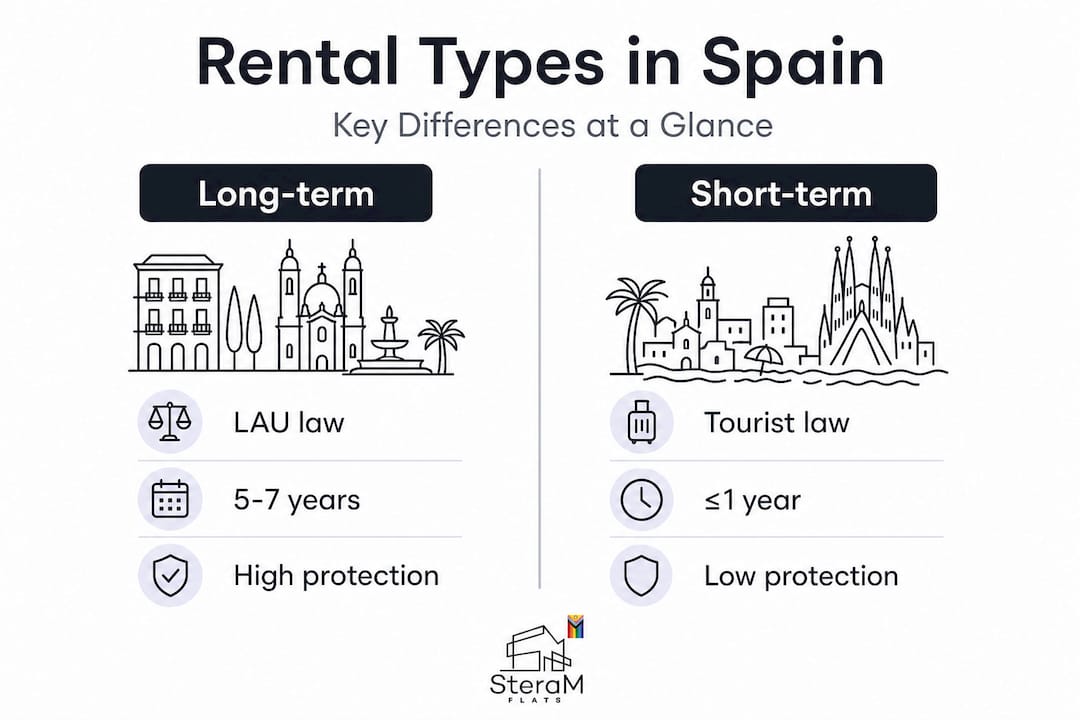
The differences are not subtle. As a tenant in a LAU habitual residence contract, you have a predictable, legally protected home for at least five years. As a tenant in a seasonal or tourist arrangement, you have flexibility but almost no guarantee of continuity.
Key practical differences to keep in mind:
- Rent stability: LAU contracts limit how much rent can increase each year, which matters enormously when planning a family budget
- Security: You cannot be evicted from a LAU habitual residence without a court order and legal grounds
- Moving costs: If you lose a short-term rental and have to relocate, the financial and logistical cost falls entirely on you
- Registration: Only habitual residence rentals allow you to register your empadronamiento (official municipal registration), which you need for public services, schools, and healthcare
Short-term contracts do have their place, particularly for investors and property owners exploring short-term rental opportunities. They offer better returns in high-demand tourist areas and greater flexibility to reclaim the property. But if you’re a family planning to build a life in Spain, the LAU framework is almost always the right foundation. For a deeper look at this trade-off, the comparison of long-term vs holiday rentals lays out the investor and tenant perspectives clearly. You can also explore the full range of ideal rental property types to find what fits your situation best.
How to choose and manage a long-term rental in Spain
Knowing the theory is one thing. Putting it into practice when you’re staring at a lease in a foreign language is another matter entirely. The following steps will help you approach any rental situation in Spain with confidence.
Identify the stated legal regime on the contract before reading anything else. Look for the words vivienda habitual or references to the LAU. If you see “temporal,” “de temporada,” or “turístico,” pause and ask questions.
Assess your actual intended use. If you plan to live in the property full time and register it as your address, you almost certainly need a LAU habitual residence contract, regardless of what the landlord prefers.
Verify the deposit requirements. A legal LAU long-term contract requires exactly one month’s rent as a security deposit. Any demand for more than that (beyond a small additional guarantee) should raise a flag.
Check the rent review clause. It should reference an official index, not give the landlord open-ended authority to raise the rent at will.
Confirm your right to register your empadronamiento. A legitimate long-term rental gives you the right to register officially at the property. If a landlord refuses this, something is wrong.
Document the property’s condition at move-in. Photos, written inventory, and a signed condition report protect you when you eventually move out and want your deposit returned.
The trickiest situations arise when the legal label you see, for example “seasonal” or “11 months,” may not control protections if the tenant uses the property as their habitual residence. Actual use under the LAU framework is what matters. This is where a mislabeled contract can actually work in your favor as a tenant, but only if you know to assert your rights.
Pro Tip: Before signing any rental contract in Spain, run the agreement by a Spanish abogado (lawyer) who specializes in housing law. Many offer fixed-fee contract reviews. The investment is worth it, especially for families planning to stay for several years. Also, make sure you understand the basics of rental insurance before you move in. Both landlords and tenants benefit from knowing how insurance interacts with their legal responsibilities under the LAU.
The same structured thinking that helps tenants protect themselves also helps landlords stay on the right side of the law. Reviewing the full landscape of rental agreement types before drafting a contract prevents costly mistakes and accidental liability.
Our perspective: Why understanding contract regime is the real key
After working with landlords and tenants across southern Spain for years, we’ve seen the same mistake repeat itself constantly. People focus on the number of months in their contract rather than the legal framework that governs it. Someone signs an “11-month seasonal contract” assuming they have no rights and paying inflated deposits as a result. A landlord drafts a short-term lease thinking it protects them from LAU obligations, only to find that a tenant who lived there full time can assert habitual residence rights in court.
The number on the contract is almost irrelevant. What matters is the regime. And once you start thinking in terms of legal frameworks rather than month counts, almost every rental decision in Spain becomes easier to analyze.
We’ve also seen families make smart rental choices in Spain by simply asking one question before signing: “Is this a vivienda habitual LAU contract?” If the answer is yes, they know exactly what they’re getting. If the answer is vague, they know to keep asking.
The uncomfortable truth is that some landlords in Spain deliberately use ambiguous contract labels to avoid legal obligations. They’re not all acting in bad faith. Some simply don’t know the law as well as they should. But the result is the same: tenants who don’t understand the regime end up accepting worse conditions than they’re legally entitled to. Our firm belief is that informed tenants and legally compliant landlords produce better outcomes for everyone, more stable tenancies, fewer disputes, and more confidence in the Spanish rental market as a whole.
Explore long-term rental solutions and expert property management
If the legal landscape of Spanish rentals feels complex, you don’t have to work through it alone. SteraM Flats has helped hundreds of individuals, families, and investors understand their options, negotiate the right contracts, and build predictable, protected living and investment arrangements across Spain.

Whether you’re a prospective tenant trying to understand your long-term rental choices or a landlord who wants to structure compliant leases without legal risk, our team provides step-by-step guidance from contract review to ongoing property management. Our guide to rental agreements is a strong starting point for anyone entering the Spanish rental market. Reach out to SteraM Flats today and let our experience in southern Spain’s property market work for you.
Frequently asked questions
What is the minimum duration for a long-term rental contract under Spain’s LAU?
The minimum is 5 years for individual landlords and 7 years for company landlords, with mandatory annual renewal options until those minimums are met.
How do I know if my rental contract qualifies as “long-term”?
If your contract is for habitual residence under the LAU, actual use determines your rights regardless of the contract’s label or written duration.
Are tenant protections stronger in long-term rentals compared to short-term in Spain?
Yes. Long-term housing “vivienda habitual” is the most protected rental arrangement in Spain, guaranteeing renewal rights, deposit limits, and rent controls that seasonal or tourist contracts do not provide.
Can a short-term rental be considered long-term if it’s used as my primary home?
Yes. If you use a property as your habitual residence, actual use under the LAU controls your protections, and you may be entitled to full LAU rights even if the contract says otherwise.
Recommended
- SteraM Flats | Rental agreements in Spain: Know your rights before signing
- SteraM Flats | Long-term vs Holiday Rentals: Smarter Choices for Spanish Property
- SteraM Flats | Rental Agreement Types in Spain: Guide for Landlords
- SteraM Flats | Rental management checklist: Essential steps for landlords in Spain