Real estate project management is defined as the integrated discipline of planning, coordinating, and controlling all activities across a property’s lifecycle, from land acquisition through final asset handoff. Unlike general construction supervision, real estate project management encompasses financial analysis, regulatory navigation, stakeholder coordination, and asset strategy within a single, unified framework. The Project Management Institute (PMI) defines a project by its temporary nature, defined objectives, and cross-disciplinary coordination requirements. All three characteristics apply directly to real estate development. The “golden triangle” of scope, budget, and schedule governs every decision a project manager makes, and mastering that balance separates successful developments from costly failures.
What is project management in real estate, and why does it matter?
Real estate project management is a specialized discipline that integrates construction management, property development, financial analysis, regulatory navigation, and asset strategy across a property lifecycle. That definition matters because it reframes the role entirely. A project manager in real estate is not simply a site supervisor. They are the single point of accountability for delivering a complex, capital-intensive asset on time, within budget, and to the agreed quality standard.
The scope of the work is broader than most professionals expect. Each development requires temporary teams, defined timelines, measurable objectives, and integrated cross-disciplinary coordination. A residential tower in Madrid and a commercial retail center in Torremolinos both demand the same core discipline, even if the scale and regulatory environment differ significantly.

The role of project planning in real estate is to create the structure that holds all of this together. Without a formal plan, decisions get made reactively, costs escalate, and timelines slip. With one, every stakeholder operates from the same set of expectations and constraints.
What are the key phases in the real estate development lifecycle?
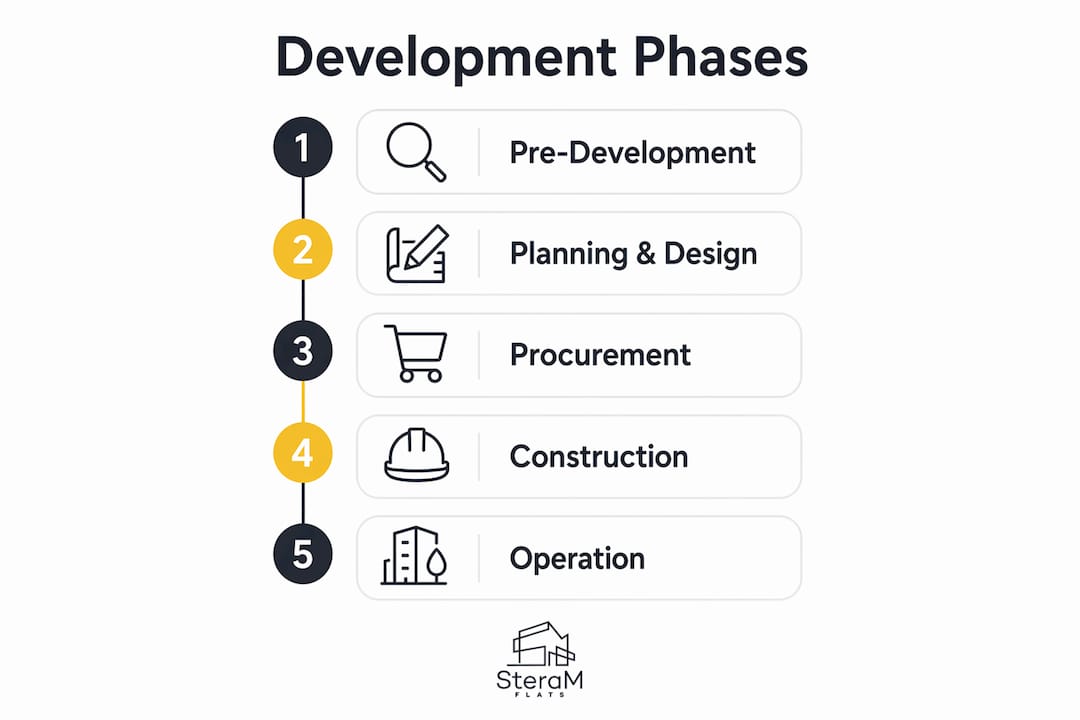
Real estate project management follows five core phases, each with distinct objectives and critical activities.
- Pre-Development and Feasibility: Site assessment, market analysis, financial modeling, and go/no-go decisions. This phase determines whether a project is worth pursuing at all.
- Planning and Design: Architectural briefs, engineering coordination, permitting applications, and budget refinement. Decisions made here lock in the majority of future costs.
- Procurement and Contracting: Contractor selection, subcontractor agreements, material sourcing, and contract negotiation. Poor procurement directly inflates construction costs.
- Construction Execution: On-site management, progress monitoring, quality control, and change order management. This is the phase most people associate with project management, but it is the last place to catch planning errors.
- Closeout and Handover: Inspections, punch lists, regulatory sign-offs, and asset transfer to the owner or operator.
The transition between phases is where projects most often lose momentum. A weak feasibility study creates budget surprises in construction. A poorly negotiated contract creates disputes during execution. Failing to invest in early-stage planning is the principal cause of cost overruns and project delays in real estate developments. That finding has a direct implication: the project manager’s most valuable work happens before a single foundation is poured.
Pro Tip: Lock down your permitting strategy during the planning phase, not after procurement. Permit delays discovered mid-construction can freeze an entire site for months.
| Phase | Primary Risk |
|---|---|
| Pre-Development | Inaccurate feasibility assumptions |
| Planning and Design | Scope creep and permit delays |
| Procurement | Cost inflation and contract gaps |
| Construction Execution | Quality failures and schedule drift |
| Closeout and Handover | Regulatory sign-off delays |
How has the role of real estate project manager evolved?
The project manager’s role has shifted from back-office support to strategic value driver. Modern project managers balance investor expectations, architectural design, contractor capability, and regulatory compliance to build investor trust and competitive market positioning. That is a fundamentally different job than scheduling subcontractors.
“Project managers today are part technologist, part risk strategist, and part stakeholder communicator. That hybrid skill set is no longer optional in complex markets.”
This evolution reflects the growing complexity of development projects. Zoning regulations have tightened. Investor scrutiny has increased. Community opposition to large developments is more organized than it was a decade ago. A project manager who cannot navigate those pressures creates liability for the entire development team.
The triple-threat skill set required today includes technical construction knowledge, financial acumen, and stakeholder communication. These three capabilities rarely coexist naturally in one person, which is why experienced project managers command significant fees and why their absence is so costly.
Key responsibilities in the modern role include:
- Translating investor return requirements into construction specifications
- Coordinating architects, engineers, contractors, and legal counsel simultaneously
- Managing real-time reporting to multiple stakeholder groups with different priorities
- Identifying and mitigating regulatory risks before they become schedule problems
Pro Tip: Build your stakeholder communication plan before the first design meeting. Knowing who needs what information, and when, prevents the information gaps that erode trust mid-project.
What are the critical success factors in real estate project delivery?
The golden triangle of schedule, budget, and quality is the primary measure of real estate project management success, particularly in commercially complex projects. Inexpert management in commercial real estate leads to significantly higher costs and extended timelines. That is not a theoretical risk. It is the documented outcome of projects that underinvest in professional management.
Commercial real estate projects carry additional complexity compared to residential developments. They involve longer permitting timelines, more regulatory bodies, greater public visibility, and higher capital exposure. A delay that costs a residential developer weeks can cost a commercial developer months of carrying costs on a nine-figure asset.
Numbered among the most common pitfalls are:
- Underestimating permitting complexity in new jurisdictions
- Selecting contractors on price alone without evaluating capacity
- Failing to build contingency reserves into the initial budget
- Delaying legal counsel until contracts are already in dispute
- Treating stakeholder communication as a reporting task rather than a relationship-building function
Early involvement of locally experienced real estate attorneys is vital for navigating complex, jurisdiction-specific regulatory requirements. Legal guidance early in the project lifecycle significantly mitigates risk and produces smoother approvals. This is one of the most frequently underestimated cost-saving measures available to a development team.
Pro Tip: In markets with complex zoning rules, such as coastal Spain, engage a local attorney during feasibility, not after you have already committed capital to a site.
The difference between residential and commercial project management is not just scale. It is the density of competing interests that the project manager must reconcile simultaneously.
| Factor | Residential Projects | Commercial Projects |
|---|---|---|
| Regulatory complexity | Moderate | High |
| Stakeholder count | Low to moderate | High |
| Public visibility | Limited | Significant |
| Capital exposure | Lower | Higher |
| Permitting timeline | Shorter | Extended |
Which methodologies and tools drive real estate project success?
The critical path method (CPM) is the most widely used scheduling technique in real estate project management. CPM identifies the sequence of activities that directly determines the project’s completion date. Any delay in a critical path activity delays the entire project. That makes dependency mapping, not just task listing, the core scheduling discipline.
Practitioners who map dependencies between permits, supply deliveries, and construction milestones prevent the cascading schedule failures that catch less structured teams off guard. A permit that takes three weeks longer than expected does not just delay that one activity. It delays every downstream task that depends on it.
Governance structure must match project scale. Large-scale real estate projects require formal Project Management Offices (PMOs) with governance frameworks, while smaller projects benefit from informal, centralized communication. Misaligning management structure to project scale is a common pitfall. Applying enterprise-level bureaucracy to a small renovation creates friction without adding accountability.
Key tools and practices that support effective real estate project management include:
- CPM scheduling software for dependency mapping and timeline control
- Real-time digital dashboards for progress tracking and stakeholder reporting
- Risk registers updated throughout the project lifecycle
- Key performance indicators (KPIs) tied to schedule, budget, and quality milestones
- Structured change order processes to control scope creep
Transparency and structured governance build investor confidence, strengthen partnerships, and create brand credibility. Projects with real-time data dashboards and measurable accountability consistently outperform in delivery metrics. That outcome is not accidental. It is the direct result of making information visible and decisions traceable.
| Tool or Method | Primary Function |
|---|---|
| Critical path method | Timeline control and dependency mapping |
| PMO governance framework | Accountability and decision authority |
| Real-time dashboards | Stakeholder reporting and risk visibility |
| Risk register | Ongoing risk identification and mitigation |
| KPI tracking | Schedule, budget, and quality measurement |
How can real estate professionals apply these principles today?
Applying project management best practices starts with assembling the right team before the project begins, not after problems surface. Attorneys, financial analysts, and technical consultants all need to be involved during feasibility. Their early input shapes decisions that cannot be reversed cheaply later.
Structured stakeholder communication is not a soft skill. It is a risk management tool. When investors, contractors, and regulators all receive consistent, accurate information on the same schedule, the number of surprises drops sharply. Surprises in real estate development are almost always expensive.
Practical steps for real estate professionals include:
- Define the project’s scope, budget ceiling, and quality standards before procurement begins
- Build a risk register during the planning phase and update it at every major milestone
- Match your governance structure to your project’s scale and complexity
- Engage local legal counsel early, especially in markets with complex zoning or environmental regulations
- Use CPM scheduling to map dependencies and identify critical path activities before construction starts
Balancing investor returns, regulatory compliance, community impact, and operational value requires continuous monitoring. The golden triangle does not stay balanced on its own. It requires active management at every phase. Understanding property management terminology and the full scope of coordination involved helps professionals set realistic expectations with all parties from the start.
Pro Tip: Review your risk register at every phase transition, not just at project kickoff. The risks that matter in construction are rarely the same ones you identified during feasibility.
Key Takeaways
Effective real estate project management requires integrating planning, legal, financial, and construction disciplines from the earliest feasibility stage through final asset handoff.
| Point | Details |
|---|---|
| Lifecycle starts before construction | Early-stage feasibility and planning decisions determine the majority of project costs and risks. |
| Golden triangle governs success | Schedule, budget, and quality must be actively balanced at every phase, not just monitored at closeout. |
| Role has evolved strategically | Modern project managers coordinate investors, regulators, architects, and contractors as a single accountability point. |
| CPM controls timelines | Critical path method scheduling maps dependencies and prevents cascading delays from permits or supply issues. |
| Legal counsel belongs in feasibility | Engaging local attorneys early reduces permitting risk and accelerates regulatory approvals significantly. |
The part of real estate project management most professionals underestimate
The most consistent pattern I observe in real estate development is that teams treat project management as a construction-phase function. They hire a project manager after the site is acquired, the design is approved, and the contracts are nearly signed. By that point, the most consequential decisions have already been made without structured oversight.
The early phases, specifically feasibility and planning, are where project management delivers its highest return. A rigorous feasibility study that identifies a permitting obstacle before capital is committed saves far more than any construction-phase efficiency ever could. The same applies to contract structure. A well-negotiated procurement agreement prevents disputes that would otherwise consume months of management attention during execution.
Digital tools have genuinely improved real-time visibility on large projects. Dashboards, risk analytics, and CPM software give project managers information they could not access a decade ago. But technology does not replace the human work of building trust with regulators, negotiating with contractors, and managing investor expectations through difficult phases. The professionals who combine both capabilities consistently outperform those who rely on one or the other.
The role of real estate agent and the role of project manager are often confused in smaller developments. They are distinct functions. Conflating them creates accountability gaps that surface at the worst possible moment.
— YellowRock
Steramflats supports real estate professionals at every project stage
Real estate project management does not end at construction closeout. The asset still needs to be listed, rented, or sold, and that transition requires the same coordination discipline as the development itself.

Steramflats offers real estate professionals a platform to publish and manage property listings across sales, long-term rentals, and vacation rentals in Spain. The platform supports the full post-development workflow, from property valuation and legal documentation to rental agreement management and investor reporting. For professionals managing assets in southern Spain, including markets like Torremolinos where regulatory and tourism dynamics intersect, Steramflats provides the local expertise and service infrastructure that project outcomes depend on. Explore Steramflats rental and property services to see how the platform fits your asset management workflow.
FAQ
What is project management in real estate?
Real estate project management is the integrated discipline of planning, coordinating, and controlling all development activities from land acquisition to final asset handoff. It combines construction management, financial analysis, regulatory navigation, and stakeholder coordination within a single accountability framework.
What does the golden triangle mean in real estate projects?
The golden triangle refers to the three primary success measures: schedule, budget, and quality. All three must be actively balanced throughout the project lifecycle, and a failure in any one dimension typically affects the other two.
What is the critical path method in real estate scheduling?
The critical path method (CPM) identifies the sequence of project activities that directly determines the completion date. Delays in any critical path activity, such as permit approvals or material deliveries, push back the entire project timeline.
When should legal counsel be involved in a real estate project?
Local real estate attorneys should be engaged during the feasibility phase, before capital is committed to a site. Early legal involvement identifies jurisdiction-specific regulatory risks that can otherwise cause permitting gridlock during construction.
How does project management differ between residential and commercial real estate?
Commercial real estate projects carry higher regulatory complexity, more stakeholders, greater public visibility, and longer permitting timelines than most residential developments. The core discipline is the same, but the density of competing interests the project manager must reconcile is significantly greater.