
Real estate partners are defined as individuals or entities who combine capital, operational expertise, and market knowledge to acquire, manage, and grow property portfolios together. The role of real estate partners goes far beyond splitting costs. Partnerships increase deal sourcing by 40% and reduce individual financial exposure by 50%, making them one of the most effective structures in property investment. When roles are clearly defined and governance is documented upfront, partnerships create compounding advantages that solo investors simply cannot replicate.
What are the key roles and responsibilities of real estate partners?
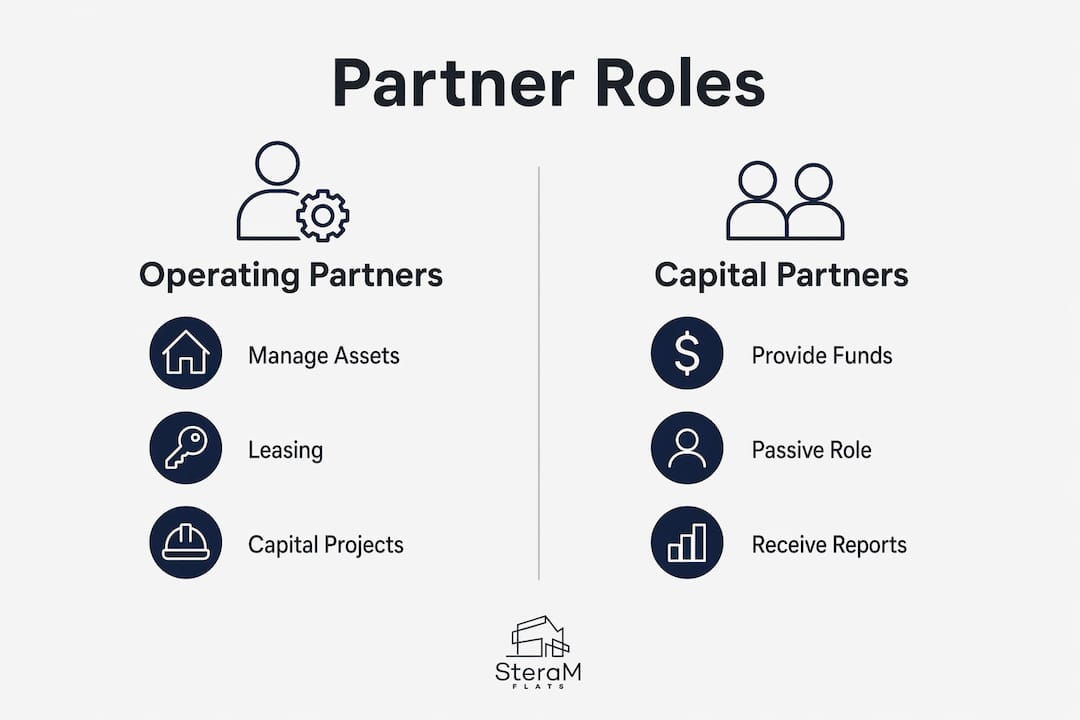
The two foundational roles in any real estate partnership are the operating partner (also called the sponsor or managing member) and the capital partner (also called the passive investor or limited partner). Distinguishing these two roles is the single most important step in structuring a functional partnership.
Operating partners: the day-to-day drivers
The operating partner manages everything that keeps the asset performing. Their responsibilities typically include:
- Sourcing and underwriting deals
- Arranging financing and managing lender relationships
- Overseeing leasing, tenant relations, and rent collection
- Coordinating renovations, capital improvements, and maintenance
- Producing financial reports for capital partners
Sponsors manage property operations including leasing, financing, and capital projects, while capital partners provide funds and hold approval rights on major decisions. Major decisions typically include property sales, refinancing, and capital expenditures above a defined threshold.
Capital partners: the passive investors

Capital partners contribute funds and take a largely passive role in day-to-day operations. They receive regular reporting, vote on major decisions, and are protected by the governance structure in the operating agreement. Their approval rights exist to protect their investment without paralyzing the operating partner’s ability to act quickly.
Compensation in most joint ventures follows a tiered structure. Common JV compensation includes an 8–12% preferred return to capital partners, followed by a 50/50 profit split with the operating partner. Capital is returned to investors before the operating partner earns any profit share. This structure aligns incentives: the sponsor only profits after investors are made whole.
Pro Tip: Draft a one-page role summary before signing any partnership agreement. List every decision each partner controls, every decision requiring joint approval, and every task with a named responsible party. Ambiguity at the start becomes litigation later.
How do partnership structures influence investment strategy and risk?
Partnership structure determines how much control you hold, how much liability you carry, and how returns are distributed. Choosing the wrong structure for your goals is one of the most common and costly mistakes in real estate investing.
| Structure | Involvement level | Liability exposure | Best suited for |
|---|---|---|---|
| Equity partnership | Active, shared management | Full personal liability | Long-term co-ownership of a single asset |
| Joint venture (JV) | Active, project-specific | Shared, project-limited | Single deals with defined exit points |
| Syndication | Passive (investors), active (sponsor) | Limited for passive investors | Pooling capital across multiple investors |
| Limited partnership (LP) | Passive (LPs), active (GP) | Limited for LPs, full for GP | Formal fund structures with many investors |
Equity partnerships suit investors who want hands-on involvement and shared ownership over the long term. Joint ventures focus on a single project with a clear exit, making them popular for fix-and-flip deals or ground-up development. Syndications allow sponsors to pool capital from many passive investors, which is how most large apartment acquisitions are structured today.
Combining financial capital and intellectual firepower creates synergy that allows partners to scale into larger, high-demand projects otherwise inaccessible to solo investors. A single investor might qualify for a $1 million acquisition. The same investor in a well-structured JV can pursue a $5 million asset with better fundamentals and stronger cash flow.
Limited partnerships formally separate the general partner (GP) from limited partners (LPs). The GP manages everything and carries full liability. LPs contribute capital, receive returns, and are shielded from personal liability beyond their investment. This structure is common in private equity real estate funds and larger syndications.
What financial benefits and tax advantages do real estate partnerships offer?
The financial case for partnering is concrete and measurable. Partnerships can double acquisition frequency within 18 months by expanding available capital and deal flow simultaneously. That acceleration compounds over time: more deals mean more income streams, more depreciation benefits, and a faster path to portfolio scale.
Annual cash-on-cash returns in partnerships typically target 6–8%, with significant tax benefits from asset depreciation over 27.5 to 39 years. Residential properties depreciate over 27.5 years under IRS rules. Commercial properties depreciate over 39 years. A $10 million apartment building with an $8 million depreciable basis generates roughly $290,000 in annual depreciation. That depreciation offsets taxable income, often sheltering cash distributions entirely.
Partnerships also reduce individual capital exposure by approximately 50%. That freed capital can fund a second deal, a reserve account, or a different asset class. Diversification across multiple partnerships reduces the risk that any single asset’s underperformance damages your overall financial position. You can explore the tax benefits of rental properties in more detail to understand how depreciation stacks with other deductions.
The due diligence quality in partnerships also tends to be higher. Two partners with different skill sets, one strong in financial modeling and one strong in construction cost estimation, will catch problems that a solo investor would miss. That intellectual cross-check reduces the probability of buying a bad deal.
Pro Tip: Ask your CPA to model the depreciation schedule for any partnership deal before you commit capital. The tax shield from depreciation frequently exceeds the preferred return in the first several years, which changes the true after-tax return calculation significantly.
How to choose the right real estate partners for your investment goals?
Selecting the right partner is more important than selecting the right property. A great asset with a bad partner will underperform. A good partner with a mediocre asset will find a way to create value.
Assess track record and market knowledge. Ask for a deal history with actual returns, not projections. Verify references from previous capital partners. Local market knowledge, specifically knowing which submarkets are tightening and which are softening, is a skill that takes years to develop and cannot be faked.
Evaluate complementary skills. The strongest partnerships pair different strengths. If you excel at financial analysis and underwriting, seek a partner with deep construction or property management experience. Overlapping skills create redundancy. Complementary skills create leverage.
Demand a written operating agreement before any money moves. A well-crafted operating agreement is not a legal formality. It is the governance tool that aligns incentives and prevents disputes. It must define capital contributions, profit distribution, management authority, reporting requirements, and dispute resolution procedures.
Define exit strategies upfront. Lack of explicit exit strategies leads to trapped partners and disputes that end in dissolution and litigation. Buyout provisions, right-of-first-refusal clauses, and forced-sale triggers must be written into the agreement before the partnership begins.
Keep business and friendship separate. Mixing personal relationships with financial obligations without professional boundaries is a reliable path to conflict. Decisions must be governed by financial metrics and clearly assigned management duties, not by personal loyalty or social pressure.
Pro Tip: Run a “stress test” conversation with any prospective partner before signing. Ask directly: “If the property loses 20% of its value in year two, what do you want to do?” Their answer tells you more about alignment than any document will.
Understanding real estate agreement fundamentals before you negotiate any partnership document will save you from agreeing to terms you do not fully understand.
Key Takeaways
Successful real estate partnerships require clearly defined roles, written governance, and aligned financial incentives from the very first day.
| Point | Details |
|---|---|
| Define roles before capital moves | Separate operating and capital partner duties in writing before any funds are committed. |
| Structure shapes risk and returns | Choose equity partnerships, JVs, syndications, or LPs based on your involvement level and liability tolerance. |
| Partnerships accelerate deal flow | Partnering can double acquisition frequency within 18 months and reduce individual capital exposure by 50%. |
| Tax advantages are substantial | Depreciation over 27.5 to 39 years can shelter significant taxable income, improving after-tax returns. |
| Exit clauses prevent disputes | Buyout provisions and sale rights written upfront are the most effective way to avoid litigation. |
What I’ve learned from watching partnerships succeed and fail
Most partnership failures I’ve observed share one trait: the operating agreement was treated as a formality rather than a working document. Partners signed it, filed it, and never looked at it again until something went wrong. By then, the language was ambiguous, the relationship was strained, and the lawyers were expensive.
The agreements that actually work are living documents. They get reviewed when a major decision comes up. They get amended when the partnership’s goals shift. Operating agreements must balance sponsor operational freedom with investor approval rights on major decisions. Too many required approvals paralyze leasing and refinancing decisions. Too few protections leave capital partners exposed. The right balance is specific to each deal and each set of partners.
The other pattern I’ve seen repeatedly: sponsors who confuse investor patience with investor passivity. Capital partners who receive clear, timely reporting and feel genuinely informed will give sponsors more operational latitude. Capital partners who feel kept in the dark become demanding, suspicious, and difficult. Communication is not a soft skill in partnerships. It is a governance function.
My strongest recommendation is to treat every partnership as a business with two CEOs who have different domains. The operating partner owns execution. The capital partner owns oversight. Neither crosses into the other’s lane without a documented reason. That clarity, more than any financial model, determines whether a partnership lasts.
— YellowRock
How Steramflats supports your real estate partnership ventures
Real estate partnerships require more than a signed agreement. They require reliable market intelligence, professional property management, and access to deals worth structuring a partnership around.

Steramflats operates across southern Spain’s most active real estate markets, giving investors and partners direct access to vetted properties, rental management expertise, and advisory support. Whether you are structuring a joint venture on a vacation rental or building a long-term residential portfolio, Steramflats provides the operational backbone that operating partners need and the transparency that capital partners demand. Explore the role of real estate agents in partnership transactions, or review property advisory services to see how professional guidance improves partnership outcomes from day one.
FAQ
What is the role of real estate partners in a joint venture?
Real estate partners in a joint venture divide responsibilities between an operating partner who manages the asset and a capital partner who provides funds and holds approval rights on major decisions. The operating partner handles leasing, financing, and property management, while the capital partner receives regular reporting and a preferred return on invested capital.
What financial returns do real estate partnerships typically generate?
Annual cash-on-cash returns in real estate partnerships typically target 6–8%, plus appreciation, with additional tax benefits from depreciation over 27.5 to 39 years depending on asset type.
Why are exit strategies critical in real estate partnership agreements?
Without explicit exit strategies, partners can become legally trapped in a deal they want to leave, leading to disputes and costly litigation. Buyout provisions and forced-sale triggers written into the operating agreement are the primary tools that prevent this outcome.
How do I evaluate a prospective real estate partner?
Assess their verified deal history, local market knowledge, and the skills they bring that you lack. Confirm they are willing to sign a detailed operating agreement that defines roles, profit splits, and exit rights before any capital is committed.
What is the difference between a general partner and a limited partner?
A general partner manages the property and carries full personal liability for the partnership’s obligations. A limited partner contributes capital, receives returns, and is shielded from personal liability beyond the amount they invested.