Real estate advisory services are defined as professional consulting solutions that help individuals and businesses make strategic, data-driven property decisions beyond simple transactions. Unlike a traditional agent who earns a commission on each deal, an advisor operates on a flat fee or hourly model to deliver impartial guidance across the full asset lifecycle. This distinction matters enormously in a market like Spain, where zoning laws, regional regulations, and tourist property rules create layers of complexity that a transaction-focused agent has little incentive to fully address. Whether you are buying your first investment apartment in Torremolinos or managing a growing portfolio across Andalusia, understanding what real estate advisory services actually do is the first step toward making decisions that hold up over time.
What do real estate advisory services include?
Real estate advisory services cover a wide range of functions that go well beyond finding and listing properties. The core purpose is to align every property decision with your financial goals, risk tolerance, and long-term wealth plan. Advisors bring market intelligence, regulatory knowledge, and financial modeling to every engagement.
The main services an advisory firm provides include:
- Market research and demand analysis. Advisors study supply and demand trends at the neighborhood level, not just the city level. This tells you whether a property is priced fairly and whether the local rental market can support your yield expectations.
- Feasibility studies and development planning. Before you commit capital to a renovation or new build, an advisor models the costs, timelines, and projected returns. This prevents expensive surprises.
- Asset valuation and comparative market analysis. Advisors use structured valuation methods to determine what a property is actually worth, independent of what a seller is asking.
- Risk assessment and investment strategy alignment. Core advisory services include risk analysis that maps potential downside scenarios before you sign anything.
- Portfolio optimization and long-term wealth management. Advisors look at your entire property portfolio, not just the asset in front of you, and recommend rebalancing when needed.
- Due diligence and regulatory compliance. This includes title checks, planning permission reviews, and compliance with local codes.
Pro Tip: Ask any advisory firm you consider to walk you through a sample due diligence report. The depth of that document tells you more about their capabilities than any sales conversation will.
How do real estate advisory services differ from agents or brokers?
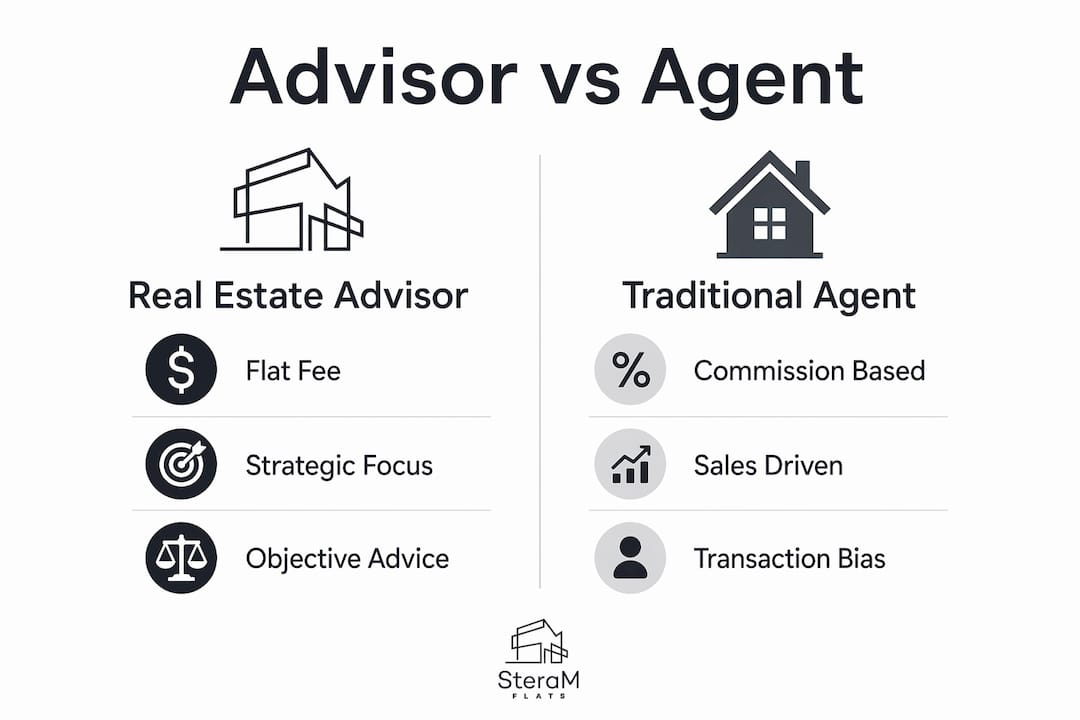
The difference between an advisor and an agent comes down to one word: incentive. A traditional agent earns a percentage of the sale price when a deal closes. That structure creates pressure to close, even when waiting or walking away would serve you better. An advisory firm, by contrast, charges flat fees or hourly rates that are not tied to whether you buy, sell, or do nothing.

This matters because objective advice avoids what professionals call “transaction bias,” the tendency to recommend action because action generates revenue. An advisor who tells you to wait six months or rebalance your portfolio before buying is doing their job correctly, even though that advice earns them no commission. You can read more about typical agent functions to see exactly where the agent’s role ends and the advisor’s begins.
| Feature | Real estate advisor | Traditional agent |
|---|---|---|
| Compensation model | Flat fee or hourly | Commission on transaction |
| Primary focus | Client strategy and portfolio fit | Deal execution and closing |
| Advice scope | Full asset lifecycle | Single transaction |
| Post-settlement support | Ongoing monitoring and planning | Typically ends at closing |
| Conflict of interest risk | Low | Moderate to high |
Pro Tip: Before signing with any advisor, ask directly: “Are you compensated in any way if I purchase a specific property?” A genuine advisory firm will answer no without hesitation.
Why does advisory matter for investors and businesses in Spain?
Spain’s real estate market rewards preparation and punishes guesswork. Regional regulations vary significantly between Andalusia, Catalonia, and Valencia. Laws like the Ley de Propiedad Horizontal govern community property rules, and local zoning codes can block development plans that looked straightforward on paper. An advisor who knows these frameworks prevents costly legal delays before they start.
The benefits of professional advisory in the Spanish context are concrete:
- Regulatory navigation. Advisors track changes in tourist license requirements, rental regulations, and planning permissions so you do not have to.
- Pricing accuracy. Access to deeper market data lets advisors identify when a property is overpriced relative to comparable assets in the same micro-market.
- Negotiation timing. Advisors understand seasonal pricing patterns in tourist markets like Torremolinos and can advise on when to make offers for maximum leverage.
- Portfolio diversification. Rather than concentrating risk in one asset type or location, advisors recommend spreading exposure across residential, commercial, and vacation rental categories.
- Long-term wealth alignment. Sophisticated investors treat property as active wealth creation, not passive speculation. Advisors build strategies that compound returns across multiple assets over years, not months.
The Spanish market also attracts a high volume of foreign buyers who face additional layers of complexity around NIE numbers, mortgage eligibility, and tax obligations. An advisor who specializes in this market removes the guesswork from each of those steps.
How to work effectively with a real estate advisor
Getting real value from an advisory relationship requires preparation on your side. The process works best when you treat it as a structured engagement, not a one-off consultation.
- Start with a full financial disclosure. Your advisor needs to know your income, existing assets, liabilities, and investment timeline before recommending anything. Holding back financial details produces generic advice that does not serve you.
- Define your goals clearly. Are you building a retirement income stream, growing capital for a future sale, or diversifying away from equities? Each goal points to a different property strategy.
- Expect a fit-first conversation. A fit-first advisory approach means your advisor may recommend waiting, rebalancing, or skipping a purchase entirely. That is the advice working as intended.
- Use their negotiation support. Advisors who know local market data can anchor negotiations with comparable sales evidence, which consistently produces better pricing outcomes than emotional negotiation.
- Maintain the relationship post-settlement. Post-settlement support is where experienced investors find the most value. Rental yield monitoring, asset revaluation, and planning the next portfolio move are all part of an ongoing advisory engagement.
Avoid advisors who push specific properties in the first meeting, quote vague fees, or cannot name the regulatory frameworks relevant to your target market. Those are clear signals that the relationship will not serve your interests.
Pro Tip: Request a written engagement letter before any advisory work begins. It should specify the scope of services, fee structure, and what deliverables you will receive. Verbal agreements in real estate advisory create confusion and disputes.
Key Takeaways
Real estate advisory services deliver the most value when clients treat them as ongoing strategic partnerships, not one-time consultations before a purchase.
| Point | Details |
|---|---|
| Advisory vs. agent distinction | Advisors charge flat fees and prioritize strategy; agents earn commissions and focus on closing deals. |
| Full-lifecycle scope | Advisory covers market research, valuation, risk assessment, and post-settlement portfolio monitoring. |
| Spain-specific value | Navigating zoning laws, tourist license rules, and regional regulations requires local advisory expertise. |
| Fit-first approach | A good advisor may recommend waiting or rebalancing before buying, which is a sign of quality, not failure. |
| Ongoing relationship | Post-settlement support, including yield monitoring and revaluation, is where long-term investors gain the most. |
Advisory is an investment in decision quality, not a cost
Most clients I have worked with arrive thinking advisory is an added expense on top of their property budget. That framing is wrong, and it costs them money. The fee you pay an advisor is not a transaction cost. It is the price of avoiding a bad decision that could set your portfolio back by years.
The most common mistake I see is clients who skip advisory on their first purchase because the property “feels right.” Emotional conviction is not a strategy. I have watched investors buy in the wrong micro-market, at the wrong price point, with the wrong rental license status, because no one with a fee-based incentive structure told them to slow down. Advisory services for better returns exist precisely to interrupt that pattern.
The other misconception is that advisory ends when you sign the deed. The real value compounds over time. Knowing when to revalue, when to refinance, and when to sell a specific asset before the market shifts is what separates investors who build wealth from those who just own property. That ongoing guidance is what a genuine advisory relationship delivers.
— YellowRock
How Steramflats supports your property decisions in Spain
Steramflats operates as a full-service real estate and property management platform across Spain, with deep expertise in the southern coastal market. The advisory approach at Steramflats is built around transparent, client-aligned guidance covering property sales, long-term rentals, vacation rentals, and portfolio management.

Whether you are buying your first investment property in Torremolinos or managing an existing portfolio, Steramflats provides the market knowledge, legal documentation support, and valuation expertise to keep your decisions grounded in data. The team handles everything from rental agreement management to renovation project oversight, so you have one trusted point of contact across the full asset lifecycle. Explore the full range of real estate and advisory services Steramflats offers, or list your property directly through the free property listing platform to get started.
FAQ
What are real estate advisory services?
Real estate advisory services are professional consulting engagements that provide strategic, data-driven guidance on property investment, portfolio management, and market analysis. Unlike traditional agents, advisors operate on fee-based models and are not compensated by transaction commissions.
How do advisors differ from real estate agents?
Advisors charge flat fees or hourly rates and prioritize long-term client strategy, while agents earn commissions and focus on closing individual transactions. This difference in compensation creates a fundamental difference in the advice each provides.
Why are advisory services important in Spain specifically?
Spain’s real estate market involves complex regional regulations, tourist license requirements, and zoning laws that vary by autonomous community. Advisory services help buyers and investors navigate these frameworks before they create legal or financial problems.
What does the advisory process look like in practice?
The process begins with a consultation covering your financial position, risk tolerance, and investment goals. Advisors then conduct market research, property matching, and due diligence before supporting negotiation and providing ongoing post-settlement monitoring.
How do I choose a trustworthy real estate advisor?
Look for advisors who charge transparent flat fees, disclose any potential conflicts of interest, and provide written engagement letters before starting work. Avoid any advisor who recommends specific properties before fully understanding your financial goals and strategy.