
A letting agent is a licensed professional or company that manages rental properties on behalf of landlords, handling everything from tenant sourcing to ongoing property maintenance. The term “letting agent” is the standard industry label in the UK and much of Europe, though the role maps closely to what Americans call a property manager or rental agent. Understanding what a letting agent does matters whether you are a landlord weighing your options or a tenant trying to understand who is responsible for what. The regulatory environment around letting agents has grown significantly, making professional management more relevant than ever in 2026.
What is a letting agent and what do they do?
A letting agent acts as the operational link between a landlord and a tenant throughout the life of a tenancy. Their core job is to take the burden of day-to-day property management off the landlord’s plate. That includes advertising the property, screening applicants, drafting tenancy agreements, collecting rent, and coordinating repairs.
The role of a letting agent differs from that of an estate agent in one key way: estate agents focus on buying and selling property, while letting agents specialize in the rental relationship. Some agencies do both, but the skills and legal obligations involved are distinct. A letting agent must stay current on tenancy law, deposit protection rules, and anti-money-laundering regulations.

Letting agents also carry legal duties that go beyond simple administration. They are legally required to perform right-to-rent checks on all prospective tenants and face regulatory scrutiny around money laundering, particularly for transactions involving monthly rents of 10,000 euros or more. That compliance burden is one reason many landlords choose professional representation rather than handling rentals themselves.
What services do letting agents typically provide?
Letting agents offer two primary service models, and knowing the difference is the first decision every landlord must make.
Let-only (tenant-find) service covers the front end of the rental process. The agent markets the property, conducts viewings, vets applicants, and sets up the tenancy agreement. Once the tenant moves in, the landlord takes over all management responsibilities. Let-only services typically charge between 8%–12% of the first year’s rent or a fixed fee of around £500–£1,500.
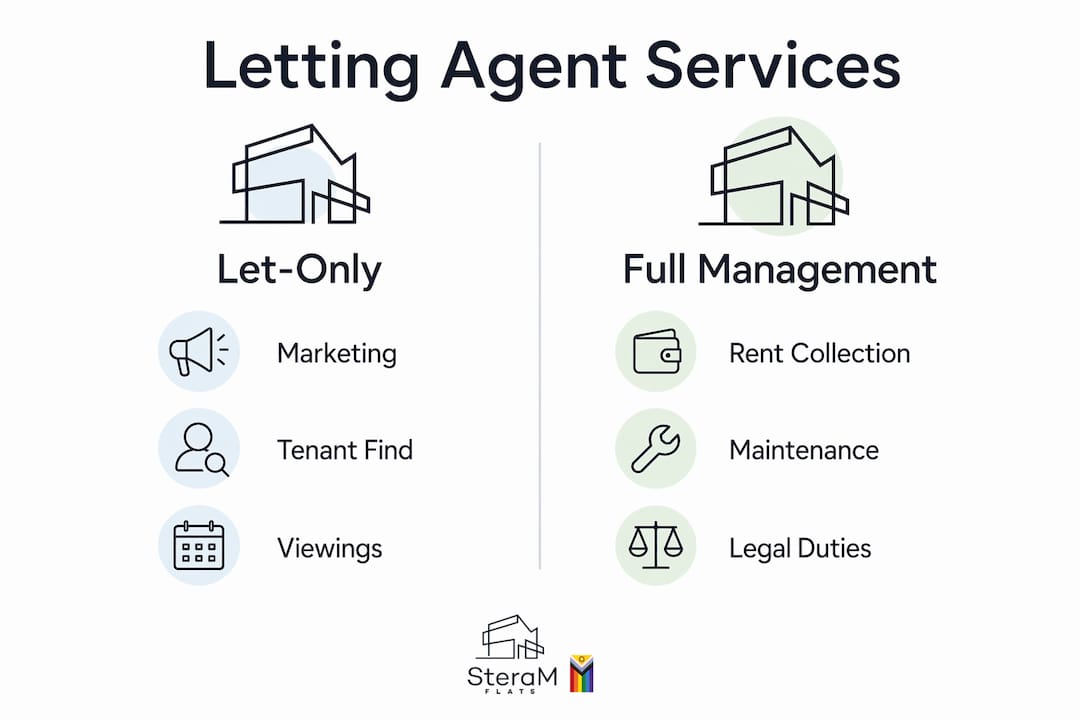
Full property management covers the entire tenancy lifecycle. The agent collects rent each month, handles maintenance requests, manages contractor relationships, conducts property inspections, and deals with any disputes or legal notices. Full management fees typically run 10%–15% of monthly rent plus VAT. That cost reflects a genuine transfer of workload and liability.
Within either model, a reputable letting agent will also:
- Conduct thorough tenant background and affordability checks
- Verify tenant identity and right-to-rent status
- Draft legally compliant tenancy agreements
- Protect tenancy deposits in a government-approved scheme within 30 days and provide deposit information to tenants
- Handle rent arrears and serve legal notices when required
- Coordinate emergency repairs and routine maintenance
Pro Tip: Before signing with any agent, ask for a written breakdown of exactly which services are included at each tier. Agents sometimes charge add-on fees for tasks like renewal paperwork or inventory reports that you might assume are covered.
Why use a letting agent: advantages for landlords and tenants
The core argument for using a letting agent comes down to risk reduction and time savings. Approximately 50% of landlords in the UK self-manage their rental properties. That figure tells you two things: self-management is common, and the risks that come with it are real and accepted by many landlords who may not fully account for them.
Professional agents add measurable value in several areas:
- Tenant screening: Standardized background and affordability checks by letting agents are critical to minimizing rental default and property damage risks in 2026. A bad tenant costs far more than a year’s management fees.
- Legal compliance: Tenancy law changes frequently. An agent who tracks updates to deposit protection rules, eviction procedures, and safety certificate requirements protects landlords from costly penalties.
- Time and availability: Maintenance calls, rent chasing, and inspection scheduling consume hours each month. Full management removes that entirely from the landlord’s schedule.
- Dispute resolution: A letting agent acts as a buffer between landlord and tenant, reducing the emotional charge of conflicts and keeping issues from escalating.
“The real value of letting agents emerges when handling complex or difficult tenancies, preventing minor conflicts from escalating into costly legal battles.” — Rightmove Landlord Guide
For tenants, a professional agent provides a clear point of contact for repairs and complaints, formal documentation of the tenancy, and the assurance that deposits are protected by law. That accountability matters, especially in markets where informal arrangements leave tenants with little recourse.
The advantages of rental properties as an investment class are strongest when management is handled professionally. Vacant periods, legal disputes, and property damage all erode returns. A good agent reduces all three.
Letting agent vs. estate agent vs. managing agent: what’s the difference?
These three roles are often confused, and the confusion has real consequences for landlords and tenants trying to understand who is responsible for what.
| Role | Primary focus | Who they work for | Key responsibilities |
|---|---|---|---|
| Letting agent | Residential rentals | Landlord (primarily) | Tenant sourcing, rent collection, tenancy management |
| Estate agent | Property sales | Buyer or seller | Valuation, marketing, transaction management |
| Block managing agent | Communal buildings | Freeholder or residents’ association | Building maintenance, service charges, communal areas |
A letting agent manages the relationship between a landlord and a tenant inside a specific property. An estate agent handles the transfer of ownership between a buyer and a seller. A block managing agent, sometimes called a property manager, oversees the shared elements of a building such as hallways, elevators, and roofs, often on behalf of a residents’ association or freeholder.
The distinction matters because responsibilities do not overlap cleanly. A landlord who owns a flat in a managed building deals with both a letting agent (for their tenant) and a block managing agent (for the building). Tenants sometimes confuse the two and contact the wrong party for repairs. Understanding what property management covers versus what a letting agent handles prevents those communication failures.
A landlord who self-manages takes on all the duties a letting agent would otherwise carry. That includes legal compliance, deposit protection, maintenance coordination, and dispute resolution. Self-management is not inherently wrong, but it requires genuine commitment and up-to-date knowledge of tenancy law.
How to choose the right letting agent
Choosing a letting agent based on the lowest commission rate is the most common mistake landlords make. Local presence and market knowledge are stronger indicators of service quality than fee levels. An agent with deep roots in your area will have established contractor networks, accurate rental valuations, and faster tenant placement.
Follow this process when evaluating agents:
- Check regulatory membership. In the UK, reputable agents belong to bodies like ARLA Propertymark or RICS. Membership signals training standards and access to client money protection schemes.
- Ask about their tenant vetting process. A good agent runs credit checks, employment verification, and previous landlord references as standard. Ask specifically what checks they perform and how they document results.
- Request a full fee schedule in writing. Understand what is included in the base fee and what triggers additional charges. Renewal fees, inspection fees, and court attendance fees are common extras.
- Evaluate their local portfolio. Ask how many properties they currently manage in your area and what their average vacancy period is. Low vacancy rates signal strong local demand knowledge.
- Verify client money protection. Agents who hold rent or deposits on your behalf must have client money protection insurance. Confirm this before signing anything.
- Read recent reviews. Look for patterns in feedback from both landlords and tenants. Complaints about slow maintenance response or poor communication are red flags regardless of fee levels.
Pro Tip: Ask any prospective agent how they handle maintenance emergencies outside of business hours. Agents without a clear out-of-hours protocol create real risk for both landlords and tenants when urgent repairs arise.
For landlords considering outsourcing property management for the first time, the selection process is worth taking seriously. The wrong agent costs more in the long run than a slightly higher fee from the right one.
Key Takeaways
A letting agent is the most effective tool a landlord has for reducing legal risk, minimizing vacancy periods, and managing tenant relationships professionally.
| Point | Details |
|---|---|
| Core definition | A letting agent manages rental properties for landlords, covering tenant sourcing through ongoing tenancy management. |
| Two service models | Let-only services handle tenant placement; full management covers the entire tenancy lifecycle at a higher fee. |
| Legal obligations | Agents must perform right-to-rent checks, protect deposits within 30 days, and comply with anti-money-laundering rules. |
| Selection criteria | Prioritize local market knowledge and regulatory membership over the lowest commission rate. |
| Tenant benefit | Professional agents give tenants a formal point of contact and legally protected deposits. |
The letting agent’s role is more complex than most landlords expect
Most landlords I speak with underestimate what a letting agent actually does until something goes wrong. The assumption is that the job is mostly admin: post a listing, find a tenant, collect rent. The reality is that a good letting agent is part compliance officer, part negotiator, and part contractor coordinator.
The regulatory environment in 2026 has made this complexity harder to ignore. Deposit protection rules, right-to-rent verification, and anti-money-laundering obligations are not optional extras. They carry real penalties. A landlord who self-manages without tracking these requirements is exposed in ways they often do not realize until they face a claim or a fine.
What I find most undervalued is the dispute prevention function. Letting agents prevent conflicts from escalating by acting as a professional intermediary. That buffer is worth more than most landlords price it. A tenant who feels they can call an agent directly, rather than confronting a landlord personally, is far less likely to let a small issue become a legal dispute.
My honest view is that the 50% of landlords who self-manage are not wrong to do so, but many of them are carrying risks they have not fully priced. The landlords who benefit most from professional agents are those with multiple properties, those who live far from their rental, and those who simply do not want property management to be a second job. For that group, the fee is not a cost. It is the price of not having to think about it.
— YellowRock
Steramflats: expert letting and property management support
Steramflats provides full-service property management and letting support for landlords and investors, particularly across southern Spain. Whether you need tenant sourcing, compliance guidance, or complete day-to-day management, Steramflats handles the process from listing to lease renewal.

The team at Steramflats brings local market knowledge, established contractor networks, and legal compliance expertise to every property they manage. For landlords who want professional representation without the guesswork of finding and vetting an agent independently, Steramflats offers a direct path to managed rental services built around your property goals. You can also list your property directly on the Steramflats platform to reach qualified tenants fast.
FAQ
What is the letting agent definition in simple terms?
A letting agent is a professional who manages rental properties on behalf of landlords, handling tasks like tenant sourcing, rent collection, and maintenance coordination throughout the tenancy.
How do letting agents differ from estate agents?
Letting agents specialize in rental property management, while estate agents focus on buying and selling property. Some agencies offer both services, but the legal obligations and day-to-day responsibilities are distinct.
What does a letting agent charge for full management?
Full management fees typically run 10%–15% of monthly rent plus VAT, while tenant-find only services charge 8%–12% of the first year’s rent or a fixed fee around £500–£1,500.
Are letting agents legally required to protect tenant deposits?
Yes. Letting agents must protect deposits in a government-approved scheme within 30 days of receipt and must provide written deposit information to the tenant.
When does using a letting agent make the most sense?
Using a letting agent makes the most sense for landlords with multiple properties, those who live far from their rental, or those who lack time to manage legal compliance and tenant relations independently.
Recommended
- SteraM Flats | The Role of Real Estate Agent: Buyer and Seller Guide
- SteraM Flats | How to Rent Out Property: A Landlord’s 2026 Guide
- SteraM Flats | Entendiendo el Papel de un Agente Inmobiliario en Torremolinos: Beneficios de Trabajar con un Profesional
- SteraM Flats | Property Management Terminology Explained for Investors