
Commercial property is real estate used primarily for business, industrial, or income-generating purposes rather than personal residence. The commercial real estate definition covers a wide spectrum: office buildings, retail centers, warehouses, healthcare facilities, and multi-unit residential buildings with more than four units. What sets commercial real estate apart from residential is not always its physical appearance. A converted house operating as a law office qualifies as commercial under most zoning frameworks. Investors and business owners who understand this distinction gain a clear advantage when evaluating assets, structuring financing, and planning for tax treatment.
What is a commercial property and how is it classified?
Commercial property is classified by intended use, not by how a building looks. A single-family home converted into a dental clinic becomes commercial real estate the moment its primary use shifts to business activity. This distinction matters because classification determines financing options, applicable tax rules, zoning compliance requirements, and insurance obligations.
The commercial real estate definition used by lenders, tax authorities, and zoning boards centers on one question: does the property generate income through business activity or house more than four residential units? If yes, it falls under commercial classification. That classification then unlocks a different set of financial tools and legal responsibilities than residential ownership carries.

One often-overlooked nuance is that commercial classification is not permanent by default. A property’s use can shift, and with it, the entire regulatory framework governing that asset. Investors who ignore this risk face unexpected tax liabilities and zoning violations.
What are the main types of commercial properties?
Five major categories define the commercial real estate market: Multifamily, Retail, Industrial, Office, and Healthcare. Each carries distinct economic drivers, tenant profiles, and risk characteristics.
| Property type | Typical tenants | Key investment trait |
|---|---|---|
| Multifamily | Residential renters | Consistent demand, lower vacancy risk |
| Retail | Shops, restaurants, service businesses | Sensitive to consumer spending cycles |
| Industrial | Logistics, manufacturing, warehousing | Lower volatility, simpler operations |
| Office | Corporations, professional services | Requires frequent market analysis |
| Healthcare | Medical practices, clinics, care facilities | Long-term stability, specialized compliance |
Multifamily properties attract investors who want steady cash flow with relatively predictable occupancy. Industrial assets appeal to those who prefer simpler day-to-day management and lower exposure to economic swings. Healthcare properties offer long lease terms but require knowledge of medical licensing and accessibility codes.
Retail and office assets demand the most active management. Both respond sharply to economic cycles, and vacancy in either category can erode returns quickly. Investors who underestimate this often find themselves managing properties that require constant tenant recruitment and market repositioning.
Pro Tip: Match your property type to your risk tolerance before you commit capital. Stability-focused investors do better with multifamily or healthcare assets. Those comfortable with operational complexity can pursue retail or office for higher potential returns.
How does the commercial property purchase process work?
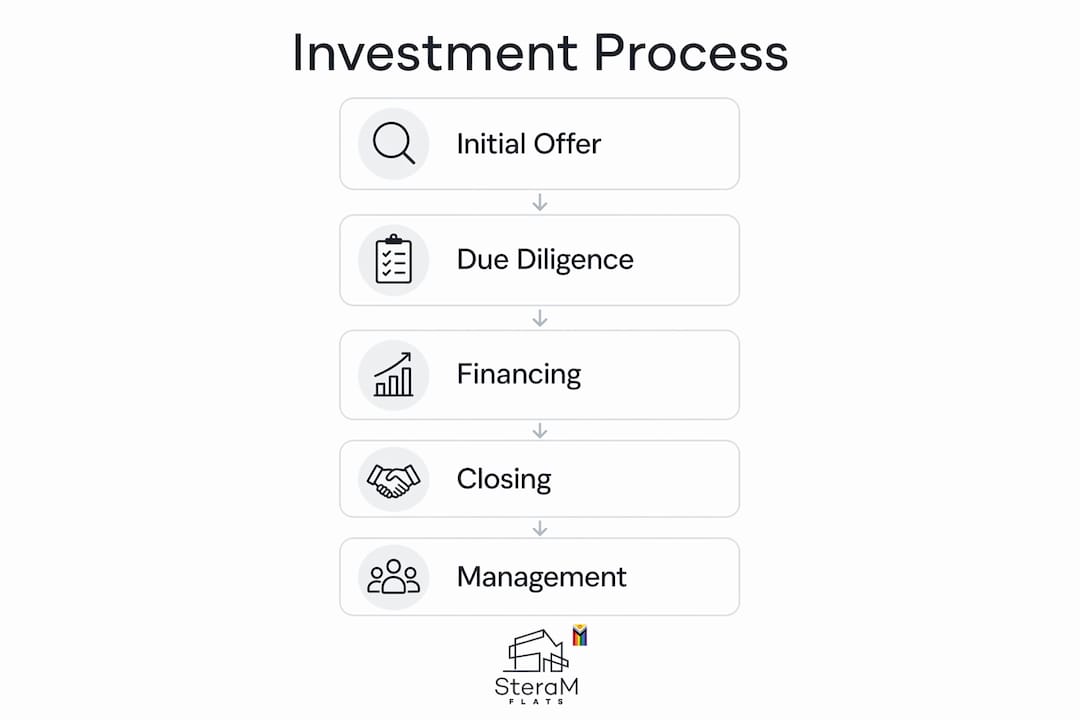
The commercial property purchase follows a defined sequence that differs significantly from buying a home. Each stage carries legal and financial weight, and skipping any step creates compounding risk.
- Negotiate a purchase agreement. The buyer and seller agree on price, terms, and contingencies. Purchase agreements for commercial assets include clauses protecting the buyer during the diligence period.
- Conduct due diligence. This is the most critical phase. Buyers verify the property’s physical condition, income history, existing leases, zoning compliance, and environmental status. Skipping due diligence exposes buyers to hidden structural defects, undisclosed liens, and income shortfalls.
- Review title and legal status. A title search confirms ownership history and identifies any encumbrances. Legal counsel reviews easements, restrictions, and any pending litigation tied to the property.
- Arrange commercial financing. Commercial loans differ from residential mortgages in structure, term, and equity requirements. Lenders assess the property’s income potential alongside the borrower’s financial profile.
- Close the transaction. Closing involves signing legal documents, transferring funds, and recording the deed. Commercial closings are more document-intensive than residential ones.
Commercial leases and loans often span 10–25 years. That time horizon means buyers are not just purchasing a building. They are committing to a long-term financial and operational relationship with the asset, its tenants, and its market.
Pro Tip: Hire a commercial real estate attorney before signing a purchase agreement. Legal counsel during the offer stage prevents costly contract errors that surface at closing. Review the commercial property selection guide for Spain-specific considerations.
What legal and financial distinctions set commercial property apart?
Commercial real estate operates under a different legal and financial framework than residential property. Understanding these distinctions prevents costly surprises after purchase.
- Zoning and permitted use. Commercial zoning determines what activities are legally allowed on a property. A building zoned for light industrial cannot host a retail store without a zoning variance. Violations carry fines and forced closure.
- Financing structure. Commercial loans typically require larger down payments and carry different underwriting criteria. Lenders evaluate the property’s income stream, not just the borrower’s personal credit.
- Tax treatment. Commercial classification unlocks accelerated depreciation schedules and eligibility for tax-deferred exchanges under Section 1031 of the U.S. Internal Revenue Code. These tools significantly reduce taxable income for growth-focused investors.
- Insurance requirements. Commercial properties require specialized policies covering liability, business interruption, and tenant-related risks. Standard homeowner’s insurance does not apply.
- Compliance obligations. Fire safety codes, accessibility standards under the Americans with Disabilities Act, and environmental regulations all apply to commercial assets. Non-compliance creates legal liability.
The legal-financial impact of commercial classification shapes every aspect of ownership strategy. Investors who treat commercial assets like residential ones routinely underestimate their tax planning opportunities and their compliance exposure.
Pro Tip: Work with a tax advisor who specializes in commercial real estate before closing. The depreciation and exchange benefits available to commercial owners can materially change your return projections.
What practical considerations matter when choosing commercial property?
Choosing the right commercial asset requires aligning the property’s characteristics with your specific goals. The priorities of an owner-occupier differ sharply from those of a pure investor.
An owner-occupier wants a location that supports business operations, with space that fits current needs and allows for growth. An investor focuses on tenant quality, lease structure, and income stability. These two goals sometimes point to the same property, but often they do not.
Tenant quality and lease structure directly determine income reliability. A property with a single long-term tenant on a triple-net lease carries less management burden than a multi-tenant retail strip with short-term leases. Triple-net leases shift operating costs like taxes, insurance, and maintenance to the tenant, reducing the landlord’s day-to-day obligations.
Vacancy risk is the most underestimated threat in commercial investing. When a commercial tenant leaves, the space often sits empty for months while the owner absorbs full carrying costs. Industrial properties historically show lower vacancy rates than office or retail, making them attractive to investors who prioritize income continuity.
Professional property management reduces operational burden significantly. Managers handle lease enforcement, maintenance coordination, compliance monitoring, and tenant relations. For investors who own multiple assets or lack local market knowledge, outsourcing management is not optional. It is the difference between a functioning investment and a full-time job.
- Evaluate the local market’s vacancy rate before committing to a property type.
- Assess the remaining lease term on existing tenants before closing.
- Factor maintenance reserves into your cash flow projections from day one.
- Confirm zoning permits your intended use before signing any agreement.
- Consider outsourcing property management if you own assets in multiple locations or lack local expertise.
Investor choice of property type depends on risk tolerance, available capital, and desired operational involvement. Industrial assets suit hands-off investors. Retail and office reward those willing to actively manage tenant relationships and market positioning.
The commercial property market rewards preparation, not optimism
Most investors who struggle with commercial real estate share one trait: they underestimated the gap between buying a property and managing one successfully. Residential investing builds habits that do not transfer cleanly to commercial assets. The lease structures are more complex, the tenant relationships are more formal, and the regulatory environment is less forgiving.
The due diligence phase is where most deals are won or lost before closing. Buyers who treat it as a formality often discover deferred maintenance, below-market rents, or zoning issues after they own the asset. Buyers who treat it as an investigative process walk away from bad deals or negotiate better terms on good ones.
Long-term thinking separates successful commercial investors from those who exit early at a loss. A 10–25 year financial commitment demands clarity on your exit strategy before you enter. Know whether you plan to hold, refinance, or sell, and structure your purchase accordingly.
Professional advisory services pay for themselves in avoided mistakes. A property advisory specialist who knows the local market can identify risks that a general real estate agent will miss. That knowledge is worth more than the fee in most transactions.
— YellowRock
How Steramflats supports commercial property buyers and investors
Steramflats operates as a full-service real estate and property management platform in Spain, with particular depth in southern Spain’s active property markets.

Investors and business owners can list commercial properties for sale or lease directly on the Steramflats platform, reaching buyers and tenants actively searching in the Spanish market. Beyond listings, Steramflats provides property management services covering lease administration, compliance monitoring, and tenant relations. For buyers navigating Spain’s legal and regulatory framework, Steramflats offers advisory support on valuation, documentation, and licensing. Whether you are purchasing your first commercial asset or expanding an existing portfolio, Steramflats provides the local expertise and transaction support to move with confidence.
Key Takeaways
Commercial property is any real estate classified by its income-generating or business use, and that classification determines financing, tax treatment, zoning compliance, and management requirements across the asset’s entire life.
| Point | Details |
|---|---|
| Classification by use | A property’s commercial status depends on its intended use, not its physical appearance. |
| Five core property types | Multifamily, Retail, Industrial, Office, and Healthcare each carry distinct risk and return profiles. |
| Purchase process rigor | Due diligence, title review, and commercial financing are non-negotiable steps before closing. |
| Legal and tax distinctions | Commercial assets unlock accelerated depreciation and tax-deferred exchanges unavailable to residential owners. |
| Management complexity | Higher rental yields come with greater compliance, insurance, and tenant management demands. |
FAQ
What is a commercial property in simple terms?
Commercial property is real estate used for business or income-generating purposes, including office buildings, retail spaces, warehouses, and apartment complexes with more than four units. Its classification affects financing, taxes, and legal obligations.
How does commercial property differ from residential property?
Commercial property is classified by its business use and is subject to different zoning rules, commercial loan structures, and tax treatment, including depreciation benefits not available to residential owners.
What are the main types of commercial real estate?
The five main commercial real estate categories are Multifamily, Retail, Industrial, Office, and Healthcare, each with distinct tenant profiles and economic drivers.
How long does a commercial property purchase take?
The timeline varies by asset complexity, but the process covering offer, due diligence, financing, and closing typically spans several months. Commercial leases and loans often lock buyers into 10–25 year commitments.
Is commercial property a good investment?
Commercial property offers higher rental yields than residential real estate, but it requires more complex management, specialized insurance, and active compliance monitoring to protect those returns.