

A licencia de obra menor is a municipal permit for modest, non-structural home works in Spain, and whether you need one, a declaración responsable, or nothing at all depends entirely on your local town hall’s rules. Here is what to do right now:
Three immediate actions:
- Check your municipality’s ordenanza municipal or urbanismo page (search “[your town] licencia obra menor” or visit the ayuntamiento’s Sede Electrónica).
- Decide whether your work qualifies for a declaración responsable (faster, often allows immediate start) or requires a formal licence.
- Gather your basic documents: ID, property reference, a budget estimate, and photos of the current state.
Quick self-assessment:
- Is the work non-structural, limited in scope, and inside the existing building envelope? Likely obra menor.
- Does your municipality offer a declaración responsable for this type of work? Check the local ordinance.
- Is the building protected, on rural land, or legally irregular? Stop and read the special cases section before filing anything.
Key Takeaways
A licencia de obra menor covers modest, non-structural home works in Spain, but the correct procedure, required documents, and resolution timeline depend on your specific municipality and property status.
| Point | Details |
|---|---|
| Check your local ordenanza first | Municipal rules define which works need a licence, a declaración responsable, or nothing at all. |
| Irregular and protected properties follow different rules | Properties without a valid título habilitante or in heritage zones usually require a formal licence, not a streamlined DR. |
| Resolution times vary widely | Some municipalities resolve in 1 month; others, like Melilla, state a 90-day window for certain procedures. |
| Budget beyond the tasa | Municipal bonds for public space and technician fees for required reports can materially increase total costs. |
| Steramflats covers the full process | From ordinance checks to Sede Electrónica filing and bond refunds, Steramflats manages permit coordination in southern Spain. |
Table of Contents
- What exactly is a licencia de obra menor?
- When is a licencia de obra menor required?
- How obra menor compares with obra mayor and declaración responsable
- Where and how to apply: step-by-step filing process
- Documentation and technical requirements homeowners are usually asked to provide
- Typical costs and timelines for resolution
- Special cases and risks: protected buildings, rural land, and public space
- Sanctions and consequences of not obtaining the correct authorization
- Practical checks to run before you file
- What homeowners consistently get wrong
- Steramflats handles the permit process so you do not have to
- Sources
What exactly is a licencia de obra menor?
A licencia de obra menor is a municipal authorization for modest, non-structural repairs or small improvements to an existing property. Think of it as the town hall’s formal “yes” before you pick up a hammer for anything beyond basic maintenance.
The permit sits within the broader concept of a título habilitante, the legal authorization that legitimizes any construction act. Not every work needs a full licence. Some fall under a declaración responsable or comunicación previa, and a small number are entirely exempt. The licence itself is not an exemption; it is a positive grant of permission after the municipality reviews your application.
Typical obra menor works include interior plastering, replacing non-load-bearing interior doors, bathroom or kitchen retiling, painting facades (where no structural element is touched), and minor plumbing or electrical repairs that do not alter the building’s configuration. What is generally not obra menor: removing or modifying a load-bearing wall, adding a new floor, changing the building’s footprint, or creating a new dwelling unit. Those push into obra mayor territory and require a full technical project signed by an architect.
When is a licencia de obra menor required?
The honest answer is: it depends on your municipality. But there are consistent decision points most town halls apply.
Ask yourself these questions before filing:
- Does the work affect any structural element (walls, beams, foundations, slabs)?
- Does it change the building’s volume, height, or footprint?
- Does it alter the building’s use or create a new independent unit?
- Is the building listed, in a protected zone, or subject to a heritage catalog?
- Is the property legally irregular (built without a valid licence or without a certificado de fin de obra)?
- Does the work require occupying public space (scaffolding, a skip container on the street)?
If you answered “no” to all of the above, your work is a strong candidate for obra menor or even a declaración responsable. One “yes” anywhere on that list means you need to dig deeper before assuming a simple permit covers you.
Rough mapping of common renovations:
- Likely obra menor: interior tiling, repainting, replacing interior doors, minor plumbing repairs, installing a new bathroom fixture in the same location.
- Possibly declaración responsable: facade painting in some municipalities, replacing exterior windows with the same dimensions, minor electrical upgrades.
- Likely obra mayor: structural wall removal, loft conversion, adding a terrace or extension, change of use from residential to commercial.
Whether a licence or a declaración responsable applies depends on the type of work, the class of land, the protection status of the building, and whether the property has a valid legal title. Irregular properties almost always require a formal licence, not a streamlined declaration.
How obra menor compares with obra mayor and declaración responsable
These three regimes are not interchangeable, and picking the wrong one is where homeowners run into real trouble.
Obra menor (formal licence): The municipality reviews your application, may request additional documents, and issues a written authorization. You cannot start work until you receive it. Resolution times vary: Barakaldo’s procedure states a one-month legal resolution period for certain licence procedures, while other municipalities set various time frames depending on local regulations.
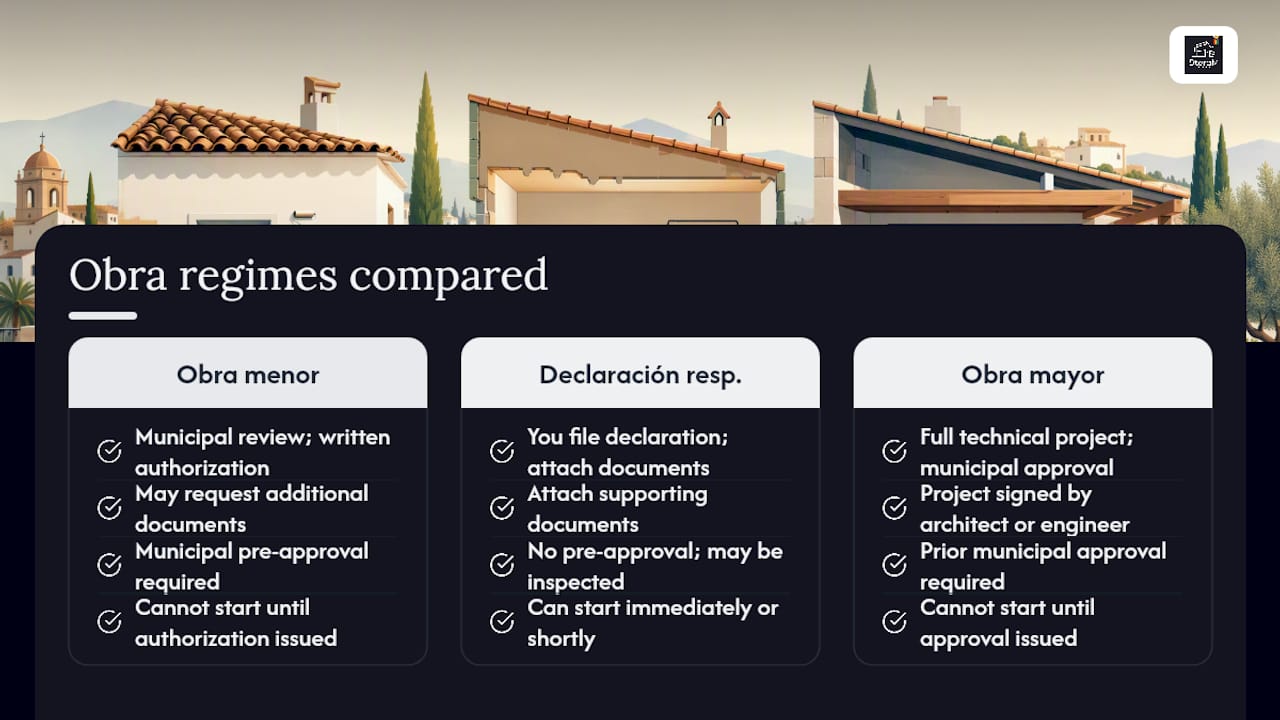
Declaración responsable (DR) / comunicación previa: You file a declaration stating that you meet all legal requirements, attach the supporting documents, and in most cases you can start work immediately or within a very short period. The municipality does not pre-approve; it may inspect afterward. This is faster, but the legal responsibility shifts entirely to you. If you misclassify a structural work as DR-eligible, inspectors can suspend the work, issue fines, and require demolition.
Obra mayor: Requires a full technical project signed by an architect or engineer, prior municipal approval, and often a building supervisor (director de obra). The process is longer, more expensive, and non-negotiable for structural changes.
The practical risk of misclassification is real. Treating a structural alteration as obra menor, or filing a DR when a formal licence is required, can trigger inspection orders, heavy fines, and forced legalization of the work at your cost. Some municipalities publish a list of works not subject to any licence and offer a “communication of non-subject acts” form so you have official proof of exemption — worth checking before you assume your project is entirely free of paperwork.
Where and how to apply: step-by-step filing process
Most town halls now offer both electronic and in-person filing. Electronic is faster and creates a clear paper trail.
Confirm the procedure. Visit your ayuntamiento’s urbanismo or Sede Electrónica page. Search for “licencia obra menor” or “declaración responsable obras.” Confirm which procedure applies to your specific work.
Download the application form. Municipal pages provide templates. Vitoria-Gasteiz’s Sede Electrónica, for example, lists required documentation and offers both telematic and in-person filing options, with a note that technical services may request additional documents depending on the specific work.
Prepare your dossier. Gather all required documents before you open the online form (see the documentation section below). Incomplete submissions are the single biggest cause of delays.
File electronically. You will need a digital certificate (certificado digital), Cl@ve PIN, or DNIe to access most Sedes Electrónicas. Attach documents as PDFs; check file size limits (typically 10 MB per file). Fill in the property cadastral reference exactly as it appears on your deed.
Pay the municipal fee (tasa). Most platforms generate a payment form (modelo de autoliquidación) immediately after submission. Pay it promptly; the clock on your resolution period usually starts from confirmed payment.
Wait for resolution or confirmation. For a formal licence, do not start work until you receive written authorization. For a DR, check whether your municipality allows immediate start or requires a brief waiting period.
Keep all documentation on site. Once authorized, keep a copy of the licence or DR, the approved plans (if any), and the payment receipt accessible during works.
Obtain a final certificate if required. Some municipalities require a certificado de fin de obra or a final inspection for certain obra menor works, particularly those involving installations.
Pro Tip: If you are filing electronically for the first time, test your digital certificate on the platform before the day you plan to submit. Certificate authentication errors are the most common reason homeowners abandon online filings mid-process.
Statistic callout: Barakaldo’s published procedure states a legal resolution period of one (1) month for certain obra menor licences. Not all municipalities match this; Melilla’s procedure references a 90-day resolution window for certain cases, illustrating how much timelines vary.
Documentation and technical requirements homeowners are usually asked to provide
The core documents requested by most municipalities for a licencia de obra menor are consistent, even if the exact list varies.
Standard documentation:
- Completed application form (download from the ayuntamiento’s Sede Electrónica or urbanismo page).
- Copy of your DNI/NIE or passport.
- Property deed or cadastral reference number.
- Detailed budget or contractor estimate describing the works.
- Photographs of the current state of the area to be renovated.
- Brief technical description of the works (sometimes called a memoria descriptiva).
- Debris removal plan if the work generates construction waste.
When a signed technical document is mandatory:
Some obra menor works cross a threshold where a licensed technician (architect, technical architect, or engineer) must sign off. This is typically required for: changes of use, significant electrical or gas installations, works affecting structural elements even partially, and any work in a protected building. The technician’s signed report or basic project (proyecto básico) then forms part of your dossier.
Municipal procedure pages often provide templates for declarations, technical certificates, and completion certificates that you or your technician must supply. Málaga’s Sede Electrónica lists these supporting documents and offers downloadable forms.

Pro Tip: Label every document clearly before uploading: “01_solicitud,” “02_DNI,” “03_presupuesto,” and so on. Municipal technical services frequently request additional documents after initial filing; a clearly organized dossier reduces back-and-forth and speeds up the review.
Typical costs and timelines for resolution
Fees for a licencia de obra menor are set by each municipality and calculated differently depending on the town. Most use one of two methods: a flat administrative fee, or a percentage of the declared budget for the works (the presupuesto de ejecución material). A few use a combination.
What you are typically paying for:
- The municipal tasa (administrative processing fee).
- The ICIO (Impuesto sobre Construcciones, Instalaciones y Obras), a construction tax levied by the municipality, usually a percentage of the works budget.
- Any fianza (deposit/bond) if you occupy public space.
Timeline benchmarks:
| Municipality | Procedure type | Stated resolution period |
|---|---|---|
| Barakaldo | Obra menor (ordinary) | 1 month |
| Melilla | Obra menor (DGA) | 90 days |
| Varies | Declaración responsable | Immediate to a few days |
Timelines above reflect what those municipalities publish for their specific procedures; your local ayuntamiento may differ.
On bonds (fianza): When scaffolding, a skip container, or any temporary structure occupies the public footpath or road, most municipalities require a separate authorization for occupation of the vía pública plus a refundable deposit. The deposit is returned after the works end and the public space is restored to its original condition. Budget for this separately; it is one of the costs homeowners most often overlook.
Special cases and risks: protected buildings, rural land, and public space
Obra menor rules have hard limits. Certain scenarios take you out of the standard procedure entirely, and missing them is expensive.
Historic and protected buildings. Any property in a Bien de Interés Cultural (BIC) zone, a historic center, or subject to a heritage catalog entry requires prior authorization from the relevant heritage body before the municipality can even process a building permit. A standard obra menor licence is not sufficient. The Código Técnico de la Edificación sets technical requirements for works on existing buildings, but heritage protection layers additional restrictions on top of those.
Rural land (suelo rústico). Works on properties classified as suelo no urbanizable or suelo rústico face stricter controls. Many municipalities will not accept a declaración responsable for these properties and require a full licence or, in some cases, a prior legalization process if the property itself was built without authorization.
Irregular properties. If your property lacks a valid título habilitante (the original building licence or equivalent), most municipalities will reject a declaración responsable outright and require a formal licence or a legalization process first. Málaga’s Sede Electrónica confirms that the legal status of the building is one of the four key factors determining which procedure applies.
Watch out if your property is in a protected zone or classified as irregular. Filing a standard obra menor application in either of these situations will likely result in suspension, a requirement to legalize the property first, and potential fines for any work already started. Get an informe urbanístico from the town hall before spending a euro on contractors.
Works affecting public space. Scaffolding, skip containers, or any temporary structure on a public footpath requires a separate ocupación de vía pública permit and a refundable bond, on top of the building permit itself.
Sanctions and consequences of not obtaining the correct authorization
Skipping the permit process is not a calculated risk. It is a documented liability.
What municipalities can do:
- Issue a stop-work order (orden de paralización) immediately upon inspection.
- Impose fines calculated as a percentage of the works budget or as fixed amounts set by local ordinance.
- Order demolition or restoration of unauthorized works at the owner’s expense.
- Initiate a disciplinary file (expediente disciplinario) that can affect the property’s legal status.
Consequences for buyers, sellers, and renters:
Unauthorized works show up during property valuations, notarial deed reviews, and mortgage applications. A buyer’s bank may refuse to finance a property with unlegalized works. Sellers may be required to legalize or demolish before completing a sale. Home insurance policies routinely exclude damage arising from works carried out without the required permits.
Regularization routes:
If works have already been carried out without authorization, the path forward depends on how much time has passed and whether the works are compatible with current planning regulations. Some municipalities allow a legalización a posteriori (retroactive legalization) if the works would have been permissible at the time. Others require partial or full demolition. The longer you wait, the fewer options you have. Seek professional advice early.
Practical checks to run before you file
Running these checks before submitting anything reduces the chance of rejection, fines, or misclassification.
Consult the local ordenanza. Download your municipality’s ordenanza de obras or ordenanza de edificación from the ayuntamiento’s transparency or urbanismo portal. This document defines which works are obra menor, which qualify for DR, and which are exempt.
Request an informe urbanístico if in doubt. A municipal urban information report clarifies whether your specific work requires a licence, a DR, or nothing. It is a cost-effective step for borderline cases and far cheaper than correcting a misclassification later. Torremolinos’s municipal ordinances illustrate how local rules can codify DR procedures specifically, defining exactly which minor works are covered under that streamlined route.
Confirm protected status. Check the municipal heritage catalog and the PGOU (Plan General de Ordenación Urbana) to see if your building or zone carries any protection. Your ayuntamiento’s urbanismo department can confirm this in writing.
Verify whether your municipality uses a DR for your type of work. Málaga’s urbanismo portal shows that many municipalities now offer a declaración responsable to streamline some minor works, but the exact scope is municipal. Do not assume a DR is available just because a neighboring town uses one.
Document every step. Save screenshots of municipal web pages (with the date visible), keep all registration receipts from electronic filings, and store any written responses from the ayuntamiento. If a dispute arises later, this paper trail is your evidence.
Pro Tip: Some municipalities publish a specific list of works “not subject” to any licence and provide an official “communication of non-subject acts” form. If your work appears on that list, request the form and keep it on file. It gives you official proof of exemption if an inspector ever questions the work.
The Ley 39/2015 de Procedimiento Administrativo Común governs how public administrations must handle applications, including response deadlines and the right to electronic filing. Knowing your procedural rights under this law matters when a municipality is slow to respond.
What homeowners consistently get wrong
The most common mistake is treating obra menor as a catch-all category for anything that is not a major structural project. It is not. Homeowners regularly misclassify works that touch structural elements, assume a declaración responsable is always available, or forget to check whether their building is in a protected zone before signing a contractor.
The second mistake is underbudgeting. The municipal tasa and ICIO are predictable, but the bond for public space occupation and any technician fees for required reports can add several hundred euros to a renovation that seemed simple on paper. Budget for those before you commit to a contractor’s quote.
The third, and most consequential, mistake is starting work before authorization arrives. A DR may allow an immediate start in some municipalities, but a formal obra menor licence does not. Starting early turns a straightforward permit into a disciplinary file.
The practical fix for all three: request an informe urbanístico from your town hall before hiring anyone. It costs little, takes a few days, and tells you exactly which procedure applies to your specific property and works. For properties in Torremolinos, Málaga, or anywhere along the Costa del Sol, where heritage zones and irregular properties are common, that report is not optional. It is the first step.
Steramflats handles the permit process so you do not have to
Navigating local ordenanzas, preparing a complete dossier, and filing through a Sede Electrónica is manageable when you know the system. When you do not, a single missing document or a misclassified work can cost you weeks and real money.

Steramflats manages the full permit and renovation coordination process for property owners in southern Spain, including Torremolinos and the wider Málaga area. The team checks your local ordinance, confirms whether your work needs a formal licence or a declaración responsable, prepares and submits the complete documentation dossier, coordinates any required technicians, and handles Sede Electrónica filings on your behalf. Bond refunds, final inspections, and post-renovation steps for owners planning to list a property for vacation rental are also covered. Visit Steramflats’s services page to request a permit consultation or document review.
Sources
These are the primary sources used in this article. Each covers a different aspect of the obra menor process and illustrates how procedures vary across Spain.
- Declaración Responsable de obras y/o cambio de uso. – Sede electrónica del Ayuntamiento de Málaga
- Obras
- Solicitud de licencia de obra menor – Sede Electrónica – vitoria-gasteiz.org
- Licencia de Obra Menor (procedimiento ordinario) – SIBAE – Barakaldo
- Ordenanzas Municipales del Ayuntamiento de Torremolinos – Portal de Transparencia
This article is general information, not a substitute for advice from a qualified lawyer. Consult a qualified legal professional about your own circumstances before acting on anything here.


