A provisión de fondos (notary provision of funds) is an advance deposit you transfer to a gestoría or notary before signing a property deed, covering notary fees, property registry costs, applicable taxes, and gestoría charges in one consolidated payment. Before you wire a single euro, do two things: ask for an itemized estimate in writing, and confirm you will receive original invoices plus a final reconciliation statement once registration is complete. Refunds of any surplus are common and typically arrive within 3–6 months of the deed date, according to practitioner guidance.
- Ask for the itemized estimate before transferring funds. Gestorías calculate conservatively, so the figure is usually higher than the final bill.
- Confirm which costs the bank covers (often mortgage formalization fees post-2019 law reform) versus which you cover (purchase taxes, registry, gestoría).
- Request original invoices for every third-party disbursement (suplido) after registration.
- Keep your transfer proof. You will need it if the reconciliation is delayed or disputed.
Pro Tip: Ask the gestoría to break the estimate into four lines: notary fee, registry fee, tax (ITP or AJD/IVA), and gestoría fee. Any estimate that arrives as a single lump sum is a red flag.
The Banco de España’s consumer blog and Steramflats both recommend confirming these details with your lender before signing anything.
Key Takeaways
A provisión de fondos is an advance deposit, not an extra fee, and any unspent balance must be returned to you once registration is complete and final invoices are settled.
| Point | Details |
|---|---|
| Always get an itemized estimate | Request a written breakdown by line item before transferring any funds to the gestoría or notary. |
| Expect a 3–6 month reconciliation | Final invoices and surplus refunds typically arrive within 3–6 months of the deed signing date. |
| Record it as account 417 | Book the provision as an advance in account 417 Anticipos a Acreedores; keep suplidos separate from the VAT base. |
| Confirm the bank’s cost split | Post-2019, banks pay AJD on mortgage deeds; verify in writing that your lender is not including it in your provision. |
| Steramflats for transaction support | Steramflats coordinates gestoría, notary, and invoice reconciliation for buyers in southern Spain. |
Pro Tip: Keep your bank transfer proof and the gestoría’s provisional estimate together in one folder. If the final reconciliation is delayed or disputed, those two documents are your starting point for any escalation.
Table of Contents
- What exactly is a provisión de fondos, and how does it differ from similar payments?
- What expenses does a notary provision of funds typically cover?
- Who requests and manages the provision, and who actually pays?
- How much should you expect to set aside? Typical ranges and examples
- How the provision is liquidated: timeline, documents, and getting your refund
- How payment is made and what a notary provision account actually is
- How to record a provision of funds in your accounts
- Steramflats’ practical tips and common mistakes observed in transactions
- A note from the Steramflats team
- Steramflats can handle your provision of funds from start to finish
- Sources
What exactly is a provisión de fondos, and how does it differ from similar payments?
A provisión de fondos is a pre-payment you make so that a gestoría or notary can settle third-party costs on your behalf without waiting for you to wire money at each step. It is not a fee for the professional’s own services; it is a float that gets spent down as invoices arrive, with any remainder returned to you.
Three terms get confused constantly:
- Provisión de fondos: An advance to cover both professional fees and third-party costs (taxes, registry, notary aranceles). The gestoría or notary holds it until each invoice is paid, then reconciles.
- Anticipo / pago a cuenta: A partial payment toward the professional’s own fee as work progresses. It reduces the final invoice but does not cover third-party disbursements.
- Suplidos: Amounts the professional pays to third parties (tax authority, registry, notary) on your behalf and then passes through to you at cost. Suplidos are excluded from the VAT base of the professional’s invoice, provided they meet the conditions set by the Agencia Tributaria’s AJD and ITP rules.
The fiscal distinction matters. According to tax guidance on provisión de fondos, the tax authorities treat a provisión de fondos as a payment for future services and expenses, not as a taxable supply in itself. Suplidos, by contrast, are pass-through costs that must be documented with the original third-party invoice attached to the gestoría’s final bill.
What expenses does a notary provision of funds typically cover?
The provision covers every cost that must be settled before or at the moment of signing the deed. For a standard property purchase in Spain, that list includes:
- Notary aranceles: Regulated fees set by the notary’s official fee schedule, based on the declared value of the transaction.
- Registro de la Propiedad: Registry fees for inscribing the deed and, where applicable, the mortgage deed.
- Transfer tax (ITP): Applies to second-hand purchases; the rate varies by autonomous community (typically 6%–10% of the declared price).
- Stamp duty (AJD): Applies to new-build purchases and to mortgage deeds; rates also vary by region.
- VAT (IVA): 10% on new residential properties (21% on commercial). Paid instead of ITP on new builds.
- Gestoría fees: The administrative fee for processing the deed, paying taxes, and registering the property.
- Bank commissions: Some lenders charge a mortgage opening commission or valuation fee that may be bundled into the provision.
- Cadastral or municipal certificates: Occasionally required for certain property types or locations.
The Agencia Tributaria is the authoritative source for ITP, AJD, and IVA rates and filing obligations. For property taxes in Spain, regional rates vary enough that you should confirm the exact percentage with your gestoría before estimating the total.
Since the 2019 mortgage law reform, banks are legally required to pay the AJD on mortgage deeds. Confirm in writing that your lender is absorbing that cost before you include it in your own provision estimate.
Statistic callout: Gestorías routinely set the provision 10%–20% above their best estimate of final costs to avoid a shortfall. Refunds of the surplus are standard practice, not an exception.
Who requests and manages the provision, and who actually pays?
The buyer pays. That is the short answer for both purchase and mortgage transactions.
Who manages the funds depends on how the transaction is structured:
- The bank or its partnered gestoría requests the provision when a mortgage is involved. The gestoría receives the funds, pays each invoice as it falls due, and issues the final reconciliation.
- The notary may hold the funds directly, particularly when the buyer and seller agree to use a notary provision account for the purchase price or deposit. The notary documents receipt through formal diligences or an acta de depósito.
- An independent gestoría chosen by the buyer can also manage the provision, though lenders often require their own gestoría for mortgage-related costs.
The Banco de España advises buyers to confirm with their lender exactly which costs the bank covers and which fall to the buyer, since the split changed materially after the 2019 mortgage law.
One term worth knowing: salvo buen fin means the funds are received subject to the transfer clearing successfully. A gestoría or notary will not disburse against a transfer until it has confirmed cleared funds, which typically takes one business day for domestic transfers.
How much should you expect to set aside? Typical ranges and examples
The total provision varies by transaction type, property value, and autonomous community. As a practitioner rule-of-thumb, Banco Sabadell’s guidance notes that the provision for mortgage-related costs alone can range from roughly 0.1% to 2% of the loan amount, though the full purchase provision is typically larger once taxes are included.
Below are two illustrative breakdowns. These figures are estimates based on typical ranges; your gestoría will provide exact figures for your community and transaction.
Example A: Second-hand apartment purchase with mortgage (€200,000 purchase price, Andalusia)
Example B: New-build apartment with mortgage (€200,000 purchase price, Andalusia)
Note that in Example B, the AJD on the mortgage deed is the bank’s responsibility under the 2019 law and is excluded from the buyer’s provision. Regional rates differ: Madrid applies 0.75% AJD, while Catalonia applies 1.5%. Always verify with your gestoría.
How the provision is liquidated: timeline, documents, and getting your refund
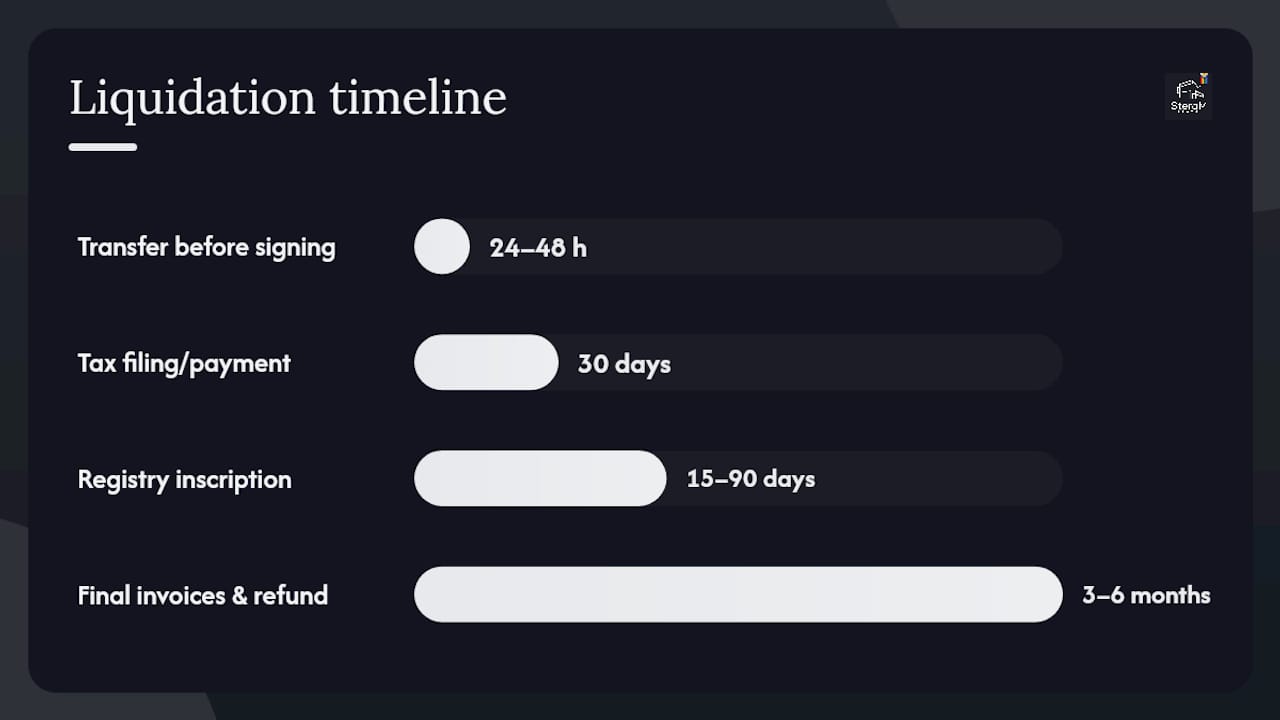
Buyers typically receive final invoices and any surplus refund after property registration is complete, commonly within 3–6 months of the signing date.
Step-by-step timeline:
- Transfer the provision to the gestoría or notary account, usually 24–48 hours before signing.
- Sign the deed at the notary. The gestoría or notary confirms cleared funds before proceeding.
- Gestoría pays the tax authority. ITP or AJD/IVA is filed and paid, usually within 30 days of signing.
- Deed is submitted to the Registro de la Propiedad. Registry inscription can take 15–90 days depending on the registry’s workload.
- Final invoices arrive. Once the registry returns the inscribed deed, the gestoría issues a final liquidation statement showing every payment made and the remaining balance.
- Surplus is refunded. Any unspent funds are returned by bank transfer, typically within a few weeks of the final statement.
For more on property registration timelines in Spain, the process can stretch longer in high-demand registries.
Documents to request at each stage:
- Itemized provisional estimate before transferring funds
- Proof of tax payment (modelo 600 for ITP, or the AJD equivalent)
- Registry fee receipt
- Original notary invoice (minuta notarial)
- Gestoría’s final liquidation statement with all suplido invoices attached
- Bank transfer confirmation for the refund
If the reconciliation is delayed beyond six months, contact the gestoría in writing requesting the final statement. If there is no response, the Banco de España’s consumer complaint channel and the notary’s professional association are the next escalation points.
How payment is made and what a notary provision account actually is
Three mechanisms are used in practice, each with different security and documentation profiles.
Transfer to the gestoría’s account is the most common route for mortgage transactions. The gestoría receives the funds, manages disbursements, and returns the surplus. It is fast and familiar, but the buyer’s protection depends entirely on the gestoría’s professional standards.
Transfer to the notary’s provision account is used when the notary holds both the purchase price and the cost provision. The notary documents receipt through formal diligences or an acta de depósito, creating a legally robust record. As notarial practice guidance explains, this mechanism gives both buyer and seller legal certainty that funds are available and verified at the moment of formalization. The notary later transfers the purchase price to the seller and pays costs from the provision, all documented in the notarial act.
Bank escrow or hold is less common in Spanish residential transactions but occasionally used in high-value or cross-border deals.
| Mechanism | Security | Documentation | Speed | Typical fees |
|---|---|---|---|---|
| Gestoría-managed account | Moderate (professional liability) | Liquidation statement + invoices | Fast | Included in gestoría fee |
| Notary provision account | High (notarial act) | Acta de depósito + diligences | Moderate | May carry a small notarial charge |
| Bank escrow/hold | High (bank guarantee) | Bank escrow agreement | Slower | Bank commission applies |
Whichever mechanism you use, confirm the salvo buen fin status of your transfer before the signing appointment. A transfer sent the morning of the signing may not have cleared in time.
How to record a provision of funds in your accounts
For a private buyer, the accounting is straightforward. For a gestoría or notary, the entries are more detailed because they must separate their own fees from suplidos.
For the buyer (private individual or company paying the provision):
Transfer the provision:
- Debit: 417 Anticipos a Acreedores (advance to creditors) — the full provision amount
- Credit: 572 Bancos (bank account)
Receive the final invoice and reconciliation:
- Debit: 623 Servicios externos (external services) — gestoría and notary fees
- Debit: 631 / 630 (tax expense accounts) — ITP or AJD amounts
- Debit: 472 H.P. IVA soportado — VAT on the gestoría/notary professional fee only (suplidos carry no VAT)
- Credit: 417 Anticipos a Acreedores — to close the advance
Receive the surplus refund:
- Debit: 572 Bancos
- Credit: 417 Anticipos a Acreedores — for the returned balance
Accounting practice forums confirm that recording the provision in account 417 and keeping suplidos separate from the VAT base is the standard treatment.
For the gestoría (receiving and disbursing the provision):
- Receipt of funds: Credit a client liability account (e.g., 410 Acreedores por prestaciones de servicios) and debit 572 Bancos.
- Payment of each suplido: Debit the liability account, credit 572 Bancos, and attach the original third-party invoice.
- Issue the final invoice: The gestoría’s own fee carries VAT; suplidos are listed separately at cost with original invoices attached, per fiscal guidance on suplidos.
The final invoice (minuta) must show the professional fee plus VAT on one line, and each suplido on a separate line with the original third-party document attached. Any unspent balance is returned and documented as a credit note or a simple refund entry.
Steramflats’ practical tips and common mistakes observed in transactions
The single most important thing you can do before transferring a provision of funds: get the estimate in writing, broken down by line item. A verbal estimate from a bank clerk is not enough.
Pro Tip: Always request the gestoría’s provisional breakdown at least 48 hours before signing. This gives you time to question any line item that looks wrong and to arrange the exact transfer amount.
From Steramflats’ transaction experience, these are the mistakes that cause the most friction:
- Transferring a round number without checking the estimate. Buyers sometimes wire a round figure “to be safe,” which creates a larger surplus and a longer wait for the refund.
- Not asking for the modelo 600 receipt. This is your proof that ITP was paid. Without it, you cannot complete the registry inscription or prove tax compliance later.
- Assuming the bank covers all mortgage costs. Post-2019, banks pay AJD on the mortgage deed, but not all lenders communicate this clearly. Some still include it in the provision request by mistake.
- Losing the transfer proof. If the gestoría disputes the amount received, your bank transfer confirmation is the only evidence you have.
- Accepting a single-line final invoice. The final statement must itemize every suplido with its original invoice attached. A one-line total is not a valid reconciliation.
Buyer checklist for the day you transfer the provision:
- Confirm the exact amount and the correct IBAN with the gestoría in writing
- Save the bank transfer confirmation immediately
- Ask when you will receive the modelo 600 receipt and the inscribed deed
- Confirm the expected refund timeline in writing
- Ask whether the notary will issue an acta de depósito if they are holding any funds
A case Steramflats has seen more than once: a buyer transferred the provision to the bank’s gestoría without requesting an itemized breakdown. The final reconciliation arrived four months later with a €400 line item labeled “gestión bancaria” that had not appeared in any prior communication. The buyer challenged it, the gestoría removed it, and the refund was issued. The lesson is simple: every line needs a name and a justification before you sign off on the final statement.
A note from the Steramflats team
Careful handling of a provision of funds protects your money and keeps the transaction on schedule. Steramflats manages the full documentation chain for buyers in southern Spain, from coordinating with gestorías and notaries to reviewing final reconciliation statements, so nothing slips through without scrutiny. If you want support with your transaction, our services page explains exactly how we work.
Steramflats can handle your provision of funds from start to finish
Buying property in Spain means coordinating a notary, a gestoría, a tax filing, and a property registry, all within tight deadlines. Steramflats takes that coordination off your plate entirely: we review your provisional estimate before you transfer a euro, track every disbursement against the original invoices, and chase the final reconciliation so your refund arrives on time.

Our transaction management and advisory services cover the full purchase process in southern Spain, including gestoría coordination, document review, and post-signing invoice reconciliation. We work with both Spanish residents and international buyers, and we are familiar with the specific notarial and tax practices across Andalusia and the Costa del Sol.
Ready to move forward? Contact Steramflats for a property transaction checklist tailored to your purchase, or ask us to review your provisional provision estimate before you commit to a transfer.
Sources
These are the primary and practitioner sources referenced throughout this article, organized by the question they answer best.
- Agencia Tributaria: Actos jurídicos documentados (AJD) and related tax pages
- Clientebancario
- Provisión de fondos del notario: Tu guía completa | Dr. Finanzas
- Pago del precio mediante transferencia a cuenta de provisión de fondos del Notario autorizante – Justito El Notario
- Provisión de fondos ¿Qué es la provisión de fondos y para qué sirve? | Asesorías
- ¿Qué es la provisión de fondos de una hipoteca? | Banco Sabadell (blog)
This article is general information, not a substitute for advice from a qualified financial advisor. Consult a qualified financial professional about your own circumstances before acting on anything here.