In Spain, the seller normally pays the agency commission for property sales, while the property owner covers intermediary costs for habitual rentals under Ley 12/2023. For sales, the standard range runs 3%–7% plus 21% IVA, according to HelpMyCash. Commissions can be structured as a percentage, a flat fee, or a subscription, and service levels vary sharply across those models.
The single most important step you can take: Before signing anything, demand a written, all-inclusive commission amount, a clear statement of whether IVA is included or added on top, and the exact contract event that triggers payment. An agency that won’t put this in writing is a red flag worth taking seriously.
Your immediate checklist:
- Get the total fee in euros, not just a percentage, with IVA explicitly shown
- Confirm payment triggers: arras deposit, deed signing, or a split between both
- Ask for an itemized list of services included in the fee
- OCU recommends negotiating a final all-inclusive written commission to avoid hidden fees
Key Takeaways
In Spain, the seller pays the agency commission for sales (3%–7% + 21% IVA), while the property owner must cover intermediary costs for habitual rentals under Ley 12/2023.
| Point | Details |
|---|---|
| Standard sales commission range | 3%–7% plus 21% IVA; exact rate depends on region, price band, and exclusivity. |
| Rental fee rule post-2023 | Ley 12/2023 requires the property owner to pay intermediary costs for habitual rentals. |
| Get everything in writing | Demand a written, all-inclusive fee in euros with IVA stated and the payment trigger named. |
| Visit report risk for buyers | Signing a visit report with a fee clause can create a binding obligation to pay the agency. |
| Steramflats’ approach | Steramflats provides itemized quotes, IVA-clear contracts, and full-service support from valuation to deed. |
Table of Contents
- What does “comisión inmobiliaria” actually mean, and who sets it?
- What are the typical commission rates and billing models in Spain?
- What services does the commission normally cover?
- Who pays, and what are the legal and tax implications?
- What contract traps should you watch out for?
- How do you negotiate a lower or all-inclusive commission?
- Worked examples: how commissions calculate in practice
- Why Steramflats’ approach to fees is worth knowing
- The real cost of a cheap commission
- Steramflats offers transparent, itemized fees for sellers and landlords
- Sources
What does “comisión inmobiliaria” actually mean, and who sets it?
The comisión inmobiliaria, also called honorarios de intermediación, is the fee an agency charges for finding a buyer or tenant and managing the transaction. In Spain, there is no legally regulated minimum or maximum for sales commissions. Agencies set their own rates freely, which is why offers range so widely.
The fee is defined in the hoja de encargo, the engagement contract between the property owner and the agency. That document is what legally entitles the agency to collect. A few terms worth knowing:
- Comisión / honorarios: used interchangeably; both mean the intermediation fee
- IVA (21%): value-added tax applied on top of the base commission; always ask whether a quoted percentage includes IVA or not
- Hoja de encargo: the written mandate that sets the fee, services, exclusivity terms, and payment trigger
- Exclusividad: an exclusive mandate, meaning only that agency can market the property during the agreed period
What are the typical commission rates and billing models in Spain?
HelpMyCash and Gibobs both confirm the market norm for sales sits at 3%–7% plus 21% IVA. The actual percentage depends on the region, the property’s price band, and whether the mandate is exclusive. Luxury or low-priced properties often land at the higher end because the absolute fee needs to justify the agency’s costs.
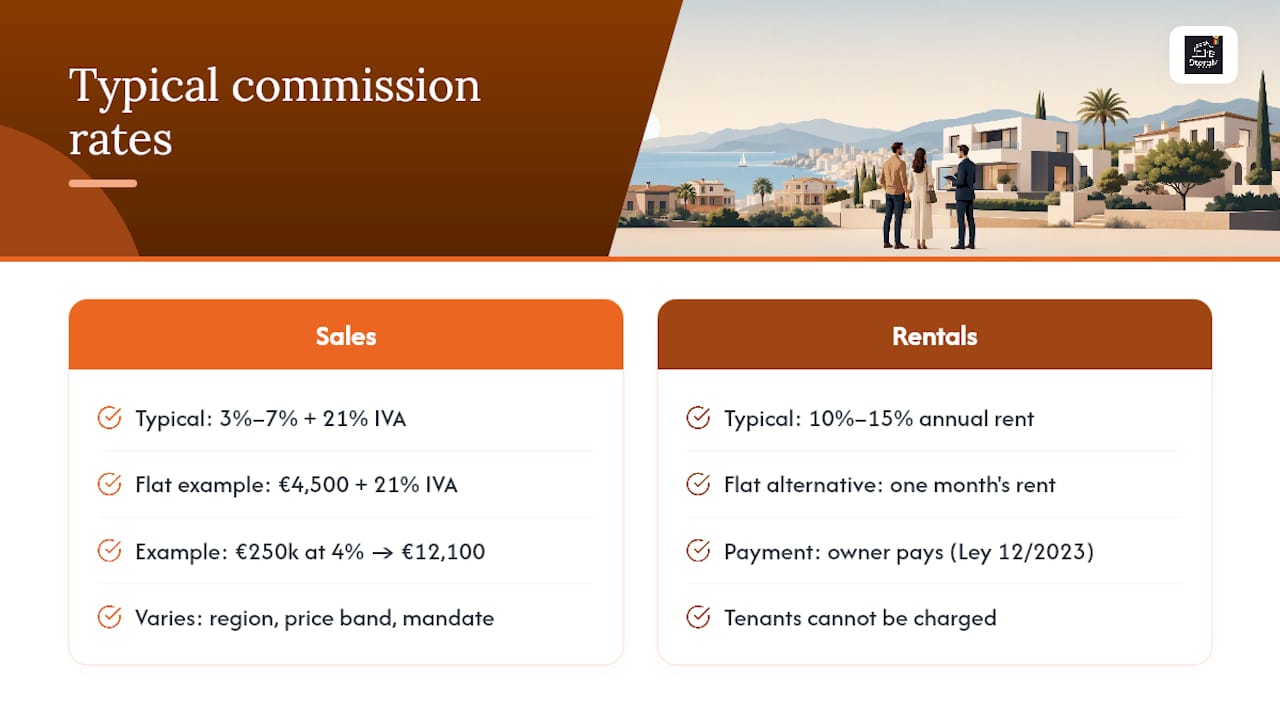
For rentals, Business Insider reports intermediary fees commonly run 10%–15% of annual rent, though many agencies simply charge one month’s rent as a flat finder’s fee. Since Ley 12/2023, the property owner must bear intermediary costs for habitual rentals. Tenants cannot legally be charged those fees.
A quick comparison: on a €250,000 sale at 4%, the base commission is €10,000, plus €2,100 IVA, totaling €12,100. A flat fee of €4,500 plus IVA costs €5,445. The gap is real, but so is the difference in what you get.
What services does the commission normally cover?
A full-service commission typically includes:
- Property valuation and comparative market analysis
- Professional photography, floor plans, and listing creation
- Marketing across portals and social channels (see why property marketing matters)
- Filtering and qualifying prospective buyers or tenants
- Conducting viewings and managing feedback
- Price negotiation on the seller’s behalf
- Drafting and reviewing the arras (deposit) contract
- Coordinating with the notary through to deed signing
Low-cost and proptech packages frequently exclude in-person viewings, legal document handling, energy certificates, habitability certificates, and ITE (building inspection) management. Hogar Mapfre notes that very low fees usually mean reduced services, shifting that work back to the owner.
Pro Tip: Ask the agency to list every deliverable in the hoja de encargo, not just a service category. “Marketing” means nothing without knowing which portals, how many photos, and whether they handle viewings. Get specifics in writing.
Who pays, and what are the legal and tax implications?
For sales, the seller pays by default. A buyer only pays if they have expressly agreed to it in a signed document. For habitual rentals, Ley 12/2023 is unambiguous: the property owner assumes intermediary costs. Charging tenants those fees is not permitted.
IVA at 21% applies to the commission and is technically the agency’s tax obligation, but it flows through to whoever pays the fee. Always confirm whether a quoted percentage is con IVA or sin IVA, because the difference on a €10,000 commission is €2,100.
Tax warning: Inflating the declared sale price to absorb the commission increases the taxable base for plusvalía municipal (the local capital gains tax on land value) and can raise the seller’s income tax liability on the gain. Hacienda calculates gains on the declared price, not the net proceeds after fees. Keep the declared price accurate and deduct the commission as a selling cost in your tax return instead.
Payment triggers vary by contract. Tuio’s blog explains the most common structures:
- Full payment at deed signing: cleanest and most seller-friendly
- 50/50 split: half at arras, half at deed
- Full payment at arras: risky if the sale later falls through; insist on a refund clause
What contract traps should you watch out for?
Red flags in the hoja de encargo and related documents:
- Open-ended exclusivity: no fixed end date or no resolution clause if the property doesn’t sell
- Hidden buyer fees: commission embedded in the sale price so the buyer unknowingly funds it
- IVA ambiguity: percentage quoted without stating whether IVA is included
- Early non-refundable charges: fees due before the sale completes, with no refund if it falls through
- Commission at arras with no fallback: if the buyer withdraws and forfeits the arras, confirm whether the agency still collects
The parte de visitas (visit report) deserves special attention. El País explains that a buyer who signs a visit report containing a fee clause may be contractually obliged to pay the agency if the sale completes. Never sign a visit report without reading it. If it contains a fee paragraph, ask the agent to cross it out and initial the change before you sign.
Contract review checklist before signing:
- Total fee in euros with IVA explicitly stated
- Exact payment trigger event named
- Exclusivity period with a fixed end date and exit clause
- Refund terms if the sale does not complete
- Full list of services included
How do you negotiate a lower or all-inclusive commission?
Follow these steps in order:
- Research local rates using Inmolovers’ commission guide and Gibobs before any meeting. Know the going rate for your price band and region.
- Request an itemized written fee before discussing percentages. This forces the agency to justify each line.
- Offer exclusivity in exchange for a lower rate. A three-month exclusive mandate with a performance milestone (e.g., minimum number of qualified viewings) is a fair trade. Agencies invest more in exclusive listings.
- Propose a short trial period with a clear exit clause if targets aren’t met.
- Ask for a marketing plan and references from recent local sales. An agency that can’t produce these is not worth a premium rate.
Seller script (exclusivity for a lower rate): “I’m willing to give you an exclusive three-month mandate if you can bring the commission to 4% sin IVA, with payment at deed signing only. Can you put that in the hoja de encargo today?”
Buyer script (visit report clause): “I see this visit report includes a fee clause. I’m happy to sign it, but I need that paragraph crossed out and initialed. If you’re not willing to do that, I’ll need to review it with a lawyer before signing.”
Pro Tip: Always ask for the percentage stated both with and without IVA in writing. Then ask for the payment trigger to be named as a specific contract event, not a vague milestone. Both requests are reasonable; any resistance tells you something.
For legal support on contracts and understanding your rights as a buyer or seller, getting professional advice before signing is worth the cost.
Worked examples: how commissions calculate in practice
For the €250,000 sale with a 50/50 payment split: €6,050 is due at arras signing, and €6,050 at deed. If the buyer withdraws and forfeits the arras, confirm in the contract whether the agency’s first installment is refundable to you.
On the price-inflation risk: if a seller adds the €12,100 commission to the declared sale price, the plusvalía calculation and income tax gain both increase on that inflated figure. The correct approach is to declare the real agreed price and deduct the commission as a selling expense in your tax filing with Hacienda.
Why Steramflats’ approach to fees is worth knowing
Steramflats operates in southern Spain with a focus on transparent, itemized fee structures. The services Steramflats provides that align with the recommendations in this guide include:
- Written, all-inclusive commission amounts with IVA stated separately
- Itemized service lists in the engagement contract
- Property valuation, professional marketing, legal documentation support, and notary coordination
- Advisory services for property investment and financing
- Management of rental agreements, energy certificates, and habitability documentation
- Specialist support for international and LGBTQ+ clients navigating Spanish property law
Steramflats’ real estate advisory services cover the full transaction from valuation to deed, which is the scope this guide recommends verifying in any agency’s hoja de encargo.
The real cost of a cheap commission
The agencies charging 1%–2% are not doing the same job for less. They are doing less of the job. Valuation, legal checks, active negotiation, and notary coordination all take time and expertise. When those are stripped out of a low-fee package, the owner absorbs the risk. A missed legal issue or a poorly negotiated price can cost far more than the commission saving. The right question is not “who charges the least?” but “what does this fee actually include, and who bears the risk if something goes wrong?” Steramflats’ practice of itemizing every service in writing is the standard every agency should meet, and the baseline every seller and landlord should demand.

Steramflats offers transparent, itemized fees for sellers and landlords
Sellers and landlords in southern Spain who want a clear, written commission with no surprises can list their property for free with Steramflats. Every engagement starts with an itemized quote, IVA stated separately, and payment triggers named in the contract before any work begins. That is the practical difference between an agency that explains its fees and one that buries them.

Steramflats handles valuation, professional marketing, legal documentation, and notary coordination, covering the full scope this guide recommends verifying. For sellers who want to see exactly what a marketing plan looks like before committing, the property marketing checklist is a practical starting point. Contact Steramflats to request an itemized quote for your property.
Sources
- OCU report on real estate agencies (agencias inmobiliarias)
- Hogar Mapfre — Comisiones de agencia inmobiliaria
- Honorarios y comisiones inmobiliarias en la venta〖2026〗
- Business Insider — Do agencies charge to rent out a flat?
- El País — Q&A: If I decide to buy a property advertised by an agency, am I obliged to pay commission?
- Comisiones de Agentes Inmobiliarios en España: Guía Completa 2026
- Tuio blog — Honorarios de una inmobiliaria: quién paga y cuánto
- Gibobs — Comisión inmobiliaria por venta: cuánto cobran y quién paga
When in doubt about your specific situation, verify current rules directly with Hacienda and consult a qualified Spanish property lawyer. This article is general information, not legal or tax advice.
This article is general information, not a substitute for advice from a qualified financial advisor. Consult a qualified financial professional about your own circumstances before acting on anything here.