Selling property in Spain is defined as a legally governed transaction requiring compliance with Spanish Tax Agency rules, regional housing authority certificates, and notarial procedures. Knowing how to sell property in Spain before you list saves you money, time, and legal risk. The process applies equally to residents and non-residents, though the tax obligations differ significantly between the two groups. With the right preparation, you can close a sale in as little as one month and walk away with the maximum net proceeds.
What are the key legal and tax requirements to sell property in Spain?
Every property sale in Spain requires a specific set of documents before the notary will sign off. You need the original title deed, a current cadastral certificate confirming the property’s registered dimensions, a valid Energy Performance Certificate, and an occupancy license where required by your autonomous community. Missing any one of these documents delays the sale.
Tax obligations are the area where sellers most often get caught off guard. Spanish law mandates the buyer to withhold 3% of the purchase price and pay it directly to the Spanish Tax Agency as an advance on the seller’s capital gains tax. That 3% is not an extra charge. It is a prepayment, and you reconcile the final amount by filing Form 210 after the sale closes. Residents file under the general income tax return instead.
Capital Gains Tax applies to the profit between your original purchase price and the sale price. Deductible expenses include notary fees, agent commissions, and documented improvement costs, all of which reduce your taxable gain. You also owe the Plusvalía tax, a municipal levy on the increase in land value, paid to the local town hall.
The notary’s role is widely misunderstood. The notary acts as a neutral public official and does not provide legal advice to sellers. Relying on the notary to protect your interests is a common and costly error. Hiring an independent property lawyer, especially if you are a non-resident, is the single most effective step you can take to avoid legal or financial exposure.
Pro Tip: Engage your lawyer before you accept any offer. Contract review at the reservation stage costs far less than fixing a problem after the deposit contract is signed.
- Title deed (escritura pública)
- Cadastral certificate
- Energy Performance Certificate
- Occupancy license or habitability certificate (region-dependent)
- Certificate of no outstanding community fees
- Latest property tax receipts (IBI)
- Mortgage cancellation certificate if applicable
How to prepare and price your property for sale in Spain
Pricing is the single biggest lever you control as a seller. Set the price too high and the property sits on the market, which signals problems to buyers. Set it right and you attract competitive offers quickly.
The best way to research pricing is to study active and recently sold listings on portals like Idealista and Fotocasa. These platforms show you what comparable properties in your area are actually selling for, not just what sellers are asking. The average negotiation discount in 2026 sits at approximately 6.2% from the asking price. That means buyers expect to negotiate, so pricing with a small buffer is reasonable, but overpricing by 20% will cost you months.
The typical sale timeline in Spain runs between 1 and 6 months. Realistic pricing drives the faster end of that range. Properties priced at or near market value attract more viewings and stronger offers within the first few weeks.
- Research comparable sales on Idealista and Fotocasa for properties with similar size, location, and condition.
- Get a professional valuation from a licensed appraiser or a real estate agency with local market knowledge.
- Address visible defects before listing. Fresh paint, repaired fixtures, and clean common areas increase perceived value.
- Obtain all required certificates before you list. Delays caused by missing documents frustrate buyers and kill deals.
- Photograph the property professionally. Listings with high-quality photos generate significantly more inquiries on major portals.
- List on multiple platforms to maximize buyer exposure. Listing on multiple portals is standard practice; Idealista offers the first two private listings free for properties under €1,000,000, and Fotocasa allows several free private listings.
Pro Tip: If you are unsure whether to use an agent, consider this: agents handle viewings, filter unqualified buyers, and negotiate on your behalf. For sellers based abroad, that coordination alone often justifies the commission.
The decision between hiring an estate agent and selling privately comes down to your availability and familiarity with Spanish administrative processes. Agents typically charge 3%–5% commission but bring buyer networks and transaction management. Private listings cost less upfront but demand significant time and local knowledge.
What are the step-by-step processes involved in selling your property in Spain?
The sale of a Spanish property follows a clear sequence. Understanding each stage prevents surprises and keeps the transaction moving forward.
Stage 1: Listing and receiving offers
You list the property, conduct viewings, and receive written offers. Once you agree on a price, the buyer typically pays a small reservation fee to take the property off the market while due diligence proceeds.
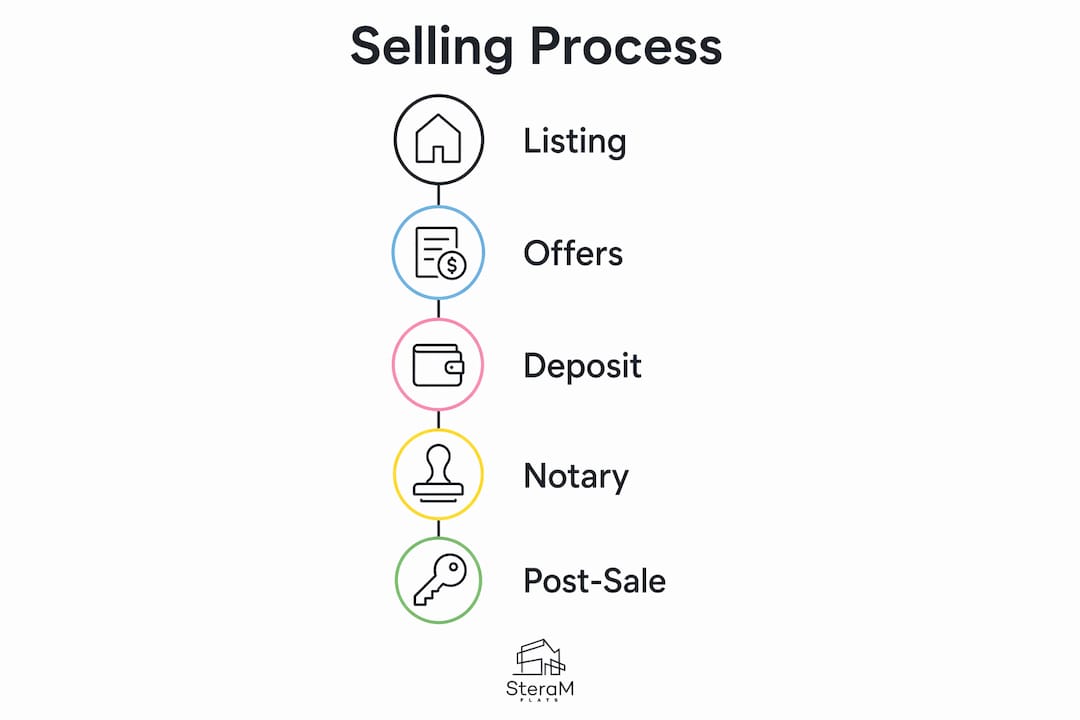
Stage 2: Deposit contract (contrato de arras)
The deposit contract formalizes the agreed price and terms. The buyer pays 10% of the purchase price as a deposit. If the buyer withdraws, you keep the deposit. If you withdraw, you must return double the deposit. This contract is legally binding and should be reviewed by your lawyer before signing.
Stage 3: Notary signing and completion
Both parties sign the public deed of sale (escritura pública) before a notary. At this point, the buyer pays the remaining balance, and the buyer’s representative pays the 3% withholding directly to the Spanish Tax Agency on your behalf.
Stage 4: Post-sale obligations
| Step | Action Required | Responsible Party |
|---|---|---|
| Capital gains filing | File Form 210 or income tax return | Seller |
| Plusvalía tax payment | Pay municipal land value tax | Seller |
| Land Registry update | Register new ownership | Buyer (typically) |
| Mortgage cancellation | Confirm lien cleared before completion | Seller |
| Certificate of no debts | Provide to buyer at signing | Seller |
Mortgage cancellation is a step sellers frequently overlook. An outstanding mortgage lien blocks the transfer of clean title. Your bank must issue a cancellation certificate, and the lien must be formally removed from the Land Registry before or at the time of signing. Coordinate this weeks in advance, not days.
Cadastral discrepancies are another common problem. If the registered size of your property differs from the actual size, the buyer’s bank may refuse to lend, or the notary may flag the inconsistency. Resolve any cadastral errors before you accept an offer.
What challenges and mistakes should sellers avoid in Spain?
The most expensive mistakes in Spanish property sales are predictable. Most stem from misunderstanding the legal framework or underestimating administrative requirements.
Relying on the notary for legal protection is the single most common mistake sellers make in Spain. The notary authenticates the transaction. The notary does not advise you. Without your own lawyer, you are unrepresented in a legally complex process.
- Ignoring regional certificate requirements. The cedula de habitabilidad (habitability certificate) is mandatory in Catalonia, Valencia, and several other regions. Regional certificates like the cedula can become a bottleneck if they have expired. Renewal takes weeks and stalls the sale.
- Underestimating tax liabilities. Sellers who do not account for capital gains tax and Plusvalía are often shocked by the net proceeds. Run the numbers before you set your asking price.
- Failing to file Form 210. Non-resident sellers must file this form to reconcile the 3% withholding. Missing the deadline triggers penalties from the Spanish Tax Agency.
- Skipping independent legal advice. This is especially critical for non-residents who cannot attend viewings or signing in person.
- Pricing based on emotion. What you paid for the property, or what you need to clear a mortgage, is irrelevant to the market. Buyers compare your listing to every other option available to them.
How to sell your property in Spain from abroad as a non-resident?
Non-resident sellers face all the same requirements as residents, plus additional layers of tax compliance and logistical complexity. The good news is that the entire process can be completed remotely with the right setup.
A Power of Attorney (POA) is the foundation of a remote sale. You grant a lawyer or trusted representative in Spain the legal authority to sign contracts, attend the notary, and handle tax filings on your behalf. The POA must be executed before a notary, apostilled, and translated into Spanish if signed outside Spain. This process takes time, so start it early.
- Appoint a Spanish lawyer with experience in non-resident property transactions before you list the property.
- Grant a notarized Power of Attorney in your country of residence, then have it apostilled and officially translated.
- Obtain your NIE number (Spanish tax identification number for foreigners) if you do not already have one. You cannot complete a sale without it.
- Confirm the 3% withholding process with your lawyer. The buyer pays this directly to the Spanish Tax Agency, but you must file Form 210 to claim any refund if the withholding exceeds your actual tax liability.
- Open or maintain a Spanish bank account to receive sale proceeds and pay local taxes and fees.
For non-resident sellers, the administrative burden of managing viewings, legal review, and tax compliance often outweighs the cost of hiring an agent. A local agent combined with a property lawyer covers the two biggest gaps: market access and legal protection. That combination costs money, but it prevents the far more expensive mistakes that come from going it alone.
Pro Tip: Ask your lawyer to provide a net proceeds estimate before you sign anything. Factor in capital gains tax, Plusvalía, agent commission, and legal fees. The number on the offer letter is rarely the number you receive.
Key Takeaways
Selling property in Spain requires legal compliance, realistic pricing, and professional support to protect your net proceeds and avoid costly delays.
| Point | Details |
|---|---|
| Legal documents first | Gather the title deed, cadastral certificate, Energy Performance Certificate, and occupancy license before listing. |
| Price with market data | Use Idealista and Fotocasa to set a competitive price; expect a negotiation discount of around 6.2%. |
| Hire your own lawyer | The notary is neutral and does not advise sellers; independent legal counsel is non-negotiable. |
| Understand the 3% withholding | Buyers pay 3% of the purchase price to the Spanish Tax Agency; sellers reconcile via Form 210. |
| Non-residents need a Power of Attorney | A notarized, apostilled POA lets a lawyer complete the entire sale on your behalf from abroad. |
What I’ve learned about selling property in Spain after years in this market
The conventional wisdom says Spain’s property market is straightforward if you follow the steps. My experience says the steps are clear, but the execution is where sellers lose money and time.
The most underrated piece of advice I can give is this: get your lawyer before you get your buyer. Most sellers hire legal help after they have already agreed to terms. By then, the leverage is gone. A lawyer who reviews the reservation contract before you sign it can negotiate protections that save you thousands.
On pricing, the 2026 market rewards sellers who are honest with themselves. Buyers are well-informed. They have access to the same portals you do. Overpricing by 15% does not give you room to negotiate. It gives buyers a reason to skip your listing entirely.
For non-residents, the single biggest mistake I see is underestimating how long the administrative steps take. Apostilling a Power of Attorney, renewing an expired habitability certificate, and clearing a mortgage lien each take weeks. Start all three the moment you decide to sell, not the moment you find a buyer.
Online portals are powerful, but they work best when your listing is complete, accurate, and priced correctly from day one. A listing that sits for four months and then drops in price signals desperation. A well-priced listing that moves in six weeks signals a healthy asset.
— YellowRock
Steramflats can help you list and sell your property in Spain
Property owners in Spain need more than a listing. They need the right exposure, the right price, and the right support to close.

Steramflats offers a free property listing service for owners who want to reach local and international buyers without paying upfront fees. Beyond listing, Steramflats provides guidance on valuation, legal documentation, and the full sales process, from the first inquiry to notary signing. The platform specializes in southern Spain, with deep knowledge of the Torremolinos and Costa del Sol markets where buyer demand from international clients is consistently strong. Whether you are selling a primary residence or an investment property, Steramflats connects you with the tools and expertise to get the transaction done correctly.
FAQ
What documents do I need to sell property in Spain?
You need the original title deed, a cadastral certificate, a valid Energy Performance Certificate, and an occupancy license where required by your region. Outstanding community fee certificates and recent IBI tax receipts are also required at signing.
How much tax will I pay when selling property in Spain?
You owe Capital Gains Tax on the profit from the sale, plus the Plusvalía municipal tax. Non-residents have 3% of the purchase price withheld by the buyer as an advance payment, reconciled through Form 210 after closing.
How long does it take to sell a house in Spain?
The average sale timeline runs between 1 and 6 months in 2026, depending on pricing accuracy, market conditions, and how quickly required documents are in place.
Can I sell my Spanish property if I live abroad?
Yes. You can complete the entire sale remotely by granting a notarized Power of Attorney to a lawyer in Spain. The POA must be apostilled and translated into Spanish if executed outside Spain.
Do I need a lawyer to sell property in Spain?
A lawyer is not legally required, but it is strongly recommended. The notary does not advise sellers, so without independent legal counsel you have no professional reviewing contracts or protecting your tax position.