
A lease agreement is a legally binding contract between a landlord (the lessor) and a tenant (the lessee) that defines the terms, rights, and obligations for occupying a rental property. The contract specifies rent amount, payment schedule, duration, and conditions of use. Fixed-term leases lock in rent and key conditions for a set period, typically 6 to 12 months, creating price stability for both parties. Whether you are renting a studio apartment in Torremolinos or leasing commercial space for a business, the lease agreement is the legal foundation that protects everyone involved.
What is a lease agreement and how does it work?
A lease agreement is the formal document that converts a verbal rental arrangement into an enforceable legal contract. Without it, both landlords and tenants rely on memory and goodwill, which courts find difficult to interpret. The lease defines who owns the property, who occupies it, for how long, and under what conditions.
The two core parties are the lessor (the property owner or authorized manager) and the lessee (the person or business renting the space). Each party takes on specific duties. The lessor must provide a habitable property and respect the tenant’s right to quiet enjoyment. The lessee must pay rent on time, maintain the property in reasonable condition, and follow the rules set out in the contract.

A lease differs from a simple rental agreement in one key way: duration. A lease locks in terms for a defined period. A rental agreement typically runs month to month with no fixed end date. That distinction matters when you are deciding how much flexibility you need versus how much price certainty you want.
Pro Tip: Always read the full lease before signing. Many disputes arise from clauses that tenants skimmed over, particularly around early termination fees and maintenance responsibilities.
What are the common types of lease agreements?
The choice between lease types balances security against flexibility. Understanding each type helps you pick the structure that fits your situation.
Fixed-term leases
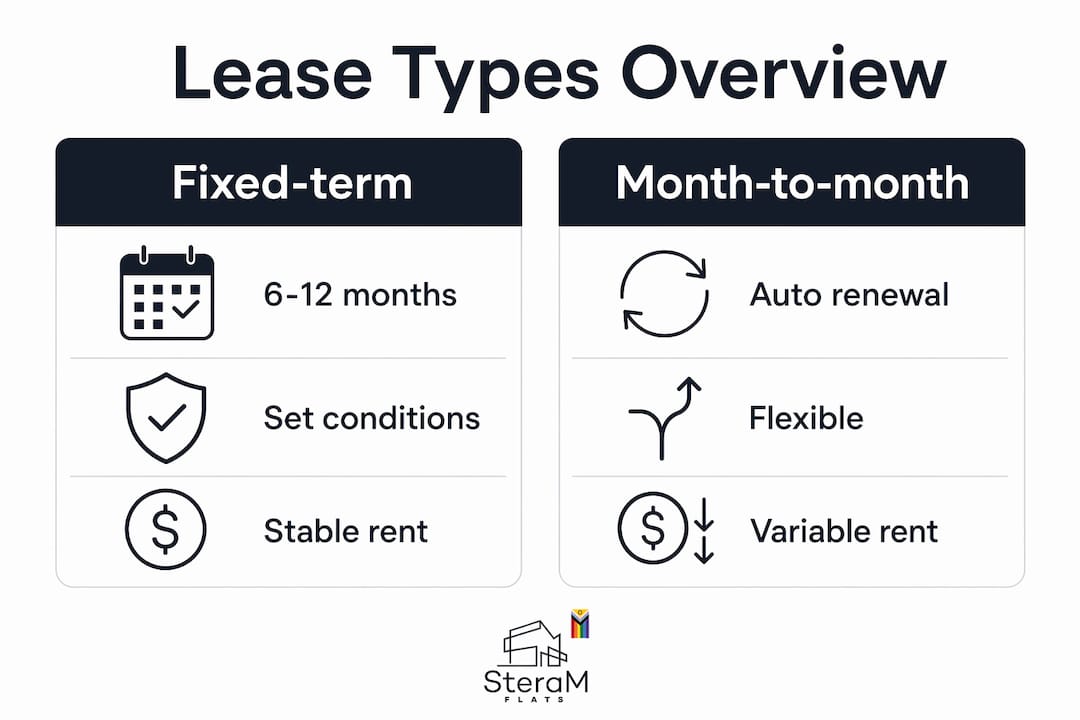
A fixed-term lease runs for a set period, most commonly 6 to 12 months for residential properties. Rent and conditions stay constant for the entire term. Landlords favor this structure because it guarantees income. Tenants benefit from knowing their rent will not increase mid-lease.
Month-to-month leases
A month-to-month lease renews automatically each month until either party gives notice. This structure suits tenants who need mobility, such as those relocating for work or waiting to buy a home. The trade-off is that landlords can raise rent or end the tenancy with shorter notice periods.
Commercial lease types
Commercial leases use Net lease structures where tenants pay base rent plus operating expenses. Three common formats exist:
- Single Net (N): Tenant pays rent plus property taxes.
- Double Net (NN): Tenant pays rent, taxes, and insurance premiums.
- Triple Net (NNN): Tenant pays rent, taxes, insurance, and maintenance costs.
NNN leases are standard in retail and industrial spaces and typically run for 5 to 20 years. Tenants under these structures must budget carefully because property taxes and insurance costs can shift significantly year to year.
Other lease formats
- Sublease: The original tenant rents part or all of the property to a third party, usually with landlord approval.
- Room rental agreement: Covers a single room within a shared property, with shared-space rules spelled out separately.
| Lease type | Typical duration | Flexibility | Who pays operating costs |
|---|---|---|---|
| Fixed-term residential | 6–12 months | Low | Landlord (usually) |
| Month-to-month | Ongoing | High | Landlord (usually) |
| Single Net commercial | 3–10 years | Low | Tenant (taxes) |
| Triple Net commercial | 5–20 years | Very low | Tenant (all costs) |
| Sublease | Varies | Medium | Depends on agreement |
Pro Tip: If you are signing a commercial lease, hire a real estate attorney to review the Net lease structure. The difference between a Double Net and Triple Net clause can cost thousands of dollars per year.
What are the essential terms in a lease agreement?
Unclear clauses about pets, guests, and maintenance are the primary drivers of eviction disputes. A well-written lease removes ambiguity before it becomes a conflict. Every lease, residential or commercial, should cover these core elements:
- Rent amount and due date: State the exact monthly figure, the due date, and any grace period before late fees apply.
- Security deposit: Specify the deposit amount, the conditions for deductions, and the deadline for its return after the tenancy ends.
- Lease duration: Define the start date, end date, and what happens if neither party acts at expiration (auto-renewal or month-to-month conversion).
- Maintenance responsibilities: Clarify who handles routine repairs, appliance maintenance, and emergency fixes.
- Pet policy: State whether pets are allowed, which species or breeds, and whether an additional deposit applies.
- Guest rules: Define how long guests may stay before they are considered unauthorized occupants.
- Notice of entry: Landlords must give notice before entering the property, typically 24 to 48 hours. Leases without this clause default to state law, which tenants rarely know.
- Early termination: Spell out the penalty for breaking the lease before the end date, such as forfeiting one or two months’ rent.
- Renewal terms: State whether the lease auto-renews, and if so, under what conditions the rent may change.
Pro Tip: Check your local jurisdiction’s landlord-tenant laws before signing. Some clauses that appear in standard lease templates are legally unenforceable in certain states or countries. Signing them does not make them valid, but it can create confusion during disputes.
You can find a full breakdown of required rental documents that landlords need to prepare alongside the lease contract.
What legal requirements govern lease agreements in 2026?
Legal requirements for lease agreements vary by jurisdiction, but several rules apply broadly across the United States, Canada, and Spain.
Leases exceeding one year must be in writing in most jurisdictions, including Texas and Ontario. An oral agreement for a long-term tenancy is difficult to prove and nearly impossible to enforce in court. Landlords in many regions must also provide a signed copy of the lease to the tenant within 3 business days of signing. Failing to do so can affect the landlord’s ability to enforce certain terms.
Residential tenancy laws such as the Uniform Residential Landlord and Tenant Act (URLTA) protect habitability and prevent landlords from waiving their core duties through contract language. A clause stating “tenant accepts property as-is with no warranty of habitability” is unenforceable under URLTA in states that have adopted it. The law overrides the contract.
| Legal requirement | Common jurisdictions | Key rule |
|---|---|---|
| Written lease for terms over 1 year | Texas, Ontario, most U.S. states | Oral leases are unenforceable for long terms |
| Signed copy to tenant | Texas, Ontario, Spain | Must be provided within 3 business days |
| Habitability standards | URLTA states, Spain | Cannot be waived by lease clause |
| Notice of entry | Most U.S. states, Spain | Typically 24–48 hours required |
Pro Tip: In Spain, the Ley de Arrendamientos Urbanos (Urban Leasing Law) governs residential leases and sets minimum tenant protections that override any conflicting lease clause. If you are renting in Spain, review this law or consult a local property advisor before signing.
For landlords operating in Spain, Steramflats offers detailed guidance on rental agreements and legal tips specific to the Spanish market.
How do lease agreements work in practice?
Understanding the lease process from start to finish prevents the most common mistakes that landlords and tenants make.
- Property offer and application: The landlord lists the property and reviews applications. Background and credit checks are standard at this stage.
- Lease negotiation: Both parties discuss terms. Tenants can negotiate rent, move-in date, pet allowances, and minor repair commitments before signing. Landlords can negotiate deposit amounts and lease duration.
- Lease review: Each party reads the full document. This is the moment to flag unclear clauses, not after signing.
- Signing and copy distribution: Both parties sign. The landlord provides a signed copy to the tenant, typically within 3 business days.
- Move-in and condition report: The tenant documents the property’s condition at move-in with photos and a written checklist. This protects the deposit at move-out.
- Ongoing compliance: The tenant pays rent on the agreed date. The landlord maintains the property and gives proper notice before entering.
- Lease end or renewal: Both parties decide whether to renew, convert to month-to-month, or end the tenancy. Notice periods (usually 30 to 60 days) apply.
Oral leases are difficult to prove in court and leave deposit and maintenance obligations open to dispute. Written agreements protect both sides at every stage of this process.
Common negotiation points include asking for a rent reduction in exchange for a longer lease term, requesting that the landlord complete specific repairs before move-in, and clarifying who pays for utilities. Landlords should document every communication in writing, even informal messages, to support enforcement if a dispute arises.
Pro Tip: Take timestamped photos of every room before you move in and send them to the landlord by email. This creates a dated record that is far more reliable than a handwritten checklist alone.
For a step-by-step walkthrough of the full rental process, Steramflats has a practical landlord’s rental guide covering everything from listing to lease signing.
Key Takeaways
A lease agreement is the single most important document in any rental relationship, and its clarity directly determines whether disputes arise or are avoided.
| Point | Details |
|---|---|
| Lease agreement definition | A legally binding contract between lessor and lessee defining rent, duration, and conditions. |
| Written leases are required | Leases over one year must be in writing; oral agreements are nearly impossible to enforce. |
| Know your lease type | Fixed-term leases offer price stability; month-to-month leases offer flexibility with less certainty. |
| Key clauses prevent disputes | Explicit terms on pets, maintenance, and notice of entry reduce the most common conflict triggers. |
| Legal protections override clauses | Habitability laws like URLTA apply regardless of what the lease says; no clause can waive them. |
Why clear leases matter more than most people realize
Most people treat a lease as a formality. They sign it quickly, file it away, and only pull it out when something goes wrong. That is exactly the wrong approach.
The lease is not just a record of what was agreed. It is the document that determines who wins a dispute. I have seen landlords lose deposit claims because their lease did not specify what counted as “damage beyond normal wear and tear.” I have seen tenants face unexpected charges because they did not notice a clause allowing the landlord to bill them for landscaping.
The gap between residential and commercial leases is wider than most business tenants expect. A Triple Net lease can turn a seemingly affordable base rent into a significantly higher monthly cost once taxes, insurance, and maintenance are added. Business tenants often sign these agreements without modeling the full-year cost. That is a mistake that compounds over a 10-year term.
One thing I consistently observe: many standard leases omit critical local requirements, which is a leading cause of disputes. A template downloaded from the internet may be perfectly legal in one state and unenforceable in another. Customizing the lease to match local law is not optional. It is the difference between a contract that holds up in court and one that does not.
The best lease is not the longest one. It is the one that leaves no room for interpretation on the points that matter most: rent, deposit, maintenance, entry notice, and termination. Get those five things right in plain language, and most disputes never happen.
— YellowRock
Steramflats and your leasing needs
Signing a lease without understanding its terms is one of the most avoidable risks in renting. Steramflats works with landlords and tenants across Spain to make that process clearer and more secure.

Whether you are a landlord preparing a lease for a long-term tenant or a renter reviewing a contract before signing, Steramflats provides the property expertise and documentation support to get it right. The platform covers residential and commercial rental services, from listing your property to navigating lease terms under Spanish law. For tenants and investors focused on long-term rentals, the tenant rights guide covers the legal protections that apply regardless of what your lease says.
FAQ
What is the lease agreement definition in simple terms?
A lease agreement is a written contract between a landlord and tenant that sets out the rent, duration, and rules for using a rental property. It is legally binding on both parties for the agreed term.
What should a lease agreement include?
A lease should include the rent amount, due date, security deposit terms, lease duration, maintenance responsibilities, pet and guest policies, notice of entry requirements, and early termination conditions.
What is the difference between a lease and a rental agreement?
A lease runs for a fixed term, typically 6 to 12 months, with locked-in rent. A rental agreement is usually month-to-month and allows either party to change terms with shorter notice.
Are oral lease agreements legally valid?
Oral leases are legally binding for short terms in some jurisdictions, but they are difficult to enforce in court. Written leases are strongly recommended for any rental arrangement.
What legal protections apply to tenants even if the lease says otherwise?
Laws like the Uniform Residential Landlord and Tenant Act impose non-waivable habitability standards that protect tenants regardless of what the lease document states. No clause can legally remove these protections.