
Financing a holiday home is defined as securing a mortgage or alternative loan product specifically for a property you will not use as your primary residence. The process follows stricter lending rules than a standard home purchase, requiring higher credit scores, larger down payments, and stronger cash reserves. Buyers who treat a vacation property like a primary home loan are routinely surprised by the gap. Understanding the requirements upfront, from debt-to-income limits to property classification, is what separates buyers who close deals from those who stall at pre-approval.
How to finance a holiday home: the credit and cash requirements
Lenders treat second home loans as higher risk than primary residence mortgages. That risk shows up immediately in the numbers they require from you.
The credit score threshold for vacation home financing sits at 720–740 minimum. That is meaningfully higher than the 620 floor most lenders accept for a primary residence loan. A score below 720 does not automatically disqualify you, but it will push your interest rate up and shrink your pool of willing lenders.

Down payment expectations follow the same pattern. Second home loans require 10–20% down, while properties classified as investment properties demand 25–30%. The classification matters enormously. A property you plan to rent out most of the year will likely be treated as an investment property by lenders, not a second home, and that distinction changes every term on your loan.
Your debt-to-income ratio is capped at 40–45% across all your debts combined. That includes your primary mortgage, car payments, student loans, and the new vacation home payment. Buyers who are already carrying significant debt often find this ceiling is the hardest constraint to clear.
- Credit score: 720–740 minimum for competitive rates
- Down payment: 10–20% for a second home; 25–30% for an investment property
- Debt-to-income ratio: 40–45% maximum including all existing debts
- Cash reserves: 6–12 months of combined housing payments for both properties, held in liquid accounts
Pro Tip: Do not count on projected rental income to help your debt-to-income ratio. Most lenders exclude future rental income from their calculations unless you can show documented rental history from the property.
What loan types are available for vacation property financing?
The loan menu for a holiday home is shorter than most buyers expect. Government-backed programs are largely off the table.
FHA and VA loans are generally unavailable for second homes or vacation properties. Both programs are designed for primary residences only. That means you are working exclusively with conventional loans and a handful of specialty products. This is the single biggest structural difference between financing a primary home and financing a second one.
Conventional loans
Conventional loans are the standard path for most vacation home buyers. They follow guidelines set by Fannie Mae and Freddie Mac and carry the credit and down payment requirements described above. Interest rates on second home loans run 0.5%–1% higher than equivalent primary residence rates. On a $400,000 loan, that gap adds hundreds of dollars to your monthly payment over the life of the loan.
Portfolio lenders
Portfolio lenders hold loans on their own books rather than selling them to the secondary market. That gives them flexibility to set their own criteria. Some portfolio lenders will accept lower down payments or work with buyers who have non-traditional income. The tradeoff is typically a higher interest rate or stricter prepayment terms. They are worth approaching if conventional lenders turn you down.
Home equity lines of credit
A home equity line of credit, or HELOC, on your primary residence is a legitimate way to fund part or all of a vacation home purchase. You borrow against the equity you have already built, often at lower rates than a standalone second home mortgage. The risk is real: your primary home becomes collateral. If the vacation property generates less income than expected, you are still responsible for the HELOC payments.
Pro Tip: Property classification as a second home versus an investment property is not your choice alone. Lenders apply their own tests based on how often you rent it and how far it is from your primary residence. Frequent full-time rentals can trigger reclassification to investment property status, which means stricter terms.
What does it actually cost to own a holiday home?
The mortgage payment is the smallest part of the total cost picture. Buyers who budget only for principal and interest routinely run into cash flow problems within the first year.
Closing costs alone run 2–5% of the loan amount. On a $350,000 purchase, that is $7,000–$17,500 due at the closing table, on top of your down payment. These costs include lender fees, title insurance, appraisal, and prepaid items like homeowner’s insurance and property taxes.
Beyond closing, the ongoing costs stack up quickly:
- Property taxes: Rates vary by location and can be significant in popular vacation markets. Spain, for example, has specific property tax obligations that foreign buyers often underestimate.
- Insurance: Vacation homes often carry higher premiums because they sit vacant for extended periods, which increases risk for insurers.
- Utilities: You pay for water, electricity, and internet whether you are there or not.
- Maintenance: Seasonal properties face accelerated wear from weather, humidity, and periods of non-use. Budget at least 1–2% of the property’s value annually for maintenance.
- HOA fees: Many vacation communities charge monthly or annual fees that can run from a few hundred to several thousand dollars per year.
Tax treatment adds another layer of complexity. If you rent the property for fewer than 14 days in a calendar year, that rental income is tax-free under IRS rules. Rent it more than that, and you enter a different tax category with different deduction rules. The line between personal use and rental use directly affects what you can deduct and how lenders view the property.
| Cost Category | Typical Range | Notes |
|---|---|---|
| Down payment | 10–30% of purchase price | Higher for investment property classification |
| Closing costs | 2–5% of loan amount | Due at closing, separate from down payment |
| Annual maintenance | 1–2% of property value | Higher in coastal or seasonal climates |
| Insurance premium | Varies by location | Vacancy periods increase rates |
| HOA fees | $0–$500+ per month | Depends on community and amenities |
What steps should you follow to secure holiday home financing?
The financing process for a vacation property follows the same broad arc as a primary home purchase, but with tighter checkpoints at every stage.
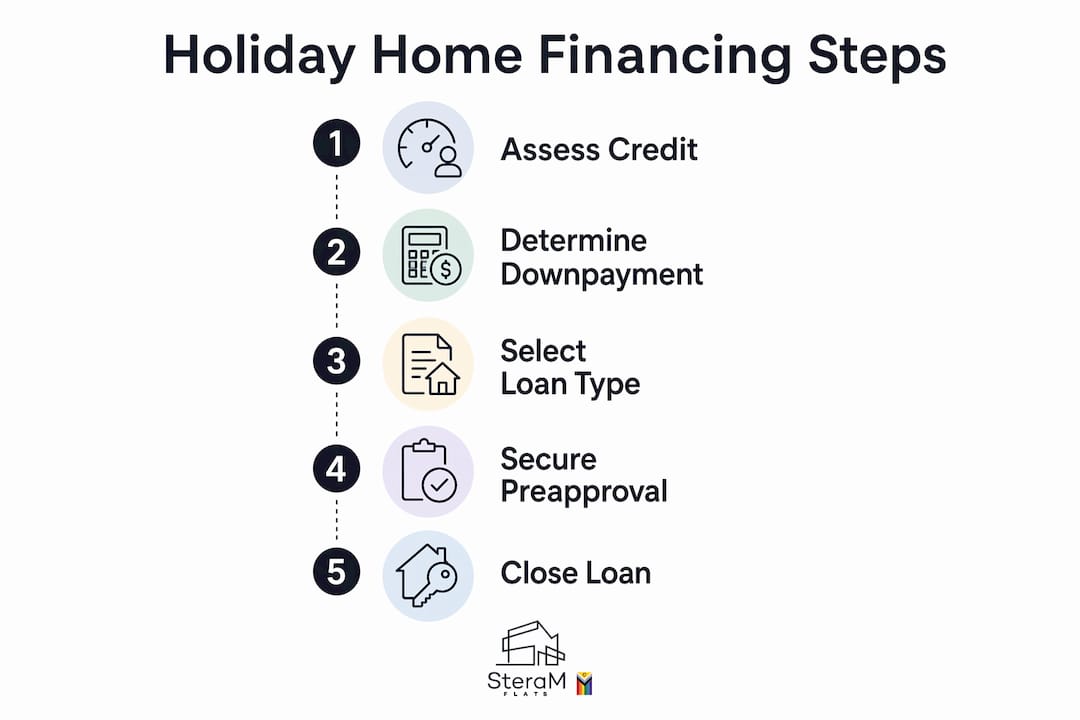
Audit your finances first. Pull your credit reports from all three bureaus. Calculate your current debt-to-income ratio including your primary mortgage. Identify how much liquid cash you have available for the down payment, closing costs, and the required 6–12 month reserve. Do this before you speak to a single lender.
Get pre-approved by at least three lenders. Because government-backed options are unavailable, rates and terms vary significantly between conventional lenders and portfolio lenders. Shopping multiple offers is not optional. It is the primary way buyers save money on a second home loan.
Prepare your documentation thoroughly. Lenders will want two years of tax returns, recent pay stubs, bank statements covering 2–3 months, and documentation of all existing debts. If you plan to rent the property, do not expect projected income to count. Rental income without documented history is typically excluded from your qualifying income.
Understand the appraisal process. Vacation home appraisals can be tricky in markets with limited comparable sales. A low appraisal can derail your financing or require a larger down payment to cover the gap. Choose a lender familiar with your target market.
Lock your rate and close. Once underwriting clears, lock your interest rate as soon as possible. Rates on second homes move with the broader market, and a delay of even a few weeks can cost you. Review the closing disclosure carefully against your loan estimate before signing.
Pro Tip: Never rely on projected rental income to qualify for the loan. Even if the property has strong rental potential, most lenders will not count income that has not been earned and documented. Build your qualification case entirely on your existing income and assets.
Key Takeaways
Financing a holiday home requires meeting stricter credit, down payment, and cash reserve standards than a primary residence loan, with no access to government-backed programs like FHA or VA.
| Point | Details |
|---|---|
| Credit and down payment thresholds | Minimum credit score of 720–740 and 10–20% down are the baseline for second home loans. |
| No FHA or VA loans | Conventional and portfolio lenders are your only options for vacation property financing. |
| Cash reserves are non-negotiable | Lenders require 6–12 months of liquid reserves covering both your primary and vacation home payments. |
| Total cost exceeds the mortgage | Closing costs, insurance, maintenance, and taxes add significantly to the true annual cost of ownership. |
| Property classification changes everything | How often you rent the property determines whether lenders treat it as a second home or an investment property. |
What I have learned about financing vacation properties
The single most common mistake I see buyers make is treating a holiday home purchase like a slightly more expensive version of buying a primary residence. It is not. The lending environment is fundamentally different, and buyers who do not understand that difference waste months chasing approvals they were never going to get.
The classification question is where most people get tripped up. Buyers assume they can call a property a “second home” and get second home rates, even if they plan to rent it out 40 weeks a year. Lenders are not naive about this. They look at the property’s location, distance from your primary home, and your stated rental intentions. If the numbers suggest it is really an investment property, they will price it that way.
Cash reserves deserve more attention than they get in most financing guides. The 6–12 month requirement is not a suggestion. It is a hard underwriting standard, and the reserves must be liquid. A retirement account that carries a penalty for early withdrawal does not count the same way a savings account does. Buyers who have most of their net worth tied up in their primary home equity often discover they do not have enough liquid assets to qualify, even when their income looks strong on paper.
My honest advice: build your financial case before you fall in love with a specific property. Know your credit score, your real debt-to-income ratio, and your liquid reserves before you start touring homes. The buyers who close quickly and at good rates are the ones who did that work six to twelve months before they started shopping.
— YellowRock
Steramflats can help you take the next step
Buying a holiday home in Spain involves more than securing a mortgage. You need to understand local property taxes, registration requirements, and whether to rent the property short-term or long-term once you own it.

Steramflats specializes in exactly this intersection of financing knowledge and on-the-ground property expertise, particularly in high-demand coastal markets like Torremolinos. Whether you are evaluating vacation rental income potential before you commit to a purchase, or you are ready to list your holiday property and start generating returns, Steramflats provides the advisory support and property management services to move from financing to ownership with confidence.
FAQ
What credit score do I need for a holiday home loan?
Most lenders require a minimum credit score of 720–740 for a vacation home mortgage. Scores below this threshold typically result in higher interest rates or outright denial.
Can I use an FHA loan to buy a vacation home?
FHA and VA loans are not available for second homes or vacation properties. These programs are restricted to primary residences, so buyers must use conventional or portfolio loans instead.
How much do I need for a down payment on a holiday home?
Second home loans typically require 10–20% down. Properties classified as investment properties require 25–30%, so your intended use of the property directly affects the down payment amount.
Will lenders count rental income when I apply for a vacation home loan?
Most lenders exclude projected rental income from your qualifying income unless you have documented rental history for the property. Relying on future rental income to qualify is a common and costly mistake.
What are the ongoing costs of owning a holiday home?
Beyond the mortgage, owners pay for property taxes, insurance, utilities, maintenance averaging 1–2% of property value annually, and potentially HOA fees. Closing costs at purchase run an additional 2–5% of the loan amount.