
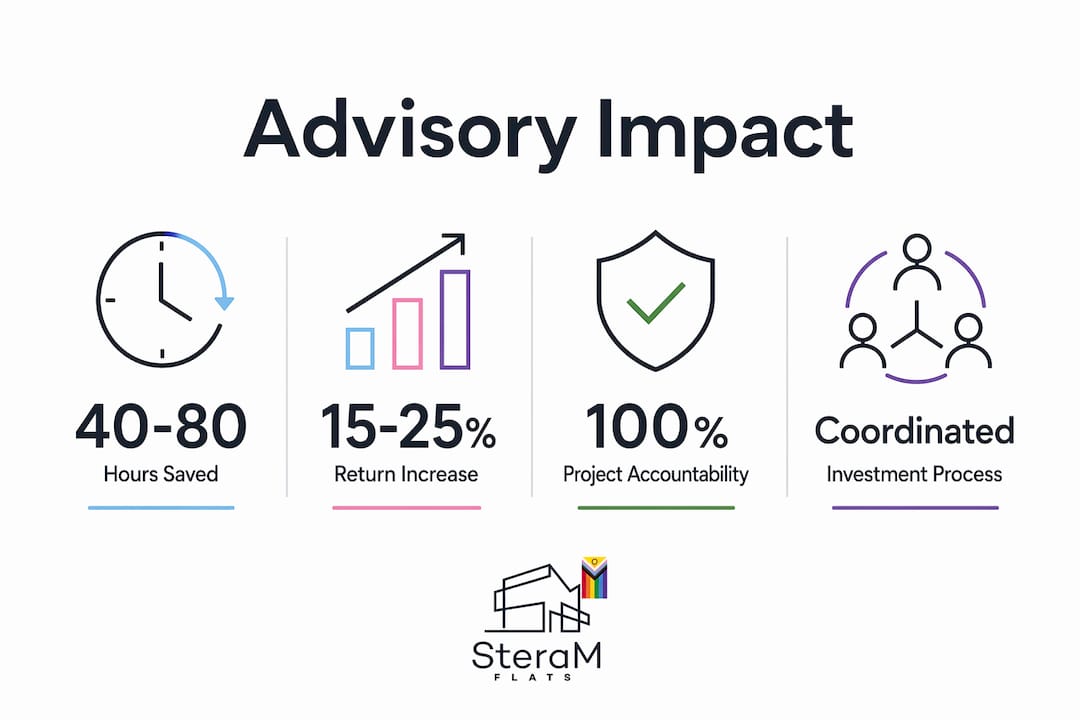
Property advisory services are professional consulting solutions that help investors and buyers make smarter, more profitable real estate decisions through strategic advice, project oversight, and market expertise. The industry term for this practice is “real estate advisory,” and it covers everything from initial goal setting to ongoing portfolio management. Investors who understand why use property advisory services gain a clear edge: advisors improve returns by 15–25% compared to independent management. That gap exists because advisors bring structured analysis, negotiation skill, and coordinated oversight that most individual buyers simply cannot replicate alone.
Why use property advisory services: the core case
Property advisory services are defined by one key difference from standard real estate transactions. Advisors focus on long-term financial goals, not just closing a deal. A traditional agent earns a commission when a sale completes. An advisor earns trust by making sure the right asset enters your portfolio at the right price and performs over time. That structural difference changes every recommendation they make.
The practical result is a more disciplined investment process. Advisors run market analysis before you commit, model financial outcomes before you sign, and stay accountable after you buy. For investors who are new to real estate or entering an unfamiliar market, that accountability is worth more than any single piece of advice.

What specific services do property advisors provide?
Property advisors cover a wide range of functions that go well beyond finding a listing. Their core services include:
- Market analysis and investment strategy. Advisors study local supply, demand, pricing trends, and yield data to identify assets that match your financial goals.
- Financial modeling. They run cash flow projections, assess borrowing capacity, and factor in tax implications before recommending a purchase.
- Due diligence. Advisors verify title, zoning, structural condition, and legal compliance so you do not inherit hidden problems.
- Project management and construction oversight. When renovations or licensing are required, advisors coordinate contractors, architects, and permit applications.
- Professional coordination. Advisors work alongside accountants and solicitors to create a synchronized financial and legal strategy, particularly for tax planning and superannuation structures.
- Ongoing portfolio review. After purchase, advisors monitor asset performance, recommend rebalancing, and flag when to hold, improve, or exit a position.
This breadth matters because real estate transactions rarely fail at a single point. They fail when multiple small problems compound. An advisor who covers all these areas prevents gaps from forming between the financial, legal, and physical sides of a deal.
Pro Tip: When evaluating an advisory firm, ask specifically how they handle post-purchase coordination. Firms that stay engaged after the sale protect you during the phase where most costly mistakes actually happen.
The role of a property advisor as a project lead means one person holds accountability across every stage. That single point of contact saves time, reduces miscommunication, and keeps your investment on track.
How do property advisory services impact returns and risk?
The financial case for hiring an advisor is direct. Investors using advisory services save 40–80 hours annually and can realize savings of £10,000–£20,000 per property through better asset selection alone. Those numbers reflect the compounding effect of avoiding underperforming properties, negotiating better entry prices, and managing assets more efficiently over time.
Risk reduction is equally measurable. Professional advisory delivers a 2–4% portfolio return improvement through ongoing market trend analysis and strategic rebalancing. That improvement comes from replacing reactive decisions with data-driven ones.
| Benefit | What it means for you |
|---|---|
| 15–25% better returns | Advisors select higher-performing assets and negotiate better entry prices |
| 2–4% portfolio improvement | Ongoing rebalancing keeps your portfolio aligned with market conditions |
| 40–80 hours saved annually | Less time managing research, coordination, and administration |
| £10,000–£20,000 savings per property | Better selection and negotiation offset advisory fees many times over |
“Advisor involvement during negotiation and post-offer phases prevents delays and saves money that can exceed advisory fees. Professional coordination with solicitors and lenders avoids transaction bottlenecks that cost investors both time and capital.”
The negotiation phase is where many investors lose money without realizing it. Post-offer coordination with solicitors and lenders prevents the kind of delays that push up financing costs and erode margins. An advisor who manages this phase actively often saves more than their entire fee in a single transaction.
Understanding the advantages of rental properties becomes much clearer when an advisor models the numbers for your specific situation rather than relying on general market averages.
When should you hire a property advisor?
Not every buyer needs a dedicated advisor. A straightforward residential purchase in a familiar market with no complex financing rarely requires full advisory support. The value of a property advisor rises sharply in specific situations:
- High-stakes or complex transactions. When the asset value is significant, the margin for error is small. An advisor’s fee becomes negligible relative to the cost of a poor decision.
- Specialist or commercial assets. Vacation rentals, mixed-use properties, and commercial units carry regulatory and operational complexity that most buyers are not equipped to assess alone.
- Unfamiliar markets. Buying in a foreign country or a new city without local knowledge is one of the highest-risk scenarios in real estate. Advisors with local expertise close that gap directly.
- Market volatility or regulatory change. Advisory support is most valuable during market uncertainty because advisors provide clarity and prevent emotional decisions based on incomplete data.
- Portfolio building. Investors acquiring multiple properties need coordinated strategy, not a series of disconnected transactions. Advisors ensure each purchase fits the broader plan.
- Limited personal time. If you cannot dedicate the hours required for proper due diligence, an advisor fills that gap without compromising the quality of your decision.
The key distinction is accountability. Property advisors function as project leads throughout the investment lifecycle, unlike sales-focused agents who move on after closing. That ongoing accountability is the reason investors who use advisors consistently outperform those who do not.
Knowing when to outsource property management often follows the same logic: when complexity exceeds your capacity to manage it well, professional support pays for itself.
What does the advisory process look like in practice?
Working with a property advisor follows a clear sequence that removes guesswork from every stage of an investment.
- Initial consultation and goal alignment. The advisor maps your financial goals, risk tolerance, timeline, and capital position. This step defines every decision that follows.
- Market research and asset sourcing. The advisor identifies properties that match your criteria, using data sets and professional networks that are not available to the general public.
- Due diligence and financial analysis. Every shortlisted property goes through legal, structural, and financial review. The advisor models projected returns, financing costs, and tax exposure.
- Negotiation and offer management. The advisor negotiates on your behalf, using market data to justify pricing and terms. This phase alone frequently saves more than the advisory fee.
- Transaction coordination. The advisor manages communication between solicitors, lenders, surveyors, and any other professionals involved in closing the deal.
- Post-purchase monitoring. After settlement, the advisor tracks asset performance, flags maintenance issues, and recommends adjustments to keep your portfolio on target.
Pro Tip: Ask your advisor for a written communication schedule before you start. Knowing exactly when you will receive updates removes anxiety and keeps the process moving without constant follow-up on your part.
Investors who combine an advisor with an accountant specializing in property tax create a fully coordinated financial strategy. The advisor handles asset selection and management while the accountant maximizes tax efficiency, and the two work together rather than in silos. This collaboration is one of the most underused advantages in real estate investing.
Property management best practices reinforce the same principle: structured processes and professional coordination consistently outperform ad hoc decision-making.
Key Takeaways
Property advisory services deliver measurably better investment outcomes by combining strategic asset selection, coordinated project management, and ongoing portfolio oversight into a single accountable relationship.
| Point | Details |
|---|---|
| Returns improve significantly | Investors using advisors achieve 15–25% better returns than those managing independently. |
| Risk reduction is quantifiable | Strategic rebalancing and market analysis deliver a 2–4% portfolio return improvement. |
| Advisors differ from agents | Agents close transactions; advisors align every decision with your long-term financial goals. |
| Most valuable in complex situations | High-stakes deals, unfamiliar markets, and volatile conditions are where advisory fees pay back fastest. |
| Post-offer coordination matters most | Advisor involvement after an offer is accepted prevents delays and saves money that often exceeds their fee. |
The part most investors get wrong about property advisors
Most investors I have observed treat property advisory as a luxury for large portfolios. That assumption costs them money. The investors who benefit most from advisory support are often those making their second or third purchase, not their tenth. By the time a portfolio is large, the mistakes have already been made.
The misconception runs deeper than timing. Many buyers assume an advisor’s value is in finding properties they could not find themselves. The real value is in the properties they talk you out of. A good advisor’s most important work is invisible: it is the overpriced apartment you did not buy, the renovation project with hidden structural issues you did not inherit, and the market you did not enter at the wrong moment.
I have also seen investors underestimate the coordination burden of a real estate transaction. Solicitors, lenders, surveyors, and contractors all operate on different timelines and with different priorities. Without a single accountable party managing that process, delays compound and costs rise. An advisor who owns that coordination role is not a luxury. They are the person who keeps the deal from falling apart.
The best advisors I have encountered are direct about what they do not know. They refer you to a tax accountant for complex structures and to a local specialist for markets outside their expertise. That intellectual honesty is the clearest signal you have found someone worth working with.
— YellowRock
How Steramflats supports your property investment goals
Steramflats operates as a full-service real estate and property management platform in southern Spain, with deep expertise in the Torremolinos market and the broader Costa del Sol region. For investors and buyers who want professional support from initial search through ongoing management, Steramflats covers advisory, valuation, legal documentation, licensing, and renovation coordination under one roof.

Whether you are buying your first investment property or expanding an existing portfolio, Steramflats provides the market knowledge and project accountability that turn good intentions into measurable results. Their vacation rental and real estate services are built for investors who want professional oversight without the overhead of managing every detail themselves. Reach out to Steramflats directly to discuss your goals and get a clear picture of what professional advisory support looks like in practice.
FAQ
What is the main benefit of property advisory services?
Property advisory services improve investment returns by 15–25% compared to independent management. They achieve this through better asset selection, negotiation, and ongoing portfolio oversight.
How do property advisors differ from real estate agents?
Real estate agents focus on completing transactions, while property advisors focus on aligning every decision with your long-term financial goals. Advisors stay accountable throughout the entire investment lifecycle, not just until closing.
When does hiring a property advisor make the most sense?
Advisory services deliver the highest value during complex transactions, market volatility, or when buying in an unfamiliar market. They are also critical when you lack the time to conduct thorough due diligence yourself.
Do property advisors work with other professionals like accountants?
Yes. Advisors regularly collaborate with accountants who specialize in property tax to create a coordinated financial strategy. This pairing is especially valuable for investors using superannuation funds or complex ownership structures.
Are property advisory fees worth the cost?
Advisory fees are typically offset by savings in negotiation, better asset selection, and avoided mistakes. Coordination during the post-offer phase alone can save more than the total advisory cost by preventing delays and transaction bottlenecks.