Tenant screening is the process landlords and property managers use to evaluate rental applicants by collecting and analyzing financial, criminal, and rental history data to determine whether someone is a qualified, low-risk renter. A full screening typically covers credit history, criminal background, eviction records, income verification, and rental references. Federal law, specifically the Fair Credit Reporting Act (FCRA) and the Fair Housing Act (FHA), governs how landlords collect and use this information. Done right, tenant screening is a standardized, repeatable workflow that protects your investment and keeps you legally covered.
Here is what a complete tenant screening covers:
- Credit report: Payment history, open accounts, debt load, and any bankruptcies
- Criminal background check: Arrest records, charges, and convictions at federal, state, and county levels
- Eviction history: Court filings and judgments from housing courts
- Income and employment verification: Confirmed earnings relative to rent, typically 2.5–3× the monthly amount
- Rental history and references: Prior landlord feedback on payment behavior, property care, and lease compliance
- Identity verification: Confirms the applicant is who they claim to be, reducing fraud risk
Consistent, thorough tenant screening significantly lowers eviction rates according to National Association of Residential Property Managers data. That alone makes it one of the highest-return practices a landlord can build into their leasing process.
What does a tenant screening report actually contain?
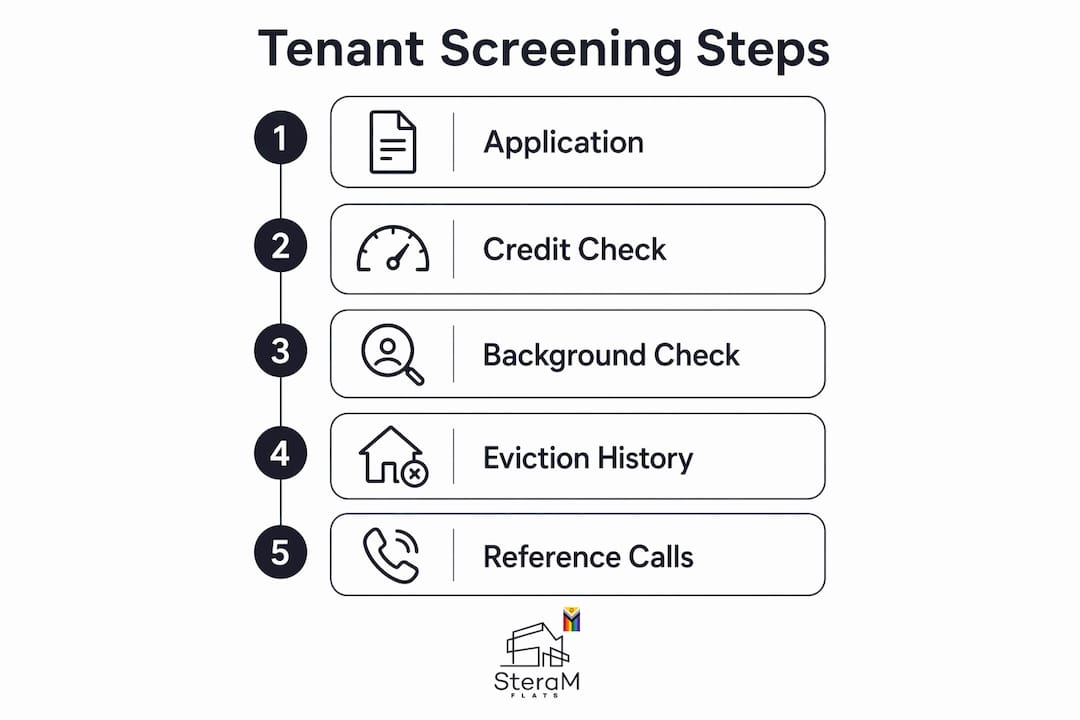
A tenant screening report is a compiled profile drawn from multiple data sources, not a single document. Landlords and property managers use it to get a complete picture of an applicant before signing a lease.
The Consumer Financial Protection Bureau identifies these core components:
- Credit report: Covers loan repayment history, credit card balances, collections, and bankruptcies. It reflects financial responsibility but says nothing about how someone behaves as a renter.
- Eviction records: Pulled from housing court databases. These capture filed eviction actions, not just judgments.
- Criminal history: Includes records from federal, state, and county sources. Scope and depth vary by screening provider and state law.
- Employment verification: Confirms current employer, job title, and sometimes salary, cross-referenced against stated income on the application.
- Rental history: Prior addresses, landlord contact details, and any documented lease violations or unpaid balances.
- Sex offender registry and national watchlists: Standard inclusions in most full screening packages.
- Risk score or recommendation: Some screening companies generate a proprietary score based on criteria the landlord selects. Applicants may not see this score in their copy of the report.
No single data point tells the full story. A strong credit score does not rule out a prior eviction. A clean criminal record does not confirm stable income. Combining all components gives you a defensible, accurate picture of who you are renting to.
Relying on one or two data sources leaves real gaps. A landlord who pulls only a credit report, for example, will miss eviction filings that never reached judgment, fraud in income documents, and criminal records that do not appear on financial databases. The value of a full screening report comes from how the pieces fit together, not from any single check.

How does the tenant screening process work, step by step?
A repeatable screening process protects you legally and makes your decisions defensible if challenged. Here is the sequence that works:
Set written screening criteria before advertising. Define your minimum income threshold, credit score floor, eviction history policy, and criminal record standards in writing. Apply these to every applicant without exception.
Pre-screen applicants at inquiry. Ask basic qualifying questions upfront: desired move-in date, number of occupants, pet ownership, and whether they meet your income requirement. This filters obvious mismatches before anyone pays an application fee.
Collect a complete rental application. The application should capture full legal name, Social Security number, current and prior addresses, employment history, income, and references. This is also where you obtain written authorization to pull consumer reports, as required by FCRA §1681b(b)(2)(A).
Order the full screening report. Request credit, criminal background, eviction history, and identity verification through a compliant screening service. The FCRA regulates this process and requires standalone written consent from the applicant before you pull any consumer report.
Verify income independently. Do not rely solely on pay stubs or bank statements the applicant provides. Applicant-provided income documents carry fraud risk; automated payroll-integrated verification tools connect directly to employer or bank data for secure confirmation. Tenant screening can be completed in 2–5 business days manually or 24–48 hours through integrated digital platforms.
Contact prior landlords and references. Use a consistent set of questions for every applicant: Did they pay on time? Did they give proper notice? Would you rent to them again? Consistent questions reduce the risk of bias claims.
Evaluate findings against your written criteria. Compare each applicant’s results to your pre-set standards. Do not make exceptions for some applicants and not others. Documented, uniform evaluation is your legal protection.
Issue an adverse action notice when required. If you deny an applicant or offer less favorable terms based on information in a consumer report, the FCRA requires an adverse action notice that identifies the screening agency and informs the applicant of their rights.
Document everything. Keep copies of applications, authorization forms, screening reports, and your written decision rationale. If a fair housing complaint ever arises, your paper trail is your defense.
Pro Tip: Build a tenant screening checklist before you list your property. Having criteria locked in before you meet applicants removes the temptation to make judgment calls that could expose you to discrimination claims.

What legal rules govern tenant screening in the United States?
Two federal laws set the floor for every landlord’s screening process. State and local rules often add requirements on top of them.
The Fair Credit Reporting Act (FCRA)
The FCRA applies any time you use a consumer reporting agency to pull background or credit information on an applicant. Key requirements include:
- Obtain standalone written consent before ordering any consumer report
- Use the report only for a permissible purpose (evaluating a rental application qualifies)
- Provide an adverse action notice if the report influences a denial or less favorable offer
- Under the FCRA, most negative information older than seven years cannot appear in a report; bankruptcies can be reported for up to 10 years; criminal convictions carry no time limit
The Fair Housing Act (FHA)
The FHA prohibits discrimination based on race, color, national origin, religion, sex, familial status, or disability. For screening, this means:
- Your written criteria must apply equally to every applicant
- Discretionary exceptions, even well-intentioned ones, create legal exposure
- State laws in many jurisdictions add protected classes such as source of income, sexual orientation, or veteran status
Fair Housing rules require screening criteria to be applied uniformly without discrimination. Exceptions and discretionary decisions increase legal exposure significantly, regardless of intent.
Criminal background checks require extra care. HUD guidance cautions against blanket bans on applicants with criminal records. An individualized assessment, considering the nature of the offense, how long ago it occurred, and evidence of rehabilitation, is the compliant approach. A flat “no criminal record” policy can constitute disparate impact discrimination under the FHA.
State and local laws add another layer. Some jurisdictions restrict when in the process you can ask about criminal history. Others require fee disclosures, limit the types of records you can consider, or mandate that you accept housing vouchers as income. Check your state’s landlord-tenant statutes and your city’s fair housing ordinances before finalizing your screening criteria. For landlords managing properties across multiple markets, the legal documents for rentals required at each stage vary considerably by jurisdiction.
What factors do landlords actually weigh when reviewing an application?
Screening criteria exist to answer one question: is this applicant likely to pay rent on time, care for the property, and fulfill the lease? These are the factors that answer it:
- Income level: Most landlords require verifiable gross income at a multiple of the monthly rent that provides a reasonable buffer for living expenses. This threshold gives a reasonable buffer for living expenses without relying on the applicant’s ability to manage finances perfectly.
- Credit history: Look beyond the score itself. Payment delinquencies, collections, and charge-offs tell you more than a three-digit number. A score of 650 with a clean recent history reads differently than a 700 with active collections.
- Eviction history: Any prior eviction filing, even one that was dismissed, warrants a conversation. Context matters, but a pattern of housing court appearances is a clear signal.
- Criminal background: Evaluate offense type, recency, and relevance to tenancy. A decade-old misdemeanor is not the same risk as a recent conviction for property damage.
- Identity verification: Confirm that the name, Social Security number, and address history on the application match what the screening report returns. Discrepancies are a fraud indicator.
- Rental references: A prior landlord who says “I would not rent to them again” tells you more than any credit score. Ask specific questions and listen for hesitation as much as the words.
- Employment stability: Length of employment and consistency of income matter alongside the dollar amount. A freelancer with variable income needs a different evaluation than a salaried employee.
Applying these factors uniformly is not just good practice. It is a legal requirement. Varying your standards based on who is in front of you, even informally, opens the door to fair housing liability. For a broader look at how screening fits into your overall rental property management workflow, consistent criteria are the foundation everything else builds on.
Why a credit report alone is not enough for tenant screening
Landlords who pull only a credit report are working with an incomplete picture. A credit report covers financial credit activity: loans, credit cards, payment history, and debt levels. It does not include eviction records, criminal history, identity verification, or rental behavior.
The Consumer Financial Protection Bureau confirms that tenant screening reports are distinct from credit reports precisely because they integrate non-financial data that directly affects tenancy risk. Here is what a credit-only approach misses:
- Eviction filings: Approximately 28% of eviction filings never result in a judgment and therefore do not appear on credit reports. Dedicated eviction databases capture these filings. An applicant with two dismissed eviction cases looks clean on a credit report.
- Criminal records: These do not appear in credit data at all. A full background check pulls from federal, state, and county criminal databases.
- Identity fraud: A credit report confirms a credit file exists for a name and Social Security number. It does not verify that the person applying is actually that person.
- Income fraud: Applicant-provided documents like pay stubs and bank statements can be altered. Automated verification tools that connect directly to payroll or bank data catch falsifications that manual document review misses.
Pro Tip: Always use a tenant reference check alongside your screening report. Prior landlord feedback fills behavioral gaps that no database captures.
The FCRA also requires standalone written consent before pulling any consumer report, whether it is a credit report or a full tenant screening package. Pulling a credit report through a consumer reporting agency without that consent is a federal violation, not just a procedural gap. A complete screening process, with all components and proper authorization, is both more accurate and more legally sound than any shortcut.
Key Takeaways
Tenant screening is the most reliable tool landlords have for reducing financial risk, avoiding evictions, and staying legally compliant throughout the leasing process.
| Point | Details |
|---|---|
| Screening covers six core areas | Credit, criminal background, eviction history, income verification, rental references, and identity checks form a complete applicant profile. |
| FCRA and FHA set the legal floor | Written consent is required before pulling consumer reports, and adverse action notices are mandatory when a report influences a denial. |
| Credit reports miss critical data | Around 28% of eviction filings never reach judgment and are invisible on credit reports; only dedicated eviction databases capture them. |
| Uniform criteria protect landlords | Written screening standards applied equally to every applicant are the primary defense against fair housing complaints. |
| Digital tools speed up the process | Integrated screening platforms can return results in 24–48 hours versus 2–5 business days for manual verification. |
Ready to list your property and connect with qualified renters? Publish your rental for free on Steramflats and reach prospective tenants who are actively searching.