Southern Spain’s vacation apartment market looks simple on the surface: sun, beaches, tourists. The reality is far more layered, and investors or travelers who only see the summer peak are missing most of the picture. Structural forces like year-round expat migration, remote work culture, retiree relocation, and fast-changing regulations are reshaping who rents, when, and at what price. Understanding these forces is not just interesting — it is the difference between a profitable investment and a costly mistake.
Table of Contents
- Why demand for vacation apartments is booming in southern Spain
- Regulations and risks: What everyone needs to know
- Supply, saturation, and shifting strategies
- What travelers and investors can expect next
- A reality check for investors and vacationers
- Explore smarter property solutions with SteraM Flats
- Frequently asked questions
Key Takeaways
| Point | Details |
|---|---|
| Year-round demand | Vacation apartments in southern Spain benefit from tourism, expat growth, and infrastructure all year long. |
| Regulations matter | Licensing, local approvals, and city policy changes can make or break an investment. |
| Strategy must adapt | Saturation and market shifts mean that successful owners pivot to mid-term or adjusted models when needed. |
| Local expertise is key | Understanding regulations and harnessing regional knowledge is crucial for maximizing returns or enjoying seamless trips. |
Why demand for vacation apartments is booming in southern Spain
Let’s dig into the real-life factors making this market so dynamic. Most people assume demand spikes in July, drops in October, and repeats. That pattern is outdated. Today, Andalusia tops Europe for online holiday apartment bookings, and the drivers behind that ranking go well beyond beach season.
Year-round tourism is the foundation. Andalucía enjoys over 300 sunny days per year, which means winter travelers — snowbirds from northern Europe, couples seeking warm long weekends, and families on school breaks — fill apartments that would otherwise sit empty in competing markets. This is not a marginal segment. It is a substantial, growing one.
Beyond pure tourism, several other groups are fueling consistent demand:
- International buyers and expats who purchase or rent vacation apartments as primary residences, especially from the UK, Germany, and Scandinavia
- Remote workers who split their year between home countries and the Costa del Sol, staying for weeks rather than days
- Retirees choosing Andalucía for its climate, affordable cost of living, and modern healthcare infrastructure
- Families relocating to access international schools concentrated around Málaga and Marbella
- Tech and business professionals drawn by Málaga’s emerging role as a southern European technology hub
The region’s infrastructure investment is often underestimated as a demand driver. Málaga’s expanding metro, upgraded hospital networks, and high-speed rail connections to Madrid reinforce the appeal for long-stay visitors and semi-permanent residents. These are people who want a proper apartment, not a hotel room.
“The vacation apartment market in Andalucía is no longer a single-season story. It is a year-round ecosystem driven by multiple overlapping demographics.”
For investors weighing their options, understanding the difference between long-term vs holiday rentals matters enormously here, because each demographic has different lease preferences and legal requirements. Similarly, the specific Spanish property types you consider will affect which of these demand segments you can actually capture.
The result is a market with remarkable resilience. Even when booking platforms report off-peak dips, the underlying pool of potential renters remains deep and varied. That depth is what separates southern Spain from most competing European markets.

Regulations and risks: What everyone needs to know
But it is not just about what is driving demand — the rules can make or break your investment. Spain’s vacation rental regulatory landscape has transformed dramatically over the past three years, and staying current is not optional.
At the regional level, properties in Andalucía require a VUT license (Vivienda de Uso Turístico), which involves meeting habitability standards, submitting documentation to the local Junta, and displaying the registration number on all listings. At the national level, Spain now requires NRUA registration (National Register of Urban Accommodation), which applies across platforms. Community approval from building residents can also block new licenses in many buildings, particularly in dense urban areas.
Non-compliance carries serious consequences. Strict licensing requirements across Europe, including Spain, mean fines that can reach tens of thousands of euros, forced delistings from Airbnb and Booking.com, and in some cases, legal injunctions against operating.
| City or region | Regulatory approach | New license availability |
|---|---|---|
| Málaga city center | License freeze in 43 zones | Suspended |
| Torremolinos | Managed licensing process | Limited |
| Marbella | Active licensing with conditions | Available |
| Granada historic center | Strict quota zones | Very limited |
| Rural Andalucía | Lighter-touch regulation | Generally available |
The picture is not uniform across the region. Málaga’s city center has effectively frozen new approvals in most neighborhoods, while rural areas and smaller coastal towns remain more accessible. This is important intelligence for anyone comparing rental services in Spain across different municipalities.
Pro Tip: Never assume that because a neighboring apartment operates as a vacation rental, yours can too. Zoning, building community votes, and recent licensing changes may apply specifically to your address. Always verify with a local legal specialist before committing capital.
Insurance is another frequently overlooked risk. Standard homeowner policies in Spain often exclude short-term rental liability. Reviewing insurance for Spanish rentals is a critical step that many first-time investors skip until after a problem occurs.
Supply, saturation, and shifting strategies
Regulations do not exist in a vacuum — they trigger shifts in how owners operate. And in 2026, those shifts are visible and accelerating.
In some city centers, over 10% of homes are now classified as vacation rentals, creating a saturation effect that reduces average occupancy rates, intensifies competition on price, and fuels community backlash. Several platforms have proactively delisted thousands of non-compliant properties in Spain following pressure from municipal authorities.
Vacation rental market saturation — selected zones:
| Area | Estimated STR share of housing stock | Recent regulatory action |
|---|---|---|
| Málaga city center | Over 10% | Licensing freeze |
| Barcelona (reference) | Approx. 1.4% after restrictions | Major cap implemented |
| Torremolinos beachfront | 8 to 12% (estimated) | Monitoring and enforcement |
| Rural Axarquía | Under 2% | Minimal |
Faced with these pressures, many property owners are rethinking their strategy. Here is a practical roadmap for adapting:
- Audit your current compliance status — confirm licenses, community approvals, and platform registration numbers are up to date before anything else
- Evaluate mid-term rental demand in your zone, particularly for remote workers and relocating professionals who typically want stays of one to six months
- Compare net yields between short-term and choosing rental strategies for your specific property and location
- Consider repositioning the property for a less saturated segment, such as wellness travelers, digital nomads, or retirees on extended stays
- Research micro-locations using platforms and local agents to identify areas where supply is still constrained and yields remain strong
The mid-term rental model (stays of 30 to 180 days) is gaining real traction as an alternative. It sidesteps some of the strictest regulations, reduces operational overhead, and often attracts higher-quality tenants. If you are starting your search from scratch, finding your ideal property in a less saturated zone can make all of these steps considerably easier.
What travelers and investors can expect next
With the pieces in motion, what does the future look like for both vacationers and property owners? The short answer is: sustained demand, but within a tighter operating environment.
Despite regulatory headwinds, over 13 million vacation stays took place in Andalucía in 2025, up 8.7% from the previous year. That growth rate, achieved during a period of active regulatory intervention, tells you something important about the underlying strength of demand.
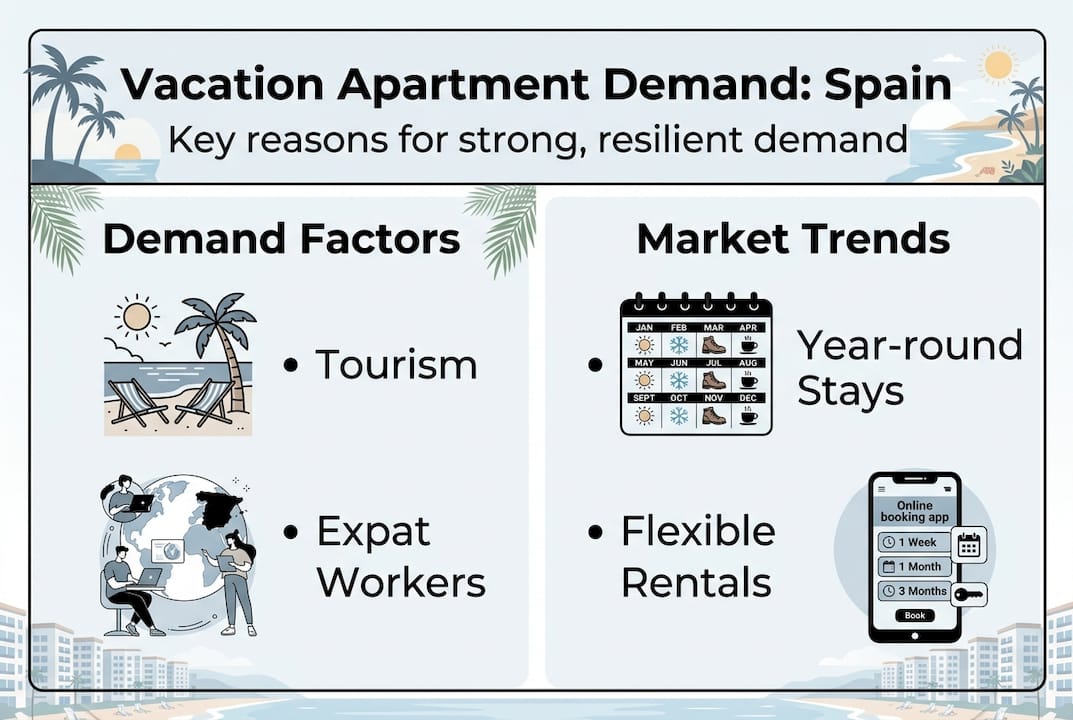
One underappreciated factor is what industry analysts call hidden seasons. Winter snowbirds from Scandinavia, the UK, and Germany book two to four month stays between November and March. Religious and cultural tourism spikes around Semana Santa. Golf tourism operates strongest in spring and autumn. Cycling and hiking travelers prefer shoulder seasons. Each of these niche segments adds occupancy days that traditional summer-only models ignore.
Here are the main trends worth watching closely:
- Tighter supply in city centers as licensing freezes remove units from the legal pool, which may support higher rates for compliant properties
- Growth of mid-term rentals driven by regulatory pressure and demand from remote workers and semi-permanent residents
- Anti-overtourism sentiment in some communities, which can influence future regulatory action and traveler perception
- Platform accountability measures requiring proof of licensing before listings go live, reducing illegal competition for compliant owners
- Growing niche demand in wellness, golf, cycling, and cultural tourism providing year-round occupancy opportunities
Pro Tip: Treat region-specific regulations and current demand data as the starting point for every investment decision or travel search. Generic Spain-wide data masks enormous local variation. What is true in Málaga center is often the opposite in a smaller coastal town 20 kilometers away. When finding vacation apartments or researching investment zones, always drill down to the municipality level. The Costa del Sol remains one of the most search-active regions in Europe for holiday accommodation, and that status is not fading.
A reality check for investors and vacationers
Conventional wisdom still circulates that tourism always wins in southern Spain and that buying a vacation apartment is a near-guaranteed income stream. That framing is dangerously incomplete in 2026.
The investors and travelers who are doing well right now share a common trait: they stopped treating this market as a monolith. They look at the specific neighborhood, the current licensing status, the rental model, and the demand profile for their target tenant. They do not rely on national averages.
Ignoring the long-term vs holiday analysis for your specific location is the most common and expensive mistake we see. A property in a frozen license zone does not become a great short-term rental because the region has high tourist numbers. And a property in an undersupplied rural area does not fail just because a city 40 kilometers away has saturation problems.
Working with local experts who track regulation changes in real time, know which buildings have favorable community votes, and understand which micro-zones have supply gaps is not a luxury. In this environment, it is the most rational move available.
Explore smarter property solutions with SteraM Flats
Ready to put insights into practice? At SteraM Flats, we work directly with both investors and vacationers navigating southern Spain’s dynamic rental market. Whether you want to compare holiday and long-term rental options before committing capital, browse hand-picked vacation rentals in southern Spain, or get tailored guidance on which property type suits your goals, our team brings on-the-ground knowledge that no algorithm can replicate.

Our local expertise covers property acquisition, license management, rental strategy, and tenant sourcing. We help you find your ideal rental property in the zones where opportunity still outpaces regulation. Reach out to our team and let us turn market complexity into a clear path forward for your investment or your next vacation.
Frequently asked questions
Why is demand for vacation apartments in southern Spain so resilient?
Year-round tourism and non-traditional demand from expats, retirees, and remote workers keep occupancy strong across all seasons, not just summer peaks.
What licenses are required to operate a legal vacation apartment in Andalusia?
You need a VUT regional license and national NRUA registration, plus community building approval before listing on any platform.
How are cities like Málaga responding to the vacation rental boom?
Málaga froze new licenses in 43 zones to address saturation and force delistings of non-compliant units operating without valid documentation.
Is the demand trend more positive for short-term or mid-term apartment rentals?
Community pushback and regulations are actively shifting many owners from short-term tourist rentals toward mid-term and long-term lease structures in high-pressure urban zones.
Recommended
- SteraM Flats | How to find holiday rentals in Spain: step-by-step
- SteraM Flats | Long-term vs Holiday Rentals: Smarter Choices for Spanish Property
- SteraM Flats | Find your ideal rental property type in Spain
- SteraM Flats | Rental management checklist: Essential steps for landlords in Spain
- Why Demand Luxury Apartments on the Côte d’Azur