Many foreign buyers assume that purchasing property in Spain works more or less like back home. It doesn’t. Spain operates a layered system of property-related taxes that applies at purchase, during ownership, when you sell, and even when you inherit. Miss one deadline or misread one rule, and you could face fines, back taxes, or unexpected costs that wipe out your projected returns. Whether you’re buying a vacation apartment in Torremolinos, a rental investment on the Costa del Sol, or a primary residence, understanding how Spanish property taxes work is one of the smartest moves you can make before signing anything.
Table of Contents
- The main types of property taxes in Spain
- Tax obligations for non-residents vs. residents
- Property tax implications when buying, selling, or inheriting
- How property tax affects rental income and investments
- A fresh perspective on optimizing Spanish property tax
- Need expert help with property taxes or real estate in Spain?
- Frequently asked questions
Key Takeaways
| Point | Details |
|---|---|
| Core Spanish property taxes | Several taxes apply to property ownership in Spain, including IBI, wealth, and capital gains taxes. |
| Resident vs. non-resident rules | Tax obligations and filing requirements differ significantly between residents and non-residents. |
| Transaction triggers | Buying, selling, or inheriting a property each has specific tax consequences and deadlines. |
| Rental tax strategies | Proper documentation and legal advice help maximize rental income and ensure tax compliance. |
| Expert help matters | Local expertise minimizes risks, avoids common pitfalls, and ensures smoother investment outcomes. |
The main types of property taxes in Spain
Spain imposes multiple property-related taxes — each with its own rules and rates — and they apply at different stages of ownership. The first step is knowing which taxes exist and who is responsible for paying them.
Here’s a quick comparison of the key taxes:
| Tax | Spanish name | Who pays | When it applies |
|---|---|---|---|
| Annual property tax | IBI | All owners | Every year |
| Wealth tax | Impuesto sobre el Patrimonio | High-net-worth owners | Annual declaration |
| Capital gains tax | IRPF/IRNR on gains | Sellers | At point of sale |
| VAT on new builds | IVA | Buyers | At purchase |
| Non-resident income tax | IRNR | Non-resident owners | Annual declaration |
| Transfer tax | ITP | Buyers of resale property | At purchase |
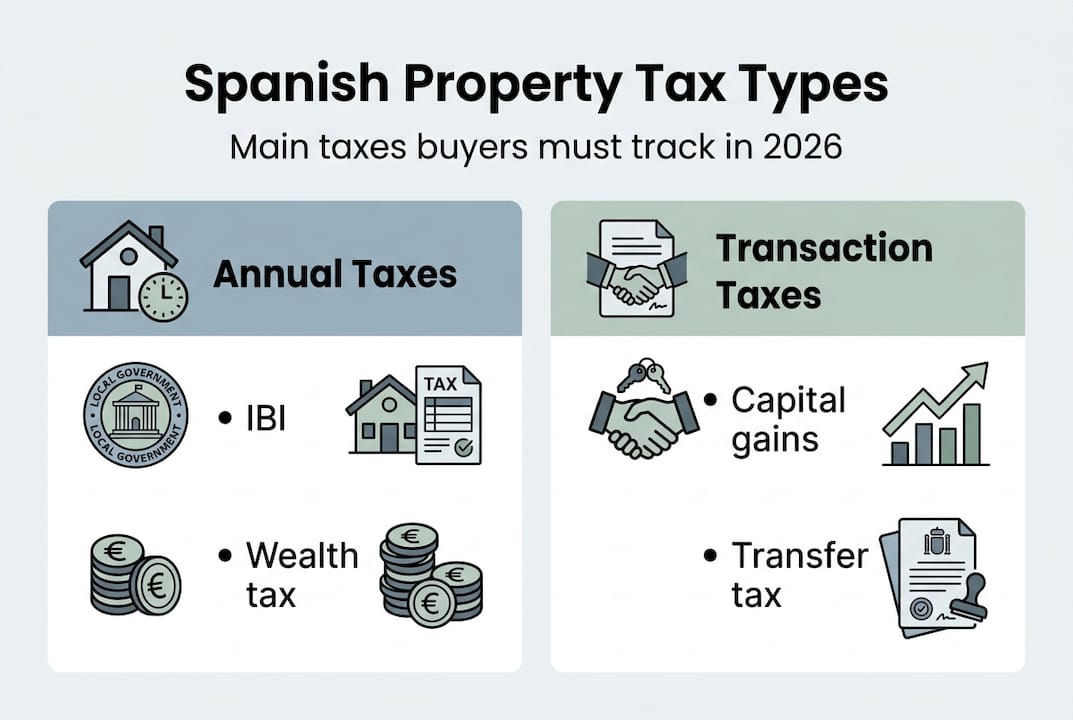
IBI (Impuesto sobre Bienes Inmuebles) is the annual local property tax charged by your municipality. Rates typically range from 0.4% to 1.3% of the property’s cadastral value (the government-assigned base value, usually well below market price). Every owner pays this, resident or not.
Wealth tax applies when your net assets in Spain exceed certain thresholds. Non-residents are taxed on Spanish assets only, while residents are taxed on worldwide assets. Rates vary by region and can reach up to 3.5%.
Capital gains tax hits when you sell at a profit. Residents pay between 19% and 28% depending on the gain size, while non-residents pay a flat 19%.
IVA (VAT) applies only to new-build purchases. The standard rate is 10% for residential properties, plus a 1.5% stamp duty. Buyers of resale properties pay ITP (Transfer Tax) instead, which varies by region but typically falls between 6% and 10%.
Non-resident income tax (IRNR) is charged even when a property sits empty. Spain assumes a notional rental income and taxes it.
The types of Spanish properties you purchase will also influence which taxes apply and at what rates, since residential and investment classifications carry different obligations.
Who is most affected by each tax:
- IBI: All owners, every year, no exceptions
- IVA/ITP: Buyers at the moment of purchase
- Capital gains: Sellers realizing a profit
- Wealth tax: High-value asset holders
- IRNR: Non-resident owners, whether or not they rent
Tax obligations for non-residents vs. residents
With the main taxes identified, let’s examine how rules shift for residents and non-residents.
For tax purposes, you are a Spanish tax resident if you spend more than 183 days per year in Spain or if Spain is the center of your economic activity. Everyone else is a non-resident, regardless of property ownership.
This distinction matters enormously. Here’s a side-by-side look:
| Obligation | Residents | Non-residents |
|---|---|---|
| Annual income declaration | Yes, worldwide income | Only Spanish-source income |
| Rental income tax rate | Progressive rate (19%–47%) | Flat 19% (EU citizens) |
| Wealth tax | Worldwide assets | Spanish assets only |
| Non-resident property tax | Not applicable | Required annually |
| Allowable deductions | Broader range | More limited for non-EU |
Non-residents must pay a specific tax on property owned in Spain, even if it isn’t rented out. Spain calculates a deemed rental yield (typically 1.1% or 2% of the cadastral value) and taxes that amount. It’s a small figure but a mandatory annual filing.
Non-compliance carries real consequences. The Spanish Tax Agency charges interest on late payments and can impose penalties of up to 150% of the unpaid amount for deliberate evasion.
Key bullet points for non-residents:
- File your IRNR return by December 31 each year for the previous tax year
- Appoint a Spanish fiscal representative if required (mandatory for some nationalities)
- Check whether your home country has a double-taxation treaty with Spain
- Keep records of all purchase costs, as these reduce your eventual capital gains bill
Pro Tip: Spain has double-taxation treaties with over 90 countries, including the US and UK. These treaties can prevent you from being taxed twice on the same rental income or capital gain. Always check the treaty terms before filing in both countries.
For those relocating to Spain or buying under specific residential and investment rules, consulting a local gestor (a licensed Spanish tax advisor) early can save significant money and avoid classification errors.
Property tax implications when buying, selling, or inheriting
Understanding ongoing obligations is critical, but it’s also important to know how taxes affect buying, selling, or inheriting property.

Buyers typically pay VAT on new homes, while sellers generally handle capital gains. But the full picture is more nuanced than that single rule suggests.
When buying:
- Identify whether the property is new build (pay IVA at 10%) or resale (pay ITP, typically 6%–10% depending on the region)
- Budget for stamp duty (Actos Jurídicos Documentados), usually 0.5%–1.5% of the purchase price
- Pay notary fees, land registry fees, and legal fees on top of taxes
- Complete all payments within 30 working days of signing the deed
When selling:
- Calculate your capital gain: sale price minus original purchase price, adjusted for eligible costs
- Pay capital gains tax to the Spanish Tax Agency before or at the time of sale
- If you’re a non-resident seller, the buyer is legally required to withhold 3% of the sale price and pay it to the tax authority on your behalf
- Claim a refund if the 3% withheld exceeds your actual tax liability
“A seller who ignores the 3% withholding rule often discovers the problem only after the sale, creating a legal dispute with the buyer and delays in receiving full payment.”
When inheriting:
Spain’s inheritance tax (Impuesto sobre Sucesiones) is managed regionally, meaning rates and exemptions vary dramatically. Andalucía, for example, has introduced near-full exemptions for direct relatives, while other regions remain more expensive. Heirs must pay within six months of the deceased’s death, though extensions are possible.
Pro Tip: Some of the biggest selling process risks involve overlooked taxes at the transaction stage. Working with a local advisor familiar with selling your home in Spain dramatically reduces the chance of surprises.
Also check the Spanish property transfer tax rules before committing to any transaction timeline, since missing payment deadlines triggers automatic penalties.
How property tax affects rental income and investments
Along with buying and selling, many investors rent their properties — here’s what you need to know about tax on rental income.
All rental income from Spanish properties must be declared, and there are specific deductions available depending on your residency status and the type of rental.
Residents report rental income as part of their annual IRPF (income tax) declaration. For long-term residential rentals, residents can deduct 60% of net rental income before calculating tax, which is a significant benefit. Non-residents pay a flat 19% rate (for EU/EEA citizens) on gross rental income, with limited deductions.
Deductible costs for rental properties:
- Mortgage interest on the property loan
- Local taxes including IBI
- Property management fees
- Insurance premiums (see landlord insurance and taxation)
- Maintenance and repair costs (not improvements)
- Utility costs if paid by the landlord
- Depreciation of the building (3% annually for residents)
Vacation rentals carry a different obligation. Short-term tourist lets require a tourist license, and income is taxed quarterly rather than annually. Expenses are deducted proportionally based on rental days versus total days owned. Platforms like those offering vacation rental services help investors navigate the license process and stay compliant.
If you’re still evaluating options, exploring finding Spanish rental properties gives you a broader view of which locations generate the strongest rental yields relative to their tax burden.
Pro Tip: Digital recordkeeping is not optional, it’s a tax-saving strategy. Investors who use structured rental management options rarely miss a deductible expense, while those managing manually often lose thousands in unclaimed costs at filing time.
A fresh perspective on optimizing Spanish property tax
Here’s something most guides won’t tell you: the biggest tax mistakes in Spanish real estate aren’t made at filing time. They’re made months or years earlier, during the planning phase, when buyers assume the rules are simpler than they are.
Seasoned investors in Spain approach property tax the same way they approach location analysis — early, carefully, and with local intelligence. One underused strategy is staggered acquisition: rather than purchasing multiple properties in a single fiscal year, spreading purchases across years reduces exposure to wealth tax thresholds and smooths out capital gains timing.
Region-specific surcharges are another issue that catches buyers off guard. Andalucía’s rates differ from Madrid’s, Catalonia’s, and Valencia’s, and regional governments regularly update these rates. What was true two years ago may not apply today.
The contrarian lesson here is that diligence up front costs far less than fixing problems later. Working with an advisor who knows both the national and regional frameworks, before you sign any agreement, consistently outperforms reactive tax planning. Avoid the seller mistakes to avoid that stem from skipping this step, and lean on specialists who actively manage vacation rental services and investment properties daily — they know which rules changed last quarter.
Need expert help with property taxes or real estate in Spain?
Spanish property taxes are manageable when you have the right team behind you. At SteraM Flats, we work with buyers, sellers, and investors across southern Spain every day, helping them navigate purchases, rentals, and legal compliance without the stress.

Whether you’re ready to list your property for free, explore our curated vacation rentals, or need a full overview of our real estate services — from valuation to legal support — SteraM Flats brings local expertise and hands-on guidance to every transaction. Your investment deserves more than guesswork. Let’s make your next move in Spain a confident one.
Frequently asked questions
What is the IBI tax and who pays it?
The IBI tax (Impuesto sobre Bienes Inmuebles) is a local property tax charged annually by Spanish municipalities, and every property owner must pay it, whether they are a resident or a non-resident.
Are there any property tax exemptions for first-time buyers in Spain?
Some regional governments in Spain provide reduced transfer tax rates or exemptions for first-time buyers and young purchasers, but eligibility criteria and benefit levels vary significantly by region.
How is capital gains tax calculated when selling Spanish property?
Capital gains tax applies to the profit from your sale, calculated as sale price minus purchase price and eligible costs, with rates ranging from 19% to 28% for residents and a flat 19% for non-residents.
Do non-residents need to file a Spanish tax return for their property?
Yes, non-resident property owners must submit annual tax returns in Spain for each property they own, even if the property is never rented out and generates no actual income.
What deductions can I claim on taxes for a rental property in Spain?
Deductions on rental income are available for documented expenses including mortgage interest, maintenance costs, insurance premiums, property management fees, and local taxes like IBI.