Property management jargon can stop a good investment decision cold. You’re reading a lease agreement, a management contract, or a property listing, and you hit terms like “NNN lease,” “CAM charges,” or “Section 13 notice,” and suddenly the whole document feels like a foreign language. This guide covers property management terminology explained in plain terms, built specifically for investors and individuals who need to make real decisions. Whether you’re signing your first rental contract, evaluating a management firm, or building a portfolio in Spain or elsewhere, knowing these terms is the difference between a confident move and a costly mistake.
Table of Contents
- Key takeaways
- Core lease and rental agreement terms
- Property management agreements and fees
- Key financial terms in property management
- Compliance, legal terms, and tenant rights
- Operational and technology terms in property management
- My honest take on learning property management language
- Manage your property with the right support
- FAQ
Key takeaways
| Point | Details |
|---|---|
| Lease terms define your rights | Knowing lessor, lessee, and tenancy types protects you before signing any contract. |
| Management fees follow standard ranges | Fees typically run 8 to 10% of collected rent, plus a separate tenant placement fee. |
| Financial terms shape investment returns | NOI, CAM, and gross vs. NNN lease structures directly affect what you actually earn. |
| Legal notice rules are unforgiving | Missing a rent increase window can lock you into current terms for 12 months. |
| Technology terms matter for oversight | Understanding PMS and reporting terms helps you evaluate how well your manager operates. |
Core lease and rental agreement terms
If you only learn one category of property management terms, make it this one. Lease language defines every right and obligation between you and the other party, and a missed definition can be expensive.
Here are the foundational terms you will encounter in any rental agreement:
- Lease: A binding legal contract between a landlord and tenant that specifies the property, rental amount, duration, and rules of occupancy.
- Lessor: The property owner or landlord who grants the right to use the property. You are the lessor if you own and rent out the unit.
- Lessee: The tenant. The person paying rent in exchange for the right to occupy.
- Rent: The periodic payment the lessee makes to the lessor for the use of the property, typically monthly.
- Security deposit: A refundable sum collected at the start of a tenancy to cover potential damages or unpaid rent. In Spain, this is regulated by law and typically equals one month’s rent for residential properties.
- Fixed-term tenancy: A lease with a defined start and end date, such as 12 months. The tenant has rights through that period, and early termination usually carries penalties.
- Periodic tenancy: A rolling agreement with no fixed end date, renewing week to week or month to month. Under the UK Renters’ Rights Act, periodic tenancy is now standard from the start of a tenancy, replacing fixed terms.
You will also see “tenant placement fee” in your property management contract. This is a separate charge from your monthly management fee. It covers the manager’s work finding and screening a new tenant. Think of it as a hiring cost. Understanding rental agreement types before signing puts you in a much stronger position to compare contracts.
Pro Tip: Always check whether your lease uses a fixed or periodic structure. A periodic tenancy gives the landlord more flexibility to end the arrangement under current law, while a fixed term offers tenants stronger short-term security.
For a full breakdown of which legal documents for rentals you need as a landlord, Steramflats maintains a practical checklist tailored to landlords operating in Spain.
Property management agreements and fees
The property management agreement is the contract between you, the property owner, and the company or individual managing your asset. This document sets the terms of their authority, defines how much you’ll pay, and specifies how either party can walk away. Most investors sign this document without reading it carefully. That’s where problems begin.
Here are the fee types you’ll see in a standard management agreement:
- Management fee: The ongoing monthly charge for day-to-day operations. Management fees typically range from 8 to 10% of collected rent. On a $1,500 monthly rent, that’s $150 per month.
- Leasing fee (tenant placement fee): A one-time fee charged when the manager finds and places a new tenant. This is typically 50 to 100% of one month’s rent per placement.
- Renewal fee: Some agreements charge a smaller fee, often 25 to 50% of one month’s rent, when an existing tenant signs a new lease term.
- Maintenance markup: Some managers add a percentage on top of contractor invoices. Always check whether this applies in your agreement.
The authority clause in your management agreement is just as important as the fees. This section defines what decisions the manager can make independently. Most agreements restrict repair spending to between $300 and $1,500 per incident without prior owner approval. Anything above that threshold requires your sign-off. If your agreement doesn’t include this limit, negotiate one in.
Termination provisions tell you how to exit the relationship. Standard agreements run on a 12-month initial term. Some include a 30 to 90 day notice period, and a few include early termination fees. Read this section before you sign, not after you’re unhappy.

Pro Tip: Ask for a sample agreement before committing to any management firm. Review the authority clause, the fee schedule, and the termination terms side by side with competing firms. The lowest management fee means nothing if the leasing fee and markups make the real cost higher.
| Agreement element | What it controls |
|---|---|
| Management fee | Monthly operational costs, typically 8 to 10% of rent |
| Tenant placement fee | One-time cost per new tenant, usually 50 to 100% of one month’s rent |
| Authority / expenditure limit | Threshold for repairs manager can approve without owner consent |
| Termination clause | Notice period and any exit fees for ending the agreement |
Property management agreement structure protects both the owner and the manager. Statutory obligations like habitability standards and anti-discrimination laws stay with the owner, while the manager handles operational compliance day to day.
Key financial terms in property management
Numbers tell the real story of any investment, but only if you understand what the numbers mean. These are the financial terms that show up most often when evaluating property performance.
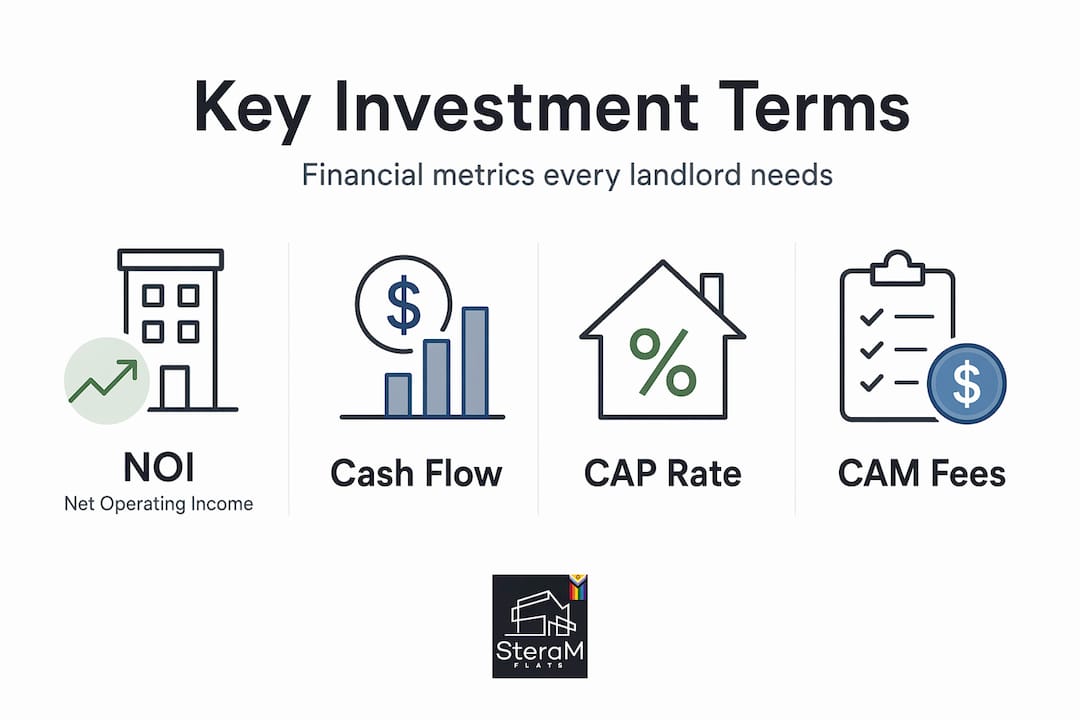
Net Operating Income (NOI) is one of the most cited figures in real estate investment. NOI equals total revenue minus operating expenses, excluding debt service, depreciation, and income taxes. If your property generates $24,000 per year in rent and costs $8,000 to operate, your NOI is $16,000. This figure is used to compare properties regardless of how they are financed.
Cash flow is what you actually take home after the mortgage, fees, and expenses. Positive cash flow means the property earns more than it costs. NOI tells you about the asset’s performance. Cash flow tells you about your personal return after financing.
Lease structures determine who pays operating costs. There are three main types:
| Lease type | Who pays operating expenses |
|---|---|
| Gross lease | Landlord covers taxes, insurance, and maintenance |
| Net lease (NNN) | Tenant pays base rent plus property taxes, insurance, and CAM |
| Modified gross | Costs are split between landlord and tenant by negotiation |
Common Area Maintenance (CAM) charges are costs shared among tenants in multi-unit or commercial properties. Think parking lot upkeep, lobby cleaning, and landscaping. In NNN leases, CAM costs pass directly to tenants and can fluctuate year to year. If you’re a tenant signing a commercial NNN lease, always ask for a CAM cap.
Trust accounting is the practice of keeping tenant security deposits and rent in a separate, designated bank account. Most jurisdictions require this by law. Commingling those funds with operating accounts is not just bad practice. It can be criminal.
Pro Tip: When evaluating a property, always request the trailing 12-month income and expense statement. Calculate NOI yourself before relying on numbers presented in marketing materials. Sellers sometimes exclude non-recurring costs to make NOI look higher.
Compliance, legal terms, and tenant rights
Legal language in property management is where many investors get burned. Not because they break the rules intentionally, but because they don’t know what the rules require. Understanding these terms protects you from costly mistakes and potential liability.
The UK introduced major changes through the Renters’ Rights Act, which took full effect in 2026. These changes have wider implications for how lease terminology functions legally:
- Section 13 notice: The formal notice a landlord must serve to increase rent. Rent increases require at least two months’ notice and can only be applied once every 12 months. The required document is called Form 4A.
- Section 21 eviction (abolished): Previously, landlords could evict tenants without giving a reason with adequate notice. Section 21 no-fault evictions were abolished effective May 2026. Landlords now need a valid legal ground to regain possession.
- Possession grounds: The specific legal reasons a landlord can use to reclaim a property. These must be evidenced, documented, and served correctly.
- Rent challenge right: Tenants now have a formal right to challenge rent increases through a tribunal if they believe the increase is above market rate.
- Pet requests: Tenants have a right to request permission to keep pets. Landlords can refuse only with reasonable justification under the new framework.
Missing a legal notice window can lock landlords into existing terms for a full 12 months. Misusing a possession ground can expose a landlord to criminal liability. These are not administrative technicalities. They carry real consequences.
Understanding compliance requirements is equally critical for the management firms acting on your behalf. A good manager tracks notice windows, documents possession grounds, and keeps your obligations current so you don’t have to.
Pro Tip: If you are a landlord managing properties in multiple jurisdictions, create a compliance calendar. Track notice deadlines, rent review dates, and license renewals. One missed date can cost you more than a year of management fees in lost flexibility or legal fees.
Operational and technology terms in property management
Once you understand leases and finances, the next layer is how a property is actually run. These operational terms appear in management reports, software dashboards, and service contracts.
- Vacancy rate: The percentage of your total rentable units that are unoccupied at any given time. A 5% vacancy rate on a 20-unit building means one unit sits empty. Lower is better, but zero vacancy sometimes signals rents are below market.
- Turnover: The process that occurs when one tenant leaves and another moves in. It includes cleaning, inspection, repairs, and re-listing. High turnover is expensive. Good managers aim for 30 to 45 days from listing to lease signing to keep vacancies short.
- Tenant screening: The process of evaluating a prospective tenant’s credit, income, rental history, and references. Strong screening reduces risk and protects your asset.
- Lease renewal: An extension of the existing lease, either on the same terms or renegotiated. Proactive renewal outreach typically reduces turnover costs significantly.
- Property Management System (PMS): Software used to manage leases, maintenance requests, rent collection, and financial reporting. A capable PMS gives you real-time visibility into your property’s performance.
- Maintenance coordination: The manager’s role in scheduling, tracking, and documenting repair and maintenance work. Effective coordination includes vendor relationships and maintenance cost budgeting to prevent small issues from becoming large ones.
- ERP (Enterprise Resource Planning): Larger management firms and portfolio owners use ERP systems that integrate accounting, operations, and reporting. In these systems, confusing “property” with “subsidiary” in the system configuration breaks financial reporting segmentation.
Good property management is not just rent collection. It is asset management, tenant relations, and financial reporting working together. The technology behind it determines how transparent your data is and how fast problems get addressed.
My honest take on learning property management language
I’ve watched investors sign management agreements without reading the authority clause, then feel blindsided when a manager approves a $1,200 repair they knew nothing about. I’ve seen tenants accept a rent increase notice served on the wrong form, then spend months in a tribunal dispute that a two-minute terminology check would have prevented.
What I’ve found, working with property owners and investors across different markets, is that most terminology confusion comes from one place: people assume the words mean something general, when they actually mean something legally specific. “Lease” sounds simple. But whether it’s fixed or periodic, whether it’s gross or triple net, determines your financial exposure for years.
My advice to both investors and tenants is this: read your documents with a glossary in hand, not after something goes wrong. The terms in this article are not academic. They’re the levers that control how much you pay, how long you’re bound, and what recourse you have when a dispute arises. Professional property management is infrastructure, especially for out-of-state or international investors who can’t physically be at the property. But even with a great manager, you need to understand what you’re reading when reports and contracts land in your inbox.
The investors I’ve seen succeed long-term are not the ones with the most properties. They’re the ones who understood the paperwork early.
— Steramflats
Manage your property with the right support
If working through property management contracts and rental listings feels like a full-time job, that’s because it often is. Steramflats helps property owners in Spain take the guesswork out of the process, from listing to lease management and legal documentation. Whether you’re listing a long-term rental or managing a vacation property in a market like Torremolinos, Steramflats combines local expertise with legal clarity.

You can list your property for free on the Steramflats platform and connect with qualified tenants without navigating the process alone. For investors managing multiple units or operating remotely, the long-term rental services offered by Steramflats include legal support, tenant vetting, and ongoing compliance guidance built for the Spanish market.
FAQ
What does NOI mean in property management?
NOI stands for Net Operating Income. It is total rental revenue minus all operating expenses, not including debt payments or depreciation. It is the primary metric used to evaluate a property’s profitability.
What is a property management fee, and how much is it?
A property management fee is the monthly charge paid to a management company for overseeing daily operations. It typically ranges from 8 to 10% of collected rent, separate from any tenant placement or renewal fees.
What is a Section 13 notice?
A Section 13 notice is the legal document a UK landlord must serve to raise a tenant’s rent. It requires at least two months’ notice and can only be issued once every 12 months under the Renters’ Rights Act.
What is the difference between a gross lease and a NNN lease?
In a gross lease, the landlord covers operating costs like taxes, insurance, and maintenance. In a triple net (NNN) lease, the tenant pays base rent plus those costs separately, including CAM charges.
What is a tenant placement fee?
A tenant placement fee is a one-time charge a property manager collects for finding and placing a new tenant. It typically equals 50 to 100% of one month’s rent and covers advertising, screening, and lease execution.