
Most investors hear “tourist area” and immediately think: seasonal income, empty properties in winter, and unpredictable markets. That instinct isn’t wrong, but it’s incomplete. Understanding why invest in tourist areas matters requires looking past the seasonal dips to a fuller picture. Tourist destinations offer something most residential markets don’t: a built-in audience of motivated spenders who need accommodation, and who pay premium rates to get it. Add capital appreciation driven by limited supply and consistent demand, and you have an asset class that rewards informed buyers considerably.
Table of Contents
- Key takeaways
- Why invest in tourist areas: demand, income, and capital growth
- Key factors that influence profitability
- Legal, regulatory, and financial nuances
- Balancing benefits and risks: practical considerations
- My honest take on tourist area investing
- How Steramflats can support your tourist property investment
- FAQ
Key takeaways
| Point | Details |
|---|---|
| Stable demand drives income | Visitor-driven rental markets create consistent short-term rental revenue, especially in peak seasons. |
| Infrastructure quality matters | Destinations with strong connectivity and government coordination deliver more reliable long-term returns. |
| Property classification is critical | How you classify your property affects your mortgage rate, tax treatment, and rental strategy. |
| Emerging niches outperform | Adventure, luxury, and wellness tourism are growing faster than general tourist markets. |
| Legal due diligence protects returns | Local short-term rental regulations can change suddenly and directly impact your cash flow. |
Why invest in tourist areas: demand, income, and capital growth
The core reason investors target tourist areas comes down to one word: traffic. Locations that draw consistent visitor numbers give you a rental market that doesn’t depend on finding long-term tenants. Platforms like Airbnb and Booking.com have made it possible to fill a coastal apartment in Torremolinos at rates that would be unthinkable under a standard annual lease. The advantages of tourism real estate start with this simple math: more visitors means more occupancy, and more occupancy means higher yield.
Peak season is where vacation rental investors genuinely profit from tourist hotspots. A property in a Mediterranean resort town can command nightly rates two to three times higher in July and August than it would in November. If you manage occupancy well across a full year, the blended rate often exceeds what a comparable long-term rental would generate. Holiday rentals in Spain, for example, consistently show stronger yield metrics in coastal tourist zones than in equivalent inland residential markets.
Beyond income, tourist areas tend to experience above-average capital appreciation. Scarcity plays a role here. Beachfront and city-center tourist locations are physically constrained. You cannot build more coastline. That supply limitation, combined with sustained visitor demand, pushes property values upward over time in ways that purely residential neighborhoods often don’t match.

That said, you should be honest with yourself about the seasonality challenge. Markets like the Costa del Sol have shoulder and off-peak periods where occupancy drops materially. Savvy investors model their returns conservatively, using off-peak months as maintenance windows and budgeting accordingly. Market saturation is also a real risk in oversupplied tourist zones where too many short-term rentals compete for the same visitors.
Pro Tip: Run your income projections using three scenarios: a strong peak season, an average year, and a below-average year with two slow months. If the investment still works in scenario three, you have a resilient asset.
Key factors that influence profitability
Not all tourist destinations perform equally as investment locations. The difference between a property that generates consistent returns and one that underperforms often comes down to factors that have nothing to do with the view.
Infrastructure and connectivity
Coordinated infrastructure investment at the destination level is one of the strongest predictors of sustained investment returns. A World Bank review of 85 tourism projects found that integrated approaches combining infrastructure, local business support, and government coordination consistently outperformed isolated development efforts. Translation for investors: a destination with a functioning airport, reliable transport links, and active local tourism planning is a safer bet than a scenic location that lacks those foundations.
Tourism subsegment growth
The kind of tourism a destination attracts matters as much as the volume. Generic beach tourism is highly seasonal. Adventure, luxury, and wellness travel draw visitors with higher spending power and often travel in off-peak periods. About 46% of travelers plan to increase spending on adventure travel, according to McKinsey’s 2025 analysis. A property positioned to serve those guests, whether through location, design, or amenities, can capture demand that commoditized vacation rentals miss entirely.
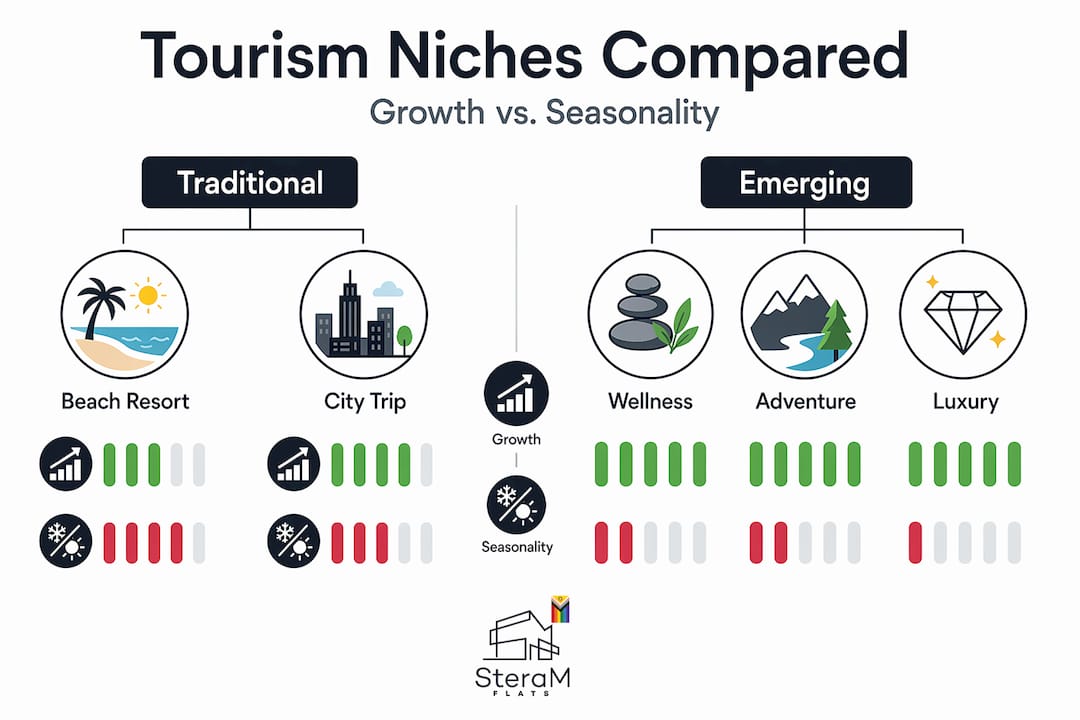
| Destination type | Seasonal risk | Income potential | Appreciation outlook |
|---|---|---|---|
| Beach resort town | High | Strong in peak | Moderate to high |
| City tourist center | Low to moderate | Year-round base | High |
| Luxury/wellness retreat | Low | Premium rates | High |
| Adventure tourism hub | Moderate | Growing niche | Strong |
Local economic integration
Tourism employment multipliers are substantial. Destinations where tourism supports a thriving local economy, with restaurants, services, and small businesses built around visitors, attract more repeat travelers and sustain demand more effectively than resort-only enclaves. For investors, that local economic vibrancy translates directly into stronger occupancy rates.
Pro Tip: Before committing to a tourist area property, check whether the local government has an active destination management plan. Destinations with formal tourism strategies tend to attract sustained investment in infrastructure, which protects your asset’s long-term value.
Legal, regulatory, and financial nuances
This is where many investors make expensive mistakes. The benefits of investing in tourism are real, but they depend on getting the legal and financial structure right from the start.
How your property is classified changes everything. The distinction between a primary residence, a second home, and an investment property affects your mortgage eligibility, the interest rate you qualify for, your tax obligations, and what rental activity you are legally permitted. Property classification determines whether you can deduct operating expenses, how depreciation works, and whether rental income is treated as passive or active income for tax purposes. Misclassifying, even accidentally, can create tax liabilities you didn’t budget for.
Short-term rental regulations are the other major variable. Many popular tourist destinations have introduced restrictions in recent years in response to housing affordability concerns. Some Spanish municipalities now require a specific tourist rental license, limit the number of days a property can be rented annually, or restrict vacation rentals in certain residential zones. Rental strategy compliance with local laws is a due diligence step you cannot skip. Regulations in this space have changed quickly, and properties that were legally rentable two years ago may face new restrictions today.
Here is a practical checklist for navigating the legal landscape before you purchase:
- Confirm the zoning classification of the specific property, not just the neighborhood.
- Verify whether a tourist rental license is required and whether one is available for the property.
- Check local ordinances on maximum rental nights per year and any homeowner association rules.
- Understand how property taxes in Spain apply to your specific classification.
- Model returns under two scenarios: full short-term rental activity and restricted activity, to stress-test your projections.
Pro Tip: Hire a local lawyer with specific experience in tourist area real estate, not a generalist conveyancer. The cost is small relative to the protection it provides against regulatory surprises.
Balancing benefits and risks: practical considerations
The reasons to invest in travel destinations are strong, but they work best for investors who go in with clear eyes about what they are taking on. Here is a structured way to think about it.
Rental income and appreciation. The combination of short-term rental premium pricing and long-term capital growth gives tourist area properties a dual return profile that pure residential assets often lack. Tourism-driven property value increases have historically outpaced inflation in well-located coastal and urban tourist zones.
Operating costs. Higher turnover means higher costs. Cleaning, maintenance, property management fees, and marketing expenses for vacation rentals are meaningfully above what a standard long-term rental incurs. Operating expense benchmarks for tourist-area short-term rentals can run 35 to 50 percent of gross revenue when all costs are included. Build this into your model before comparing to other asset classes.
Regulatory and market risk. Seasonal demand fluctuations, local competition from new supply, and the possibility of tighter short-term rental rules all represent real risks. Diversifying across a portfolio of properties or targeting year-round destinations reduces exposure to any single variable.
Lifestyle benefits. This one gets underweighted in financial analysis. Owning a property in a place you enjoy visiting has tangible personal value. That value is real even if it doesn’t appear on a spreadsheet. For many investors, the ability to use their property during preferred travel windows, while generating income the rest of the year, is a core part of the investment thesis.
Long-term demand outlook. Global travel demand continues to grow across most forecasts. Investors who align with experience-led tourism trends and position their properties for emerging traveler preferences are better placed for durable returns than those buying generic beach apartments in saturated markets.
My honest take on tourist area investing
I’ve worked with enough property investors in tourist areas to tell you what the glossy brochures consistently leave out. The investors who do well here are not the ones who find the prettiest location. They are the ones who did the homework on infrastructure and local regulation before they fell in love with a property.
What I’ve found again and again is that visitor numbers alone are a misleading proxy for investment quality. A destination can attract millions of tourists and still be a mediocre investment market because the local government has capped short-term rental licenses, or because a surge in supply has driven down nightly rates. The destinations that generate real, sustained returns for investors tend to have something specific: active coordination between local government, tourism agencies, and private investment. That combination is rarer than it sounds.
Seasonality is also routinely underestimated. Investors run their projections on peak-month occupancy and are genuinely surprised when two slow months in winter compress their annual yield. The investors I’ve seen succeed treat the off-season not as a problem but as a planning parameter. They budget for it, use it for maintenance, and structure their financing so that a quiet February doesn’t create cash-flow stress.
My strongest advice: stop thinking about “tourist areas” as a category and start thinking about specific destinations, specific tourism niches, and specific regulatory environments. The gap between the best and worst tourist area investments I’ve seen is enormous, and it almost never comes down to location aesthetics. It comes down to due diligence, classification, and local knowledge.
— Steramflats
How Steramflats can support your tourist property investment
Owning a vacation property in a tourist area is one thing. Running it profitably while staying compliant with local regulations is another challenge entirely.

Steramflats offers full-service vacation rental and real estate services for investors targeting tourist areas in southern Spain, with deep local expertise in markets like Torremolinos. From securing the right tourist rental license to managing occupancy and handling maintenance, the team removes the operational complexity that catches many first-time vacation rental investors off guard. Steramflats also provides property valuation, legal documentation support, and investment advisory services to help you structure your purchase correctly from day one. If you are serious about the benefits of investing in tourism and want a local partner who knows the southern Spain vacation market in depth, explore what Steramflats can do for your investment.
FAQ
Why invest in tourist areas instead of standard residential markets?
Tourist areas offer a dual return from short-term rental income at premium rates and long-term capital appreciation driven by limited supply and consistent demand. Standard residential markets typically provide only one of these at a time.
What are the biggest risks of investing in vacation rental properties?
The main risks are seasonal income fluctuations, higher operating costs compared to long-term rentals, and regulatory changes that can restrict short-term rental activity with little notice.
How does property classification affect returns in tourist areas?
Property classification as a primary residence, second home, or investment property changes your mortgage terms, tax obligations, and what rental activity is permitted, so getting it right at purchase is critical.
Which tourism niches offer the strongest investment potential in 2026?
Adventure, luxury, and wellness tourism are outpacing general beach tourism in growth. McKinsey data shows 46% of travelers plan to spend more on adventure travel, signaling durable demand in those segments.
Do I need a special license to rent my property short-term in Spain?
Most tourist-heavy municipalities in Spain now require a specific tourist rental license, and some zones have stopped issuing new ones. Always verify licensing availability for the specific property and municipality before purchasing.
Recommended
- SteraM Flats | Short-term rentals: Opportunities for investors and tourists
- SteraM Flats | How Holiday Rentals Boost Property Investment Returns in Spain
- SteraM Flats | Vacation apartment demand in southern Spain: key drivers
- SteraM Flats | Long-term vs Holiday Rentals: Smarter Choices for Spanish Property