Empty calendars and one-star reviews are the silent killers of rental profitability. Many property owners in Spain launch their vacation rentals with genuine enthusiasm, only to find themselves overwhelmed by inconsistent bookings, frustrated guests, and revenue that flatlines after the first summer season. The good news is that these problems are almost always fixable. With the right tools, a structured approach, and a clear understanding of what guests actually want, you can turn a struggling rental into a consistent, high-yield asset. This guide walks you through exactly how to do that.
Table of Contents
- Essential tools and requirements for vacation rental management
- Step-by-step: Setting up your rental for success
- Optimizing guest experience and operations
- Scaling, troubleshooting and common pitfalls
- What years of rental management in Spain taught us
- Next steps: Get professional support for your Spanish vacation rental
- Frequently asked questions
Key Takeaways
| Point | Details |
|---|---|
| Smart automation | Automated tools and instant communication dramatically improve occupancy and guest satisfaction. |
| Evidence-based upgrades | Professional photos and core amenities like WiFi directly boost bookings and revenue. |
| Know your metrics | Tracking performance indicators such as ADR, RevPAR, and review scores is vital for maximizing returns. |
| Scale wisely | Self-management works for a single property but agencies or systems are needed for scaling up. |
| Guest satisfaction first | Prioritize fast responses and proactive service to lift ratings, repeat bookings, and long-term profits. |
Essential tools and requirements for vacation rental management
Running a successful vacation rental in Spain is not just about having a nice property. It requires a specific stack of technology, services, and legal compliance measures working together in the background.
Technology you cannot skip
A channel manager syncs your availability calendar across platforms like Airbnb, Booking.com, and Vrbo in real time, eliminating the double-booking nightmare that plagues self-managed rentals. A property management system (PMS) goes further, centralizing guest communications, automated check-in instructions, cleaning schedules, and financial reporting. Tools like Avantio have allowed agencies to scale to 400+ properties with documented gains of 38% more revenue and 42% higher occupancy, proving that automation is not a luxury but a foundation for growth.
Dynamic pricing software is equally essential. You should not be manually adjusting rates every week. These tools analyze competitor pricing, local demand signals, and seasonal patterns to set the optimal rate for each night. Properties using dynamic pricing consistently outperform static-rate competitors in both occupancy and average daily rate (ADR).
Services and compliance
You need reliable cleaning and maintenance partners. A single bad cleaning report can tank your review score and suppress your listing in platform search results for weeks. Beyond cleaning, compliance with Spanish vacation rental law requires proper licensing, guest registration with local authorities, and in many regions, insurance tailored to short-term lets. Use our rental management checklist to make sure you have every box checked before your first guest arrives.
Amenities that move the needle
Professional photos and quality amenities like fast WiFi and a dedicated workspace can boost bookings by 25% and push your ADR into a higher bracket. Benchmark data shows occupancy rates across Spanish markets ranging from 59% to 83%, ADR from €110 to €204, and RevPAR (revenue per available room) from €67 to €107. These numbers are not fixed. Your amenities, photos, and response speed all influence where you land on that spectrum. Review your property management guide to understand how to position your property at the top end.
| Tool | Primary function | Impact on performance |
|---|---|---|
| Channel manager | Calendar sync across platforms | Eliminates double bookings |
| PMS (e.g., Avantio) | Centralized operations | Scales to 400+ units |
| Dynamic pricing | Automated rate optimization | Higher ADR and occupancy |
| Professional photography | Visual listing quality | Up to 25% more bookings |
| Cleaning service | Guest satisfaction | Protects review scores |
Pro Tip: Automate your guest communication sequences from the first booking confirmation through post-stay review requests. A single saved message template sent at the right time can handle 70% of standard guest inquiries without you lifting a finger.
Step-by-step: Setting up your rental for success
With the necessary tools and requirements in place, it is time to execute a launch strategy that sets your property apart from the hundreds of similar listings competing for the same guests.
Step 1: Research your market benchmarks
Before you set a single price, pull local occupancy and ADR data for your area. In Málaga, a well-managed property can generate between €18,000 and €30,000 per year in gross revenue, while Barcelona properties can reach €52,000. Knowing your target gives you a revenue goal to work backward from, rather than guessing.
Step 2: Apply dynamic pricing from day one
Use a tool that benchmarks your nightly rate against comparable listings within your neighborhood. Avoid the common mistake of setting a flat rate and leaving it alone. Peak season, local festivals, and school holidays in key source markets like Germany and the UK all create demand spikes you can capitalize on with the right software.
Step 3: Stage and photograph the property professionally

You get roughly three seconds to catch a traveler’s eye on any listing platform. Invest in a professional photographer who understands vacation rental photography, which means wide-angle shots of bright, staged rooms, not dark phone photos of unmade beds. Consider the vacation rental upgrades that pay for themselves fastest, including a decent coffee machine, blackout curtains, and reliable high-speed internet.
Step 4: List on multiple platforms with a synced calendar
Never rely on a single platform. Each has a different audience. Airbnb attracts younger travelers and families. Booking.com pulls in last-minute bookers and European guests. Vrbo skews toward longer-stay American visitors. A channel manager keeps all three calendars in sync so you never accidentally double-book.
Step 5: Handle compliance before you open
Spanish regional laws vary significantly. Andalusia, Catalonia, and Valencia each have different licensing requirements and guest registration protocols. Getting your license sorted before your first booking is not optional. It is the foundation that protects your investment.
| Revenue scenario | Gross annual income | Net yield |
|---|---|---|
| Tourist rental (well-managed) | €18,000 to €30,000 | 4% to 7% |
| Long-term rental (same property) | Lower gross | 3.5% to 5% |
| Barcelona top-performer | Up to €52,000 | Varies by cost |
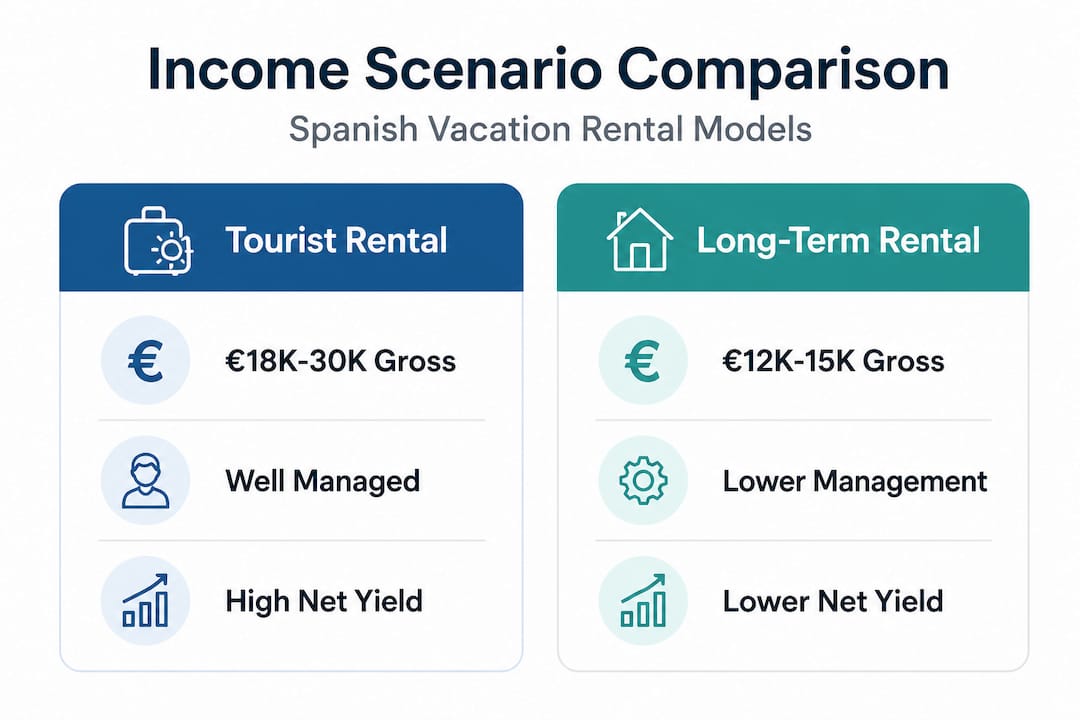
Annual expenses for a Spanish vacation rental typically fall between €8,000 and €14,000, covering cleaning at roughly €40 per stay, platform commissions of 12% to 15%, and utilities. Net yields for tourist lets land at 4% to 7%, compared to 3.5% to 5% for long-term contracts. The math clearly favors vacation rentals when managed correctly. Dig deeper into boosting investment returns and see the full rental strategy comparison to decide what model fits your goals.
Pro Tip: Track your net yield quarterly, not just annually. Seasonal cash flow peaks in summer and valleys in winter can mask underlying performance issues that are far easier to fix mid-year than in January.
Optimizing guest experience and operations
Launching your rental is just the start. Consistent excellence in guest service and operations separates the best-performing properties from average ones, and the data behind this is more striking than most owners realize.
Response time is your ranking engine
Replying to guest inquiries within one hour boosts your chances of securing instant bookings by 116% and improves your visibility in platform search algorithms. This single metric has a bigger impact on revenue than most property upgrades. AI-powered messaging tools and unified inboxes can automate up to 70% of standard guest messages, including check-in instructions, house rules, and local recommendations. You stay responsive around the clock without being chained to your phone. Review your options on our booking platform comparison page to understand where automation fits.
Maintenance as a guest satisfaction strategy
Do not wait for a guest to complain about a broken shower or a flickering lightbulb. Proactive maintenance, meaning monthly property inspections and rapid issue resolution, prevents the kind of one-star reviews that take months to dilute. Agencies that scaled to 400+ properties consistently cited proactive maintenance as a non-negotiable operating standard.
Personalized touches that guests remember
The basics are required: clean towels, functioning appliances, fast WiFi. What drives five-star reviews is the extra layer. A welcome note with local restaurant recommendations. A bottle of local olive oil on the kitchen counter. A printed guide to the neighborhood written in your guests’ language. These touches cost almost nothing but read as genuine hospitality in reviews.
Essential amenities checklist for Spanish vacation rentals:
- High-speed WiFi with the password clearly displayed
- Air conditioning (non-negotiable in southern Spain)
- Fully equipped kitchen with good quality cookware
- Workspace or desk with good lighting
- Blackout curtains in all bedrooms
- Washing machine and dryer
- Local area guide in multiple languages
- Welcome kit (coffee, tea, water, a small local snack)
Guest satisfaction consistently and directly lifts ADR and occupancy. Properties with review scores above 4.8 out of 5 command premium nightly rates and appear at the top of platform search results without paying for promoted listings.
Consider pairing your amenity investment with guest comfort upgrades that also reduce energy costs, like smart thermostats and LED lighting throughout.
Pro Tip: Treat your review score as a live business KPI. Every week, review your last five guest interactions and ask: what could have been better? One consistent answer, like slow check-in instructions, is a process fix that pays dividends for every future booking.
Scaling, troubleshooting and common pitfalls
Once your operations are running efficiently, consider how to scale up or avoid mistakes that are common among both new and experienced property managers alike.
Self-management versus agency management
Self-management gives you full control and higher margins in the short term. But the workload escalates quickly. Coordinating cleaners, responding to 11 PM messages, managing maintenance emergencies, and staying current with compliance updates can easily become a full-time job before you own more than two properties. Agencies take 20% to 30% of your rental income but bring systems, contacts, and compliance expertise that self-managers build slowly and sometimes painfully.
| Management mode | Revenue share | Workload | Scalability | Compliance risk |
|---|---|---|---|---|
| Self-managed | 100% | Very high | Low | Higher |
| Hybrid (tools + VA) | 90% to 95% | Moderate | Medium | Moderate |
| Full agency | 70% to 80% | Low | High | Lower |
Check the latest vacation rental trends in southern Spain and review your rental management options before committing to a management structure.
Common pitfalls to avoid
- Overbooking due to unsynchronized calendars across platforms
- Slow response times that hurt platform rankings and lose bookings to competitors
- Inconsistent cleaning standards that generate bad reviews and suppress future visibility
- Ignoring license renewal deadlines which can result in fines or forced listing removal
- Setting static prices and missing revenue spikes during local events and peak periods
- Underinvesting in photography and losing clicks to better-presented competitors
Pro Tip: Set a quarterly operations audit. Review your occupancy rate, your top complaints from guest reviews, and your cleaning partner’s performance. Three hours every quarter prevents six months of preventable revenue loss.
What years of rental management in Spain taught us
Here is the uncomfortable truth that does not appear in most vacation rental guides: the owners who struggle most are not the ones with bad properties. They are the ones who underestimate the operational complexity and overestimate how much location alone will save them.
Conventional wisdom says anyone with a decent apartment near the beach can earn passive income from vacation rentals. That is misleading without a serious qualifier: you need systems first. Without automated communications, a reliable cleaning partner, dynamic pricing, and a compliance framework, what you have is not a passive income stream. It is a second job with irregular hours and guest reviews as your performance reviews.
The insight that actually moves the needle is this: guest satisfaction consistently outweighs location and interior design in determining your revenue ceiling. We have seen beautifully decorated properties in prime locations average 3.9 stars because of slow responses and mediocre cleaning. We have also seen modest properties in secondary locations averaging 4.9 stars and fully booked three months in advance because the operations were tight and the guest experience was predictable and personal.
Smart automation is not about removing the human element. It is about making the human element available at the right moments. Let the PMS handle check-in instructions and wifi passwords. Use AI messaging to handle frequently asked questions. Then invest your actual time in the things guests remember: the welcome experience, the local recommendations, and the rapid response when something does go wrong.
Investment returns data backs this up clearly. Properties managed with integrated systems and a guest-first mindset consistently outperform comparable units that are managed reactively. Reviews are your real-time business performance indicators. A 4.6 average is not “pretty good.” In a competitive market, it is the difference between appearing on page one and page four of search results.
The owners who build durable, scalable rental income in Spain are the ones who treat this like a hospitality business from day one. Not a side project.
Next steps: Get professional support for your Spanish vacation rental
Managing a vacation rental profitably takes more than a great property. It takes the right systems, the right partners, and ongoing attention to performance data.
At SteraM Flats, we support property owners across Spain with everything from licensing and compliance to full operational management and guest experience optimization. Whether you are launching your first rental or looking to scale an existing portfolio, our team handles the complexity so you can focus on returns. Explore our vacation rental services and see what professional management looks like in practice. Review our full property management services offering, or discover the cost-saving upgrades that improve guest comfort without breaking your budget. Contact us for a custom management solution tailored to your property and goals.
Frequently asked questions
What are the key performance indicators to track for vacation rentals in Spain?
You should monitor occupancy rate, ADR, RevPAR, and guest review scores to gauge performance. Benchmark data shows occupancy ranging from 59% to 83%, ADR from €110 to €204, and RevPAR from €67 to €107 across Spanish markets.
What are typical annual expenses for vacation rentals in Spain?
Annual expenses typically fall between €8,000 and €14,000, covering cleaning at around €40 per stay, platform commissions of 12% to 15%, and utilities. Net yields for tourist rentals reach 4% to 7%.
How does response time impact bookings and rankings?
Responding within one hour increases instant bookings by 116% and improves your ranking in platform search results. AI messaging tools can automate up to 70% of standard guest inquiries.
Should I manage my rental myself or hire an agency?
Self-management keeps more revenue but can become a full-time job quickly as your portfolio grows. Agencies enable compliance and scalability but charge 20% to 30% of rental income.
Does investing in amenities actually increase bookings?
Yes. Properties with WiFi and dedicated workspaces see measurable gains in both occupancy and ADR. Amenities like air conditioning and a well-equipped kitchen are baseline expectations in competitive Spanish markets.