Spain’s short-term rental market has entered its strictest enforcement era yet. With over 80,000 unregistered listings ordered off platforms in early 2026 alone, and fines reaching €600,000 for non-compliant owners, the confusion surrounding holiday home registration has never carried heavier consequences. If you own a property in Spain and rent it out, even occasionally, understanding why registration is legally required and what it does for your rental business is no longer optional. This article walks you through everything you need to know.
Table of Contents
- Why registration of holiday homes is mandatory in Spain
- Benefits of registering your holiday home
- Risks and penalties for not registering your property
- How registration protects your revenue and reputation
- Our perspective: Registration is your advantage, not just a legal hurdle
- Get expert help with holiday home registration and management
- Frequently asked questions
Key Takeaways
| Point | Details |
|---|---|
| Registration is mandatory | You must register your holiday home to list legally and avoid heavy penalties in Spain. |
| Major platforms enforce compliance | Unregistered properties risk delisting from sites like Airbnb and Booking, losing income potential. |
| Compliance safeguards your investment | Registration protects your reputation, revenue, and offers better legal and tax advantages. |
| Penalties for non-compliance are severe | Fines can reach €600,000, and authorities are actively removing illegal listings. |
| Expert help available | Professional services guide you through registration and maximize your rental success. |
Why registration of holiday homes is mandatory in Spain
Spain does not treat short-term rentals as a casual side activity. The law classifies them as a regulated tourism activity, meaning your property must be formally registered with the relevant regional authority before a single guest checks in. The specific rules vary by autonomous community. Andalusia, for instance, requires registration with the Registro de Turismo de Andalucía, while Catalonia and the Balearic Islands have their own systems. But the principle is the same everywhere: operate first, register later is not an option.
This has been true for years, but enforcement was historically patchy. That changed dramatically in 2024 and 2025 when Spanish authorities began sharing data directly with platforms like Airbnb and Booking.com. The platforms are now legally required to verify registration numbers before publishing listings. When a listing lacks a valid registration number, it gets removed. Not suspended. Removed.
The scale of enforcement tells the whole story. Over 65,000 listings were removed in 2025, and 80,000 more followed in early 2026. These are not edge cases. They represent a structural shift in how Spain regulates the tourism economy.
Here is what non-compliance can cost you:
- Fines up to €600,000 depending on the region and severity of the violation
- Immediate delisting from Airbnb, Booking.com, Vrbo, and similar platforms
- Revocation of the NRUA (Non-Resident Urban Accommodation Permit), which can be permanent
- Tax audits triggered by undeclared rental income
- Criminal liability in cases involving repeat violations or fraud
Understanding Spanish property registration rules up front protects you from all of the above. The cost of registration, in time and fees, is minimal compared to any one of these outcomes.
Benefits of registering your holiday home
Registration is often framed as a burden. In practice, it is the foundation of a profitable, sustainable rental business. Owners who register gain access to tools, platforms, and legal protections that unregistered properties simply cannot touch.
Platform access and revenue visibility
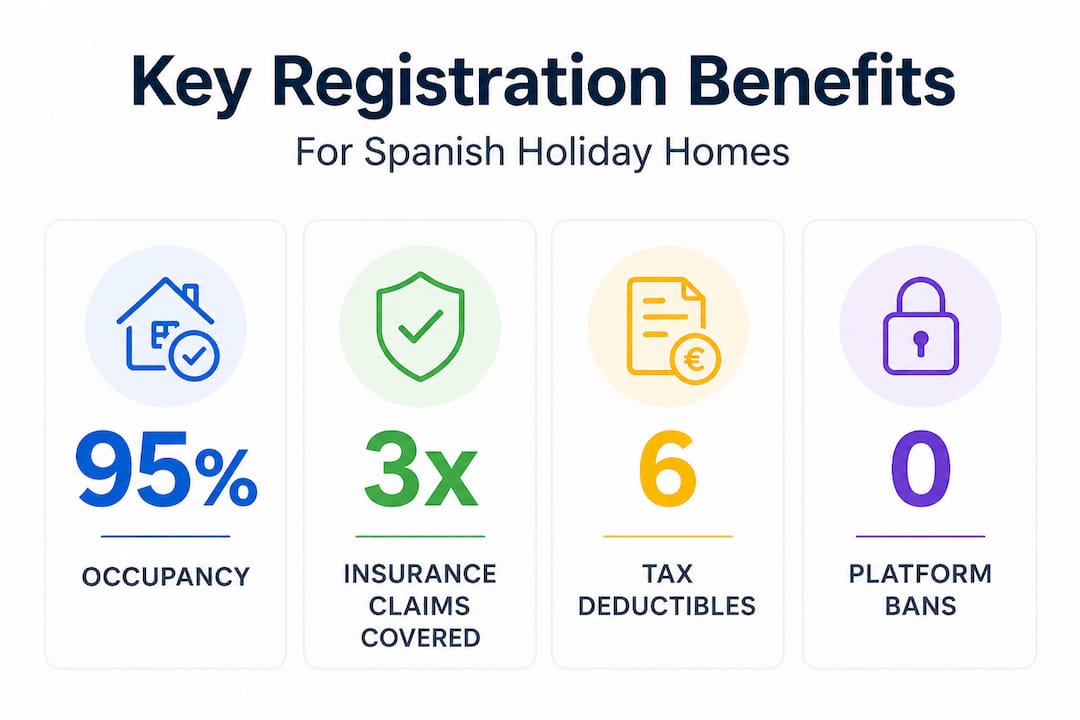
The most immediate benefit is straightforward: only registered properties can stay listed on major booking platforms. Airbnb, Booking.com, and Vrbo now require a valid registration number in your listing. Without it, your property disappears from the market entirely. Given that 145,000+ listings were removed across 2025 and 2026, being registered is the single most important factor keeping your rental income intact.
Beyond platform access, registered properties attract more bookings. Guests increasingly filter for compliant listings because they want assurance that the rental is safe, legal, and insurable. A registration number in your listing title signals legitimacy in a way that builds immediate trust.
“The best investment you can make in your holiday property is ensuring it operates within the law. Registration is not paperwork. It is your license to earn.”
Legal peace of mind and insurance advantages

Registered owners operate under a documented legal framework. If a guest disputes a booking, causes damage, or raises a complaint, you have standing. Unregistered owners have almost no legal recourse because they were operating illegally in the first place. Most insurance providers also refuse to cover short-term rental activities unless the property holds a valid tourism license. Registered properties can access specialized vacation rental insurance, which covers liability, property damage, and income loss.
Tax deductions available to registered owners
Registered rental properties unlock legitimate tax deductions. Maintenance costs, platform fees, furniture, utilities, and property management fees can all be deducted from your taxable rental income. Unregistered owners cannot claim these deductions, and if discovered, they face back taxes on gross revenue without any of the offsets.
Pro Tip: Work with a local gestor (tax advisor) to set up your rental income reporting from day one. Registered owners who report correctly often find their effective tax rate is far lower than expected once deductions are applied.
Here is a quick comparison to illustrate the difference:
| Factor | Registered property | Unregistered property |
|---|---|---|
| Platform listings | Active and visible | Subject to removal |
| Insurance coverage | Full tourism rental coverage | Typically excluded |
| Tax deductions | Available on all rental expenses | Not applicable, audit risk |
| Guest trust | High, verified listing | Lower, no assurance |
| Fine exposure | None when compliant | Up to €600,000 |
| Legal protection | Strong | Minimal |
The vacation rental advantages for registered owners go well beyond avoiding penalties. They translate into higher occupancy, better pricing power, and a business that can actually grow. If you want to take the operational complexity off your plate entirely, professional management services handle licensing, compliance, guest communication, and revenue optimization as a complete package.
Risks and penalties for not registering your property
Skipping registration does not just create legal risk. It creates business risk that can wipe out years of rental income in a single enforcement action. The penalties in Spain are structured to hurt, and regional governments have shown they are not shy about applying them.
Here is how the penalty structure typically breaks down:
| Violation type | Potential fine range |
|---|---|
| Operating without registration | €2,000 to €18,000 |
| Failure to display registration number | €1,000 to €6,000 |
| Repeated or serious violations | Up to €150,000 |
| Systemic or large-scale non-compliance | Up to €600,000 |
The financial penalties are only part of the picture. The operational consequences can be just as damaging:
- Immediate platform delisting. Once Airbnb or Booking.com removes your listing, reinstatement is not automatic. You must re-register, re-submit documentation, and wait for approval. During that period, you earn nothing.
- NRUA revocation. Losing your Non-Resident Urban Accommodation Permit can bar you from legally operating a short-term rental in that property again. In some regions, reapplication is restricted for a set number of years.
- Tax audits triggered by rental income. Spain’s tax agency (Agencia Tributaria) cross-references platform data with income declarations. If you received rental income but declared nothing, an audit is likely. Penalties on undeclared income include the unpaid tax plus interest plus fines.
- Guest complaints escalating to inspections. A single complaint from a neighbor or guest about noise, overcrowding, or illegal operation can trigger an inspection. Inspectors arriving at an unregistered property have authority to shut it down immediately.
- Loss of future rental income. Once a property is flagged as non-compliant in official records, its future marketability suffers. Buyers, insurers, and management companies treat its history as a liability.
Understanding the full picture of rental income and penalties matters when you are calculating whether registration is worth the effort. The math is never close. Also, understanding property taxes in Spain helps you see how declaring rental income correctly actually works in your favor once deductions are applied. Use a compliance checklist for landlords to track every requirement across the registration and ongoing operation of your rental.
Pro Tip: Do not assume that because your property is in a rural area or a small town, enforcement won’t reach you. Regional tourism inspectors have expanded their reach significantly since 2024, and neighbor reporting has increased.
How registration protects your revenue and reputation
Compliance is not just about avoiding trouble. It actively supports the growth of your rental business in ways that compound over time. Registered owners build a track record. They accumulate reviews, maintain platform rankings, and develop the kind of guest reputation that drives repeat bookings and word-of-mouth referrals.
When a guest books a registered property, they have confidence in what they are getting. The listing is verified, the property meets legal standards, and the owner is accountable. This accountability actually reduces cancellations, because guests are less likely to worry about last-minute scams or substandard conditions that fall outside any legal framework.
Consider these direct benefits that registration delivers to your day-to-day operation:
- Uninterrupted booking flow. No surprise delisting means no gap in your calendar and revenue. Owners who registered early in 2025 watched competitors disappear from platforms while their own bookings continued without disruption.
- Higher review scores. Properties that meet legal standards tend to be better maintained and better managed. Guests notice this and reflect it in their ratings. Higher ratings improve your platform ranking, which drives more bookings organically.
- Platform badge and visibility. Some platforms now highlight verified, registered listings with trust badges. This makes your property more clickable in search results, a real competitive edge in a crowded market.
- Stable long-term income. As enforcement continues to tighten, the pool of competing listings will shrink further. Registered owners who stay in the market gain from reduced competition and can often command higher nightly rates as a result.
The data on vacation apartment demand in southern Spain shows that tourist interest remains strong even as inventory contracts. Registered owners are positioned to capture a growing share of a stable demand pool. That is the definition of a favorable market position.
The platform verification requirement, which removed over 145,000 listings across 2025 and 2026, functions as a natural filter. The owners left on the platforms are increasingly those who invested in compliance. And that group is earning more per property as a result.
Our perspective: Registration is your advantage, not just a legal hurdle
We have worked with property owners at every stage of this regulatory shift. And one thing stands out clearly: the owners who framed registration as a strategic decision rather than a bureaucratic chore are the ones building sustainable rental businesses right now.
Most people in the market still see compliance as overhead. A form to file. A fee to pay. A box to check. That mindset misses something important. When tens of thousands of listings get removed from platforms in a single enforcement wave, the registered owners who remain do not just survive. They thrive. Their competition just left the market involuntarily.
Regulation is actually doing registered owners a favor. It is raising the floor on quality across the industry, removing cut-corner operators who undercut prices by ignoring costs, and making the guest experience more predictable. Better guest experiences mean higher platform-wide ratings, more tourist spending, and a stronger market for everyone operating legally.
There is also something to be said for the access that registration unlocks. Proper licensing is often the prerequisite for accessing professional property management services, specialized insurance products, and institutional partnerships with relocation agencies or corporate travel buyers. These channels represent rental income that is simply unavailable to unregistered properties, regardless of how nice the apartment looks.
Our recommendation is to treat registration as the first investment in your rental property’s long-term value. Use an insider registration guide to understand the documentation requirements specific to your region. Then map out the full revenue potential once your listing is live, compliant, and professionally managed. The investment returns from a well-run registered rental in southern Spain are compelling. The returns from an unregistered one are borrowed time.
Get expert help with holiday home registration and management
Navigating Spain’s short-term rental registration process takes local knowledge, legal clarity, and precise documentation. Missing a single step can delay your ability to list your property and cost you weeks of rental income.

At SteraM Flats, we specialize in helping property owners in Spain turn their holiday homes into compliant, profitable rental businesses. From obtaining your tourism license to managing your listing, guests, and revenue, we handle the process from start to finish. Explore our full range of vacation rental and real estate services, use our practical management checklist for landlords to assess where you stand today, and see how our holiday property management service keeps your property earning at its full potential year-round. Reach out and we will build a tailored plan for your property.
Frequently asked questions
What documents are required to register a holiday home in Spain?
You will typically need the property deed, a valid national ID or passport, a habitation certificate, and a compliance certificate confirming the property meets regional tourism standards. Requirements vary slightly by autonomous community.
What happens if I rent out my property without registering?
You risk immediate delisting from platforms like Airbnb and Booking.com, fines up to €600,000, loss of your tourism license, and potential tax audits for undeclared rental income.
Can I list my holiday home on Airbnb if it’s not registered?
No. As of 2026, Airbnb and other major platforms actively delist properties without valid registration numbers. Over 80,000 listings were removed in one enforcement action alone earlier this year.
Does registration improve my legal protection as a landlord?
Yes, significantly. Registered owners have documented legal standing in disputes with guests, access to proper vacation rental insurance, and protection from surprise inspections that can shut down unregistered properties immediately.
Recommended
- SteraM Flats | Property registration in Spain: A complete guide for foreign buyers
- SteraM Flats | How Holiday Rentals Boost Property Investment Returns in Spain
- SteraM Flats | Spain vacation rentals: cost savings, comfort & flexibility
- SteraM Flats | Rental management checklist: Essential steps for landlords in Spain
- Ferienimmobilien Mallorca: Steuern, Nutzung & Fallstricke