Spain’s rental market attracts serious investment, but one hidden obstacle trips up landlords more than almost anything else: licensing compliance. Many investors purchase properties in Andalucía, Madrid, or along the Costa del Sol fully intending to rent them out, only to discover that operating without a valid rental license exposes them to fines reaching tens of thousands of euros. The rules aren’t always obvious, and they vary significantly by region. This guide walks you through exactly what a rental license is, how to apply for one, how requirements differ across Spain’s key regions, and how to avoid the mistakes that delay or derail most applications.
Table of Contents
- What is a rental license and why is it required?
- The step-by-step process for obtaining a rental license in Spain
- Comparing rental license requirements by region
- Common challenges and mistakes in the rental license application process
- Why planning ahead makes rental licensing smooth and profitable
- Connect with experts for seamless rental licensing
- Frequently asked questions
Key Takeaways
| Point | Details |
|---|---|
| Understand license necessity | Rental licenses are legally required in Spain and skipping them can cost investors big. |
| Follow regional requirements | Different Spanish regions have unique rules and you must tailor your application accordingly. |
| Avoid common application errors | Missing documents or ignoring regional specifics often delays or blocks licensing approval. |
| Plan early for compliance | Preparing documents and anticipating regional deadlines helps investors unlock rental income faster. |
What is a rental license and why is it required?
A rental license, known in Spain as a licencia de alquiler or licencia de actividad turística for vacation rentals, is an official authorization from a regional or municipal authority that permits a property owner to legally rent out their property. Without this document, any rental activity, whether short-term or long-term, is technically unauthorized and exposes the landlord to legal risk.
Spain mandates rental licenses for several interconnected reasons. First, regional governments use them as a quality control mechanism, ensuring that properties offered to tenants or tourists meet basic safety, habitability, and energy standards. Second, they serve a clear tax purpose: the national tax agency (Agencia Tributaria) cross-references license databases with declared rental income to identify unreported earnings. Third, they protect tenants and tourists from substandard accommodations that could pose health or safety risks.
The key phrase to understand is competencia autonómica, which means each of Spain’s 17 autonomous communities sets its own rules. What applies in Andalucía is not the same as what applies in Catalonia or the Canary Islands. This decentralized structure is one of the main reasons landlords get confused. You cannot use a single national template for your application.
Here is what a rental license typically grants you:
- Legal right to advertise your property on platforms such as Airbnb, Booking.com, or Idealista
- Protection from administrative sanctions issued by regional inspection bodies
- Tax legitimacy when declaring rental income and claiming deductible expenses
- Credibility with guests and tenants who increasingly look for licensed properties
- Access to financing since banks and mortgage providers in Spain often require license documentation for investment property loans
Failing to obtain a license is a costly gamble. Regional governments in Andalucía, for example, issue fines up to €18,000 for first-time unlicensed holiday rental offenses. Repeat violations can reach €150,000. Beyond the financial hit, authorities can order immediate suspension of your rental activity, leaving you with no income from a property you may have purchased specifically as an investment vehicle.
Compliance is not just a legal obligation. It is the foundation of a profitable and sustainable rental investment in Spain. A licensed property commands higher occupancy rates, better guest reviews, and access to premium listing platforms.
To understand what full compliance looks like from day one, reviewing a thorough rental management checklist before you even list your property is one of the smartest moves you can make.
The step-by-step process for obtaining a rental license in Spain
Once you understand why a license is needed, here’s the process for securing one. The exact steps will vary slightly depending on your region, but the following sequence reflects the standard path taken in most of Spain’s major property markets.
1. Confirm which type of license applies to your rental
Spain distinguishes between holiday rentals (short-term, touristic use) and long-term residential rentals. Each has a different licensing track. If you plan to rent to tourists for periods under 31 days, you need a vivienda de uso turístico (VUT) license. For long-term tenants, the process is less intensive but still requires habitability certification.
2. Verify your property meets habitability standards
Before submitting any application, ensure your property has a valid cédula de habitabilidad (habitability certificate). This document confirms the property meets minimum living standards including room sizes, ventilation, plumbing, and electrical systems. Without it, your application will be rejected immediately.
3. Obtain an energy performance certificate
An energy efficiency certificate (certificado de eficiencia energética) is mandatory for all rental properties in Spain. This document rates your property from A (most efficient) to G (least efficient). It must be issued by a certified technician and registered with the regional authority. Properties rated F or G may face restrictions in some regions going forward.
4. Arrange adequate insurance coverage
Landlord liability insurance is a requirement in most regions for both holiday and long-term rentals. Specific insurance requirements vary by community but typically cover civil liability for guests and third-party damages. Keep your policy document on hand when you submit your application.
5. Gather your ownership documentation
You will need a copy of the property deed (escritura de compraventa), your national ID or NIE (foreigner identification number), and in some regions, a floor plan or technical certificate from an architect or surveyor.
6. Submit your application to the regional authority
Most regions now offer online submission portals, though some municipalities still require in-person filings. In Andalucía, you register through the Junta de Andalucía’s online platform. In Madrid, the process goes through the Community of Madrid’s housing department. In Valencia, the Generalitat Valenciana manages the registry.

7. Receive your registration number
Once approved, you will receive an official registration number that must appear in all your rental listings and advertising materials. Displaying this number is not optional, it is legally required.
Pro Tip: Start gathering your documents at least six to eight weeks before you plan to list your property. Bureaucratic delays are common, especially during peak tourist seasons when regional offices are handling high volumes of applications.
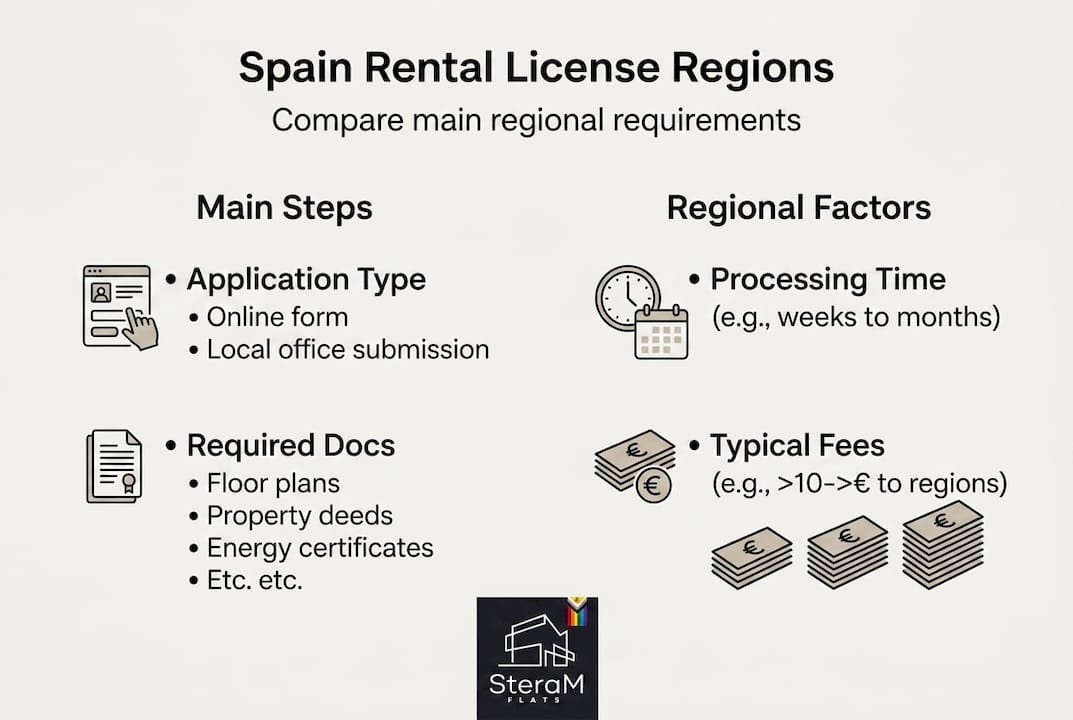
Typical processing time ranges from four to eight weeks in most regions, though Madrid and Catalonia have been known to take longer during high-demand periods. Application fees are generally modest, ranging from €50 to €200 depending on the region and property type.
Comparing rental license requirements by region
Because licensing rules differ from region to region in Spain, knowing local requirements is essential before investing in a property you intend to rent out.
| Region | License type | Typical processing time | Key requirement | Estimated fee |
|---|---|---|---|---|
| Andalucía | VUT registration | 4 to 6 weeks | Habitability certificate, energy rating | €80 to €120 |
| Madrid | Vivienda de uso turístico | 6 to 10 weeks | Floor plan, civil liability insurance | €100 to €180 |
| Valencia | Tourist accommodation registry | 4 to 8 weeks | Technical inspection, energy certificate | €60 to €150 |
| Catalonia | Habitatge d’ús turístic | 8 to 14 weeks | Municipal permit, high saturation zones apply | €150 to €250 |
| Balearic Islands | Tourist exploitation license | 6 to 12 weeks | Energy rating B or above required | €200 to €400 |
The contrast between these regions is significant. Catalonia, particularly in Barcelona, has imposed a moratorium on new holiday rental licenses in most city neighborhoods since 2023. This means that even a fully prepared application may be rejected not due to documentation issues, but simply because the zone is saturated. Investors looking at Barcelona should check zoning maps before purchasing with rental income in mind.
Andalucía is generally considered more investor-friendly. The registration process is relatively straightforward for landlords, and the Junta de Andalucía’s online system has reduced turnaround times considerably. The Costa del Sol corridor, including Torremolinos and Marbella, continues to see strong demand for licensed vacation rentals, and compliance levels are improving as inspection campaigns increase.
The Balearic Islands represent the most stringent market in Spain. Properties must achieve an energy rating of B or above, which can require significant renovation investment before applying. On the upside, a licensed property in Mallorca or Ibiza commands premium nightly rates that more than justify the upfront compliance cost.
It is also worth noting that long-term rentals face fewer licensing hurdles than tourist rentals in most regions. A standard 12-month residential lease typically requires only the habitability certificate and energy performance certificate. However, tax registration is still mandatory, and some municipalities require notification filings even for long-term arrangements.
A 2023 survey by Spain’s national statistics institute found that approximately 40% of holiday rental properties operating in Spain’s coastal regions did so without a valid license. Regional authorities have significantly increased inspection activity since that data was published, making compliance more urgent than ever for current and prospective landlords.
Common challenges and mistakes in the rental license application process
Even with a clear checklist, there are hurdles and traps that can complicate your application. Understanding what typically goes wrong is just as valuable as knowing what to do right.
The most frequent application mistakes include:
- Submitting an expired habitability certificate. These certificates have validity periods of five to fifteen years depending on the region. Many landlords discover theirs lapsed years ago, which requires a new inspection before any application can proceed.
- Using an unregistered energy certifier. The technician who issues your energy certificate must be officially registered in the relevant regional database. A certificate from an unregistered professional will be rejected, wasting weeks of processing time.
- Missing municipal notifications. Even when the regional license is obtained, some municipalities require a separate communication or secondary permit. This is especially common in tourist-heavy areas of Málaga province.
- Failing to renew after property renovations. Any significant structural change to a property, including additions, conversions, or changes to room use, may invalidate existing certificates and require fresh assessments.
- Incorrect property description in the application. The details you submit must exactly match the property registry (Registro de la Propiedad). A discrepancy of even a single square meter in floor area can trigger a correction request that delays your approval by weeks.
| Mistake | Time lost | Solution |
|---|---|---|
| Expired habitability certificate | 3 to 6 weeks | Request new inspection before applying |
| Unregistered energy certifier | 2 to 4 weeks | Verify certifier registration before hiring |
| Missing municipal notification | 1 to 3 weeks | Check local requirements independently |
| Post-renovation re-certification | 4 to 8 weeks | Schedule inspections before listing |
| Property description mismatch | 2 to 5 weeks | Cross-check registry data before submitting |
Understanding common real estate errors in Spain’s coastal markets reveals a clear pattern: problems almost always stem from skipping preparatory checks, not from the application process itself being overly complex.
Pro Tip: Before you hire any technician for habitability or energy certification, ask directly whether they are registered with the relevant regional authority and request their registration number. A reputable professional will provide this without hesitation.
One additional mistake that catches investors off guard is listing a property on rental platforms while the license application is still pending. Several platforms now require you to input a valid registration number before publishing. Attempting workarounds can result in platform suspension, which is its own separate complication to manage.
Why planning ahead makes rental licensing smooth and profitable
Here is something the standard licensing guides rarely say out loud: the landlords who struggle most with licensing are almost always those who treated it as an afterthought rather than a first step in their investment plan.
We have seen this pattern repeatedly. An investor closes on a property in Torremolinos in April, eager to catch the summer season. They start furnishing and marketing the property in May, then discover in early June that the habitability certificate needs renewal, the energy certificate has the wrong address, and the municipality requires a separate filing. By the time everything is resolved, August is half over. They missed their most profitable months.
Contrast that with the investor who started the compliance process the moment they signed the purchase agreement. They had their registration number in hand before the furniture arrived. That investor earned full-season income from day one.
There is also a financial planning dimension that gets overlooked. Compliance costs money upfront: inspections, certificates, insurance, and filing fees can total anywhere from €300 to €800 depending on the region and property size. But that same compliance unlocks the ability to legally advertise on premium platforms, qualify for favorable mortgage terms, and command higher nightly or monthly rates from tenants who trust licensed properties. Reviewing management checklist insights before your purchase closes lets you budget accurately and build compliance costs into your acquisition analysis from the start.
Staying ahead of regulatory changes matters too. Spain’s regional governments periodically revise licensing standards, and landlords who track these updates avoid expensive surprise re-certifications.
Connect with experts for seamless rental licensing
Navigating Spain’s rental licensing landscape on your own is absolutely possible, but working with professionals who understand the local requirements saves you time, stress, and costly application errors.

SteraM Flats supports landlords and investors throughout the entire compliance process, from reviewing your documentation against current regional standards to coordinating with certified technicians for the certificates you need. Whether you are comparing rental management help options or weighing the pros and cons of choosing rental types for your specific property, the team brings on-the-ground expertise in Spain’s most active markets. Reach out today to make your rental investment compliant, profitable, and stress-free from the start.
Frequently asked questions
How long does it take to obtain a rental license in Spain?
Obtaining a rental license usually takes four to eight weeks depending on your region and whether your documentation is complete and accurate from the start.
Which documents are required for the rental license application?
You generally need proof of ownership, a valid ID or NIE, a habitability certificate, an energy performance certificate, and adequate landlord insurance to complete a rental license application in Spain.
What happens if I rent without a license in Spain?
Renting without a license can result in substantial fines, formal legal action by regional authorities, and forced suspension of your rental activity until compliance is achieved.
Do rental license requirements change for holiday rentals versus long-term rentals?
Yes, holiday rentals typically require a tourist activity license with stricter standards, while long-term rentals generally need fewer certifications, though regional rules always apply.
Can SteraM Flats help with obtaining rental licenses?
Yes, SteraM Flats offers property management and compliance support to help landlords in Spain navigate the rental licensing process efficiently and correctly.