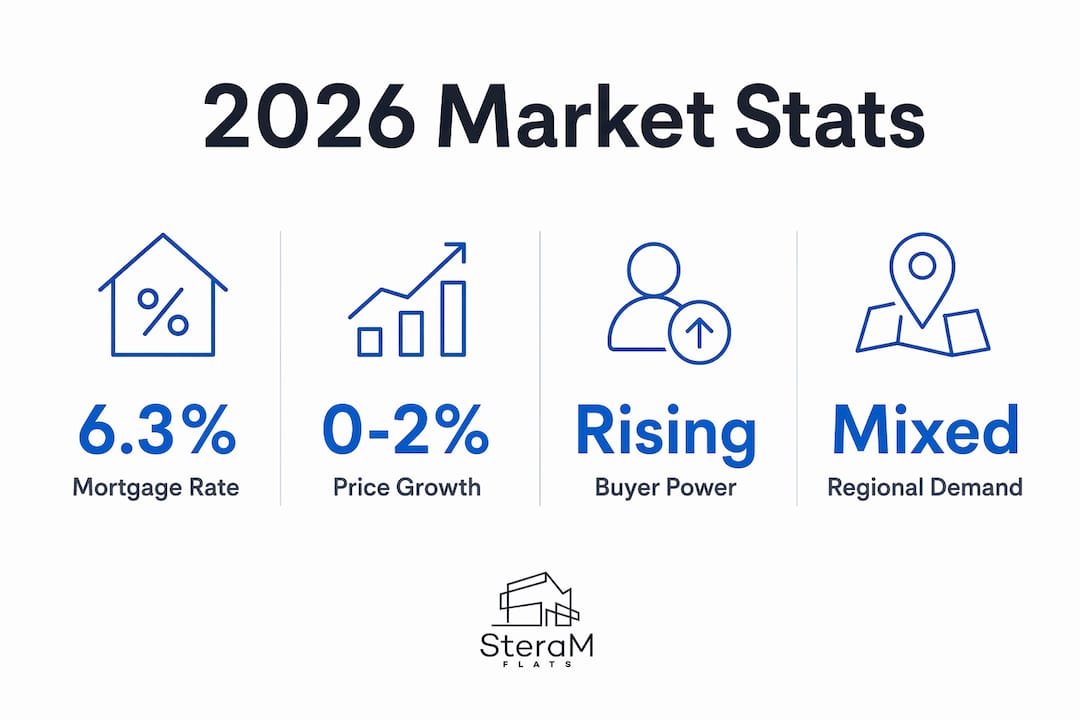
2026 is a gradual recovery year. Buyers hold more negotiating power than at any point since 2019, national price growth is near-flat, and investors who pick carefully will outperform those who buy broadly. Realtor.com’s midyear forecast projects the average 30-year fixed mortgage rates remain elevated in 2026, existing-home sales remain relatively stable with a slight improvement in 2026, and national home-price growth is expected to be near flat. J.P. Morgan’s housing outlook and Morgan Stanley both frame this as an inflection point, not a boom. Cohen & Steers puts it plainly: real estate’s stable cash flows and rising transaction volumes position it for continued growth in a year when other asset classes look stretched.
For US buyers and investors focused on southern Spain, the takeaway is immediate: start your market research now, lock in your financing strategy, and prioritize selectivity over speed.
Table of Contents
- What do the 2026 real estate market trends actually show?
- What do US trends mean for buyers focused on southern Spain?
- How should you approach buying or investing in 2026?
- What does a US buyer actually need to do to purchase in southern Spain?
- What risks should you watch in southern Spain in 2026?
- Key Takeaways
- What the 2026 southern Spain market looks like from the ground
- Steramflats helps US buyers and investors move from research to ownership
- Sources and further reading
What do the 2026 real estate market trends actually show?
The macro numbers tell a consistent story across forecasters, though exact figures vary. Mortgage rates remain elevated, existing-home sales are stable with some projections showing slight increases, home-price growth is expected to be flat to modest, rents vary regionally with some decline nationally and increases in specific metros, active listings have increased moderately, and buyer leverage is strengthening in many US markets.
| Metric | 2026 Projection | Source |
|---|---|---|
| 30-yr fixed mortgage rate | 6.3% average | Realtor.com midyear |
| Existing-home sales | 4.10 million | Realtor.com midyear |
| National home-price growth | 0% to +1.2% | J.P. Morgan / Zillow |
| National rent direction | ~-1.2% nationally, +2%–3% in supply-constrained metros | Realtor.com / Redfin |
| Active listings change | — | Realtor.com |
The rent divergence is worth pausing on. Nationally, new multifamily supply is pushing rents down. But in supply-constrained metros and tourist-heavy markets, rents are still climbing 2%–3%. That split matters enormously for anyone evaluating yield in southern Spain.
What do US trends mean for buyers focused on southern Spain?
US macro conditions shape how American buyers approach cross-border purchases in ways that aren’t always obvious.

At 6.3%, US mortgage rates are high enough that many buyers are carrying dollar-denominated debt while targeting euro-denominated assets. That creates a currency and financing calculus worth modeling carefully before committing. A rate buydown from a Spanish developer, or a Spanish mortgage at a lower variable rate, can change the effective cost of ownership significantly.
Tourism-driven demand in southern Spain operates on a cycle different from US residential markets. Coastal towns along the Costa del Sol see rental demand spike from April through October, with occupancy rates that can justify premium pricing on short-term lets even when national US rent trends are flat or negative. The key is that tourist-area yield projections should use multi-year normalized occupancy, not peak-season numbers, and should include an explicit buffer for permit and renovation risk.
Morgan Stanley expects performance to diverge further across sectors and locations, making local, asset-specific positioning more important than broad market bets. CBRE’s 2026 outlook reinforces this: prime assets in supply-constrained locations outperform; secondary assets in oversupplied submarkets struggle.
Pro Tip: When evaluating a coastal property in southern Spain, check three microdemand drivers before anything else: proximity to an international airport (Málaga-Costa del Sol handles over 20 million passengers annually), walkable beach or marina access, and year-round amenity clusters like restaurants and medical facilities. Properties that score on all three hold occupancy through shoulder season, which is where long-run yield is actually made.
How should you approach buying or investing in 2026?
The core strategic principle from both Morgan Stanley and Cohen & Steers is the same: active, selective management focused on property fundamentals beats passive, broad cyclical exposure in 2026. That means choosing assets by location and property type, not by riding a rising tide.
For southern Spain investors, the highest-conviction sectors are:
- Tourism short-term rentals in supply-constrained coastal areas — limited new build, strong international demand, and a tourism sector that has recovered past pre-pandemic levels
- Supply-constrained residential — towns where planning restrictions limit new development, supporting price floors and rental yields
- Prime retail corridors in established tourist centers, where foot traffic and limited new supply support occupancy
Investment filters to apply to every deal:
- Location: is it within 15 minutes of the coast and an international transport hub?
- Yield vs. price growth: model both, and don’t accept a low yield on the promise of capital appreciation alone
- Regulatory risk: does the property already hold a tourist rental license, or is one obtainable?
- Renovation capex: get a written estimate before signing; renovation costs in Spain have risen with materials inflation
- Tenant or guest mix: short-term tourist lets carry higher management intensity; factor that into net yield
Pro Tip: Ask developers and motivated sellers directly about rate buydowns or price incentives. Builder incentives including rate buydowns can improve effective affordability more than list-price reductions in some scenarios. Evaluate the present value of buydown dollars against straight price concessions before deciding which to accept.
Recommended 90–180 day action timeline:
- Days 1–30: Confirm financing strategy and currency approach; get pre-approval or assess Spanish mortgage options
- Days 31–60: Engage a local agent; shortlist 5–8 properties using the filters above
- Days 61–90: Commission valuations and legal due diligence on top 2–3 properties
- Days 91–150: Negotiate, make offer, sign preliminary contract (contrato de arras)
- Days 151–180: Complete notary closing, register title, activate rental license if applicable
What does a US buyer actually need to do to purchase in southern Spain?
The sequence is straightforward, but each step has local specifics that trip up first-time cross-border buyers.
- Finance readiness — Decide whether you’re using US funds, a Spanish mortgage, or a combination. Spanish lenders typically finance up to 70% for non-residents.
- Local agent — Engage a licensed agent with documented experience in the specific submarket. Steramflats covers property search, valuation, and legal documentation across southern Spain.
- NIE number — Apply for your Spanish tax identification number (Número de Identificación de Extranjero) early; it’s required for every transaction step.
- Due diligence — Title search (nota simple), verify tourist rental permit status, check community fees and outstanding debts on the property.
- Offer and preliminary contract — Sign a contrato de arras (reservation deposit, typically 10%) to secure the property.
- Notary closing — Final deed signed before a Spanish notary; Steramflats coordinates legal and documentation support at this stage.
- Registration and management — Register the title at the Land Registry; activate rental licensing if applicable. Steramflats handles rental management and ongoing property management for holiday rentals.
Typical cross-border costs to budget:
- Transfer tax (ITP): 7%–10% of purchase price depending on the Andalusia region band
- Notary and Land Registry fees: roughly 1%–2% combined
- Legal/solicitor fees: typically 1%–1.5%
- Agent commission: varies; confirm in writing upfront
- Renovation lead times: 3–6 months for a standard refurbishment in southern Spain
Pro Tip: US pre-approval doesn’t transfer to a Spanish lender, but it signals financial credibility to sellers. If you plan to use a Spanish mortgage, start the application in parallel with your property search — Spanish bank approvals for non-residents can take 6–8 weeks. For expats comparing cross-border purchase logistics, expat home ownership guides covering financing and residency considerations offer useful context on what to expect.
What risks should you watch in southern Spain in 2026?
- Affordability mismatch: Sellers pricing to 2022–2023 peaks face longer time-on-market and more frequent price cuts. Markets shifting toward buyers reward realistic initial pricing; walk away from any listing where the seller won’t acknowledge current comps. Mitigation: request a current comparative market analysis before making any offer.
- Local coastal oversupply: Certain submarkets, particularly newer apartment developments outside established tourist corridors, have seen supply outpace demand. Mitigation: check vacancy rates and days-on-market for the specific street or complex, not just the town.
- Tourist rental permit shocks: Spanish regional governments have tightened short-term rental licensing in several areas. Mitigation: verify the permit status of any property before signing a reservation deposit, not after.
- Climate and insurance risk: Coastal properties face rising insurance costs tied to flood and storm risk. Mitigation: get an insurance quote before closing; factor the annual premium into your yield model.
- Rental seasonality liquidity: A property that earns 80% of its annual income in four months carries real cash-flow risk in a slow year. Mitigation: model yield on a normalized 10-month occupancy basis, not peak season.
Before signing anything, verify tourist rental permit status, outstanding community debts, and energy certification directly with the local town hall (ayuntamiento) and the Land Registry. No agent or seller representation substitutes for primary-source confirmation.
Key Takeaways
2026 favors selective buyers and active investors: mortgage rates at 6.3%, near-flat national price growth, and rising buyer leverage create a window for well-prepared US buyers targeting southern Spain’s tourism-driven market.
| Point | Details |
|---|---|
| Mortgage rate reality | The 30-year fixed averages 6.3% in 2026; factor this into US financing and cross-currency cost models. |
| Near-flat national price growth | Home-price growth runs 0% to +1.2% nationally; southern Spain coastal assets can outperform with the right location filters. |
| Buyer leverage is rising | Roughly 70% of US markets favor buyers in 2026; use that negotiating power and don’t accept 2022-peak pricing. |
| Tourism rental nuance | National rents are down ~1.2%, but supply-constrained tourist markets still see +2%–3%; model yield on normalized occupancy. |
| Steramflats local support | Steramflats handles property search, valuation, legal documentation, tourist-rental licensing, and ongoing management in southern Spain. |
What the 2026 southern Spain market looks like from the ground
The macro forecasts from Realtor.com, J.P. Morgan, and Morgan Stanley describe a recovery that is real but uneven. What that looks like on the Costa del Sol is more specific: motivated sellers in secondary locations, strong demand for well-located coastal apartments with existing tourist licenses, and a growing gap between properties that are permit-ready and those that aren’t.
The renovation-for-yield pattern is particularly active right now. Properties bought at a discount, refurbished to a modern standard, and listed on short-term platforms are achieving occupancy rates that justify the capex, especially in towns with year-round international visitor traffic. The vacation apartment demand drivers in southern Spain, including transport connectivity and amenity density, are holding up even as broader European tourism faces macro headwinds.
Steramflats works with international buyers at every stage of this process, from initial property search and investment analysis through legal documentation, license management, and full holiday rental management. The property investment roadmap for Spain is the right starting point for anyone building a position in this market.
Steramflats helps US buyers and investors move from research to ownership
Buying property in southern Spain from the US involves more moving parts than a domestic purchase. Steramflats covers the full sequence: property search and valuation, legal and documentation support, tourist rental licensing, renovation coordination, and ongoing holiday rental management once you own.

For investors, Steramflats also provides investment analysis and yield modeling tailored to specific properties and submarkets. For owners ready to list, you can post your property for free and get immediate exposure to an active buyer and renter audience. Contact Steramflats directly to request a localized investor roadmap for southern Spain.
This article is general market information, not financial or legal advice. Verify current regulations, tax obligations, and permit requirements with a qualified local professional before making any purchase or investment decision.
Sources and further reading
- Realtor.com 2026 Midyear Housing Market Forecast — midyear update with mortgage rate, sales, price, rent, and inventory projections
- Zillow 2026 Housing Market Predictions — sales volume (4.26M) and home-value growth (+1.2%) projections
- J.P. Morgan US Housing Market Outlook — price growth range and builder incentive analysis
- Morgan Stanley Real Estate Midyear Outlook 2026 — inflection point thesis, sector bifurcation, active management emphasis
- CBRE US Real Estate Market Outlook 2026 — sector-level performance divergence, prime vs. secondary assets
- Cohen & Steers Mid-Year 2026 US Real Estate Perspective — listed and private market returns, sector spotlights
- Realtor.com Market Clock Report Q2 2026 — buyer-market share data (70% of markets)
- Redfin 2026 Housing Predictions — “Great Housing Reset” framing, constrained-metro rent projections
- Steramflats: Why Invest in Tourist Areas — local yield analysis and permit risk context for southern Spain
| Source | Type | Date / Period |
|---|---|---|
| Realtor.com Midyear Forecast | Data snapshot + forecast | 2026 midyear update |
| Zillow Research | Sales and price forecast | 2026 annual predictions |
| J.P. Morgan Global Research | Institutional outlook | 2026 housing market |
| Morgan Stanley Investment Management | Expert view / inflection point | Midyear 2026 |
| CBRE | Sector bifurcation analysis | 2026 market outlook |
| Cohen & Steers | Listed/private market perspective | Mid-year 2026 |
| Realtor.com Market Clock Q2 | Buyer leverage data | Q2 2026 |
| Redfin | Recovery framing + rent forecasts | 2026 predictions |
| Steramflats | Local E-E-A-T / tourist market | 2026 investor guide |