The 2026 coefficient updates for the plusvalía municipal are not in force. Congress failed to convalidate Real Decreto-ley 16/2025, so the government formally abandoned the proposed changes, and the coefficients from 2024 remain the active standard for all transfers from January 28, 2026 onward. El País reported that the government renounced updating the coefficients entirely after Congress rejected the measure.
If your transfer happened between January 1 and January 27, 2026, the proposed coefficients were provisionally in effect during that window. Your liquidation may have been calculated under rules that no longer apply, and you may have overpaid.
Three immediate steps:
- Check the exact date your deed was signed (escritura de transmisión).
- Confirm which coefficients your municipality applied to the liquidation.
- If the higher 2026 coefficients were used and your transfer falls in that January window, you may have grounds to claim a refund or request rectification of the autoliquidation.
For transfers from January 28 onward, the pre-existing coefficients apply and no refund claim is triggered. The AEAT provides guidance on reinvestment exemptions, and official municipal simulators exist for Madrid and Málaga to help you estimate your bill before the formal liquidation arrives.
Key Takeaways
The single most important fact for 2026: the proposed coefficient increases under RD-Ley 16/2025 were not convalidated, so the 2024 coefficients remain active for all transfers from January 28, 2026 onward, and anyone who paid under the higher rates in January 2026 has grounds to claim a refund.
| Point | Details |
|---|---|
| 2026 coefficients status | RD-Ley 16/2025 was not convalidated; 2024 coefficients apply from January 28, 2026 onward. |
| January 2026 refund window | Transfers completed January 1–27, 2026 may have used higher coefficients; request rectification within four years. |
| Choose your calculation method | Compare the objective method (cadastral value × coefficient) and the real method (actual gain); submit the lower result with documentation. |
| Check your municipal ordinance | Coefficients, rates, and bonifications vary by ayuntamiento; always verify the current fiscal ordinance before closing. |
| Steramflats coordination | Steramflats runs simulator estimates, compares both methods, and coordinates refund requests and municipal submissions for sellers and heirs. |
Table of Contents
- What is the plusvalía municipal (IIVTNU) and what does it tax?
- When is the plusvalía paid and what are the filing deadlines?
- Who is liable for the plusvalía?
- How is the plusvalía calculated: objective method vs. real method
- What happened to the plusvalía municipal in 2026: coefficient status
- What happens when there is no gain or the land value decreased?
- Transfers within one year: what you need to know
- Key bonifications and exemptions you can claim
- How plusvalía municipal interacts with your IRPF return
- Official calculators and how to estimate your plusvalía step by step
- If you paid plusvalía in January 2026: how to correct it or claim a refund
- Why municipal ordinances matter and how to find yours
- Expert guidance: how to protect yourself from normative instability when selling in 2026
- How Steramflats advises sellers and heirs navigating plusvalía in 2026
- Steramflats helps you sell, transfer, and manage the paperwork
- Sources
What is the plusvalía municipal (IIVTNU) and what does it tax?
The Impuesto sobre el Incremento de Valor de los Terrenos de Naturaleza Urbana (IIVTNU), commonly called the plusvalía municipal, is a local tax levied on the increase in value of urban land from the moment of acquisition to the moment of transfer. It taxes the land component only, not the building or improvements on top of it.
A quick example: if you bought a flat in 2010 and the cadastral land value at the time was €40,000, and the same cadastral land value is €60,000 today, the tax base is calculated on that €20,000 increase (or a proxy for it using official coefficients). The building’s market appreciation is irrelevant for this calculation.
Key structural points:
- The tax is potestative: municipalities choose whether to apply it and set their own ordinances within state-level limits. Not every municipality collects it.
- Coefficients and bonifications vary by ayuntamiento. Two neighboring towns can produce meaningfully different tax bills for identical properties.
- The tax applies to urban land only. Rural land (suelo rústico) is excluded.
Pro Tip: Your IBI (Impuesto sobre Bienes Inmuebles) receipt breaks down the cadastral value between land (suelo) and construction (construcción). The land figure is the one that matters for plusvalía calculations. Keep your most recent IBI receipt before any transfer.
When is the plusvalía paid and what are the filing deadlines?
Three events trigger the tax: a sale, a donation, or an inheritance. The rules on who files and when differ slightly across these scenarios.
- Sale (compraventa): The seller (transmitter) is liable. The deadline to file is typically 30 business days from the date of the deed, though some municipalities extend this. Filing is done at the municipal treasury (recaudación municipal) or through the ayuntamiento’s online portal.
- Donation: The donor is liable. Same 30-business-day window from the notarial act.
- Inheritance: The heir or legatee is liable. The deadline is 6 months from the date of death, with a possible extension of another 6 months if requested within the first 5 months.
Missing a deadline does not eliminate the obligation. Late filings attract surcharges and interest. The surcharge typically starts at 5% for payments made within 3 months of the deadline and rises from there. If the municipality discovers the omission before you file voluntarily, penalties are considerably higher.
Most municipalities now accept online submissions through their virtual offices. In Málaga province, the Patronato de Recaudación Provincial (PrpMálaga) handles collection for many smaller municipalities. Madrid has its own dedicated portal through the Agencia Tributaria de Madrid.
Who is liable for the plusvalía?
The general rule is straightforward: the person transferring the property (seller, donor, or the estate of the deceased) is liable. In practice, this means:
- In a sale: The seller pays. Buyers and sellers sometimes negotiate who absorbs the cost in the private contract, but legally the obligation rests with the seller. Whatever the private agreement says, the municipality will pursue the seller if the tax goes unpaid.
- In a donation: The donor pays. If the donor is a non-resident or fails to pay, the municipality can pursue the recipient (donatario) as a subsidiary debtor.
- In an inheritance: The heir or legatee who receives the property pays. When multiple heirs share a property, each pays on their proportional share.
Practical scenarios:
- You sell your flat in Torremolinos. You are the seller. You pay the plusvalía.
- You inherit a house from a parent. You are the heir. You pay within 6 months of the date of death.
- You donate a plot to your child. You are the donor. You pay within 30 business days of the notarial deed.
One nuance worth knowing: in sales involving non-resident sellers, the buyer is legally required to withhold a percentage of the sale price and pay it to the tax authorities on the seller’s behalf for IRPF purposes. The plusvalía municipal is separate from this withholding and still falls on the seller directly.
How is the plusvalía calculated: objective method vs. real method
Since the Tribunal Constitucional rulings that struck down the old formula, Spanish law now offers two calculation methods. The taxpayer can choose the more favorable one when they can substantiate the real result.
Objective method
Formula: Tax base = Cadastral land value × Coefficient (by years of ownership)

The coefficient is set at state level (and may be reduced by the municipality). You find the cadastral land value on your IBI receipt or through the Catastro’s online portal (sedecatastro.gob.es). The number of complete years of ownership determines which coefficient band applies.
Real method
Formula: Taxable gain = Transmission price minus Acquisition price (plus allowable improvement costs)
The taxable base is the proportion of that gain attributable to land (calculated using the cadastral land-to-total-value ratio). You need the original purchase deed, the sale deed, and invoices for any improvements. This method is worth using when the property was bought at a high price and sold at a lower one, or when the market gain is modest.
Worked example
Assume a flat in Málaga with a cadastral land value of €50,000, held for 12 years. The active 2024 coefficient for 10–15 years is 0.13 (illustrative; confirm your municipality’s figure).
Steps to decide which method to use:
- Pull the cadastral land value from your IBI receipt.
- Calculate the objective method result using the active coefficient for your year band.
- Calculate the real gain (sale price minus purchase price minus allowable costs) and apply the land ratio.
- Compare both figures. Submit the method that produces the lower tax base, with supporting documentation.
Pro Tip: The IBI tax details on your annual receipt show the cadastral land value separately from the construction value. Screenshot or photograph that breakdown before you go to any simulator.
What happened to the plusvalía municipal in 2026: coefficient status
This is the section most sellers and heirs need to read carefully.
The timeline:
- Late December 2025: Real Decreto-ley 16/2025 was published, introducing updated coefficients intended to reflect current market conditions. It entered provisional effect immediately upon publication.
- January 1–27, 2026: The new, higher coefficients applied to all transactions during this window. Municipalities that had already issued liquidations used these figures.
- January 27, 2026: Congress voted not to convalidate RD-Ley 16/2025. The decree ceased to have legal effect from that date.
- February 2026: The government formally confirmed it would not pursue the coefficient update through alternative legislative channels.
The practical consequence: the coefficients from Real Decreto-ley 26/2021 (the reform that followed the Constitutional Court rulings) remain the active framework. Proposed increases of up to 40% in some year bands never took permanent effect.
Who needs to recheck their liquidation:
Anyone who completed a transfer between January 1 and January 27, 2026 and whose municipal liquidation or autoliquidation applied the RD-Ley 16/2025 coefficients. The Brains RE News analysis confirms that the non-convalidation obliges a review of liquidations made during the provisional period, with impacts varying by years of ownership.
What to assume for 2026 transfers (from January 28 onward): The 2024 coefficients under RD-Ley 26/2021 apply. No new coefficient table is in force. Confirm with your specific municipality, as local ordinances may have introduced their own modulations within the state-level limits.
What happens when there is no gain or the land value decreased?
After a series of Tribunal Constitucional rulings, Spanish municipalities can no longer charge plusvalía when the taxpayer can demonstrate there was no real increase in land value. The real method exists precisely for this purpose.
When to use this argument:
- You bought the property at a higher price than you sold it for.
- The market value of the land has not risen during your ownership period.
- You can document the absence of gain with objective evidence.
Documents that support a zero or negative gain claim:
- Original purchase deed (escritura de compraventa) showing acquisition price and date.
- Sale deed showing transmission price.
- Invoices for improvements (obras) that increase the acquisition cost for calculation purposes.
- Independent property valuation (tasación) from a certified appraiser.
- Cadastral update records showing land value trajectory.
Checklist to prepare a claim:
- [ ] Gather both deeds (purchase and sale).
- [ ] Calculate real gain: sale price minus purchase price minus documented improvement costs.
- [ ] Apply the cadastral land-to-total ratio to isolate the land gain.
- [ ] If the result is zero or negative, prepare a written statement of self-declaration using the real method.
- [ ] Submit to the municipal treasury with all supporting documents attached.
- [ ] Keep copies of everything, including the submission receipt.
Municipalities increasingly accept this documentation. Post-constitutional jurisprudence has made it harder for ayuntamientos to insist on the objective method when the taxpayer can prove no real gain occurred.
Transfers within one year: what you need to know
Short-hold transfers, those where the property was owned for less than 12 months, attract particular attention under the plusvalía framework. The proposed RD-Ley 16/2025 coefficients specifically targeted these cases with higher multipliers, reflecting the view that very short-hold gains are more speculative.
Key points for sub-12-month transfers:
- The objective method coefficient for holdings under one year is typically the highest in the table, meaning the tax bill is proportionally larger relative to the cadastral land value.
- The proposed 2026 changes would have raised these coefficients further. Since they were not convalidated, the 2024 rates apply.
- If you sold within a year and your municipality applied the provisional 2026 coefficients, your refund claim is particularly worth pursuing.
- The real method can be especially valuable here: if you bought and sold quickly without a large real gain, documenting the actual transaction prices may produce a significantly lower tax base than the objective method.
Pro Tip: If you are planning a sale and have held the property for 11 months, waiting until the 12-month mark crosses you into a lower coefficient band under the objective method. Run both scenarios through the municipal simulator before setting your closing date. A few weeks’ difference can mean hundreds of euros.
Key bonifications and exemptions you can claim
Several exemptions can reduce or eliminate the plusvalía bill entirely. Each has specific conditions and documentation requirements.
Reinvestment in a main residence (exención por reinversión en vivienda habitual)
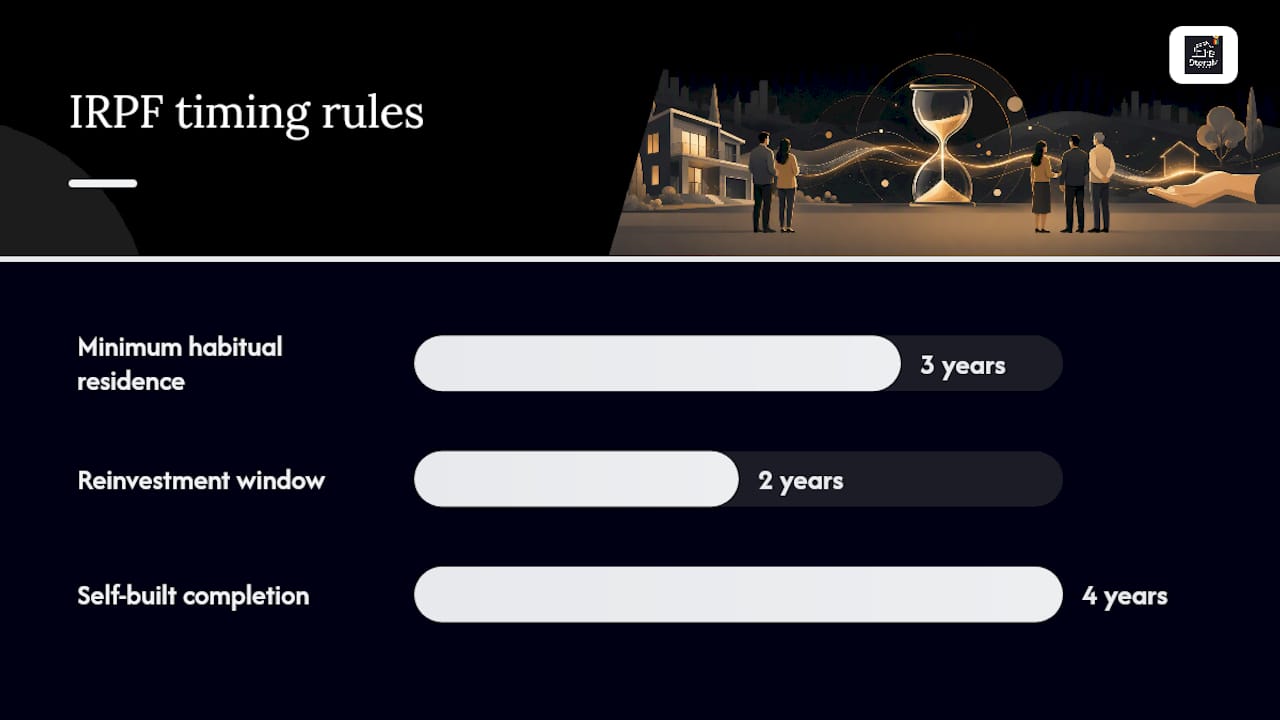
This is the most commonly used exemption. AEAT guidance sets two critical windows: reinvestment must occur within two years before or after the sale, and for self-built homes (autopromoción), construction must be completed within four years. The exemption applies to the IRPF capital gain; its interaction with the municipal plusvalía depends on the specific municipal ordinance.
Persons over 65 or with severe dependency
Many municipalities exempt transfers of the main residence by persons aged 65 or older, or those with recognized severe dependency. Check your specific municipal ordinance, as the conditions and documentation requirements vary.
Dación en pago and mortgage foreclosure (ejecución hipotecaria)
Properties transferred through dación en pago (handing the property to the bank to cancel a mortgage) or through judicial foreclosure are exempt from plusvalía under national legislation, provided the property was the taxpayer’s main residence and the taxpayer has no other assets to pay the debt.
Municipal bonifications
Some municipalities offer additional bonifications, such as reductions for long-term owners or for transfers of social housing. These are not universal. Check your ayuntamiento’s current fiscal ordinance.
Checklist for claiming exemptions:
- Identify which exemption applies to your situation.
- Gather proof: age/dependency certificate, reinvestment deed or construction certificate, mortgage cancellation documents, or social housing classification.
- Submit the exemption claim alongside your plusvalía declaration, not after.
- If the municipality issues a liquidation without applying the exemption, file a written objection within the appeal period (typically 30 days from notification).
The Madrid municipal portal lists the documentation required for each exemption category and is worth consulting even if you are not in Madrid, as the framework is similar across municipalities.
How plusvalía municipal interacts with your IRPF return
The plusvalía municipal and IRPF are separate taxes, but they interact in ways that matter for timing and documentation.
The IRPF capital gain:
When you sell a property, the gain (or loss) is declared in your annual IRPF return for the year of sale. The plusvalía municipal paid is a deductible cost that reduces the net gain for IRPF purposes. Keep your municipal payment receipt.
The reinvestment exemption for IRPF:
If you sell your main residence and reinvest the proceeds in a new main residence, the capital gain can be excluded from IRPF taxation. The rules:
- The property sold must have been your habitual residence for at least three years (with exceptions for death, job change, marriage, or similar).
- Reinvestment must occur within two years before or after the sale date.
- For self-built homes, construction must be completed within four years of the sale.
- You must declare your intention to reinvest in the IRPF return for the year of sale, even if you have not yet purchased the new property.
Administrative timeline:
- Year of sale: declare the gain in IRPF and note the reinvestment intention.
- Within two years: complete the purchase of the new main residence.
- If building: obtain the certificate of completion (certificado de fin de obra) within four years.
- Keep all construction invoices, contracts, and the completion certificate as proof.
The municipal plusvalía exemption (where it exists) is a separate municipal decision and does not automatically follow from the IRPF exemption. Confirm with your ayuntamiento whether a reinvestment exemption applies locally and what documentation they require. For a broader view of how this fits into property taxes in Spain, the interaction between IRPF and municipal taxes is one of the most frequently misunderstood areas for sellers.
Official calculators and how to estimate your plusvalía step by step
Three official tools are worth knowing. All are orientative, meaning the formal liquidation issued by the municipality is the binding figure.
Official simulators:
- Ayuntamiento de Madrid: The Madrid municipal portal includes an estimative calculator for the IIVTNU. Input your cadastral reference, acquisition date, transmission date, and percentage transmitted. The tool returns an estimated quota.
- PrpMálaga (Patronato de Recaudación Provincial de Málaga): The PrpMálaga IIVTNU simulator covers municipalities in Málaga province that delegate collection to the Patronato. It is explicitly non-binding.
- Municipal virtual offices: Many ayuntamientos have their own online portals. Search “[your municipality] + oficina virtual tributaria” to find the local tool.
Step-by-step walkthrough:
- Locate your IBI receipt and note the cadastral land value (valor catastral del suelo).
- Find your cadastral reference number (referencia catastral) from the IBI receipt or the property deed.
- Note the acquisition date and transmission date (exact dates from deeds).
- Enter the percentage of the property being transferred (100% for a full sale, proportional for an inheritance share).
- If using the real method, enter the acquisition price and sale price.
- Run both methods and compare outputs.
Worked example (illustrative):
Assume a property in Málaga province with a cadastral land value of €45,000, held for 8 years, full transfer.
Save a screenshot of the simulator output. If the municipality’s formal liquidation differs significantly from the estimate, the simulator output helps you frame a written query or objection.
If you paid plusvalía in January 2026: how to correct it or claim a refund
This section is for anyone who completed a transfer between January 1 and January 27, 2026 and whose liquidation applied the RD-Ley 16/2025 coefficients.
Legal background: RD-Ley 16/2025 had provisional effect from publication in late December 2025. When Congress did not convalidate it on January 27, 2026, the decree ceased to have legal effect. Transactions completed during the provisional window were subject to those coefficients at the time, but the non-convalidation creates grounds to review whether the higher coefficients should have been applied.
Step-by-step administrative route:
- Gather your documents: paid receipt (carta de pago), the liquidation notice, the purchase and sale deed, and proof of payment.
- Calculate the difference: run the same transaction through the 2024 (pre-RD-Ley 16/2025) coefficients to determine the overpayment amount.
- File a rectification request (solicitud de rectificación de autoliquidación): if you filed the autoliquidation yourself, submit a written request to the municipal treasury asking for correction and reimbursement of the difference.
- File a request for reimbursement of undue payments (solicitud de devolución de ingresos indebidos): if the municipality issued the liquidation, this is the formal route. Submit to the municipal treasury with all supporting documents.
- Deadline: the general prescription period for claiming undue payments is four years. Act promptly, but you are not in immediate danger of losing the right.
- If the municipality refuses: file an administrative appeal (recurso de reposición) within one month of the refusal notice. If that fails, escalate to the Tribunal Económico-Administrativo Municipal (TEAM) or the regional equivalent.
Key elements to include in your refund request letter: Your full name, NIE/NIF, property address and cadastral reference, date of transfer, amount paid, the coefficient applied, the coefficient that should have applied under RD-Ley 26/2021, the calculated difference, and a clear request for reimbursement. Attach copies of all documents. Send by registered mail (burofax) or through the municipal electronic registry so you have a timestamped record.
The Idealista analysis confirms this refund route is available for payments made during the provisional application window.
Why municipal ordinances matter and how to find yours
The plusvalía municipal is potestative: each municipality decides whether to apply it, and within state-level limits, can set its own coefficients and bonifications. Two properties 5 kilometers apart can face very different tax bills.
What municipalities can modulate:
- Coefficients (they can apply rates below the state maximum).
- Tax rate (the percentage applied to the tax base, up to a legal ceiling).
- Bonifications (reductions for specific circumstances: long-term ownership, social housing, family transfers).
- Whether to apply the tax at all (some small municipalities do not).
How to find your municipality’s current ordinance:
- Go to your ayuntamiento’s official website and search for “ordenanza fiscal IIVTNU” or “plusvalía municipal.”
- Check the municipal official gazette (Boletín Oficial de la Provincia, BOP) for the most recent version. BOP archives are searchable online.
- Contact the municipal treasury (recaudación municipal or tesorería) directly and ask for the current fiscal ordinance and the applicable coefficient table.
- Request a pre-liquidation (liquidación provisional estimativa) in writing before you close a transaction. Some municipalities provide this service.
- If you are in Málaga province and your municipality delegates to PrpMálaga, contact them directly through their virtual office.
Pro Tip: Always ask for the ordinance in writing and note the date you received it. If the municipality later applies a different coefficient, having the written ordinance protects you in any appeal.
Expert guidance: how to protect yourself from normative instability when selling in 2026
The non-convalidation of RD-Ley 16/2025 follows a similar pattern from the previous year. Practitioners at firms like Garrigues have flagged that repeated provisional decrees that fail convalidation create genuine administrative burden for taxpayers who transact during the provisional windows.
Risk mitigation checklist:
- [ ] Confirm the legal framework in force on the exact date of your deed, not the date you agreed the sale.
- [ ] Save every municipal communication: liquidation notices, payment receipts, simulator outputs, and any written correspondence.
- [ ] If a municipal officer tells you which coefficients apply, ask for that confirmation in writing.
- [ ] Consult a fiscal adviser (asesor fiscal) or gestor before closing any transfer worth more than a modest amount. The cost of advice is far lower than the cost of an unchallenged overpayment.
- [ ] Retain all documents for at least four years (the general prescription period for tax claims in Spain).
- [ ] If you are selling and the buyer’s notary or agent tells you the plusvalía is “standard,” verify the coefficient table yourself.
Pro Tip: For sellers in southern Spain, the property sale guide for 2026 covers the full administrative timeline, including when to engage a gestor and what documents to prepare before the notarial appointment.
How Steramflats advises sellers and heirs navigating plusvalía in 2026
When clients come to Steramflats facing a sale, inheritance, or donation in 2026, the first question is always the same: what date is on the deed, and which coefficients did the municipality apply? For transactions in January 2026, that question has real money attached to it.
The practical advice is consistent: run both calculation methods before accepting any municipal liquidation as final. The real method frequently produces a lower result for properties bought during the 2006–2012 period, when prices peaked and then fell. Keep every document from the transaction, including the IBI receipt, both deeds, and any improvement invoices. And if the municipality’s figure looks higher than expected, ask for an itemized breakdown before the appeal window closes.
Steramflats coordinates with fiscal advisers and gestores to help clients estimate their tax exposure before closing and, where needed, to support rectification requests and refund claims. For complex inheritance cases involving multiple heirs or properties in different municipalities, having a single point of coordination matters.
Steramflats helps you sell, transfer, and manage the paperwork
Selling a property in Spain means navigating the plusvalía municipal, IRPF declarations, notarial fees, and municipal deadlines simultaneously. Steramflats handles the real estate side and coordinates the administrative work so you are not doing it alone.

Specifically, Steramflats can run the municipal simulator for your property, compare both calculation methods, and flag whether your situation qualifies for an exemption before you sign anything. For January 2026 transactions where a refund may be available, the team can help prepare the rectification request and coordinate with the relevant municipal treasury. For sellers who are ready to list, publishing your property through Steramflats connects you with buyers while the administrative side is handled in parallel. For those who need broader advisory support on the transfer process, the real estate advisory services page explains exactly how that coordination works.
To get started, prepare: your most recent IBI receipt, the cadastral reference number, both deeds (purchase and sale or inheritance acceptance), and any municipal liquidation notices you have already received. Contact Steramflats with those documents and the team will run the numbers and advise on next steps.
Sources
The sources below are the primary references for calculating, verifying, and challenging your plusvalía municipal in 2026.
- El Gobierno renuncia a actualizar los coeficientes de plusvalía en las ventas y herencias de vivienda
- La temida subida de la plusvalía municipal de 2026 ya no está en vigor: cómo reclamar lo pagado de más — idealista/news
- Qué cambia en la plusvalía municipal tras la no convalidación del Real Decreto-ley 16/2025 | Brains RE News
- Agencia Tributaria: Información – Transmisión de la vivienda habitual con reinversión
- Plusvalía. Exenciones. Información – Portal del Contribuyente del Ayuntamiento de Madrid
This article provides general information about the plusvalía municipal in Spain and does not constitute tax or legal advice. Rules vary by municipality and individual circumstances. Confirm current regulations with your ayuntamiento or a qualified fiscal adviser before making decisions.
This article is general information, not a substitute for advice from a qualified financial advisor. Consult a qualified financial professional about your own circumstances before acting on anything here.