A property search is the thorough investigation buyers use to uncover all essential legal, planning, environmental, and ownership facts about real estate before purchase. Most buyers confuse this process with simply browsing listings online. The two activities are related but serve entirely different purposes. A real estate search combines digital filtering to find candidate properties with formal legal checks that protect you from hidden risks. Solicitors, local authorities, HM Land Registry, and online listing platforms all play distinct roles in this process. Skipping any part of it exposes you to costly surprises after you have already committed.
What is a property search, exactly?
A property search is defined as the formal investigation process conducted during conveyancing to uncover legal, planning, environmental, and infrastructure issues that are not visible from a physical viewing. Property searches cover issues like planning restrictions, drainage connections, flood risks, and chancel repair liability. These are facts that no amount of walking through a property will reveal. The property search definition, in legal terms, refers specifically to these official checks ordered by your solicitor or conveyancer on your behalf.
The term also applies more broadly to the act of searching available properties through online portals, applying filters, and shortlisting candidates that match your criteria. Both meanings matter. The legal checks protect you from risk. The digital search process saves you time and focuses your attention on properties worth pursuing. Understanding both sides of the process is what separates confident buyers from those who get caught off guard.

One critical distinction: a property search is not a property survey. A survey examines the physical condition of a building, including damp, subsidence, and structural defects. A search examines legal and administrative records. You need both to get the full picture.
What are the main types of property searches?
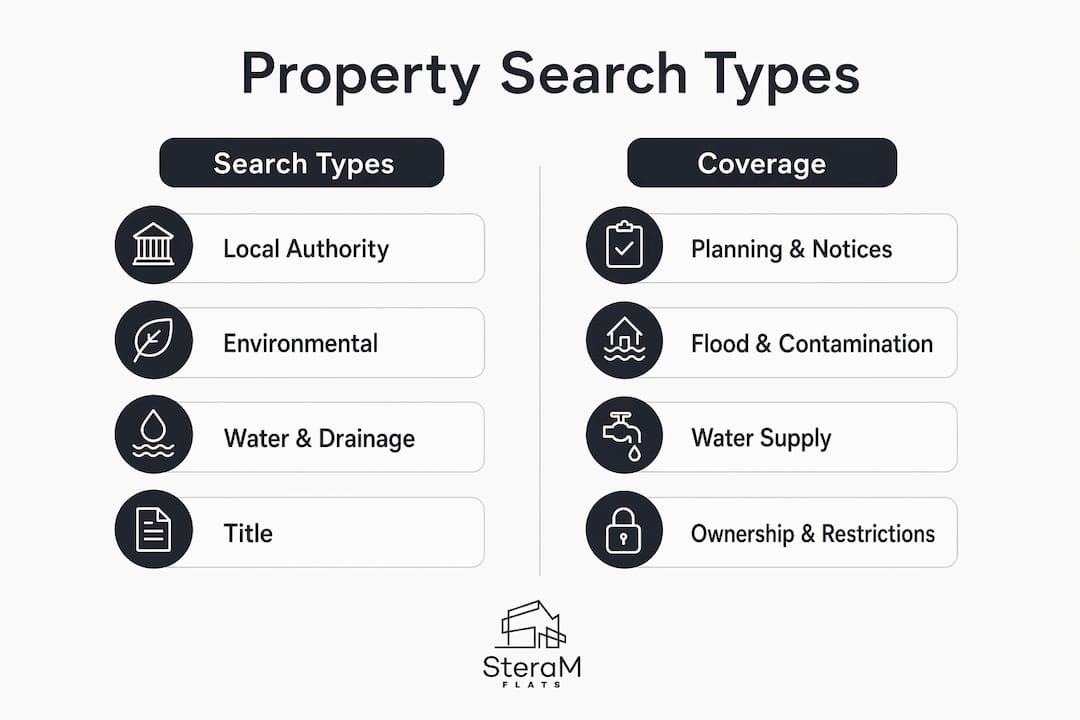
Property searches fall into four primary categories, each targeting a different category of risk. Knowing what each one covers helps you understand what your solicitor is actually doing during conveyancing.
Local Authority Search examines planning permissions, enforcement notices, road schemes, and restrictive covenants held by the local council. This search tells you whether the property has any outstanding planning violations or whether a new highway is planned 50 meters from the front door.
Environmental Search covers flood risk, ground contamination, and proximity to landfill sites. Properties in coastal or low-lying areas, like parts of southern Spain or the English coastline, carry elevated flood risk that only this search will formally document.
Water and Drainage Search confirms whether the property is connected to the public water supply and sewer network. An unconnected property may require a private septic tank, which carries ongoing maintenance costs and legal obligations.
Title Search confirms legal ownership, transfer history, and any charges or restrictions registered against the property. HM Land Registry provides title register access for registered properties, including tenure type and restrictive covenants. Registry data does not cover unregistered land and does not guarantee the absence of all issues, so it is one input among several.
| Search Type | What It Covers | Typical Turnaround |
|---|---|---|
| Local Authority | Planning, enforcement, covenants | 1 day to 8 weeks |
| Environmental | Flood risk, contamination, landfill | 1–3 days |
| Water and Drainage | Sewer and water connections | 1–3 days |
| Title Search | Ownership, charges, restrictions | 1–5 days |
Pro Tip: Order all four searches simultaneously, not sequentially. Waiting for one result before ordering the next can add weeks to your timeline.
How and when are property searches conducted?
The property search process begins after your offer is accepted and before contracts are exchanged. Your solicitor or conveyancer orders the searches immediately after receiving the contract pack from the seller’s solicitor. Ordering searches promptly upon contract receipt prevents delays from cascading into exchange and completion timetable setbacks. The buyer typically pays for searches as a disbursement, meaning the cost passes through your solicitor to the relevant authority.
The most unpredictable part of the process is the local authority search. Turnaround times range from one day for electronic submissions to eight weeks for manual processing, depending on the local council’s backlog. That eight-week scenario is not rare. Some councils in England and Wales consistently run behind, and that delay alone can push back your entire completion date.
Here is the typical sequence your solicitor follows:
- Receive contract pack from the seller’s solicitor.
- Review draft contract and raise preliminary inquiries.
- Order all four searches simultaneously.
- Review search results and flag any issues to you.
- Raise additional inquiries with the seller if searches reveal problems.
- Proceed to exchange once all results are satisfactory.
Sellers can also commission searches upfront before listing, which removes the local authority backlog risk entirely. Seller-commissioned searches reduce conveyancing delays by bypassing local authority backlogs. If you are buying in a competitive market, ask whether the seller has already ordered searches. It can shave weeks off your timeline.
Pro Tip: If you are buying in a slow local authority area, ask your solicitor about personal search companies. These firms physically inspect council records and typically return results in 24–48 hours, though lenders may have preferences about which search providers they accept.
What practical steps help you search for property effectively?
How to search for property effectively requires a staged approach, not a single sweep through a listings portal. An efficient property search uses staged qualification: broad filtering, initial screening, shortlisting, detailed analysis, and final decision. Each stage eliminates unsuitable options before you invest time in deeper investigation.
Here is a practical framework for your search:
- Define your non-negotiables first. Price ceiling, minimum bedrooms, location radius, and property type. These filters eliminate 80% of listings immediately.
- Use saved search alerts on listing platforms. Setting up alerts on portals means new listings reach you the same day they go live. Speed matters in competitive markets.
- Run a preliminary title check early. Before you fall in love with a property, verify basic ownership through HM Land Registry or the equivalent national registry. Registry data helps confirm registered ownership but should not be solely relied upon for full risk assessment.
- Check for fraud indicators. Verified listing platforms with legal compliance checks reduce fraud risk and improve search efficiency. Look for platforms that verify seller identity and property ownership before listing.
- Shortlist before visiting. Limit physical viewings to properties that have passed your digital screening. Visiting every promising listing wastes time and distorts your judgment.
- Coordinate with your solicitor before making an offer. A brief conversation about a property’s location, tenure type, and any visible planning history can flag potential issues before you are emotionally committed.
For buyers looking at Spain specifically, the foreign buyer search process adds layers around NIE numbers, notary requirements, and Spanish land registry checks. The staged approach still applies, but the entities involved differ from the UK system.
Pro Tip: Save your search configurations on at least two different platforms. Portals update their algorithms and listing databases independently, so a property that appears on one may not surface on another.
Property searches vs. property surveys: what is the difference?
Property searches and surveys cover distinct but complementary risks. Buyers benefit most from conducting both for full confidence. Confusing the two is one of the most common and costly mistakes first-time buyers make.
A property search addresses legal, administrative, and environmental records. It tells you what the law says about the property and what obligations come with it. A property survey addresses the physical condition of the building. It tells you whether the roof is failing, whether there is rising damp in the basement, or whether the foundations show signs of movement.
Conveyancers confirm that searches inform of obligations and risks from the legal and planning side, while surveys reveal structural and physical condition evaluations like damp, subsidence, or electrical issues. Neither replaces the other.
| Criteria | Property Search | Property Survey |
|---|---|---|
| Focus | Legal, planning, environmental records | Physical building condition |
| Ordered by | Buyer’s solicitor or conveyancer | Buyer directly |
| Covers flood risk | Yes | No |
| Covers structural defects | No | Yes |
| Required by lenders | Usually yes | Depends on loan type |
| Typical cost range | $300–$700 combined | $500–$1,500+ |
Buyers who skip the survey because they assume the search covers physical condition regularly discover expensive defects after completion. Buyers who skip the searches because they trust the survey miss planning enforcement notices or contamination risks. The two processes are not interchangeable. They are additive.
Key takeaways
A thorough property search combines formal legal checks with a staged digital search strategy to protect buyers from hidden risks and wasted time.
| Point | Details |
|---|---|
| Property search definition | It is the formal investigation of legal, planning, environmental, and ownership records during conveyancing. |
| Four core search types | Local authority, environmental, water and drainage, and title searches each cover different risks. |
| Timing matters | Order all searches immediately after receiving the contract pack to avoid cascading delays. |
| Searches and surveys differ | Searches cover legal records; surveys cover physical condition. Both are necessary for a complete picture. |
| Staged digital search | Use filters, saved alerts, and preliminary title checks before committing to viewings or offers. |
Why i think most buyers underestimate the property search
Most buyers treat the property search as a box to check, something their solicitor handles while they focus on paint colors and furniture layouts. That mindset is expensive. The searches are where the real due diligence happens, and the results genuinely change decisions.
I have seen buyers walk away from properties they loved because an environmental search revealed active ground contamination from a former industrial site. I have also seen buyers proceed confidently on properties that looked risky on the surface, because the searches confirmed the issues had been formally resolved. The data changes the picture either way.
The digital side of property searching has improved dramatically. Platforms now integrate preliminary legal checks, ownership verification, and fraud detection directly into the listing experience. That was not the case five years ago. Buyers who use these tools early, before they are emotionally invested in a specific property, make better decisions with less stress.
My honest advice: treat the search process as two parallel tracks. Run your digital search to find candidates. Run your legal searches to verify them. Do not let one track lag behind the other. The buyers who get into trouble are almost always the ones who fell in love with a property before the legal picture was clear.
Combine that diligence with legal support for real estate from professionals who know the local market, and you have a process that actually protects you.
— YellowRock
How Steramflats makes your property search simpler
Steramflats operates as a full-service real estate platform across southern Spain, with particular depth in Torremolinos and the Costa del Sol. The platform combines verified property listings with direct access to legal, valuation, and management services, so you are not piecing together your search from five different sources.

Whether you are buying a residential property, scouting an investment opportunity, or exploring vacation rental options, Steramflats gives you filtered search tools alongside professional guidance on documentation, registration, and compliance. You can list or browse properties directly on the platform, with listings verified for accuracy and legal standing. For buyers who want the full picture before committing, that combination of digital search and professional oversight is exactly what a thorough property search process requires.
FAQ
What is the property search definition in legal terms?
A property search is the formal investigation ordered during conveyancing to uncover legal, planning, environmental, and infrastructure issues not visible from a physical viewing. It is distinct from browsing listings and is conducted by your solicitor on your behalf.
What is a property search form used for?
A property search form is submitted to local authorities, water companies, or land registries to formally request records about a specific property. Your solicitor completes and submits these forms as part of the conveyancing process.
How long does the property search process take?
Local authority searches range from one day to eight weeks depending on the council. Environmental and drainage searches typically return within one to three days. Ordering all searches simultaneously minimizes total wait time.
Do property searches replace a building survey?
No. Property searches cover legal and administrative records, while surveys assess physical condition. Both are necessary. Searches reveal flood risk and planning issues; surveys reveal damp, subsidence, and structural defects.
Can i conduct a property search myself?
You can access basic title information through HM Land Registry directly, but the full set of legal searches requires a licensed solicitor or conveyancer. Self-ordering is possible in some jurisdictions but is not recommended without legal expertise to interpret the results.