The valor catastral is the administrative value the state assigns to a home for tax purposes, and it almost always sits below what the property would fetch on the open market. The fastest way to find yours is to look at your latest IBI receipt, where it appears printed near the top; if you don’t have that handy, log into the Sede Electrónica del Catastro with a digital certificate or Cl@ve. Either method takes minutes.
TL;DR:
- The valor catastral is mainly used for property tax calculations and typically updates only every few years, often lagging behind current market values.
- It is calculated based on the property’s location, surface area, construction quality, age, and urban circumstances, using standardized coefficients applied at the municipal level.
- Owners can verify the valor catastral through their IBI receipts, official certificates, online portals, or physical offices, with access restricted to those with a legal or direct interest.
- Errors in the cadastral record are common and can be corrected through a straightforward process involving document verification and possible professional surveys.
- A regular review of the cadastral data is advised to avoid overpaying taxes or misrepresenting property value during sales or transfers.
Table of Contents
- What Is Valor Catastral and What Makes It Up?
- How Do You Check the Valor Catastral of a Home?
- How Is the Valor Catastral Calculated?
- Valor Catastral vs Valor de Referencia vs Market Value
- How Does Valor Catastral Affect Your Taxes?
- What If You Think the Valor Catastral Is Wrong?
- SteraM Flats Tips: When to Use Valor Catastral and When to Get Help
- Understanding What Valor Catastral Vivienda Really Means for Your Taxes
- Sources
What Is Valor Catastral and What Makes It Up?
The valor catastral comes from the Dirección General del Catastro, an agency under the Ministry of Finance that maintains a registry of every property in Spain for tax purposes. It’s not an opinion of what your home is worth. It’s a calculated figure built from two pieces:
- Valor del suelo (land value), based on the plot’s location and buildable potential
- Valor de la construcción (construction value), based on the building’s size, materials, and age
Municipalities set these figures through a document called the Ponencia de Valores, a mass-valuation framework that applies the same criteria across an entire town or district rather than appraising each home individually. That’s why two nearly identical apartments on the same street can carry slightly different cadastral values if their construction dates or registered surface areas differ. Because it’s a bureaucratic tool designed for consistency, not a live market snapshot, the valor catastral typically lags behind what buyers are actually paying for comparable homes.
How Do You Check the Valor Catastral of a Home?
Spanish owners have five realistic ways to pull this number, and which one works best depends on whether you’re the owner, an heir, or someone with a legitimate legal interest in the property.
- IBI receipt. Your annual property tax bill lists the valor catastral directly. This is the quickest option if you already have the paperwork.
- Sede Electrónica del Catastro. Access requires a digital certificate, DNIe, or Cl@ve, plus your property’s reference catastral, the 20-digit code that identifies the parcel. Once logged in, request a descriptive and literal certificate.
- IRPF declaration. If you own a second home, its cadastral value often appears in your income tax paperwork from prior years.
- Puntos de Información Catastral (PIC). These are physical desks, often inside town halls or notary offices, where staff can pull the record for you.
- Gerencia territorial offices. For anything unusual, the regional Catastro office handles requests in person.
You can also estimate it yourself with basic math: divide your IBI bill by your municipality’s tax rate. If you paid $450 in IBI and your town applies a 0.6% rate, your valor catastral is roughly $75,000.
Pro Tip: Keep your reference catastral saved somewhere accessible. Almost every Catastro procedure, from certificates to corrections, asks for it first, and hunting for it mid-transaction wastes time you don’t have.
One privacy note worth knowing: valor catastral isn’t fully public. Under the legal regime governing cadastral access, only the owner, their legal representatives, or parties who can prove a direct interest, like a bank processing a mortgage, can request the full certificate.
How Is the Valor Catastral Calculated?
Municipalities don’t reassess every home each year. Instead, they update the Ponencia de Valores on a cycle that historically runs close to a decade, though some towns move faster or slower depending on local budget pressure and how outdated their records have become.
The factors that feed into the number include:
- Location within the municipality (zone, street classification, distance to services)
- Surface area of the dwelling
- Intended use (residential, commercial, mixed)
- Construction quality and materials
- Age of the building
- State of conservation
- Broader urban circumstances, like zoning changes or new infrastructure nearby
Catastro applies modules and coefficients to translate these factors into a euro figure, essentially standardized multipliers that account for regional construction costs and depreciation by age. Because the whole system runs on periodic reviews rather than continuous tracking, valor catastral tends to lag well behind market swings, particularly in neighborhoods that gentrified fast or where prices spiked after the ponencia was last updated.
Valor Catastral vs Valor de Referencia vs Market Value
Confusing these three figures is one of the most common mistakes Spanish owners make, and it matters because each one governs a different tax.
| Value | Set by | Update frequency | Main use |
|---|---|---|---|
| Valor catastral | Municipal ponencia de valores | on a multi-year cycle | IBI (property tax) |
| Valor de referencia | Catastro, based on notarial sale data | Annually | ITP, AJD, ISD (transfer, stamp, inheritance/gift taxes) |
| Market value | Buyers and sellers | Continuous | Actual sale price |
The valor de referencia was introduced specifically to stop underdeclared sale prices from shrinking transfer tax bills, and Catastro recalculates it every year using real notarial transaction data. Valor catastral, by contrast, barely moves between ponencia reviews. If you’re selling a home, the valor de referencia is what the tax authority checks your declared price against; if you’re just paying your annual IBI, valor catastral is the only number that matters.
How Does Valor Catastral Affect Your Taxes?
Three taxes hinge directly on this figure, and the differences catch a lot of owners off guard.
- IBI (Impuesto sobre Bienes Inmuebles): calculated as valor catastral multiplied by the municipal tax rate, which is typically a small percentage depending on the town.
- IIVTNU (plusvalía municipal): charged when you sell or inherit, using the cadastral land value as part of its base.
- IRPF: for second homes not rented out, a small percentage of the valor catastral gets added as imputed income on your tax return.
Quick example: a home with a valor catastral of $90,000 in a municipality charging a typical IBI rate pays correspondingly. If the ponencia updates and pushes that value higher, the tax bill increases accordingly without the owner doing anything to the property.
Some town halls offer bonifications, discounts of up to 90% for large families, solar panel installations, or officially protected housing, so a rising valor catastral doesn’t always translate one-to-one into a bigger bill. You can see how this plays into your broader tax picture in our guide to IBI tax in Spain.
What If You Think the Valor Catastral Is Wrong?
Errors happen more often than you’d expect, usually because the surface area, use classification, or construction date on file doesn’t match reality. Fixing this follows a fairly predictable path.
- Audit the record first. Pull your certificate from the Sede Electrónica and check the registered surface area, use, and reference catastral against your actual title deed and floor plan.
- File a correction of errors if the mistake is factual, like a wrong square footage or a room counted twice. This is the fastest route and doesn’t require a formal appeal.
- Submit a claim to the Gerencia de Catastro if the correction request is denied or the disagreement is about valuation criteria rather than a clear factual error.
- Lodge a recurso administrativo (administrative appeal) as a last step if the Gerencia rejects your claim, escalating the case for formal review.
Expect to provide your DNI, the property deed, and any supporting documentation like floor plans or a certificate of habitability. Simple corrections often resolve within a couple of months; formal appeals can run longer.
Pro Tip: If the discrepancy involves square footage or structural changes, get a licensed surveyor’s report before you file. Catastro moves faster on claims backed by professional documentation than on a homeowner’s own measurements.
For anything beyond a straightforward paperwork fix, especially if it might affect a pending sale, a property manager familiar with real estate project management can coordinate the surveyor, the paperwork, and the Catastro filing together.
SteraM Flats Tips: When to Use Valor Catastral and When to Get Help
Some property management firms work with valor catastral mostly in three situations: confirming a seller’s tax exposure before listing a property, sanity checking rental pricing against a home’s catalogued value, and explaining to buyers or tenants why the cadastral figure and the asking price don’t match.
- If the valor catastral looks roughly in line with comparable homes nearby, it’s usually not worth disputing, just explaining.
- If it’s clearly inflated because of an outdated ponencia or an error in the surface area, correction is worth pursuing before a sale closes, since it affects both IBI and plusvalía calculations.
- For rental pricing, valor catastral is a weak guide on its own. Market comps and occupancy data matter more.
Owners weighing whether a discrepancy is worth fighting often benefit from a second opinion. An overview of property management services covers where that kind of support fits into the bigger picture of owning property in Spain.
Understanding What Valor Catastral Vivienda Really Means for Your Taxes
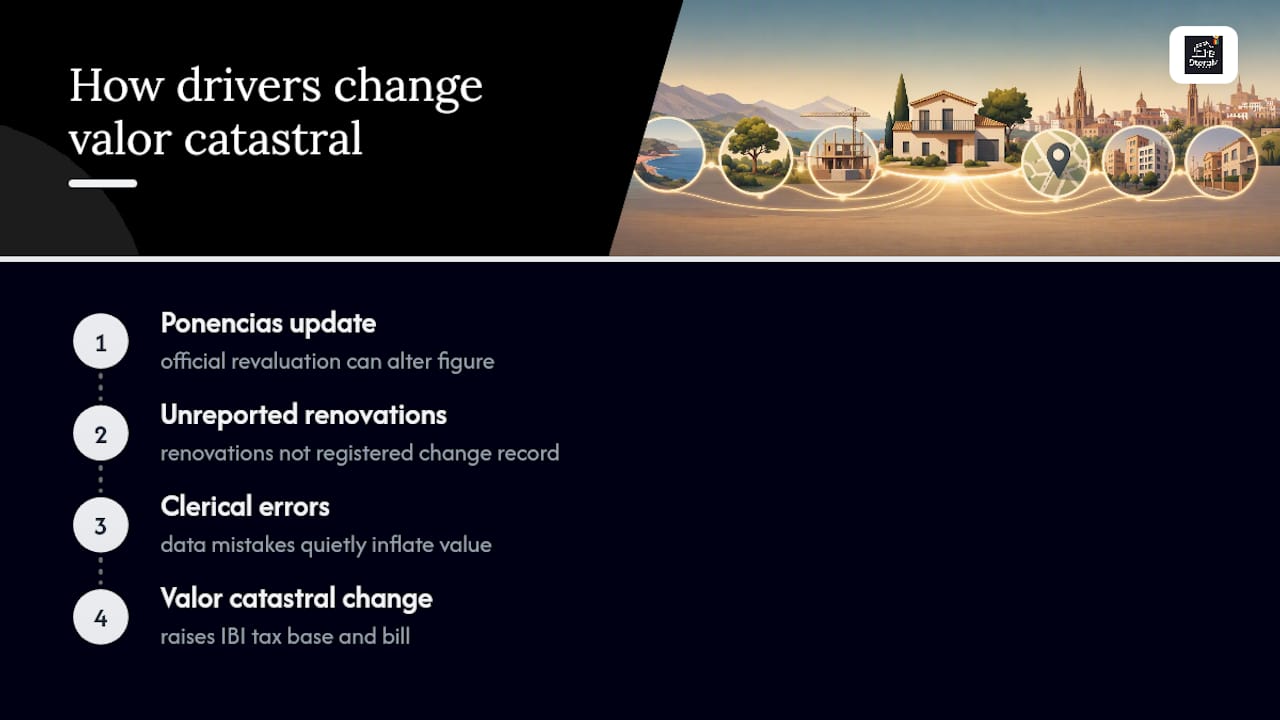
Most guides treat valor catastral as a static number you look up once and forget. That’s a mistake. The figure changes when ponencias update, when you renovate without notifying Catastro, or when a clerical error sits uncorrected for years, quietly inflating your IBI bill in the meantime.
The bigger blind spot is confusing valor catastral with valor de referencia. Owners who assume they’re the same thing get blindsided during a sale, when the tax authority applies the referencia figure to calculate transfer tax regardless of what price they actually agreed on with a buyer.
If there’s one thing worth prioritizing, it’s auditing your Catastro record every few years, not just when you get an unexpected tax notice. A ten-minute check of your surface area and construction details against what’s on file costs nothing and can save hundreds of euros in overpaid IBI down the line. Correction of factual errors remains the single most effective lever homeowners have, and it’s underused simply because most people don’t know it exists.
— YellowRock
Sources
- Tinsa — How to know the cadastral value of a dwelling
- BBVA — What is and how to calculate the cadastral value
- Banco Santander — How to calculate the cadastral value of a dwelling (FAQ)