
A real estate agent is a licensed professional who guides clients through buying, selling, or renting property by providing negotiation, market analysis, marketing, and transaction management services. The industry standard term is licensed real estate salesperson or broker, though “real estate agent” is the widely accepted shorthand used by buyers, sellers, and investors alike. Whether you are purchasing your first apartment in Torremolinos or selling an investment property, understanding the role of real estate agent is the clearest way to decide whether professional representation is worth it. The short answer: it almost always is.
What are the key responsibilities of seller’s agents vs. buyer’s agents?
The functions of real estate agents split into two distinct tracks depending on who they represent, and confusing the two is one of the most common mistakes clients make before signing any agreement.
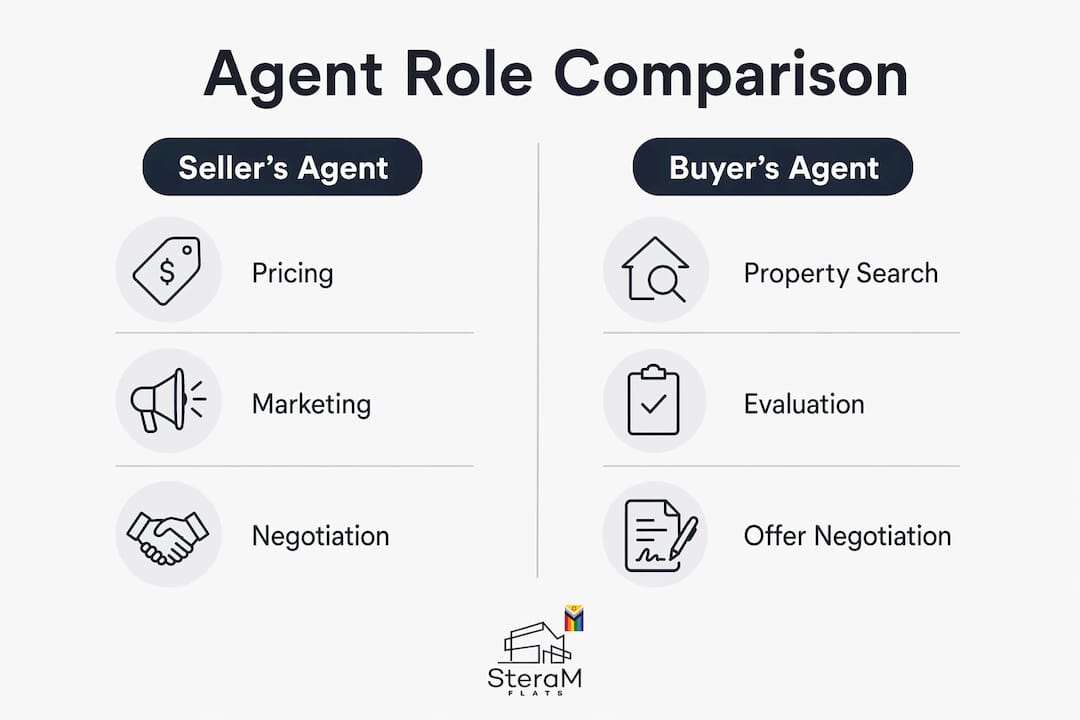
Seller’s agents (also called listing agents) take on the job of positioning a property to attract the strongest possible offer. Their core responsibilities include:
- Pricing the home using comparable sales data and current market conditions
- Listing the property on the MLS and syndicating it across digital platforms and social media
- Advising on staging, photography, and presentation to maximize perceived value
- Screening buyer inquiries and coordinating showings
- Reviewing and negotiating offers, counteroffers, and contingencies on the seller’s behalf
Buyer’s agents operate on the opposite side of the same transaction. Their real estate agent duties center on protecting the buyer’s financial interests and simplifying a process that involves dozens of moving parts:
- Identifying properties that match the buyer’s criteria, including off-market opportunities
- Drafting competitive offers with terms, contingencies, and timelines that protect the buyer
- Negotiating purchase price and repair credits after inspections
- Recommending vetted inspectors, attorneys, and mortgage professionals
- Managing closing paperwork and tracking deadlines to prevent costly delays
The table below shows how these two roles compare across the transaction lifecycle:
| Task | Seller’s agent | Buyer’s agent |
|---|---|---|
| Pricing strategy | Sets listing price using comps | Evaluates offer price against market data |
| Marketing | Lists on MLS, social media, open houses | Searches MLS, networks, and off-market sources |
| Negotiation | Negotiates offers received from buyers | Negotiates purchase terms with seller’s agent |
| Inspections | Coordinates access for buyer inspections | Recommends inspectors, reviews findings |
| Closing coordination | Manages seller-side documents and signatures | Tracks buyer-side paperwork and deadlines |
Both roles are legally and ethically bound to act in their respective client’s best interest. That obligation is not optional. It is a fiduciary duty.
What does a typical day look like for a real estate agent?
A real estate agent’s daily workflow is far less glamorous than property television suggests, and far more demanding. The job runs on communication, logistics, and constant context-switching between multiple clients and transactions at different stages.
Here is a realistic picture of how a working day breaks down:
- Morning communications. Agents start by reviewing emails, texts, and voicemails from clients, other agents, lenders, and title companies. Response time matters. A delayed reply on an offer can cost a client the deal.
- Scheduling and coordination. Showings, inspections, appraisals, and client meetings all require precise scheduling. Agents often manage five to ten active clients simultaneously, each at a different transaction stage.
- Market research updates. Agents continuously review new comparable sales, price reductions, and inventory changes to keep their pricing advice current. A recommendation based on data from three weeks ago can be materially wrong in a fast-moving market.
- Property showings and listing appointments. Afternoons often involve driving clients through properties or meeting sellers to discuss listing strategy, pricing adjustments, or offer responses.
- Paperwork and transaction management. Contracts, addenda, disclosure forms, and lender documents require careful review. Errors at this stage can delay or kill a closing.
- Evening follow-ups. Many clients are only available after work hours. Agents who limit their availability to a nine-to-five schedule lose business and clients.
Pro Tip: Ask any agent you are considering hiring how many active clients they currently represent. An agent managing more than fifteen active transactions simultaneously may not have the bandwidth to give your deal the attention it needs.
The pace is relentless, but it is also why experienced agents earn their commission. Coordination at this level requires professional discipline, not just enthusiasm for real estate.

What fiduciary duties do real estate agents owe their clients?
Fiduciary duty is the legal backbone of every agency relationship in real estate. Agency relationships create legally binding obligations that require agents to place their client’s interests above their own, and above the interests of any other party in the transaction.
The core fiduciary duties agents owe their clients are:
- Loyalty. The agent must act solely in the client’s best interest, not in their own financial interest or the interest of the other party.
- Disclosure. Agents must share any information that could affect the client’s decision, including known defects, competing offers, and market conditions.
- Confidentiality. Information the client shares, such as their maximum budget or motivation to sell quickly, cannot be disclosed to the opposing party.
- Reasonable care. Agents must apply professional competence and diligence throughout the transaction, from pricing analysis to document review.
- Good faith. All actions must be honest and transparent, with no deception or manipulation.
“Agency relationships create fiduciary duties legally binding agents to protect clients’ best interests with loyalty, disclosure, and confidentiality.” — Pennsylvania Association of Realtors
Dual agency, where one agent represents both buyer and seller in the same transaction, complicates these duties significantly. In dual agency, the agent cannot fully advocate for either party without compromising the other. Some states restrict or ban it outright. If you encounter a dual agency situation, ask directly how the agent plans to protect your specific interests, and consider whether independent representation is the safer choice.
Understanding these obligations matters because they are the legal mechanism that separates a professional agent from a salesperson simply trying to close a deal.
How does a real estate agent add value beyond what you can do yourself?
The rise of Zillow, Idealista, and other listing platforms has made one thing easier: finding properties to look at. What those platforms cannot do is negotiate on your behalf, manage the contract-to-close process, or tell you whether a listing is priced $30,000 above what the market will actually support.
The importance of real estate agents becomes clearest in three specific areas:
Market expertise that goes beyond the listing price
Agents separate strategy from execution in ways that protect clients financially. On the strategy side, they assess whether a listing price reflects current comparable sales or whether a seller is testing the market with an inflated number. Market expertise is dynamic. Agents continuously reassess comparable sales and market indicators, so their pricing advice reflects today’s conditions, not data from last quarter.
Negotiation that changes the final number
Negotiation is where the commission pays for itself most visibly. A skilled buyer’s agent knows when to push for a price reduction, when to ask for closing cost credits instead, and when to walk away from a deal that has structural problems. Seller’s agents know how to create competitive tension between multiple offers to drive the final price higher. These are learned skills, not instincts.
Pro Tip: Before accepting any offer or making any counteroffer, ask your agent to walk you through the comparable sales that justify the number. If they cannot produce that analysis on demand, that is a warning sign.
Transaction management that prevents expensive mistakes
Contract-to-close handling is the highest-risk phase of any property transaction. Missed deadlines, unsigned addenda, and improperly routed documents can unwind even a well-negotiated deal. Agents manage document logistics, track signature requirements, and coordinate with lenders, title companies, and attorneys to keep the transaction on schedule.
The table below shows where agent involvement produces the clearest measurable difference:
| Area | Without an agent | With an agent |
|---|---|---|
| Pricing accuracy | Based on public listing data only | Based on current comparable sales analysis |
| Negotiation | Direct, often emotionally driven | Structured, strategy-based, and documented |
| Off-market access | None | Agent network and MLS relationships |
| Document management | Self-managed, high error risk | Professionally tracked with deadline alerts |
| Professional referrals | Cold search or online reviews | Vetted network of inspectors, attorneys, lenders |
Real estate agent services also extend to property search support for foreign buyers navigating unfamiliar legal systems, which adds another layer of value that no listing platform can replicate.
Key takeaways
The role of real estate agent is defined by fiduciary duty, market expertise, and transaction management. These three functions together determine whether a deal closes on favorable terms or falls apart under pressure.
| Point | Details |
|---|---|
| Two distinct agent roles | Seller’s agents focus on pricing and marketing; buyer’s agents focus on search, offers, and closing. |
| Fiduciary duty is legally binding | Agents must act with loyalty, disclosure, confidentiality, and reasonable care toward their clients. |
| Market expertise is ongoing | Agents continuously update comparable sales data to keep pricing and offer strategies accurate. |
| Negotiation changes outcomes | Structured, strategy-based negotiation consistently produces better terms than direct buyer-seller negotiation. |
| Transaction management prevents failures | Document logistics and deadline tracking at the contract-to-close stage prevent costly deal collapses. |
Why the agent’s role is more technical than most clients expect
Most people hire a real estate agent expecting help finding a property or attracting buyers. What they actually get, if they choose well, is a transaction manager, a market analyst, a negotiator, and a legal coordinator rolled into one. That gap between expectation and reality is where deals go wrong.
In my experience working with property transactions in Spain, the single most underestimated part of the agent’s job is the contract-to-close phase. Clients celebrate when an offer is accepted, but that moment is actually the beginning of the most technically demanding stretch of the transaction. Document routing, lender coordination, notary appointments, and registration requirements all have to happen in the right sequence, with the right authorizations, on a fixed timeline. One missed step can reset the entire process.
The other misconception I see regularly is that fiduciary duty is a formality. It is not. When an agent knows your maximum budget and is legally required to keep that confidential, that protection has real financial value. When a seller’s agent is legally bound to disclose a known structural defect, that disclosure can save a buyer from a six-figure mistake. These obligations exist because the role of real estate agency is fundamentally about representation, not just facilitation.
The agents who deliver the most value are not the ones with the most listings or the flashiest marketing. They are the ones who understand that their job is to protect their client’s position at every stage of a transaction, including the stages the client does not know to worry about.
— Steramflats
How Steramflats supports buyers, sellers, and investors in Spain
Steramflats operates as a full-service real estate agency in southern Spain, with deep expertise in Torremolinos and the surrounding Costa del Sol market. Whether you are selling a residential property, managing a vacation rental, or searching for an investment opportunity, Steramflats provides professional guidance from valuation through closing.

Sellers can list their property for free and access Steramflats’ network of qualified buyers and renters. Investors benefit from property management, rental agreement support, and legal documentation services that cover the full transaction lifecycle. For buyers and investors new to the Spanish market, Steramflats’ team handles the complexity so you do not have to. Explore the full range of real estate services available and connect with the team for a personalized consultation.
FAQ
What is the main role of a real estate agent?
A real estate agent is a licensed professional who represents buyers or sellers in property transactions, providing market analysis, negotiation, marketing, and transaction management services. Their primary obligation is to act in their client’s best financial and legal interest throughout the process.
What is the difference between a buyer’s agent and a seller’s agent?
A seller’s agent (listing agent) focuses on pricing, marketing, and negotiating offers on behalf of the seller, while a buyer’s agent helps clients find properties, draft offers, and manage the closing process. Both roles carry fiduciary duties, but their specific responsibilities and loyalties are opposite.
Do real estate agents have legal obligations to their clients?
Yes. Agents owe fiduciary duties including loyalty, disclosure, confidentiality, and reasonable care, which are legally binding under state or regional licensing laws. These duties require agents to prioritize their client’s interests above all others, including their own.
Can I buy or sell property without a real estate agent?
You can, but the risks are significant. Without an agent, buyers lose access to off-market listings, structured negotiation, and professional document management. Sellers without representation often misprice their property and mishandle the contract-to-close phase, which is the most document-intensive part of any transaction.
How do real estate agents get paid?
Most agents earn a commission based on the final sale price of the property, typically paid at closing. The commission is usually split between the buyer’s agent and the seller’s agent, with each agent’s brokerage taking a portion. Brokerage structure and licensing laws govern how commissions are structured and disclosed in each jurisdiction.
Recommended
- SteraM Flats | Why get legal support for real estate in Spain: A guide
- SteraM Flats | Entendiendo el Papel de un Agente Inmobiliario en Torremolinos: Beneficios de Trabajar con un Profesional
- SteraM Flats | How to Rent Out Property: A Landlord’s 2026 Guide
- SteraM Flats | Property Search Process in Spain: A Foreign Buyer’s Guide