IBI tax in Spain is the mandatory annual municipal property tax that every property owner must pay, calculated not on market value but on an official administrative figure called the valor catastral (cadastral value). Formally known as the Impuesto sobre Bienes Inmuebles, IBI applies to residents and non-residents alike, with no exemptions based on how you use the property or where you live. Whether you own a beachfront apartment in Torremolinos or a rural farmhouse in Andalusia, this bill arrives every year without fail. Understanding how it works is the foundation of sound financial planning for any property owner in Spain.
What is IBI tax in Spain and who pays it?
IBI tax is a mandatory annual municipal tax levied on all property owners in Spain, regardless of residency status or nationality. The Spanish Land Registry assigns each property a cadastral value, and the local ayuntamiento (town hall) applies its own rate to that figure to produce your annual bill. There is no income threshold, no minimum ownership period, and no residency requirement that exempts you. If your name is on the title deed, you owe IBI.
The tax revenue funds local municipal services: road maintenance, public lighting, parks, and emergency services. This is a purely local tax, which means the national Spanish government does not collect it and does not set the rate. That distinction matters because it explains why two identical apartments in neighboring towns can carry very different IBI bills. For anyone building a property investment strategy in Spain, IBI is a fixed annual cost that must be factored into yield calculations from day one.

How is IBI tax calculated?
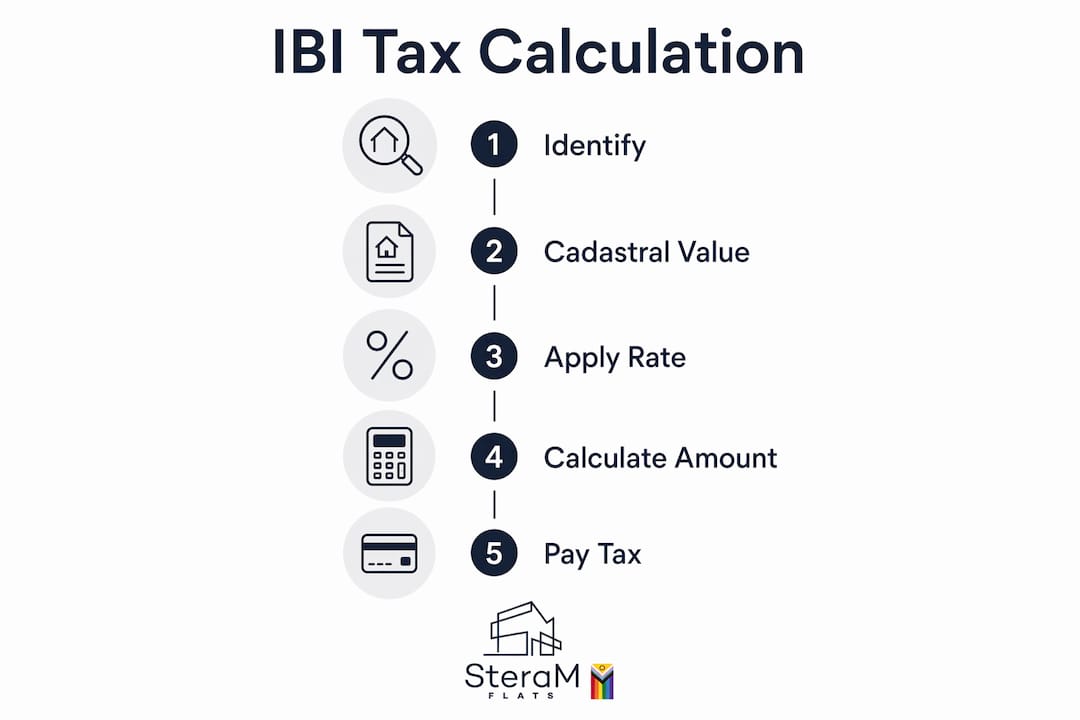
The calculation starts with the valor catastral, an administrative value assigned by the Dirección General del Catastro (Spain’s Land Registry). This figure is often 30 to 50 percent below market value, which surprises many foreign buyers who expect their tax bill to reflect what they paid for the property. It does not. The cadastral value is based on location, land area, construction type, age, and use, and it is updated periodically through a process called ponencia de valores.
Once the cadastral value is set, the municipality applies its own rate:
- Urban properties (IBI urbana): rates typically range from 0.4% to 1.1% of cadastral value
- Rural and agricultural land (IBI rústica): rates typically range from 0.3% to 0.9%
- Special properties (such as those with special characteristics like large industrial sites): rates can reach up to 1.3%
A property with a cadastral value of €120,000 in a municipality charging 0.6% generates an annual IBI bill of €720. That same property might sell for €250,000 on the open market, but the tax base ignores that figure entirely. This gap between cadastral and market value is why foreign buyers frequently overestimate their IBI burden before receiving their first bill, and occasionally underestimate it after a cadastral reassessment.
Pro Tip: Request the current cadastral value from the Catastro website (sedecatastro.gob.es) before purchasing any property. This gives you an accurate IBI estimate before you commit to the purchase.
Cadastral reassessments can push values closer to market prices, sometimes significantly increasing IBI overnight. If your municipality triggers a ponencia de valores, expect your bill to rise in the following cycle. Checking the Catastro records annually takes five minutes and can prevent an unpleasant surprise.
When and how do you pay IBI tax in Spain?
Payment timing is entirely controlled by the local municipality, which creates one of the most common traps for property owners. Each municipality sets its own payment window, typically falling between August and November, with no single national deadline. A property owner in Málaga and one in Barcelona may face different deadlines by two full months.
The most common payment methods are:
- Domiciliación bancaria (direct debit): The municipality debits your Spanish bank account automatically within the payment window. This is the most reliable method.
- Online payment: Most town halls now offer payment through their official websites using a Spanish bank card or account.
- In-person at the town hall or authorized bank: You bring your IBI bill and pay at the counter. This requires you to have received the paper bill.
- Payment via SUMA or ORGT: In some regions like Alicante and Catalonia, a regional tax agency handles IBI collection on behalf of municipalities.
Missing the payment window carries real consequences. Late payment surcharges range from 5% to 20% of the original tax amount, and interest accrues on top of that. If the debt remains unpaid after repeated notices, municipal authorities can impose an embargo on your bank account. That is not a theoretical risk. Spanish municipalities use this power routinely, and non-resident property owners are not immune.
Pro Tip: Set up domiciliación bancaria through your Spanish bank account as soon as you complete a property purchase. Automating IBI payments eliminates the risk of missing localized deadlines, especially if you live outside Spain and rely on postal delivery.
How does IBI tax differ from other property taxes in Spain?
IBI is frequently confused with the Non-Resident Income Tax, known as IRNR (Impuesto sobre la Renta de No Residentes). They are entirely separate obligations with different tax bases, collection authorities, and filing requirements. Mixing them up can lead to underpayment, double penalties, or missed declarations.
| Feature | IBI | IRNR |
|---|---|---|
| Tax type | Local municipal tax | National income tax |
| Tax base | Cadastral value | Rental income or imputed income |
| Who collects it | Town hall or regional agency | Spanish Tax Agency (AEAT) |
| Filing required | No return needed | Annual declaration via Form 210 |
| Rate | 0.4% to 1.1% of cadastral value | 19% (EU/EEA) or 24% (non-EU) |
| Applies to | All property owners | Non-residents only |
The IRNR applies at 19% for EU and EEA citizens and 24% for non-EU citizens, calculated either on actual rental income or on an imputed income figure if the property sits empty. IBI, by contrast, requires no tax return and no interaction with the national tax authority. You simply pay the bill the town hall sends. Both taxes are mandatory for non-resident property owners, and both must be budgeted for separately. A complete overview of Spain property taxes is worth reviewing before you finalize any purchase.
What variations exist in IBI tax by property type and municipality?
Spain’s IBI system creates meaningful differences based on both property classification and location. The two primary categories are IBI urbana (urban properties, including apartments, houses, and commercial premises) and IBI rústica (rural and agricultural land). IBI applies to both urban and rural properties, and a single rural estate that straddles both a built structure and agricultural land can generate two separate IBI bills in the same year.
Municipal rate variation across Spain is substantial:
- Madrid: urban IBI rate of approximately 0.456%
- Barcelona: urban IBI rate of approximately 0.66%
- Torremolinos (Málaga): rates within the standard Andalusian range of 0.4% to 0.9%
- Smaller rural municipalities: sometimes charge higher rates to compensate for a smaller tax base
Some regions delegate IBI collection to provincial agencies. In the province of Alicante, SUMA Gestión Tributaria handles billing and collection for most municipalities. In Catalonia, the ORGT manages collection for many towns. These agencies operate on their own calendars, which may differ from what you expect if you have experience paying IBI in another region.
Properties in tourist-heavy coastal areas often carry higher cadastral values relative to their size than equivalent inland properties, reflecting the land value component of the cadastral calculation. This is a practical consideration for anyone comparing investment properties across different Spanish regions.
How to manage IBI tax efficiently as a property owner
Managing IBI well comes down to three habits: knowing your liability date, automating payment, and monitoring your cadastral record.
The legal owner on January 1st of any given year is responsible for that full year’s IBI bill, even if the property is sold in February. This rule catches many buyers and sellers off guard during transactions. If you purchase a property after January 1st, the seller owes that year’s IBI to the town hall. Confirm this in writing during the purchase negotiation and check whether the seller has already paid before you sign.
Key practices for efficient IBI management:
- Register your contact details with the local town hall so bills reach you directly, especially if you are a non-resident.
- Check your cadastral record annually at sedecatastro.gob.es to catch reassessments before the bill arrives.
- Keep records of all IBI payments for at least five years, as proof of payment may be required during property sales or mortgage applications.
- Contact the town hall proactively if you have not received a bill by September. In rural areas, postal disruptions frequently cause owners to miss IBI bills, leading to accumulated taxes and penalties across multiple years.
Pro Tip: If you manage multiple properties across different municipalities, consider working with a local property manager or gestor who monitors payment calendars on your behalf. The cost of professional oversight is almost always less than a single late payment penalty.
Foreign buyers who register their property correctly from the start are far less likely to encounter IBI surprises, because accurate registration ensures the cadastral record reflects the correct owner and address for billing purposes.
Key takeaways
IBI tax in Spain is a local municipal tax calculated on cadastral value, not market price, and every property owner must pay it annually regardless of residency or how the property is used.
| Point | Details |
|---|---|
| Cadastral value drives the bill | IBI is calculated on an administrative value often 30 to 50 percent below market price, not what you paid. |
| Rates vary by municipality | Urban rates range from 0.4% to 1.1%; rural rates from 0.3% to 0.9%, set entirely by the local town hall. |
| January 1st ownership rule | Whoever owns the property on January 1st owes that full year’s IBI, even if they sell the next day. |
| IBI and IRNR are separate taxes | Non-residents owe both: IBI to the town hall and IRNR to the national tax agency via Form 210. |
| Automate to avoid penalties | Direct debit from a Spanish bank account eliminates the risk of missing localized payment windows and surcharges. |
Why IBI tax planning matters more than most buyers realize
Most foreign buyers I have worked with arrive with one of two misconceptions. Either they think IBI will be enormous because they paid a high market price, or they dismiss it as a trivial expense and never set up a proper payment system. Both approaches create problems.
The cadastral value gap is genuinely useful for buyers. A property worth €400,000 on the market might carry a cadastral value of €180,000, producing an annual IBI bill under €2,000 even in a higher-rate municipality. That is manageable. But the trap is assuming that value stays static. Municipalities trigger reassessments, and when they do, bills can jump 30% or more in a single cycle. I have seen property owners in coastal Andalusia receive IBI bills nearly double what they budgeted after a reassessment they never anticipated.
The payment calendar issue is the other consistent failure point. Non-residents who rely on paper bills mailed to a Spanish address they visit twice a year are playing a risky game. Postal delivery in rural municipalities is unreliable, and the town hall’s obligation ends when it sends the bill. The debt accumulates whether you received the notice or not. Setting up direct debit takes one visit to a Spanish bank and removes this risk permanently.
My practical advice: treat IBI as a fixed annual cost, check your cadastral value every January, and automate payment before you leave Spain after any property purchase. These three steps eliminate virtually every IBI problem I have seen property owners face.
— YellowRock
How Steramflats can support your property ownership in Spain
Owning property in Spain involves more than finding the right apartment or villa. IBI tax, legal compliance, rental management, and local administration all require ongoing attention, especially for non-residents.

Steramflats provides property sales, long-term rentals, vacation rentals, and full property management services across southern Spain, with particular expertise in the Torremolinos area. The team handles rental agreements, property valuation, legal documentation, and local compliance, so you stay on top of obligations like IBI without managing every detail yourself. Whether you are listing your property for sale or rental, or looking for vacation rental management support, Steramflats offers a practical, experienced partner for every stage of Spanish property ownership.
FAQ
What does IBI stand for in Spain?
IBI stands for Impuesto sobre Bienes Inmuebles, which translates as the tax on real estate. It is Spain’s local municipal property tax, collected annually by each town hall.
How is IBI tax calculated in Spain?
IBI is calculated by applying the municipality’s tax rate, typically between 0.4% and 1.1%, to the property’s cadastral value as assigned by the Spanish Land Registry. The cadastral value is an administrative figure, not the market price.
When is IBI tax due in Spain?
Payment windows vary by municipality and generally fall between August and November. There is no single national deadline, so you must check with your local town hall or regional tax agency for the exact dates.
Do non-residents in Spain have to pay IBI?
Yes. IBI applies to all property owners in Spain regardless of residency status or nationality. Non-residents also owe a separate national tax called IRNR, filed via Form 210, which is a different obligation entirely.
What happens if you don’t pay IBI in Spain?
Late payment surcharges range from 5% to 20% of the original tax amount, with interest accruing on top. Persistent non-payment gives municipal authorities the legal power to freeze your bank account through an embargo.