
Mishandling a rental agreement in Spain can cost you thousands of euros in fines, drag you into court proceedings that last years, or leave you locked into terms you never intended to accept. The legal landscape here is genuinely complex, with multiple layers of national law, regional regulations, and recent pro-tenant reforms that override anything you write into a contract. This guide walks you through everything you need to know, from drafting a legally compliant contract to choosing the rental strategy that actually maximizes your returns.
Table of Contents
- Understanding rental agreement laws in Spain
- The essentials: Drafting a compliant rental contract
- Deposit and registration: Avoid fines and conflict
- Managing tenancy: Landlord obligations and dealing with disputes
- Optimizing income: Choosing the right rental strategy
- Our take: What most landlords get wrong about rental management in Spain
- Get expert help with your rental agreements
- Frequently asked questions
Key Takeaways
| Point | Details |
|---|---|
| Follow legal contract rules | Always use written rental agreements and include all required elements for compliance. |
| Register deposits quickly | Avoid hefty fines by registering all security deposits with authorities within 30 days. |
| Know your landlord duties | Understand obligations for property condition, taxes, and notice procedures to prevent disputes. |
| Optimize rental strategy | Choose between long-term and short-term rentals based on your goals and local regulations. |
| Avoid easy mistakes | Check community rules, document every step, and never misclassify rental types to stay protected. |
Understanding rental agreement laws in Spain
With the risks clear, let’s start by clarifying the legal framework landlords must follow.
Rental agreements in Spain are primarily governed by the Ley de Arrendamientos Urbanos, or LAU. This legislation, Ley 29/1994 with 2023 amendments via the Housing Law (Ley 12/2023), sets the baseline for all residential rentals in urban areas. Understanding it is not optional. It is the foundation of every valid tenancy.
The LAU covers urban housing contracts, which means residential properties used as a primary home. Seasonal rentals and tourist apartments fall under different rules entirely. This distinction matters enormously because the protections afforded to tenants in standard residential contracts are far more extensive than those in short-term or holiday arrangements.
Minimum rights override contract clauses.
This principle is critical. Even if a tenant signs a clause agreeing to shorter notice periods or reduced protections, the clause is legally void if it conflicts with LAU minimums. As a landlord, you cannot contract your way out of legal obligations, no matter what the tenant agrees to on paper.
Here is a quick comparison of the main property types and how the law applies:
| Property type | Governing framework | Minimum rental term | Key landlord protection |
|---|---|---|---|
| Primary residential | LAU (Ley 29/1994) | 5 years (7 if landlord is a company) | Eviction via court for non-payment |
| Seasonal/student rental | LAU seasonal rules | Agreed in contract | Shorter obligations, less protection |
| Tourist apartment | Regional regulations | Night by night | License required, community vote may apply |
| Commercial property | LAU commercial section | Agreed, typically 5 years | Different renewal rights |
Key areas the LAU regulates for residential landlords include:
- Mandatory contract extension for up to 5 years (or 7 for corporate landlords) unless the tenant chooses to leave
- Rent increase limits tied to national indices, not freely negotiable since the 2023 Housing Law
- Notice requirements before contract termination or non-renewal
- Restrictions on what fees landlords can charge tenants, including agency fees post-2023
Exploring the different agreement types for landlords before you draft anything is time well spent. Each type carries its own obligations, and misclassifying your rental can expose you to unexpected legal liability. You should also review the tenant and landlord rules that govern day-to-day obligations throughout the tenancy.
The essentials: Drafting a compliant rental contract
Now that you know what the law expects, let’s move to the contract creation itself.
A valid residential rental contract in Spain must be written. It must include several mandatory elements without exception. Verbal contracts are invalid, and any clause that contradicts LAU protections is automatically void, meaning a judge will simply ignore it if a dispute arises.
Verbal contracts are invalid and clauses against LAU are void.
Here is a step-by-step drafting checklist every landlord should follow:
- Identify both parties fully. Include the full legal names, NIE or DNI numbers, and address of both landlord and tenant.
- Describe the property precisely. Include the registered address, cadastral reference, and any parking spaces or storage units included.
- Set the rent and payment terms. Specify the monthly amount, due date, payment method, and the bank account to be used.
- State the contract duration. Minimum is generally 1 year for the first period, with automatic extensions up to 5 years total.
- Include deposit information. State the amount, where it will be held, and the conditions for return.
- Attach a detailed inventory. List every item in the property with its condition at the start of tenancy. Photographs are strongly recommended.
- Specify who covers utilities and maintenance. Be explicit. Ambiguity here leads to disputes.
- Include an energy performance certificate (EPC). Legally required since 2013. The tenant must receive a copy.
- State rules on subletting. Under LAU, subletting requires landlord consent in writing.
- Add a rent review clause. Post-2023, increases must follow legally permitted indices. Note which index applies.
Make sure you know your rights as a landlord before finalizing any document. An overlooked clause can transform a cooperative tenant relationship into a legal battle overnight.
Pro Tip: Never use a contract template downloaded from an informal source or copied from a friend. Templates from certified legal advisors or reputable professional bodies are the only safe starting point. And always have a local property lawyer review the final document before signing. Use the rental management checklist to verify that nothing has been missed before the tenancy begins.

Deposit and registration: Avoid fines and conflict
With the contract set, the next priority is handling the deposit correctly.
The fianza (security deposit) is mandatory for all residential rentals in Spain. The amount is fixed at one month’s rent for standard housing contracts. You must register it with the relevant regional housing authority within 30 days of signing. Fail to do this and you risk fines of up to 75% of the deposit amount in some regions. That is not a typo.
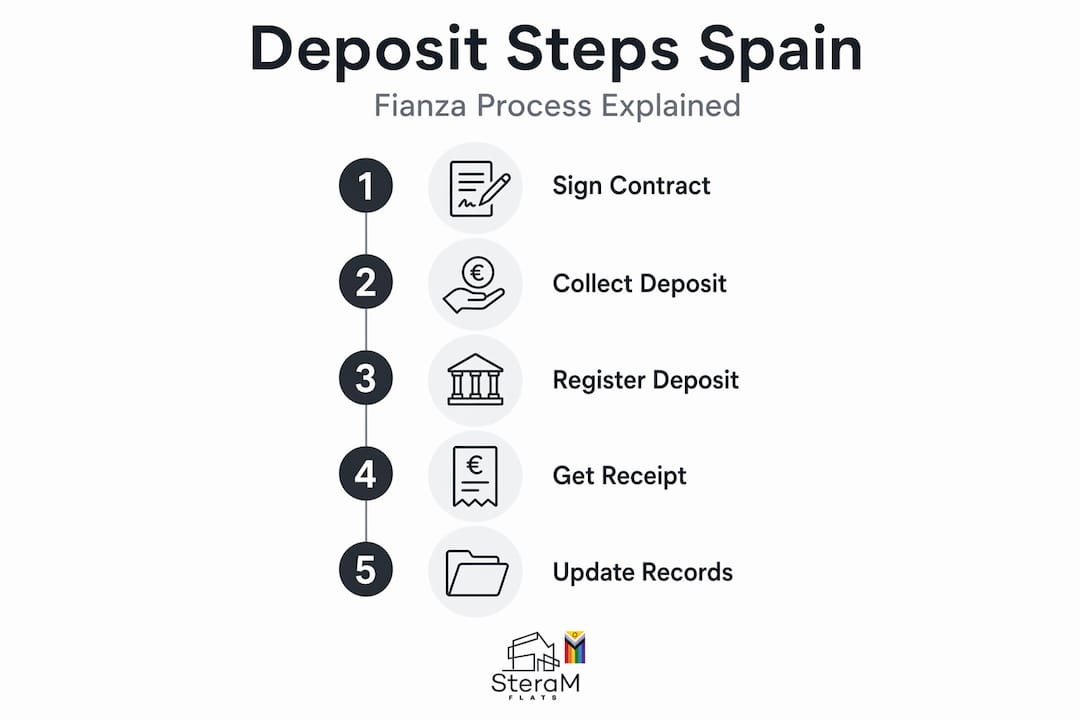
| Step | What to do | Timeframe |
|---|---|---|
| Collect deposit | One month’s rent for housing | At contract signing |
| Register with authority | Submit to regional housing body (e.g., Junta de Andalucía) | Within 30 days |
| Hold deposit | Keep in separate or notified account | Throughout tenancy |
| Return or deduct | Return within 30 days of key handover | After tenancy ends |
| Dispute deductions | Justify each deduction with documented evidence | Within return period |
The deposit must be returned within 30 days of the tenant vacating. If you withhold any portion, you need documented proof. The inventory you completed at the start of the tenancy is your primary defense here. Without it, a judge will almost always side with the tenant.
Common mistakes landlords make with deposits include:
- Not registering the deposit at all, assuming it is informal
- Delaying registration past the 30-day window
- Making deductions for normal wear and tear, which is not permitted
- Failing to return the deposit within the legal timeframe, which can result in the tenant claiming double
- Not updating the registration when the rent changes and a higher deposit is collected
Pro Tip: Always register the deposit on time, every time. Regional housing authorities in Spain are increasingly active in enforcement. The fine for non-registration is not a theoretical risk; it is a real and growing one, particularly in Andalucía and Cataluña.
For a thorough review of essential tenant rules and what tenants are entitled to claim, checking the full legal breakdown helps you prepare for any eventualities. You can also cross-reference your process against the management checklist to ensure every administrative step is covered.
Managing tenancy: Landlord obligations and dealing with disputes
Once the deposit and registration are in order, focus on ongoing tenancy management and conflict resolution.
Spanish law places significant obligations on landlords throughout the life of a tenancy. These go well beyond simply collecting rent each month. Landlords must deliver a habitable property, carry out major structural repairs, pay IBI (Impuesto sobre Bienes Inmuebles, the annual property tax), cover community fees unless contractually transferred, provide a valid Energy Performance Certificate, and since 2023, cover real estate agency fees that were previously passed to tenants.
Your ongoing obligations as a landlord include:
- Maintaining structural integrity of the building and installations
- Repairing major systems like plumbing, heating, and electrical if they fail through normal use
- Paying IBI and other property-related taxes unless the contract explicitly states otherwise
- Covering community (homeowners association) fees unless specifically delegated to the tenant in the contract
- Ensuring the property stays habitable throughout the tenancy
- Not disturbing the tenant’s peaceful enjoyment of the property
When disputes arise, how you respond legally matters as much as being in the right. For non-payment of rent, eviction is possible under LAU art. 27, but the process must follow specific steps.
Here is the correct dispute escalation sequence:
- Document everything. Keep records of all communications, missed payments, and property inspections.
- Send a formal burofax notice. A burofax is a certified letter service through Correos (the Spanish postal service) that creates legal proof of delivery and content. Use it for every formal communication, especially notices of breach.
- Allow the legal response period. Tenants have specific rights to remedy non-payment even after a burofax.
- File for eviction (desahucio) in court if the breach continues. This process can take months, so document early.
- Consider mediation before court. It is faster, cheaper, and increasingly encouraged by Spanish courts.
Burofax is the legally recognized proof of notice in Spanish tenancy disputes. Without it, your notice may not exist in the eyes of a judge.
For a thorough understanding of tenant rights and legal clarity in long-term rentals, reviewing the complete breakdown of tenant protections helps you anticipate what any dispute process will look like from the other side.
Optimizing income: Choosing the right rental strategy
With legal and operational basics handled, you can now focus on strategies to optimize your rental income.
Not all rental strategies are equal in Spain, and the best choice depends on your property’s location, your tax residency status, and the local licensing environment. Long-term rentals offer stability while short-term and tourist rentals can generate significantly higher gross yields, but they require licenses, community approval, and more active management.
| Rental type | Potential income | Licenses required | Management intensity | Stability |
|---|---|---|---|---|
| Long-term residential | Moderate | None beyond standard | Low | High |
| Short-term seasonal | High | Often regional license | Medium | Medium |
| Tourist/holiday apartment | Highest | Tourist license required | High | Low (seasonal) |
Key income optimization strategies include:
- Dynamic pricing for short-term rentals, adjusting rates based on local events, seasonality, and demand
- Obtaining the correct tourist license before listing on any platform to avoid fines that can reach tens of thousands of euros
- Confirming community approval for tourist use, since homeowners associations have had the right to restrict holiday lets since 2019
- Declaring rental income correctly: non-residents must use Modelo 210, with tax rates between 19% and 24% depending on your country of residence
- Tracking allowable expenses to reduce your taxable income, including maintenance, management fees, and insurance
Pro Tip: Misclassifying a tourist rental as a seasonal rental to avoid licensing is one of the most costly mistakes landlords make in Spain. Regional authorities in Andalucía, Cataluña, and the Canary Islands are actively auditing short-term rental listings. The fines are severe and the process for correcting an illegal listing is far more painful than getting licensed correctly from the start.
Before launching any holiday rental, review the full holiday rental registration requirements for your region. Properties in tourist-heavy coastal areas like Torremolinos often have specific municipal rules on top of regional ones. You can also explore how holiday rentals boost property investment returns and review the long-term vs holiday rentals comparison to decide which model fits your goals.
Our take: What most landlords get wrong about rental management in Spain
Having reviewed practical steps and legal strategies, here is what our experience shows actually matters most.
Most landlords who run into serious trouble in Spain did not intend to break the law. They rushed into contracts, did not read the LAU carefully, or assumed that what works in their home country applies here. It does not.
The single most common mistake we see is poor documentation from the very start. Landlords skip the detailed inventory, rely on informal communications, and then have no evidence when a dispute arises.
Most disputes arise from poor documentation, not bad intentions.
The second most common mistake is mishandling notices. Sending a WhatsApp message to warn a tenant they are in breach carries zero legal weight in Spain. Only formal, documented notices, especially burofax, are recognized in court proceedings. We have seen landlords lose winnable cases simply because their notice could not be proven.
The third mistake is chasing yield without checking community rules. A property in an apartment block may be perfectly located for tourist rentals, but if the homeowners association has voted to prohibit them, listing it on a holiday platform exposes you to serious fines and community conflict.
Our advice: invest time upfront in getting the legal and community framework right before you sign anything. Explore how to find your ideal rental property type and check whether your property is suited to the strategy you have in mind. A little patience at the start saves an enormous amount of stress later.
Pro Tip: Schedule a legal review of your contract and property setup every two years. Spanish rental law has changed significantly in 2019, 2022, and 2023. What was compliant three years ago may not be today.
Get expert help with your rental agreements
Ready to simplify rental agreement management? Here are resources that make it easier.
Managing rental agreements in Spain involves more moving parts than most landlords expect, from LAU compliance and deposit registration to licensing and income optimization. Getting one element wrong can cost far more than professional help would have.

At SteraM Flats, we work directly with property owners across southern Spain to handle the full rental management process, including legal documentation, property listing, deposit administration, and license applications. Whether you are setting up your first rental or reviewing an existing portfolio, our team provides practical, region-specific guidance. Start by reviewing tenant rights to understand what your tenants are entitled to, and use our management checklist to audit your current setup. We are here to help you get it right.
Frequently asked questions
What are the minimum legal requirements for a rental agreement in Spain?
A written contract must include rent amount, duration, deposit details, and an inventory; verbal agreements are invalid and any clause that conflicts with LAU protections is automatically void.
How soon must the security deposit be registered after signing?
The deposit must be registered with the regional housing authority within 30 days of signing; late registration can trigger fines of up to 75% of the deposit amount.
Can I evict a tenant for non-payment in Spain?
Yes, eviction is possible under LAU art. 27 for non-payment, but tenants retain the right to leave after 6 months with 30 days’ notice, and any extension requires a formal burofax notice to be legally valid.
Should I choose long-term or short-term rental for higher income?
Short-term rentals typically generate higher gross yields but require regional licenses and community approval; long-term rentals offer more predictable income with fewer regulatory hurdles.
Recommended
- SteraM Flats | Rental Agreement Types in Spain: Guide for Landlords
- SteraM Flats | Rental agreements in Spain: Know your rights before signing
- SteraM Flats | Rental agreements in Spain: Essential rules for tenants and landlords
- SteraM Flats | Rental management checklist: Essential steps for landlords in Spain