
You can be fined before a single guest ever sets foot in your property. That’s the reality facing vacation rental owners in Spain today. Advertising without a proper tourism license or a valid national registration code can trigger immediate delisting on major platforms and serious financial penalties, even if the rental sits empty. Spain’s enforcement landscape has shifted dramatically, and the rules that applied two years ago look nothing like what’s required in 2026. This guide walks you through every layer of compliance, from first-time applications to annual declarations, so you stay legal, listed, and protected.
Table of Contents
- What is a tourist license and who needs one?
- Core documents and requirements for tourist license applications
- National digital registry and NRUA code: New rules from 2025
- Annual declaration and compliance obligations for NRUA code holders
- Editor’s perspective: What most owners miss about tourist license compliance
- Connect with experts and streamline your tourist license process
- Frequently asked questions
Key Takeaways
| Point | Details |
|---|---|
| License essential for rentals | A tourist license and national registry code are required for legal short-term rentals in Spain. |
| Core documents needed | Property owners must prepare certificates, insurance, responsible declaration, and meet regional standards before applying. |
| National registry adds obligations | New NRUA code and digital registry rules apply to all listings starting July 2025. |
| Annual declaration is mandatory | From March 2026, property owners must file an annual informative declaration or risk severe penalties. |
| Enforcement is now strict | Non-compliance, even with advertising, leads to delisting and possible sanctions across Spain. |
What is a tourist license and who needs one?
A tourist license (licencia turística) is an official permit that authorizes a property to operate as a short-term vacation rental for paying guests. Think of it as your property’s permission slip to participate in the tourism economy. Without it, you’re not just operating in a gray area — you’re operating illegally under Spanish law.
Here’s who needs one:
- Short-term vacation rental owners who rent to tourists for periods typically under 31 days
- Second-home owners listing properties on any booking platform, even occasionally
- Investors who purchased property specifically for holiday rental income
- Primary residence owners who rent out their home or a room during holidays or events
The rules are especially important because Spain is not a single regulatory environment. Each of Spain’s 17 autonomous communities (regions like Andalusia, Catalonia, Valencia, and the Canary Islands) sets its own licensing requirements, fees, inspection standards, and documentation rules. A property that meets standards in Málaga may fail to meet them in Barcelona. Regional variation is one of the most overlooked compliance traps for owners who move into a new market.
Regardless of region, one rule applies nationally: your listing must display your tourism registration number, and platforms are required to verify and remove listings that don’t show it. That means Airbnb, Booking.com, and similar platforms are legally obligated to delist you if your number is missing or invalid.
“To operate a tourist rental legally you must have (or file for) a regional tourism number/license and include that number in advertising and listings; platforms have to verify and/or remove listings without it.” — Wise
Non-compliance consequences are real and immediate. Fines in Andalusia, for example, can reach tens of thousands of euros depending on the severity of the violation. Repeat offenses can lead to permanent bans from operating tourist rentals. Our detailed rental license guide breaks down the regional application process step by step, which is essential reading before you start your application.
Core documents and requirements for tourist license applications

Understanding who needs a tourist license is just the start. Next, let’s explore what documents and standards you’ll need before even applying.
Most property owners are surprised by how document-heavy the application process is. There’s no single national checklist because each region adds its own layer of requirements. But there is a core set of documents that nearly every region expects. Getting these ready before you file saves weeks of back-and-forth with local authorities.
According to standard regional requirements, the typical core documentation includes:
- Habitability certificate or first-occupation certificate (Cédula de Habitabilidad / Licencia de Primera Ocupación): This confirms the property meets minimum living standards and was legally constructed for residential use.
- Energy efficiency certificate (Certificado de Eficiencia Energética): Required for all rental properties across Spain, this rates your property’s energy performance on a scale from A to G.
- Liability insurance (Seguro de Responsabilidad Civil): Coverage that protects you and guests in case of injury or property damage during their stay.
- Furnishing, equipment, and safety compliance: Your property must meet minimum standards for furniture, appliances, ventilation, emergency exits, and first aid equipment, with specifics varying by region and property category.
- Responsible declaration (Declaración Responsable): A signed statement confirming your property meets all requirements at the time of filing, often replacing the prior need for a full pre-inspection in many regions.
Some regions add extra layers. Andalusia, for instance, requires you to display the address of the nearest police station and post an official complaints form (hoja de reclamaciones) visibly inside the property. The Canary Islands require a 24-hour emergency contact number to be provided to guests. Never assume what worked in one region applies in another.
| Document | Required nationally? | Regional variations |
|---|---|---|
| Habitability certificate | Yes (most regions) | Format and issuing body vary |
| Energy efficiency certificate | Yes | Rating minimums differ |
| Liability insurance | Yes | Minimum coverage amounts vary |
| Furnishing/safety compliance | Yes | Category-specific standards |
| Responsible declaration | Yes (most regions) | Some still require prior inspection |
| Emergency contact info | No | Required in Canary Islands, others |
| Complaint forms posted | No | Required in Andalusia |
Pro Tip: File your Declaración Responsable correctly on the first attempt. Errors or omissions in this document are one of the most common reasons applications stall. Double-check the property address, registry number, and ownership details against your title deed before submitting.
Before you start gathering documents, review our property checklist to ensure your property is physically ready for inspection. Also, understanding Spain’s insurance requirements for rental properties will help you choose the right coverage level before your application.
National digital registry and NRUA code: New rules from 2025
After preparing your documentation, the next step is understanding how Spain’s new registry system will impact your listings and compliance routine.
Spain has introduced one of the most significant regulatory shifts in the vacation rental sector in over a decade. The national digital single-window registry, known as the NRUA (Registro Único de Alquileres / National Register of Rental Accommodations), creates a centralized national database for all short- and medium-term rentals. This was a long time coming — fragmented regional systems made it easy for non-compliant rentals to fly under the radar. That era is over.
The NRUA system launched obligations for listings and platform verification starting July 1, 2025. Here’s what changed:
- All property owners offering short-term or medium-term rentals must register their property in the national NRUA database.
- Each registered property receives a unique NRUA code that must appear on every listing, advertisement, and booking platform profile.
- Booking platforms are legally required to verify NRUA codes and remove or block listings that don’t display a valid code.
- The Ministry of Housing can access the NRUA database to cross-reference tax declarations, regional registrations, and platform activity.
Here’s a direct comparison of how compliance worked before and after July 2025:
| Compliance element | Pre-July 2025 | Post-July 2025 |
|---|---|---|
| Registration system | Regional only | Regional + national NRUA |
| Code required in listings | Regional code only | Both regional and NRUA code |
| Platform verification | Partial enforcement | Mandatory by law |
| Annual declaration | Not required nationally | Required from March 2026 |
| Ministry oversight | Limited | Full access via NRUA database |
Important: If you registered your property under the old regional system only, that registration does not automatically carry over to the NRUA. You need to file separately through the digital single-window portal (Ventanilla Única Digital). This is the single most common compliance gap we’re seeing among experienced landlords who thought they were already covered.
The NRUA requirement affects not just new hosts but every existing vacation rental operator in Spain. Even properties that have been legally listed and operating for years need to update their status. Learn more about what holiday home registration involves under the new national framework.
One number worth noting: Spain had an estimated 340,000 to 400,000 active vacation rental listings as of 2024 across all major platforms. The NRUA system is designed to bring every one of those listings into a single verifiable database, making non-compliance far more visible than it ever was before.
Annual declaration and compliance obligations for NRUA code holders
With the registry established, ongoing compliance becomes central. Let’s pinpoint the annual steps owners need to take.
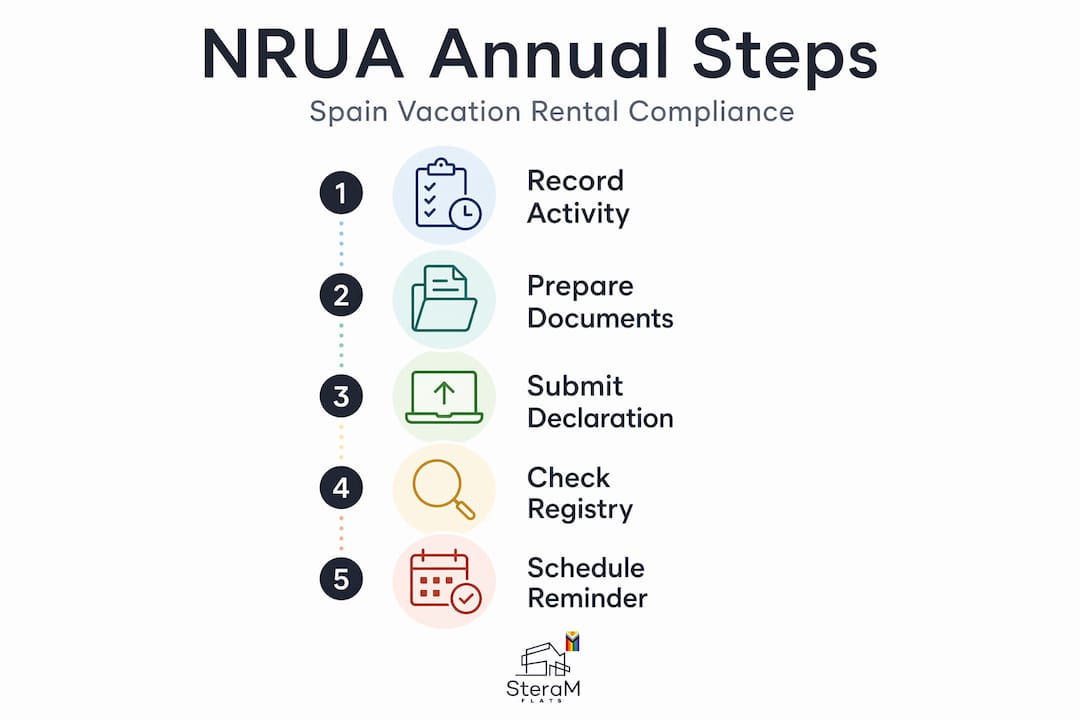
Getting your NRUA code is not a one-time event. Starting in 2026, holding an NRUA code comes with an annual obligation: the informative declaration. This is a digital report submitted through the Ventanilla Única portal that summarizes your rental activity from the prior year, including the number of nights rented, guest origin data, and income generated. It’s not a tax return, but it feeds information to authorities that can inform tax audits and regional inspections.
Here’s what the annual compliance cycle looks like in practice:
- January through February: Review your prior year’s rental records, guest logs, and income summaries to prepare for declaration filing.
- March (first filing deadline from 2026): Submit your annual informative declaration through the national digital single-window platform.
- Year-round: Keep your NRUA code current in all listings. Update if ownership details, property status, or regional licenses change.
- Year-round: Maintain your regional tourist license in good standing, as both licenses must remain valid simultaneously.
- Before each rental season: Confirm all safety, insurance, and property standards still meet requirements in your autonomous community.
The stakes for missing the annual declaration are significant. Failing to file can result in the cancellation of your NRUA registration number and sanctions from autonomous communities, which means you lose the legal right to list your property anywhere. Recovery from a cancelled registration is time-consuming and costly.
“From 2026, owners with NRUA must submit an annual informative declaration about prior-year activity; failure can lead to loss of the registration number and sanctions from autonomous communities and thus loss of ability to list legally.” — El Español
Pro Tip: Set a calendar reminder every January 15 to begin gathering your rental activity records. The March deadline comes faster than you expect, especially during high season preparation for spring bookings. Using a property management system that logs guest data automatically will make this process significantly less painful.
Enforcement is no longer passive. Regional tourism departments are actively cross-referencing listing platform data with registration databases. If your listing shows activity but your annual declaration shows nothing, that discrepancy will flag your account for investigation. Smart vacation rental management practices now include compliance tracking alongside pricing and marketing.
Editor’s perspective: What most owners miss about tourist license compliance
The rules are clear on paper, but experience on the ground reveals a different pattern: most enforcement problems don’t happen because owners ignored the law. They happen because owners assumed they were already compliant when they weren’t.
Here’s the uncomfortable truth: many experienced property owners who obtained their regional tourist license years ago have not updated their status under the NRUA system. They believe that because they were legal before July 2025, they remain legal today. That assumption is wrong, and it’s costing people real money and real listings.
Another common misconception is that compliance only matters once a guest complains or an inspector knocks on your door. But enforcement increasingly targets listings themselves, not just active rental activity. Your property can be flagged and fined for an advertisement that lacks a valid registration code, even if no one ever booked it.
The Declaración Responsable trips up more owners than almost any other document. Because it’s a self-certification, many owners sign and file it without actually verifying that their property meets all the stated standards. Then an inspection occurs and finds a fire extinguisher missing, outdated wiring, or insufficient natural lighting in a bedroom. Suddenly that “responsible declaration” becomes evidence of a false statement, which escalates the severity of the violation considerably.
What actually works is a proactive compliance calendar, not a reactive one. Keep a folder for each property that contains your current regional license, your NRUA code confirmation, your energy certificate expiry date, your insurance renewal date, and your most recent annual declaration receipt. Reviewing this folder once a quarter takes 15 minutes and prevents 15 weeks of legal headaches. Our step-by-step compliance guide is built around this proactive framework and is a practical tool, not just theory.
The owners who navigate Spain’s vacation rental market most successfully are not necessarily the ones with the biggest marketing budgets or the best interior design. They’re the ones who treat compliance as a core part of their business operation, not an afterthought.
Connect with experts and streamline your tourist license process
Navigating Spain’s tourist license process, especially with the new NRUA requirements layered on top of regional rules, is genuinely complex. You don’t have to figure it out alone.
At SteraM Flats, we work directly with property owners across southern Spain to manage every step of the compliance process, from gathering your initial documentation to filing annual declarations and keeping your listings current. Our team specializes in vacation rental management for the Torremolinos and Costa del Sol market, where regional rules from Andalusia intersect with national NRUA requirements. Whether you need a full walkthrough via our rental checklist, step-by-step help with your license application, or want to explore short-term rental opportunities in the region, our experts are ready to guide you through every requirement with confidence.
Frequently asked questions
Do I need a tourist license if I only rent out for a few weeks a year?
Yes, short-term rentals require licensing regardless of how few weeks you rent, and your registration code must appear in all listings and advertisements.
What happens if I forget my NRUA annual declaration?
Failing to file your declaration can result in the cancellation of your NRUA registration number and formal sanctions from the relevant autonomous community.
Is there a centralized registry for all regions in Spain?
Yes, Spain launched the national NRUA registry in July 2025, which creates a single digital system for all short- and medium-term rental registrations across the country.
What documents do I need to apply for a tourist license?
You typically need a habitability certificate, energy efficiency certificate, liability insurance proof, furnishing and safety compliance documentation, and a signed responsible declaration confirming your property meets all regional standards.
Can platforms remove my listing if I don’t have a license?
Yes, platforms are legally required to verify and delist rentals that don’t display a valid tourism license number and NRUA registration code in their listings.