
Property investment in Spain is defined as the acquisition of residential or commercial real estate by domestic or foreign buyers for capital appreciation, rental income, or both. This guide covers everything you need to execute a sound investment: current market data, legal prerequisites including the NIE (Número de Identificación de Extranjero), tax structures for new-build and resale properties, financing options, and renovation considerations. Whether you are buying a coastal apartment in Torremolinos or a city flat in Málaga, the workflow is the same. Understand the rules, build the right team, and the Spanish market rewards you.
What are the current real estate market trends in Spain?
Spain’s average registered home price reached €2,429/m² in Q1 2026, an 8.9% increase year-on-year. That figure tells you the market is not cooling. Prices are rising faster than inflation, which means buyers who wait are paying more, not less.
The split between property types matters for your strategy. New-build prices grew 6.9% YoY to €2,495/m², while existing homes climbed 9.6% to €2,294/m². Resale properties are appreciating faster in percentage terms, largely because new supply remains constrained in high-demand coastal zones. This creates a genuine opportunity in the resale segment for investors willing to renovate.

Foreign buyers completed 24,791 property purchases by March 2026, concentrated on the Mediterranean coast and the Balearic and Canary Islands. That figure is slightly down 3.2% year-on-year, yet foreign demand still underpins the entire market. Supply tightness alongside strong tourism-driven demand continues to push prices upward despite softer transaction volumes. You can explore vacation apartment demand in southern Spain to see exactly which micro-markets are attracting the most international capital.
| Region | Primary driver | Property type in demand |
|---|---|---|
| Costa del Sol | Tourism and expat relocation | Resale apartments and villas |
| Balearic Islands | Luxury tourism | New-build and premium resale |
| Canary Islands | Year-round climate and rentals | Apartments and holiday units |
| Valencia coast | Affordability relative to Catalonia | Mixed new-build and resale |
Pro Tip: If your goal is rental yield rather than pure capital gain, prioritize municipalities with year-round tourism rather than seasonal beach towns. Torremolinos and Benalmádena on the Costa del Sol maintain occupancy rates across 10 to 11 months of the year, which changes your yield calculation significantly.
What legal steps and documentation do foreign investors need?
Foreign investors must obtain an NIE before signing any notarial contract, paying property taxes, or opening a Spanish bank account linked to the purchase. The NIE is not optional and it is not fast. The application requires the EX-15 form, a Modelo 790 fee payment, and proof of purpose such as a reservation agreement or draft purchase contract. NIE delays can halt signing and tax payment entirely, so treat it as your first task, not your last.
The legal workflow for a Spanish property purchase follows a clear sequence:
- Obtain your NIE. Apply in person at a Spanish consulate in your home country or at a National Police station in Spain. Remote application support services exist for investors who cannot travel immediately.
- Sign a reservation agreement. This takes the property off the market and typically requires a deposit of €3,000 to €6,000.
- Execute the private purchase contract (Contrato de Arras). This locks in the price and terms. Losing your deposit is the penalty for withdrawal.
- Conduct legal due diligence. Your lawyer checks the Registro de la Propiedad (property registry) for encumbrances, outstanding mortgages, and planning compliance. This step is non-negotiable.
- Sign the public deed (Escritura) before a notary. The notary verifies identities and executes the deed but does not replace your need for independent legal due diligence. The notary works for the transaction, not for you.
- Pay taxes and register the property. Tax payment deadlines are strict. Registration at the Registro de la Propiedad completes your legal ownership.
Understanding why legal support matters in Spanish real estate is not just reassuring. It is the difference between a clean title and an inherited debt.
Pro Tip: Start your NIE application the moment you identify a property you intend to buy. Remote application support services can handle the process while you are still abroad. Waiting until you have a signed reservation agreement is too late in a competitive market.
How do taxes and costs differ for new-build vs. resale property?
The tax structure in Spain splits cleanly between two property categories, and the difference affects your total acquisition cost by thousands of euros.
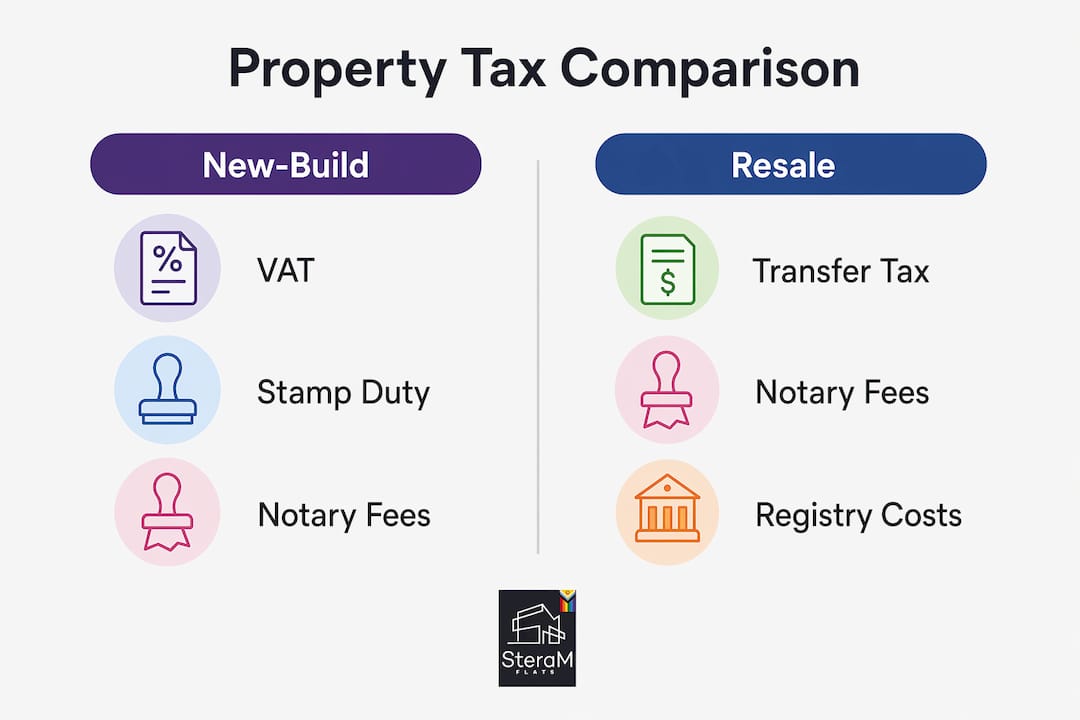
Resale properties are subject to the Impuesto de Transmisiones Patrimoniales (ITP), a regional transfer tax ranging from 6% to 10% of the purchase price depending on the autonomous community. Andalusia, which covers the Costa del Sol, currently applies 7%. Catalonia applies 10%.
New-build properties are subject to IVA (VAT) at 10% plus the Actos Jurídicos Documentados (AJD) stamp duty, which ranges from 0.5% to 1.5% by region. The combined tax burden is broadly similar to resale ITP, but the base calculation and timing differ.
Beyond the headline tax, a full cost structure typically adds 10% to 15% over the purchase price. Budget for the following:
- Notary fees: Scaled to the property value, typically €600 to €1,500.
- Property registry fees: Usually €400 to €700.
- Legal advisor fees: Typically 1% of the purchase price.
- Mortgage arrangement fees (if applicable): Varies by lender.
Ongoing ownership costs add another layer. IBI (Impuesto sobre Bienes Inmuebles) is the annual property tax levied by the municipality, calculated on the cadastral value of the property. Non-resident owners also face an annual imputed income tax even when the property generates no rental income. Community fees for shared building maintenance are a fixed monthly obligation in apartment complexes. A full breakdown of property taxes in Spain is worth reviewing before you finalize your budget.
Spain’s valor de referencia (value reference) rules mean the tax authority can assess ITP on the official reference value rather than the declared sale price if the reference value is higher. This catches investors who negotiate below-market prices expecting a lower tax bill.
What financing and renovation considerations should investors know?
Spanish banks offer mortgages to non-residents, typically up to 70% of the property’s appraised value compared to 80% for residents. The appraisal is conducted by a bank-approved tasador (valuer), and the result directly determines your maximum loan. Renovation mortgage packages bundle purchase and refurbishment costs into a single facility, which simplifies cash management for investors buying properties that need work.
NextGenerationEU funds support energy-efficient upgrades including insulation, window replacements, and heat pump installations, with subsidies varying by region. These grants are real money. An investor renovating a 1970s Costa del Sol apartment can access regional subsidies that offset a meaningful portion of the energy upgrade cost, improving both the property’s rental appeal and its long-term value.
Renovation in Spain requires permits, and permit management is where most foreign investors lose time and money. Key points to understand:
- Licencia de obra mayor (major building permit) is required for structural changes, extensions, or changes of use. Approval timelines vary by municipality and can run from two months to over a year in busy coastal areas.
- Licencia de obra menor covers cosmetic and non-structural work such as tiling, painting, and bathroom refits. Processing is faster but still requires submission and approval.
- Permit approval lead times and early material orders are the main causes of renovation delays and cost overruns in Spain. Order materials before permits are approved only if you are certain the permit will clear.
- Unlicensed works create title problems. A buyer discovering unauthorized extensions at resale faces demolition orders or costly legalization processes.
You also need a Spanish bank account. Recurring costs like IBI, utilities, and community fees require a Spanish IBAN because local payment processing systems demand it despite SEPA provisions. Open the account early in the process, not after completion.
Pro Tip: Build your renovation schedule backward from your target rental or resale date. Identify permit approval time as your longest lead item and start the application before you close on the purchase if the seller permits access. This single habit saves most investors two to four months of dead time.
Key takeaways
Successful property investment in Spain requires combining current market data, early NIE acquisition, accurate tax budgeting, and permit-aware renovation planning before committing capital.
| Point | Details |
|---|---|
| Market prices are rising | Spain’s average home price hit €2,429/m² in Q1 2026, up 8.9% YoY. Act on data, not assumptions. |
| NIE is your first task | Apply for your NIE before any other step. Delays halt signing and tax payment. |
| Budget 10% to 15% above purchase price | Taxes, notary, registry, and legal fees consistently add this range to total acquisition cost. |
| Notary does not replace your lawyer | Independent legal due diligence on encumbrances and compliance is non-negotiable. |
| Open a Spanish bank account early | IBI, utilities, and community fees require a Spanish IBAN regardless of SEPA rules. |
What I have learned from watching investors get Spain wrong
Most investors who struggle in Spain do not fail because of the market. They fail because they underestimate the administrative sequence. I have watched buyers lose reservation deposits because their NIE was still processing. I have seen renovation budgets double because a licencia de obra mayor took nine months in a coastal municipality that was not expecting the application volume.
The investors who do well share one habit: they build their professional team before they find a property. That means a Spanish lawyer who specializes in property transactions, a gestor (administrative advisor) who handles tax filings and NIE paperwork, and a local architect or project manager if renovation is part of the plan. Trying to assemble this team after you fall in love with a property puts you in a weak negotiating position and a tight timeline.
Geographic focus also matters more than most guides admit. Southern Spain, particularly the Costa del Sol corridor from Estepona to Nerja, offers a combination of year-round rental demand, established foreign buyer infrastructure, and improving transport links that other regions cannot match at the same price point. The types of Spanish properties available in this corridor range from studio holiday apartments to large villas, giving investors genuine flexibility on entry price and exit strategy.
One more thing: do not let the value reference rules catch you off guard. Negotiate hard on price, but model your tax bill on the official valor de referencia, not the agreed sale price. The difference can be substantial in markets where prices have moved faster than cadastral values.
— YellowRock
How Steramflats supports your investment in Spain
Steramflats operates at the intersection of property transactions and management in southern Spain, with deep expertise in Torremolinos and the broader Costa del Sol market. Whether you are acquiring your first Spanish investment property or expanding a portfolio, Steramflats handles property valuation, legal documentation coordination, rental license applications, and ongoing rental management.

Investors using the Steramflats platform can list their property for sale or rental at no cost, reaching buyers and tenants actively searching in southern Spain. For investors weighing rental strategies, the Steramflats guide on long-term vs. holiday rentals breaks down yield expectations, legal obligations, and market demand by property type. The platform is built for investors who want professional support without assembling five separate service providers.
FAQ
What is the NIE and why do I need it to buy property in Spain?
The NIE (Número de Identificación de Extranjero) is the tax identification number required for all foreigners completing financial transactions in Spain, including property purchases. Without it, you cannot sign a notarial deed, pay property transfer tax, or open a Spanish bank account linked to the purchase.
How much should I budget beyond the purchase price?
Budget an additional 10% to 15% of the purchase price to cover transfer taxes (ITP or IVA plus AJD), notary fees, property registry fees, and legal advisor costs. This range applies consistently across Spain’s major investment regions.
Do I need a Spanish bank account as a foreign property investor?
Yes. IBI property tax, utility direct debits, and community fees all require a Spanish IBAN for payment processing. Open your Spanish bank account early in the transaction process, not after completion.
What permits are required for renovating a Spanish property?
Major structural works require a licencia de obra mayor from the local municipality, with approval timelines ranging from two months to over a year. Minor cosmetic works require a licencia de obra menor. Unlicensed works create legal title problems that surface at resale.
Is southern Spain a good location for property investment?
Southern Spain, particularly the Costa del Sol, combines year-round rental demand driven by tourism, strong foreign buyer activity, and rising prices. Spain’s average home price rose 8.9% year-on-year to €2,429/m² in Q1 2026, with coastal resale properties leading appreciation in percentage terms.
Recommended
- SteraM Flats | Top passive income property types in Spain for investors
- SteraM Flats | Long-term vs Holiday Rentals: Smarter Choices for Spanish Property
- SteraM Flats | Types of Spanish Properties: Residential & Investment Guide
- SteraM Flats | How Holiday Rentals Boost Property Investment Returns in Spain