The property search process in Spain is defined as the structured sequence of legal, financial, and administrative steps required to identify, evaluate, and legally acquire real estate in the country. Spain’s system differs significantly from the US or UK models, with mandatory documents like the Nota Simple, the Contrato de Arras, and the escritura pública forming the backbone of every transaction. Foreign buyers who skip or rush any of these stages risk inheriting debts, planning violations, or unresolved title disputes. This guide walks you through every stage, from preparation to post-purchase registration, so you know exactly what to expect before you commit a single euro.
What you need before starting the property search process in Spain
Before you browse a single listing, two documents are non-negotiable: the NIE (Número de Identificación de Extranjero) and a Spanish bank account. The NIE is your tax identification number in Spain, and without it you cannot sign contracts, pay taxes, or register ownership. Opening a Spanish bank account is equally critical because all purchase funds, including deposits and final payments, must flow through a traceable Spanish account.
Beyond identification, you need an independent Spanish lawyer before you make any offer. The notary verifies identities and formal transaction validity but is not a substitute for buyer’s due diligence. Your lawyer performs title checks, reviews planning compliance, and confirms the property carries no hidden debts. This distinction matters enormously and is one of the most misunderstood aspects of buying property in Spain.
Here are the core tools and documents you need to assemble before your search begins:
- NIE number: Apply at a Spanish consulate in your home country or at a Foreigners’ Office (Oficina de Extranjeros) in Spain.
- Spanish bank account: Required for all financial transactions in the purchase chain.
- Independent lawyer: Specializing in Spanish property law, not provided by the seller or agent.
- Nota Simple: An official registry extract confirming ownership, property description, and any charges or mortgages.
- Catastro records: The Spanish cadastral registry records that confirm the property’s physical boundaries and tax reference number.
- Property portal access: Platforms like Idealista and Fotocasa list the majority of Spanish resale and new-build properties.
Pro Tip: If you cannot travel to Spain for the initial stages, a notarial power of attorney (poder notarial) lets your lawyer act on your behalf for everything from NIE applications to contract signing. This is a standard and legally recognized mechanism for remote purchases.
How to conduct an effective property search and initial checks
The practical side of property hunting in Spain starts with choosing your search channels wisely. National portals carry the widest inventory, but local agencies often list properties that never reach the major platforms, particularly in coastal areas like the Costa del Sol and Torremolinos. Combining both gives you the most complete picture of available stock.
Once you identify candidates, follow these steps before scheduling a visit or making any offer:
- Filter by location and infrastructure. Check proximity to schools, transport links, hospitals, and commercial centers. In Spain, neighborhood quality varies block by block in cities like Madrid, Barcelona, and Málaga.
- Order a Nota Simple immediately. The Nota Simple confirms registered ownership, property description, and any existing charges. Request it through the official Spanish Land Registry portal or ask your lawyer to obtain it.
- Schedule an in-person or virtual visit. Virtual tours are now standard across Spanish agencies, but an in-person inspection remains the gold standard for identifying structural issues, noise levels, and community condition.
- Cross-check the Catastro reference. Confirm the property’s physical dimensions in the Catastro match what the seller describes. Discrepancies between registry and cadastral data are common and must be resolved before any contract is signed.
- Research recent comparable sales. Spanish notaries publish aggregated transaction data by region. Use this to assess whether the asking price reflects market reality.
Pro Tip: Treat the Nota Simple as a structured risk-screening document, not just a formality. Each entry, from mortgage liens to easements, points to a specific check your lawyer must perform before you proceed.
One early mistake buyers consistently make is falling in love with a property before completing these checks. Emotional attachment leads to rushed reservations, which can cost you your deposit if legal problems surface later.

Understanding legal checks and contracts after choosing a property
Once you identify a property you want to pursue, the common purchase stages move from offer to reservation agreement, then to full due diligence, and finally to the private purchase contract. Each stage carries specific legal obligations and financial consequences.
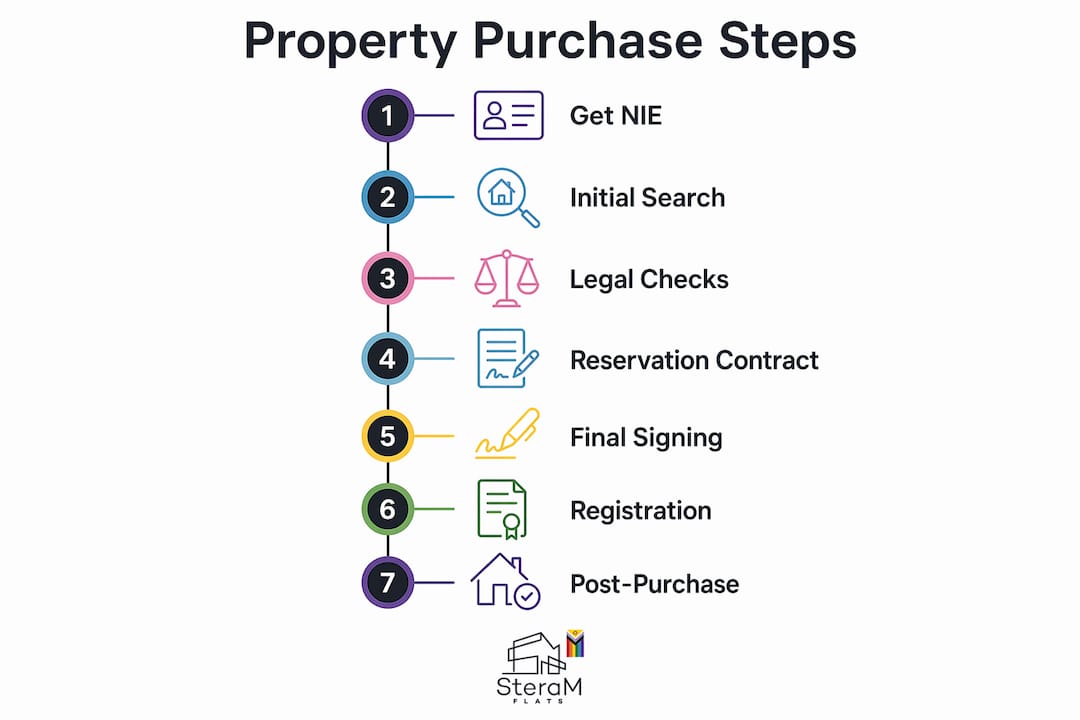
The reservation contract (contrato de reserva) takes the property off the market in exchange for a small deposit, typically between 3,000 and 6,000 euros. This is refundable only under specific conditions, so your lawyer must review it before you sign. Due diligence runs in parallel, covering title verification, planning compliance, and debt clearance.
Here is a comparison of the two main contract types you will encounter:
| Contract type | Purpose | Key risk if breached |
|---|---|---|
| Contrato de Reserva | Secures the property temporarily while due diligence runs | Buyer loses deposit if they withdraw without legal cause |
| Contrato de Arras | Private purchase contract with full deposit (typically 10%) | Buyer loses deposit; seller must return double if they withdraw |
The Contrato de Arras is the more binding of the two. Once signed, the buyer commits 10% of the purchase price as a deposit. If the seller pulls out, they owe you double that amount. If you pull out without legal justification, you forfeit the deposit entirely.
Critical legal checks your lawyer must complete before the Contrato de Arras is signed include:
- Title verification: Confirm the seller is the registered owner with no disputes or co-ownership complications.
- Debt clearance: Community debts attach to property and transfer to the buyer unless verified and cleared before sale. Your lawyer must obtain certificates from the community of owners, the town hall, and utilities.
- Planning compliance: Confirm no illegal extensions or structures exist on the property. Illegal builds can result in demolition orders that become your problem after purchase.
- License verification: Check that the property holds the relevant habitation license (cédula de habitabilidad) and, for rentals, any applicable tourist license.
The notary’s role at the escritura pública signing is to authenticate the transaction, not to protect your interests. Many buyers assume the notary acts as their legal guardian. The notary does not review debts, planning history, or community arrears on your behalf.
Final steps: mortgage, registration, and post-purchase tasks
A typical resale property transaction in Spain runs 6 to 10 weeks from reservation to completion, with the mortgage approval phase often determining the pace. If you need financing, start the mortgage application process as soon as your offer is accepted, not after the Contrato de Arras is signed.
Follow these steps through the completion phase:
- Submit your mortgage application. Spanish banks require proof of income, tax returns, bank statements, and the property’s Nota Simple. Non-resident buyers typically access up to 70% loan-to-value financing.
- Order a fresh Nota Simple close to completion. Registry charges can change rapidly, and a stale document may miss new liens or ownership changes registered after your initial check.
- Attend the notary appointment. Both buyer and seller sign the escritura pública in the notary’s presence. Your lawyer should attend to review the final deed before you sign.
- Pay purchase taxes and fees. Resale properties attract Transfer Tax (ITP), which ranges from 6% to 10% depending on the region. New builds attract VAT at 10% plus Stamp Duty. Budget an additional 10% to 13% of the purchase price for all taxes and fees.
- Register ownership at the Land Registry. Your lawyer or the notary’s office submits the deed for registration. This step is what legally protects your ownership against third-party claims.
| Post-purchase task | Timeline | Who handles it |
|---|---|---|
| Tax payment (ITP or VAT) | Within 30 days of signing | Buyer or lawyer |
| Land Registry registration | 2 to 6 weeks post-signing | Lawyer or notary’s office |
| Utility transfers | Within 30 days of completion | Buyer with seller’s account details |
| Community fee registration | Immediately after completion | Buyer notifies community administrator |
| Home insurance | Before or on completion day | Buyer arranges independently |
For a detailed walkthrough of the registration phase, the property registration guide for foreign buyers covers the Land Registry process step by step.
Key takeaways
Successful property purchases in Spain require completing legal due diligence, ordering a current Nota Simple, and engaging an independent lawyer before signing any contract.
| Point | Details |
|---|---|
| Get your NIE first | Without a NIE and Spanish bank account, no contract or tax payment is legally possible. |
| Nota Simple is non-negotiable | Order it before any offer and again close to completion to catch new charges or ownership changes. |
| Notary does not protect you | The notary authenticates the deed only; your independent lawyer handles title, debts, and planning checks. |
| Budget 10 to 13% on top of purchase price | Taxes, notary fees, registry costs, and legal fees add significantly to the headline price. |
| Community debts transfer with the property | Obtain written debt-free certificates from the community, town hall, and utilities before signing. |
What I’ve learned from watching buyers get this wrong
Most foreign buyers who run into serious problems in Spain make the same mistake: they trust the process to protect them when the process is designed to be neutral. The notary is not your advocate. The seller’s agent is not your advisor. Even well-meaning friends who “bought in Spain years ago” are working from outdated information, since Spanish property law has changed materially in recent years.
The single most underestimated risk I see is community debt. Buyers focus on the mortgage, the price negotiation, and the location, and then discover after completion that the previous owner owed three years of community fees plus a special assessment for roof repairs. Community debts transfer to the buyer automatically under Spanish law. That is not a technicality. It is a financial liability that lands on you the day you sign.
Remote buyers using a notarial power of attorney have a real advantage in one respect: they are forced to engage a lawyer early because they have no other option. Buyers who travel to Spain and fall in love with a property on a viewing trip often try to shortcut the legal process out of excitement. That excitement is expensive.
My honest advice: treat the legal budget as part of the purchase price, not an optional add-on. A good Spanish property lawyer costs between 1% and 1.5% of the purchase price. That fee has saved buyers from inheriting illegal extensions, undisclosed mortgages, and planning infringements worth multiples of the legal cost. The Spain real estate guide that serves you best is the one that tells you where the real risks sit, not just the steps to follow.
— YellowRock
Find your next property in Spain with Steramflats
Steramflats operates as a full-service real estate and property management platform focused on southern Spain, with particular depth in the Torremolinos and Costa del Sol markets. Whether you are buying, renting, or listing a property, Steramflats connects you with verified listings, legal guidance, and rental management support in one place.

Sellers and landlords can list a property for free and reach buyers and tenants actively searching in Spain’s most competitive coastal markets. Buyers and renters benefit from Steramflats’ local expertise, transparent listings, and support throughout the transaction process. If you are also considering the rental side of the market, the tenant rights guide covers deposit rules, contract protections, and the 2026 rental law reforms in plain language.
FAQ
What documents do I need to buy property in Spain?
Foreign buyers need a NIE (Número de Identificación de Extranjero), a Spanish bank account, and a Nota Simple from the Land Registry. An independent lawyer is also required to conduct due diligence before any contract is signed.
How long does buying property in Spain take?
A typical resale transaction runs 6 to 10 weeks from reservation to completion, assuming no title disputes or mortgage delays. New-build purchases can take significantly longer depending on construction timelines.
What is a Nota Simple and why does it matter?
The Nota Simple is an official document from the Spanish Land Registry that confirms the property’s registered owner, physical description, and any existing charges or mortgages. It is the first document your lawyer should review and must be refreshed close to the completion date.
Can foreigners buy property in Spain without being present?
Yes. A notarial power of attorney (poder notarial) allows your appointed lawyer to sign contracts, obtain your NIE, and complete the purchase on your behalf without you being physically present in Spain.
What taxes apply when buying property in Spain?
Resale properties attract Transfer Tax (ITP) at 6% to 10% depending on the region. New builds are subject to 10% VAT plus Stamp Duty. Total purchase costs including taxes, notary fees, and legal fees typically add 10% to 13% on top of the agreed purchase price.