The Registrar has 15 business days from the asiento de presentación (presentation seat) to qualify and, where appropriate, inscribe a property document. Business days exclude weekends and official holidays, and the presentation seat itself locks in your priority date the moment it’s issued. If you’ve just signed a deed, your first move is simple: confirm you have that presentation seat in hand, and make sure your tax payments are documented or at least underway.
TL;DR:
- The qualification and inscription period in Spain’s Property Registry is a maximum of 15 business days from the presentation seat, excluding weekends and holidays.
- The presentation seat secures your priority date, but final inscription depends on proof of tax payment and correction of any defects identified during the review process.
- Common delays or rejections often stem from missing or incorrect tax documentation, cadastral mismatches, or incomplete powers of attorney, which are all avoidable with proper preparation.
- The 15-day period can restart if the document is returned for correction, additional tax documents arrive late, or prior pending issues are resolved, potentially prolonging the process.
- Registering promptly protects your ownership rights and prevents disputes, especially important for non-resident buyers relying on NIE procedures and cross-border tax filings.
Table of Contents
- Plazo Inscripción Registro Propiedad: What the Law Actually Requires
- Asiento de Presentación: How Your Priority Date Gets Locked In
- Documents and Tax Proof You Need Before Inscription Goes Through
- What Happens When the Registry Misses the 15-Day Deadline
- First-Time Registration: Extra Rules and the Two-Year Provisional Window
- From Signing to Inscription: The Practical Timeline Step by Step
- Why Registering Fast Actually Protects You (A Practitioner’s View)
- How Steramflats Helps You Get Through Registration Without the Delays
- Sources
- FAQ
Plazo Inscripción Registro Propiedad: What the Law Actually Requires
The statutory clock is clear, even if the paperwork behind it rarely feels that way. Spain’s Ministry of Justice sets the qualification and inscription period at 15 business days from the asiento de presentación, and Registradores.org confirms the same 15-business-day dispatch rule applies to essentially every title presented for registration. That’s the plazo inscripción registro propiedad most buyers are searching for when they want a straight answer, and now you have it.
Here’s where people get tripped up: “business days” in this context means Monday through Friday, excluding national and regional holidays. Saturdays, Sundays, and holidays don’t count toward the 15 days, so a document presented on a Thursday won’t finish its countdown three weeks later. It’ll finish sooner than that math suggests, because weekends simply don’t move the needle.
The dies a quo, or start date, is the date stamped on the asiento de presentación, not the date the notary signed the deed and not the date you dropped off paperwork at the counter. That distinction matters because notaries in Spain increasingly present deeds telematically, and the Madrid notary portal processes many of these submissions the same day the deed is signed, which means your clock can start almost immediately.
The 15-day period isn’t always a single, uninterrupted stretch. It can restart under specific circumstances:
- When a document is returned to correct defects (subsanación) and then resubmitted, the qualification period begins again from the new presentation.
- When the registrar needs to consult prior pending documents affecting the same property, the countdown can restart from the date those prior documents are dispatched.
- When additional tax documentation arrives after the initial presentation, the registrar may recalculate the qualification window from that later date.
Quick math example: say a notary presents your deed telematically on a Tuesday. Counting only business days and skipping any holidays that fall in the window, day 15 lands three calendar weeks later, roughly. If a holiday like a regional fiesta falls inside that stretch, the deadline pushes out by however many holiday days intervene. This is why practitioners track holidays on the local registry calendar rather than assuming a flat three-week rule.
Registry Fact Check: The 15-business-day period is a maximum for the registrar’s qualification and inscription action, not a guarantee the property will be fully inscribed that fast. Complex files, especially those needing tax verification, first registrations, or defect correction, routinely take longer.
Asiento de Presentación: How Your Priority Date Gets Locked In
The asiento de presentación is the entry the registrar makes the moment your document arrives at the registry, whether it comes in by notarial telematic transmission, in person, or through an authorized agent. It’s not the inscription itself. It’s a placeholder that reserves your spot in line and, critically, secures your priority date against anyone who might try to register a competing claim on the same property afterward.
This is the part most buyers underestimate. Even before your taxes are paid and before the registrar has qualified the document, the presentation seat already protects you. The Ministry of Justice draws a firm line between the presentation seat, which secures priority, and final inscription, which requires proof of tax payment. If a second buyer tries to present a conflicting document on the same property the following week, your earlier presentation seat wins on priority, regardless of whose paperwork gets processed first at the counter.
The presentation seat doesn’t last forever. In practice, extensions are tied to specific circumstances:
- The initial seat generally runs for the statutory qualification window, and registrars can extend it when tax proof or corrected documentation is pending.
- Practitioners commonly reference extended presentation windows running up to around 60 working days in cases involving pending tax settlement or document correction, though this varies by registry and circumstance.
- If nothing is resolved within the extended window, the presentation seat can lapse, and you’d need to represent the document, losing your original priority date.
Pro Tip: Ask your notary or gestor for the exact presentation seat number and date the same day it’s issued, not weeks later. That single reference number is what you’ll need if you ever have to prove your priority date in a dispute, and registries don’t always volunteer it proactively.
Keep in mind that the presentation seat is provisional by nature. It tells the world “something is pending here,” but it doesn’t transfer ownership on the public record the way a completed inscription does. Buyers who stop tracking the file after getting the presentation seat sometimes discover months later that inscription never actually happened because a tax document was missing.
Documents and Tax Proof You Need Before Inscription Goes Through
Final inscription doesn’t happen just because 15 business days pass. The registrar needs a complete file, and tax proof is usually the piece that holds things up longest. The Ministry of Justice is explicit that applicants must normally prove payment of the taxes tied to the transaction before final inscription proceeds, even though a presentation seat can be obtained beforehand to lock in priority.
Here’s what the registrar typically expects in the file:
- The public deed (escritura pública) signed before a Spanish notary, describing the property, the parties, and the transaction terms.
- Proof of tax payment, which for most residential sales means the Impuesto de Transmisiones Patrimoniales (ITP) or, for new builds, VAT plus the AJD stamp duty where applicable.
- Identification documents for all parties, meaning DNI for Spanish nationals or NIE for foreign buyers and sellers.
- Cadastral reference matching the property description in the deed exactly, since mismatches between the deed and the cadastre are a leading cause of rejection.
- Powers of attorney, when a representative signs on behalf of a buyer or seller, properly notarized and, for documents originating abroad, apostilled or legalized.
Who can actually walk the document into the registry, or send it electronically, matters more than most buyers realize. Presentation can come from the property owner directly, from the notary via telematic transmission (increasingly the default and, according to the Madrid notary portal, generally faster and less error-prone than manual submission), from a lawyer, or from an authorized gestor or agent holding a valid power of attorney.
If taxes haven’t been paid yet, the presentation seat can still be recorded to preserve your priority date, but final inscription waits. The registrar essentially parks the file until tax proof arrives, and that parked period doesn’t always pause the 15-day qualification clock in a way that’s favorable to you, so getting tax paperwork moving fast is worth prioritizing over almost everything else in the process. Reviewing what’s actually owed before you get to this stage helps avoid last-minute scrambling. Steramflats’s guide to property taxes in Spain breaks down what buyers owe and when. For fee estimates on the notary and registry side, the OCU fee calculator gives a reasonable ballpark before you commit to a closing date.
If a power of attorney is part of your transaction, whether because you’re buying from abroad or because a family member is signing on your behalf, Steramflats’s overview of legal support for real estate transactions in Spain covers when that extra layer of paperwork is worth arranging in advance.
What Happens When the Registry Misses the 15-Day Deadline
Delay and refusal are two different problems, and confusing them costs people time. A delay means the registrar simply hasn’t acted within 15 business days. A negative qualification means the registrar has reviewed the file and found a defect that blocks inscription outright. The remedies differ for each.
For plain delay, official commentary is direct about the consequence: if the registrar registers a document outside the statutory period, the law contemplates a reduction in registry fees as compensation for the missed deadline. This isn’t a formal complaint process you have to file. It’s baked into the fee structure itself, though you should still confirm with your registrar or gestor that any applicable reduction was actually applied to your invoice.
Negative qualification is a heavier issue. The registrar’s blog on how a sale gets inscribed points to mismatched cadastral references and inconsistent property descriptions as among the most common reasons a document gets bounced back rather than inscribed. When that happens, you enter subsanación, the correction process:
- The registrar issues a written resolution explaining exactly what’s defective, often noted as a footnote (nota marginal) on the presentation entry itself.
- You, your notary, or your lawyer correct the identified defect, whether that’s a cadastral mismatch, a missing tax receipt, or an incomplete power of attorney.
- The corrected document gets resubmitted, and a new 15-business-day qualification window typically begins from that resubmission date.
Pro Tip: Always request the registrar’s resolution in writing, with the specific defect noted and dated. Verbal explanations from registry staff are helpful for understanding the problem quickly, but the written resolution is what your notary or lawyer needs to draft an accurate correction, and it’s your paper trail if you ever need to escalate.
If you believe a qualification was wrongly refused, you have the option to appeal, either to the Directorate General of Legal Security and Public Trust or through judicial channels, though most defects resolve faster through straightforward correction than through formal appeal. A defected submission generally flows like this: register the defect, correct it with professional help, resubmit promptly, and wait out the new qualification window. Involving a lawyer early, rather than after a second rejection, tends to shorten this loop considerably. Steramflats’s guide on getting legal support for real estate in Spain walks through when that step is worth taking.
First-Time Registration: Extra Rules and the Two-Year Provisional Window
Inmatriculación is the term for registering a property that has never before appeared in the Property Registry, and it comes with a heavier procedural load than a standard resale transaction. This situation shows up more often than you’d expect in rural areas, older family properties, and some coastal developments where the original construction was never formally inscribed.
Because there’s no existing registry entry to build on, the registrar has to establish the property’s legal history from scratch, and Spanish law requires extra safeguards before that history becomes final. According to legal guidance on property registration in Spain, first registrations typically require additional documentary proof of ownership history, and the procedure often includes notifying neighboring property owners and completing an official publication step, both intended to give any third party with a competing claim the chance to object before the registration becomes permanent.
The procedure used for inmatriculación varies. Some cases proceed through a double title mechanism, others rely on historical ownership documents, and others follow specific routes under the Mortgage Act, each with slightly different documentary demands and timelines.
- Expect the notification and publication steps to add real time to your timeline compared to a standard resale.
- The resulting inscription is typically provisional for two years, during which a third party with a legitimate competing claim can challenge it.
- Only after that two-year window closes without challenge does the inscription become fully consolidated and effectively unchallengeable on those grounds.
For buyers, this means a first-registration property carries a lingering, if narrow, risk window that a standard resale doesn’t have. Sellers benefit from starting the inmatriculación process well ahead of any sale, since buyers and lenders alike tend to be cautious about properties still inside that provisional period. If you’re evaluating a property that falls into this category, get a lawyer involved early rather than after an offer is already on the table. Steramflats’s complete guide to property registration in Spain for foreign buyers covers what non-resident buyers specifically should watch for in these cases.
From Signing to Inscription: The Practical Timeline Step by Step
Knowing the legal deadline is one thing. Actually walking through the process without losing weeks to avoidable mistakes is another. Here’s how it plays out in practice, start to finish.
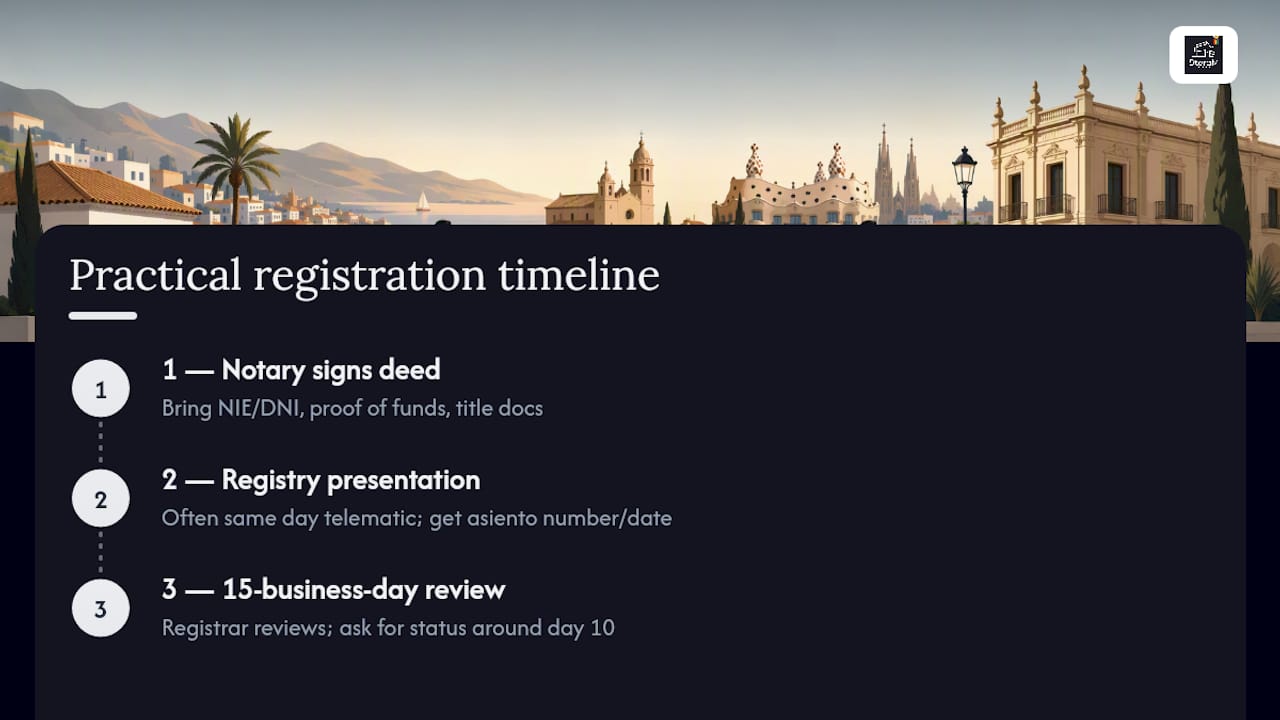
Step 1: The notary prepares and signs the public deed. Before signing day, your notary calculates the applicable taxes and confirms which receipts you’ll need. Bring your NIE or DNI, proof of funds if requested, and any prior title documents. Most transactions in tourist-heavy areas involve non-resident buyers, so confirming your NIE is active and correctly recorded before signing day avoids a common last-minute holdup.
Step 2: The document gets presented to the registry. Increasingly, this happens the same day as signing, since notaries can transmit deeds telematically directly to the corresponding Property Registry. According to the Madrid notary portal, telematic presentation tends to move faster and generates fewer transcription errors than manual, in-person filing. Whichever channel is used, get the asiento de presentación number and date in writing immediately. This is your proof of priority.
Step 3: The 15-business-day qualification window runs. During this stretch, the registrar reviews the deed, the tax documentation, and the cadastral match. If you haven’t heard anything by around day 10, it’s reasonable to ask your gestor or notary to request a status check directly with the registry. Registries don’t proactively update you; you have to ask.
Step 4: If a defect surfaces, subsanación kicks in. The registrar issues a written resolution identifying the problem. Loop in your notary or lawyer immediately rather than trying to interpret registry language yourself; a fast, correctly targeted correction resubmitted promptly restarts the qualification window without much additional delay. A slow or incomplete correction, on the other hand, can add weeks.
Step 5: Inscription happens, and you get the paperwork to prove it. Once qualified successfully, the registrar makes the inscription entry and typically adds a footnote (nota or nota marginal) referencing the presentation and inscription dates. Keep a certified copy of the inscribed deed and the registry’s confirmation. You’ll need both for future sales, mortgage applications, or tax filings.
Timeline Snapshot: Under ordinary circumstances with a clean file and no tax delays, presentation to final inscription commonly lands within the 15-business-day statutory window referenced by Registradores.org. Files with defects, pending tax proof, or inmatriculación requirements routinely run well beyond that baseline, sometimes by weeks rather than days.
Non-resident buyers should build in extra runway for one specific reason: cross-border tax payments and NIE-related paperwork tend to move slower than domestic filings, and that slippage lands squarely inside the tax-proof step that gates final inscription.
Why Registering Fast Actually Protects You (A Practitioner’s View)
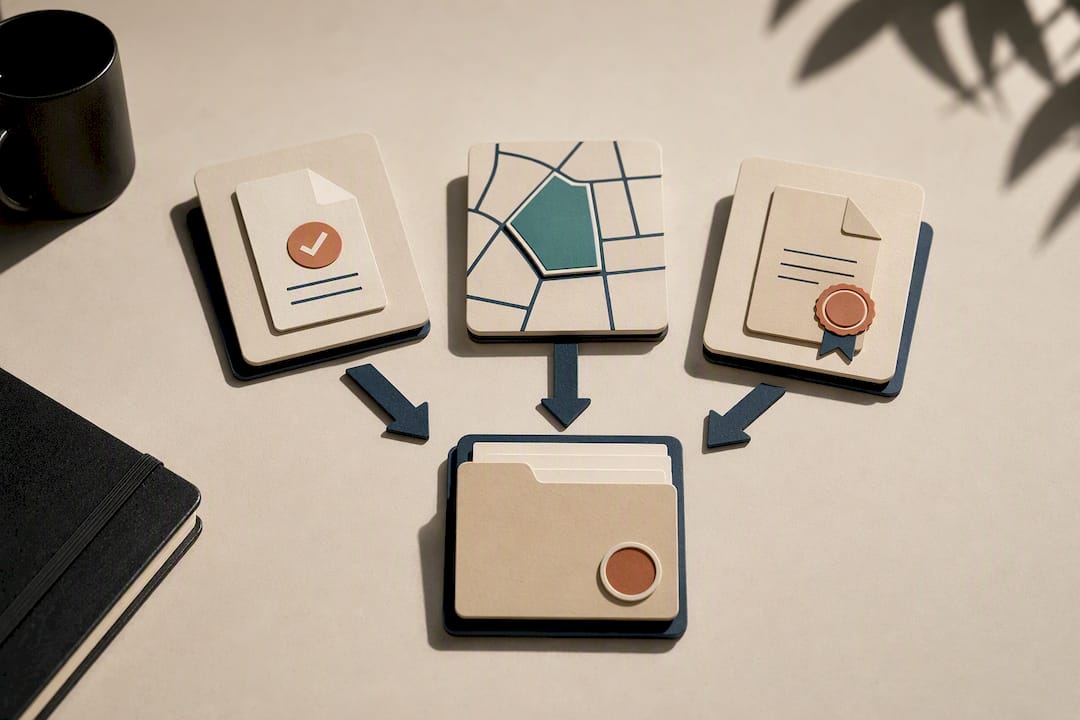
Most delays we see in practice trace back to three preventable causes: tax proof that wasn’t ready at presentation, a cadastral reference that doesn’t quite match the deed’s property description, and powers of attorney missing a required apostille or legalization stamp. None of these are complicated to fix in advance. All three become expensive and time-consuming to fix after a negative qualification has already been issued.
Non-resident buyers face a slightly different risk profile than domestic buyers. NIE processing, foreign tax residency documentation, and apostilled powers of attorney from abroad all take longer than their domestic equivalents, and none of that extra time is baked into the registrar’s 15-business-day clock. If you’re buying from outside Spain, start your NIE application and any power-of-attorney arrangements well before you’re anywhere near signing a deed, not after.
Tourist-heavy zones along the coast, where a large share of transactions involve overseas buyers and short-term rental properties, see this pattern constantly. A property intended for holiday letting often carries additional licensing and cadastral considerations layered on top of the standard registration file, which is one more reason to have someone who knows the local registry’s habits reviewing your paperwork before presentation rather than after a rejection notice arrives.
None of this is exotic legal theory. It’s the same handful of friction points showing up transaction after transaction, and nearly all of them are avoidable with a checklist and a few days of lead time.
— YellowRock
How Steramflats Helps You Get Through Registration Without the Delays
Steramflats works with buyers, sellers, and non-resident investors across southern Spain’s property market, and registration paperwork is exactly where its team spends a lot of its time preventing the mistakes described above. Instead of hiring a general practice lawyer and a separate gestor and hoping their timelines line up, Steramflats coordinates tax documentation, cadastral verification, and power-of-attorney preparation as one continuous process before your deed ever reaches the notary’s table.

That coordination matters most in exactly the cases where delays are common: first registrations, non-resident purchases requiring NIE and apostilled documentation, and holiday-rental properties with extra licensing steps. Steramflats’s fee for a completed property sale runs on a commission of 3-5%, paid only when the transaction closes, with no retainer charged upfront. If you’re buying, selling, or investing and want someone tracking your presentation seat and tax proof from day one instead of discovering a problem at day 14, take a look at Steramflats’s full range of services and reach out to get your specific file reviewed before you sign.
This article is general information, not a substitute for advice from a qualified lawyer. Consult a qualified legal professional about your own circumstances before acting on anything here.
Sources
- Registro de la Propiedad – Ministerio de Justicia (English)
- Registradores
- The property registration in Spain – Boltas Boyé Abogados
- Procedimiento y plazo de inscripción – ES Registro
FAQ
How long does it take to register a property in the registry?
The registrar generally has 15 business days from the asiento de presentación to qualify and, where appropriate, inscribe the document. Files needing tax proof, defect correction, or first-time registration typically take longer than this baseline window.
What is the deadline to register a public deed?
The deadline runs from the date the presentation seat is issued, not from the signing date at the notary, and it follows the same 15-business-day qualification period. Weekends and official holidays don’t count toward those 15 days.
Is it mandatory to register a home in the Property Registry?
Registration isn’t strictly obligatory to complete a sale, but it’s strongly recommended because it’s what gives your ownership legal protection and public standing against third-party claims. Without inscription, your presentation seat offers only temporary priority protection, not the full legal certainty a completed registration provides, as Steramflats’s guide for foreign buyers explains in more detail.
What happens if the Property Registry takes longer than 15 days?
If inscription happens outside the statutory 15-business-day window, official commentary points to a reduction in registry fees as the built-in consequence. If the delay stems from a defect rather than simple backlog, you’ll receive a written resolution and need to correct the issue through subsanación before the file moves forward.
What documents do I need before final inscription?
You’ll need the signed public deed, proof of tax payment (ITP, AJD, or VAT depending on the transaction), valid identification (DNI or NIE), a matching cadastral reference, and any powers of attorney properly notarized. Final inscription generally waits until tax proof is confirmed, even though the presentation seat itself can be recorded beforehand.