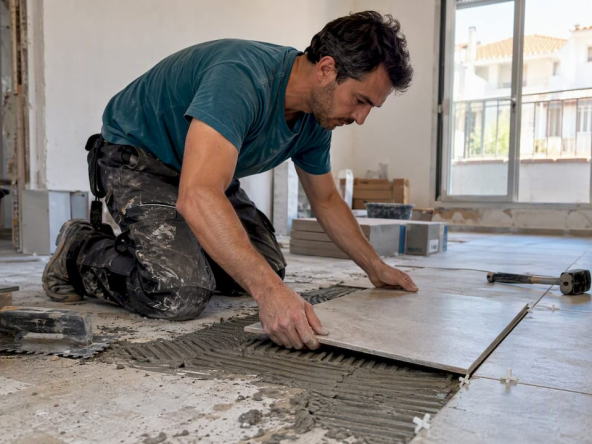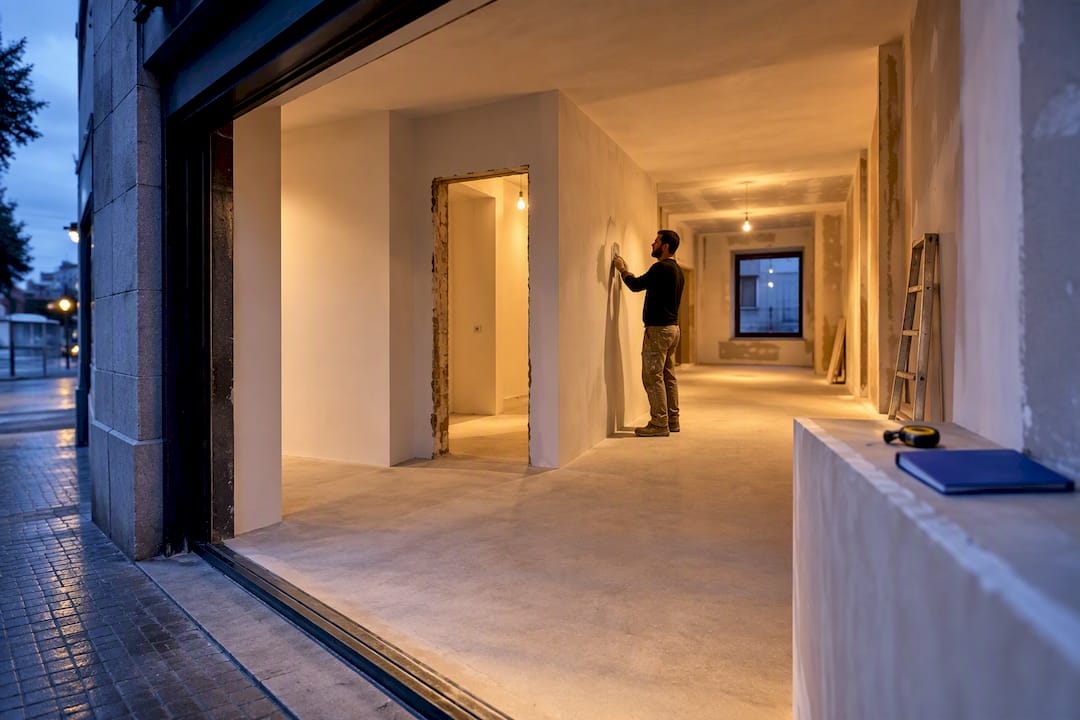
Yes, converting a commercial space into a dwelling is possible in Spain, but only when the municipal PGOU classifies the location as compatible with residential use. Before signing anything, run a viability check with the town hall and an architect. Skip that step and you risk buying a space that can never legally become the home you pictured, no matter how much money you pour into the reform.
TL;DR:
- The conversion of commercial spaces into residences in Spain depends on PGOU zoning rules, requiring confirmation of compatibility through municipal checks and legal documentation.
- Community statutes can prohibit residential use even when the PGOU permits it, and physical constraints such as insufficient ceiling height or lack of natural light can also block conversions.
- The standard process involves obtaining a technical project from an architect and choosing between a municipal licence or a declaración responsable, with municipal approval being more reliably accepted for registration.
- Registration of the change in the Catastro and Registro de la Propiedad is essential; skipping this step can result in legal and financial complications, including impacts on property taxes and saleability.
- Large projects typically take 6 to 18 months and involve costs for technical work, construction, permits, notary, and registry fees, with legal changes becoming official only after full municipal and registral approval.
Table of Contents
- What Is Cambio de Uso Vivienda and How Does It Work?
- How Do You Check if a Commercial Space Can Become Housing?
- Do You Need a Licence or Just a Declaración Responsable?
- What Habitability Rules Does the Converted Space Need to Meet?
- What Documents and Approvals Does the Process Require?
- How Do You Register the Change and What Taxes Apply?
- How Long Does Cambio de Uso Take and What Does It Cost?
- What Are the Biggest Risks and Recent Legal Changes to Watch?
- A Project Manager’s Phased Approach to Cambio de Uso
- How Steramflats Helps You Move From Feasibility to Keys in Hand
- Where to Verify the Rules Yourself
- Sources
- FAQ
What Is Cambio de Uso Vivienda and How Does It Work?
Cambio de uso vivienda, the formal reclassification of a property from commercial to residential use, is not automatic and it is not a right tied to ownership. It is a permission granted (or denied) by the town hall based on urban planning rules, and it only becomes real once it is reflected in the Registro de la Propiedad and the Catastro. A lot of buyers assume that if a space “could work” as a home, the paperwork will follow. It does not work that way.
The process for a residential to commercial reversal, or in this case a commercial to residential conversion, always depends on the PGOU (Plan General de Ordenación Urbana), the master zoning document each municipality maintains. If the PGOU marks a zone or a specific ground floor as strictly commercial, no amount of technical project work fixes that. A change of use is not a right; it is subject to what the plan allows, and it requires a technical project by an architect plus a municipal licence, or in some municipalities a declaración responsable, before the use can be regularized.
This is the standard industry term you will see cited in ordinances, court rulings, and registry resolutions: cambio de uso. Everything downstream, the CTE habitability checks, the licencia de obras, the Catastro update, hangs on this single administrative gate being open in your specific case.
How Do You Check if a Commercial Space Can Become Housing?
Before you make an offer, before you hire anyone, before you fall in love with the exposed brick and high ceilings, you need three answers: what the PGOU says, what the title deed and community statutes say, and what the building itself physically allows.
Start with the PGOU. Every town hall publishes its planning ordinance, usually searchable on the municipal website or available for consultation at the urbanismo department. Look for the zoning classification of the specific street or block, and check whether residential use is listed as compatible, conditioned, or prohibited for ground-floor commercial units. Some municipalities allow conversion only above a certain floor, or only when the unit no longer fronts a designated “commercial axis” street.
Then read the title deed and the community statutes. Community of owners’ rules can prohibit residential use in commercial units even when the PGOU allows it, and in buildings where the statutes expressly ban the change, unanimous community consent may be required before you can proceed. This detail gets missed constantly. An investor checks the zoning, gets a green light, and only discovers the community bylaws block the change after the architect has already been paid.
Physical red flags come next. A handful of conditions kill conversions regardless of what the paperwork says:
- Ceiling height below the municipal minimum (commonly 2.50 meters in many ordinances)
- No exterior façade or window, meaning no natural light or cross ventilation is achievable
- Ground-floor units in dense blocks where parking requirements per new dwelling cannot be met
- Structural elements (load-bearing walls, shared ducts) that block reconfiguration without touching neighboring units
If any of these apply, stop and get a second opinion before spending more on due diligence.
Order a consulta previa when the answer is unclear. A formal, written consulta urbanística previa from the town hall costs little relative to a failed purchase, and professionals consistently recommend obtaining one before committing capital to a renovation or purchase contract. It is the closest thing to a guarantee you will get in Spanish urban planning.
Pro Tip: Do not rely on a verbal opinion from a town hall clerk. Request the consulta previa in writing and keep a copy. If the project stalls later, that document is your evidence the municipality gave prior guidance, and it can matter in a dispute over subsanación requirements.
Do You Need a Licence or Just a Declaración Responsable?
The two legal routes for regularizing a change of use are not interchangeable, and picking the wrong one can cost you the ability to register the change at all.
Licencia municipal (express permit). This route requires the town hall to actively review and approve your technical project before work begins. It is slower, generally following the statutory 3-month resolution window for licence applications, though documentation gaps regularly push real timelines beyond that. The upside: once granted, you have unambiguous municipal approval that registrars almost always accept.
Declaración responsable. Here you self-certify compliance and can often start faster, sometimes immediately, without waiting for municipal sign-off. The catch: a declaración responsable does not guarantee registral inscription later. Registrars increasingly want an explicit municipal act of conformity, not just your self-declaration, before they will update the property’s legal classification.
That “municipal act of conformity” is the linchpin of the entire process. It is the town hall’s formal written confirmation that the completed use complies with planning rules, and it is often the most reliable evidence registrars request when you go to inscribe the change. A notarized act of notoriety combined with cadastral evidence is sometimes accepted as a substitute, but it carries a real risk of rejection.
Recent regulatory developments have sharpened this picture considerably. A 2026 resolution from the Dirección General de Seguridad Jurídica y Fe Pública (DGSJFP), stemming from the Gladia Capital Partners case, addressed head on whether registrars can demand a municipal licence before inscribing a change of use. The resolution opens a narrow alternative path (acta notarial plus catastral resolution) but also confirms that in many cases the safer route is still to formally initiate municipal licensing proceedings rather than gamble on an alternative the registrar might reject.
In practice, most large-city projects pair two municipal procedures back to back: the works licence (covering the physical renovation) and the change-of-use licence (covering the legal reclassification). Some town halls process these as a single combined application; others require sequential filings, with the change-of-use approval contingent on the works passing final inspection. Our guide to licencia de obra menor breaks down which category of renovation work triggers which permit tier, a distinction that matters enormously once you are sequencing these two applications.
What Habitability Rules Does the Converted Space Need to Meet?
The Código Técnico de la Edificación (CTE) sets the national floor for what counts as habitable, and municipal ordinances then layer their own minima on top. Both have to be satisfied, and this is where a surprising number of otherwise-approved projects stall during the technical review.
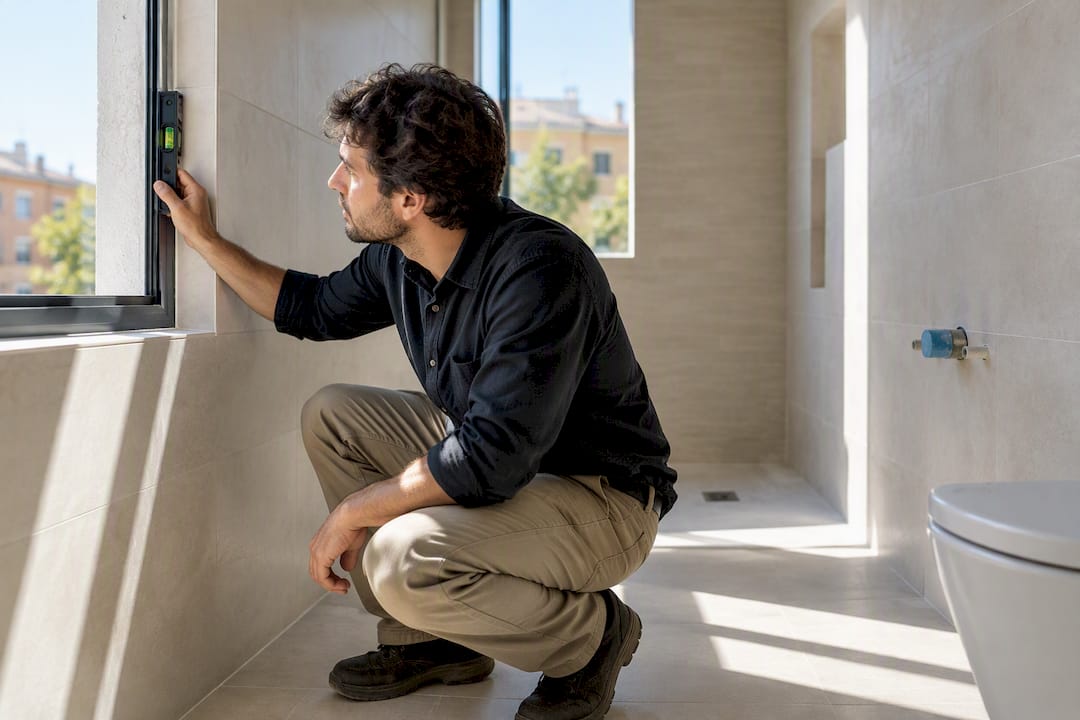
Structural safety comes first: the building has to demonstrate it can bear residential loads and, where relevant, pass an Inspección Técnica del Edificio (ITE) if it is older housing stock. Ventilation and natural lighting follow directly from the CTE’s habitability sections, which is precisely why a unit with no operable window is usually a dead end regardless of square footage. Energy performance is the final technical layer: once works are complete, the property needs a fresh energy certificate reflecting its new residential classification, since the certificate for commercial use does not carry over.
Municipal minima vary by city, but the pattern is consistent enough to summarize:
| Requirement | Typical municipal minimum | Notes |
|---|---|---|
| Ceiling height | 2.50 meters | Some historic centers allow slightly less with exemptions |
| Useful surface (studio/one-bedroom) | Varies by municipality | Set in local ordinances, not the CTE |
| Natural light and ventilation | Operable exterior window required | Interior-only units generally fail |
| Parking | One space per new dwelling in many zones | Local ordinances specify exact ratios |
| Accessibility | Elevator required above a set floor threshold | Ground-floor conversions often exempt |
Madrid’s own ordinance is frequently cited as a reference point because it explicitly conditions ground-floor conversions on exteriority and minimum useful surface, a stricter reading than some smaller municipalities apply. Accessibility rules kick in mainly for upper-floor conversions in buildings without an existing elevator. A ground-floor local converting to a studio typically clears this hurdle without issue; a third-floor former office in a walk-up building usually does not, unless the building undertakes a separate elevator installation project.
For anyone converting a property in Andalucía specifically, the regional habitability certificate carries its own documentation trail worth understanding before you budget the project. Our breakdown of the certificado de habitabilidad rules in Andalucía covers what regional authorities ask for beyond the national CTE baseline.
What Documents and Approvals Does the Process Require?
Once the viability check clears and you have picked your legal route, the project moves into a fairly predictable documentation sequence. Here is the order most architects and gestores follow:
- Commission the technical project. As of the Supreme Court’s 2026 ruling, only architects may sign projects for changes of use in buildings whose characteristic use is commercial or industrial, in certain cases previously open to aparejadores or técnicos. Confirm with your professional early which signature category your specific building falls under.
- Assemble the supporting file. Town halls typically request the signed technical project, descriptive and constructive memorias, a photographic record of the existing and proposed state, and proof of payment of the Impuesto sobre Construcciones, Instalaciones y Obras (ICIO).
- Submit for the ITE if the building qualifies by age. Older buildings often need this technical inspection certificate attached to the file before the town hall will process the licence.
- File the licence application or the declaración responsable, depending on which route your municipality requires or permits for this category of change.
- Respond promptly to subsanación requests. Nearly every application receives at least one formal request to correct or supplement documentation; missing this deadline resets the clock.
- Request the certificate of first occupation, or present the declaration of conformity, once works are physically complete and pass final inspection.
Pro Tip: Keep a single, dated folder (physical or digital) tracking every submission and every municipal response. Subsanación requests carry strict reply deadlines, and a missed one can force you to restart the application from scratch, adding months you did not budget for.
How Do You Register the Change and What Taxes Apply?
Getting the town hall’s approval is not the finish line. The change only becomes legally real once it is reflected in both the Catastro and the Registro de la Propiedad, and skipping this step leaves the property in a strange legal limbo.
Start by checking the property’s current recorded use on Sedecatastro, the official cadastral portal. This tells you exactly how the space is classified today and gives you the cadastral reference you will need for every subsequent filing. Once the municipal licence or act of conformity is in hand, the next step is a notary deed (escritura pública) that incorporates that municipal document, which is then presented to the Registro de la Propiedad for inscription. Without the escritura and the municipal backing, the property remains registrally a commercial space, regardless of how it actually functions day to day.
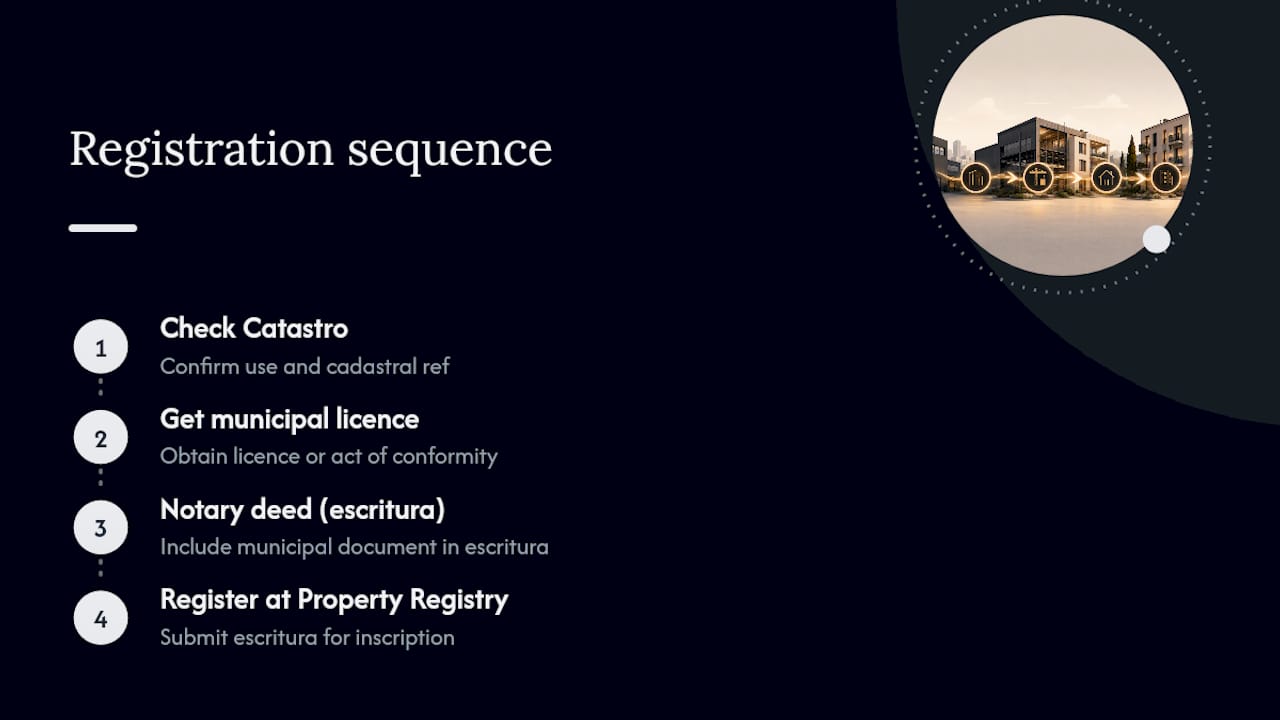
The tax consequences follow the reclassification. IBI (the annual property tax) gets recalculated under the new residential classification, which can shift the rate applied. A sale after the change may also trigger plusvalía municipal considerations tied to the updated use, and rental income earned from the space gets classified differently for tax purposes once it is legally residential rather than commercial.
The risk of skipping registration is not abstract. Owners who use a former local as a home without inscribing the change often assume that de facto occupation regularizes the property automatically; it does not. Unregistered use can block mortgage financing, complicate a future sale, and leave the tenant or occupant in a legally ambiguous position if a dispute ever reaches court. For older properties, there is one narrow exception worth knowing: Article 28.4 of the TRLS allows inscription by prescription when residential use has consolidated over time and the window for municipal disciplinary action has expired, but this route demands rigorous municipal certification and varies significantly by autonomous community. Treat it as a last resort, not a plan.
How Long Does Cambio de Uso Take and What Does It Cost?
Municipalities are bound to a 3-month statutory resolution period for licence applications, but that number rarely reflects reality on the ground. In large cities, projects that involve both a works licence and a change-of-use licence commonly run 6 to 18 months from first filing to final registration, especially when subsanación requests or community disputes enter the picture.
Budget across five categories, and build in a contingency for at least one of them running over:
- Technical fees: architect’s project, memorias, and any required ITE inspection
- Construction works: the physical reform needed to meet CTE and municipal minima
- Municipal taxes and fees: primarily ICIO, calculated as a percentage of the declared works budget
- Notary and registry costs: for the escritura pública and its inscription
- Contingency fund: for community pushback, unexpected structural findings, or a second round of subsanación
A useful rule for investors: never sign a purchase contract with a hard completion date until the PGOU compatibility and the community statutes have both come back clean. If either one is ambiguous, negotiate a conditional clause tied to obtaining the consulta previa or the formal licence, rather than closing on hope.
Pro Tip: If your consulta previa comes back ambiguous rather than a clear yes or no, treat that as a “no” for budgeting purposes. Renegotiating a purchase price after finding out mid-renovation that the conversion is not viable is a far worse position than walking away early.
What Are the Biggest Risks and Recent Legal Changes to Watch?
The single most damaging misconception in this space is treating lived-in occupation as legal proof. Using a former commercial unit as a residence for years does not create a legal right to residential classification, and a town hall can still order the use discontinued, or a registrar can refuse to inscribe a sale, even after a decade of quiet occupancy.
Three developments from 2026 change the practical calculus for anyone weighing a conversion right now:
- The DGSJFP resolution tied to the Gladia Capital Partners case narrows, but does not eliminate, the path to registering a change of use without a full municipal licence, through a combination of notarial act and cadastral resolution.
- The Supreme Court’s ruling on signature authority means some conversion projects now legally require an architect’s signature where a técnico or aparejador might previously have sufficed, a shift that can change your professional fees and project timeline.
- Registrars appear increasingly reluctant to accept a bare declaración responsable without a supporting municipal act of conformity, pushing more owners toward the slower but safer licencia municipal route.
The core tension in Spanish change-of-use law right now is this: urban planning control sits with the town hall, but the legal certainty an owner needs to sell, finance, or inherit the property sits with the Registro de la Propiedad. When those two systems disagree about what evidence is sufficient, the owner is the one who absorbs the delay and the cost.
The practical mitigation is straightforward even if it is not fast: build in holdbacks on any purchase contract tied to conversion, treat completion as conditional on registral clarity rather than just municipal approval, and run the feasibility check before the legal or financial commitment, never after.
A Project Manager’s Phased Approach to Cambio de Uso
A conversion that works cleanly on paper still needs five distinct phases run in order: pre-purchase viability, formal technical project, municipal application, physical works, and final registration. Skipping ahead, starting works before the licence clears, for instance, is the single most common way projects end up stuck.
Each phase needs a different specialist: an architect for the technical project, an urbanismo lawyer for the legal route decision, a gestor to manage the administrative filings, a contractor for the physical works, and ideally one project manager coordinating all four so nothing falls through the cracks between disciplines. If the PGOU check comes back negative, or the community statutes expressly prohibit the change, that is a hard stop, not a negotiation point. Support for owners through sequence steps including feasibility read, licence applications coordination, and renovation may be available from specialized real estate service providers.
— YellowRock
How Steramflats Helps You Move From Feasibility to Keys in Hand
Some companies offer coordinated services to assist with cambio de uso projects, handling feasibility, licensing, and renovation under a single management.
The full service list covers exactly what a conversion project needs at each stage: a real profitability study before you commit capital, licencia de obras and cambio de uso licence management, turnkey renovation coordination, and even the certificado energético and cédula once works wrap up. If financing is part of the picture, Steramflats’ mortgage brokerage for non-residents charges no upfront fee, since the commission is only earned on a completed transaction.
To get started, gather what you already have (the property’s cadastral reference, the community statutes if available, and any prior consulta previa response) and request a feasibility check. Some real estate service providers operate on transparent, commission-based models that charge fees only on successful transactions, avoiding hidden fees or lock-in contracts.
Where to Verify the Rules Yourself
Three sources are worth bookmarking before you go further. Sede Catastro lets you confirm a property’s currently recorded use and pull its cadastral reference in minutes. Your municipality’s PGOU, usually published on the town hall’s urbanismo webpage, sets the zoning rules and any ordinance-specific minima for height, surface, and parking. And DGSJFP resolutions, searchable through the Boletín Oficial del Estado, clarify how registrars are currently treating change-of-use inscriptions nationally, a picture that keeps shifting as new case law comes down.
Sources
- Cambiar el uso de un local por vivienda — MundoJuridico
- Licencia cambio de uso — Irun (municipal guidance)
- Cambio uso local a vivienda: ¿necesitas licencia? — CambiosLegales
- Sedecatastro
FAQ
How Do You Change the Use of a Property in Spain?
You confirm PGOU compatibility, commission a technical project from an architect, and then either apply for a municipal licence or file a declaración responsable, depending on what your municipality permits. The change only becomes legally complete once it is reflected in the Catastro and inscribed at the Registro de la Propiedad through a notary deed.
What Do You Need to Convert a Commercial Local Into a Home?
You need PGOU compatibility confirmed in writing, a technical project meeting CTE habitability standards, and either a municipal licence or an accepted declaración responsable. Community statutes must not expressly prohibit the change, and in buildings where they do, unanimous owner consent is typically required.
How Much Does It Cost to Convert a Local Into a Vivienda?
Costs break down into technical fees, construction works, municipal taxes like ICIO, and notary and registry fees, with totals varying widely based on the building’s condition and the scope of works needed. There is no single published figure for this in Spain since ICIO rates and works budgets differ by municipality and project; Steramflats can provide a project specific estimate on request through its services page.
How Is a Cambio de Uso From Local to Vivienda Taxed?
Once the change is registered, IBI gets recalculated under the new residential classification, and a future sale may trigger plusvalía municipal considerations tied to that reclassification. Rental income from the space is also taxed differently once it carries legal residential status rather than commercial.
Do You Always Need a Licence to Register the Change?
Not always. In a narrow set of cases, a 2026 DGSJFP resolution allows an alternative path using a notarial act plus catastral resolution, but registrars generally still prefer an explicit municipal act of conformity or a full licence before inscribing the change.