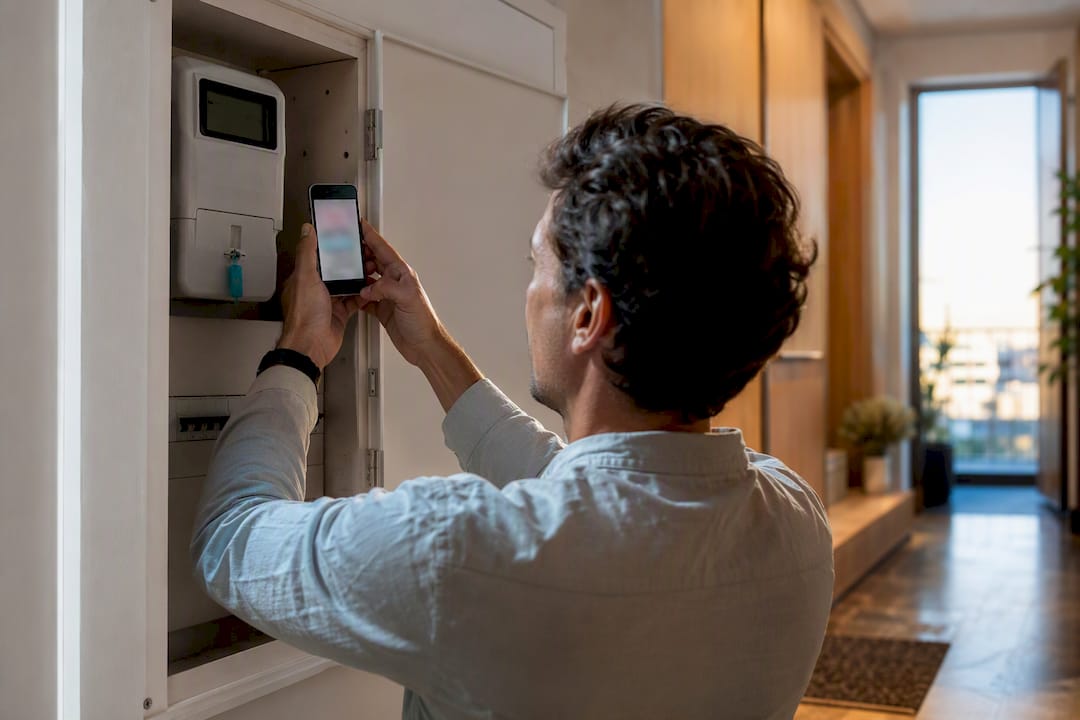
The buyer must request the change of holder on every supply. It never happens automatically, no matter what the seller promises at closing. Start with electricity and gas: contact the commercializadora with your CUPS code, the deed, your DNI or NIE, and an IBAN. The change is usually free and often finishes within a few days, but read the meter yourself at handover so you never get billed for the previous owner’s usage.
TL;DR:
- The change of ownership on utilities in Spain requires submitting a request to the commercializadora with the CUPS code, ID, deed, and IBAN; it is not automatic.
- The process usually takes between 1 and 20 days for electricity and gas, with costs typically limited to a small fee for technical visits, while water changes depend on municipal procedures.
- Manual meter readings at handover, documented with photos and a signed note, are essential proof to prevent billing disputes if the seller delays or refuses cooperation.
- Changing tariffs during the transfer by choosing a traspaso can help buyers avoid inheriting overpriced plans, especially if done at the moment of purchase.
- Professional services like Steramflats can assist non-residents and busy buyers by handling paperwork, coordinating provider contacts, and managing meter readings.
Table of Contents
- Step-by-Step: How to Change Electricity and Gas Suppliers
- How Does Changing Water Service Differ From Electricity?
- What About Internet, Phone, and Community Fees?
- Who Pays the Bills Until the Transfer Goes Through?
- How Long Does It Take and What Does It Cost?
- What Documents Do You Need Before You Call?
- What Do Providers and Practical Experience Actually Recommend?
- Where Can You Verify Procedures Yourself?
- What This Process Actually Teaches Buyers
- Let Steramflats Handle the Handover Paperwork for You
- Sources
- FAQ
Step-by-Step: How to Change Electricity and Gas Suppliers
Every electricity and gas contract in Spain is tied to a CUPS code, a unique 20 to 22 character identifier for that specific supply point. You’ll find it on any recent bill. If the seller can’t produce one, ask the outgoing commercializadora directly. This code is what makes the whole request possible, since without it, no provider can locate the contract to transfer.
Here’s the actual sequence:
- Gather your documents. You need your DNI, NIE, or passport, the deed or purchase contract, an IBAN for direct debit, a recent bill copy, and ideally the seller’s name and DNI to speed things along.
- Decide between subrogation and traspaso. Subrogation keeps the existing contract’s tariff and conditions but puts your name on it. A traspaso lets you change the tariff, the power level, or the provider entirely while you’re at it, as Repsol explains in its guide to changing the electricity holder.
- Submit the request. Most commercializadoras (Endesa, Naturgy, Repsol, and others) let you do this through the online client area, by phone, by email, or in person at a branch.
- Wait for confirmation. You’ll typically get an email or SMS confirming the switch, sometimes with a reference number for tracking.
- Expect a prorrateo on your first bill. Endesa’s own guidance on holder changes confirms the first invoice splits costs proportionally between the outgoing and incoming holder based on the change date.
Remember that the commercializadora is the company that bills you, not the one that owns the physical wires. The distinction between distributor and commercializer matters because you only need to call the commercializadora. They coordinate with the distributor automatically if a technical visit is needed.
Pro Tip: Moving day is the perfect moment to audit your tariff. If the seller was on an outdated or overpriced plan, a traspaso lets you shop around instead of inheriting a bad deal.
How Does Changing Water Service Differ From Electricity?
Water doesn’t work like electricity or gas. There’s no national commercializadora system. Instead, water is typically managed by the ayuntamiento or a municipal water company specific to that town, which means the process, the paperwork, and the turnaround time all vary by location.
Before you call anyone, check what’s actually required:
- Deed or purchase contract showing you’re the new legal owner.
- ID (DNI, NIE, or passport).
- The supply point identifier or a copy of the most recent water bill.
- Confirmation that there are no outstanding municipal debts tied to the property.
If the water supply was cut off or the meter was deactivated between owners, you may need to request a fresh alta, which can involve scheduling a technical visit before water flows again. Always check for unpaid municipal debts before you sign anything. Some town halls attach unpaid water charges to the property itself, not just the previous account holder, which can leave you covering someone else’s bill if you skip this check.
What About Internet, Phone, and Community Fees?
Internet and phone work differently depending on whether the previous owner’s line stays active or gets canceled. If the line is still live and you want the same provider, you can often port it using the existing contract details or a MAC code. If the seller cancels before you move in, you’ll need a brand new installation, which usually takes longer and may require a technician visit.
A few things to sort out at the same time:
- Contact your chosen provider with your ID, the property address, and either the port code or confirmation of a fresh installation.
- Notify the community of owners administrator (the president or secretary) so building records reflect the new owner.
- For shared services like the elevator or communal cleaning, find out who currently holds those contracts and request the transfer or a new agreement in your name.
Community administrators often maintain their own supplier list for building insurance and shared utilities, so this step avoids confusion at the next annual meeting.
Who Pays the Bills Until the Transfer Goes Through?
Legal responsibility sits with whoever is the registered contract holder, not whoever happens to be living in the property. Naturgy is explicit about this: if the change hasn’t been processed yet, the previous holder is technically still on the hook, but disputes over exact consumption get messy fast without proof.
Here’s how to protect yourself:
- Take a timestamped, manual meter reading the day you get the keys. Photograph the meter face clearly, including the reading digits.
- Ask the seller to sign a simple handover note confirming that reading.
- If the seller doesn’t cooperate, use the purchase deed as evidence of your ownership date and press the commercializadora directly. They can usually process the change with your documentation alone.
- If a provider or seller stalls unreasonably, OCU and FACUA both publish consumer guidance on escalation steps, including formal complaints.
Pro Tip: A gestoría or your buying agent can request the change on your behalf with a simple authorization, which matters if you’re not physically in Spain when the paperwork needs filing.
How Long Does It Take and What Does It Cost?
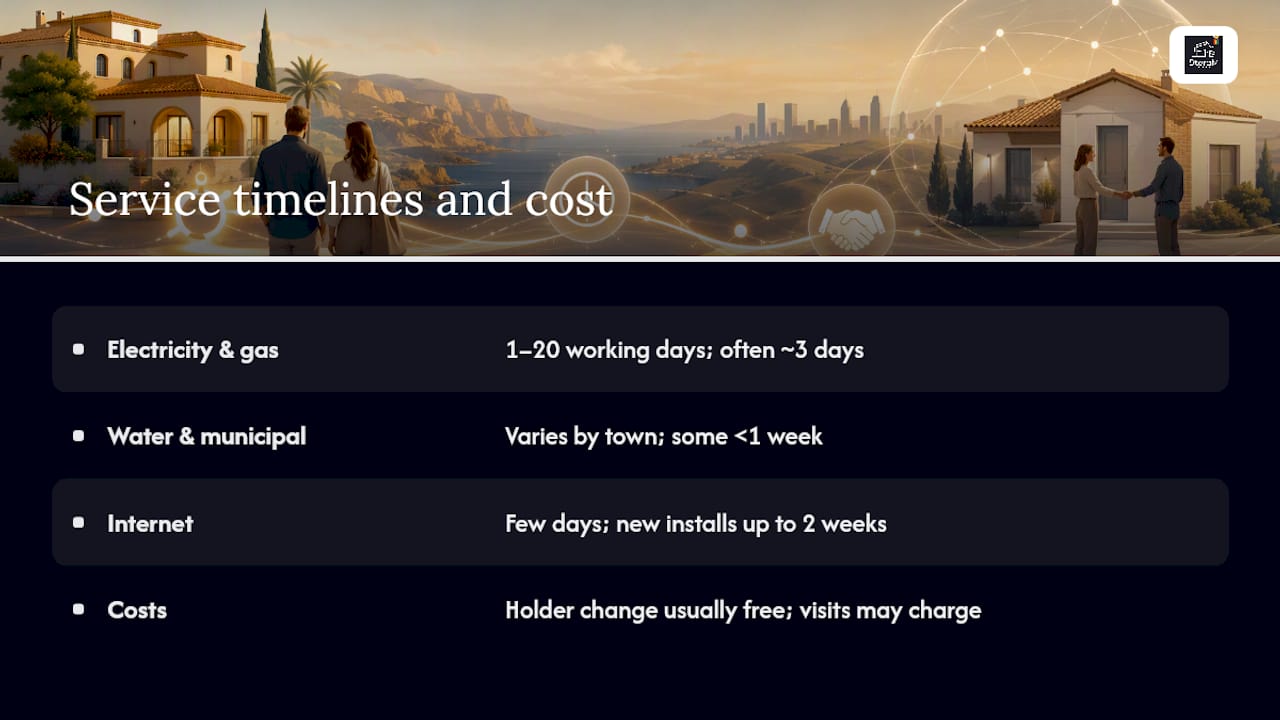
Most electricity and gas holder changes complete within 1 to 20 working days, and Holaluz reports that many finish in as little as 3 days when documentation arrives complete on the first try.
Water and municipal services don’t follow a fixed timeline. Some town halls process changes in under a week; others take longer depending on staffing and whether a technical visit is needed. Check directly with your local ayuntamiento rather than assuming a national standard applies.
Internet ports can move fast, sometimes just a few days, while brand new installations can stretch to two weeks depending on technician availability in your area.
On cost: the holder change itself is generally free across electricity and gas. The one common exception is a distributor technical visit, which Endesa notes typically incurs a modest charge when a physical inspection is required. Separate charges apply if you’re changing power capacity or need a new electrical boletín, but those are distinct from the basic ownership transfer.
What Documents Do You Need Before You Call?
Print this list and check off each item before you dial a single provider. Missing one document is the single biggest reason these calls drag into a second phone call.
- Your ID: DNI, NIE, or passport, plus a phone number and email.
- The deed or purchase contract showing the full property address.
- The CUPS code, pulled from any recent electricity or gas bill.
- The seller’s name and DNI if you can get it, since it speeds verification.
- An IBAN for direct debit setup.
- A photo of the meter reading with date and time visible.
- A signed authorization form if a gestoría or agent is calling on your behalf.
| Document | Needed for | Where to get it |
|---|---|---|
| DNI/NIE/Passport | All suppliers | Your own records |
| Deed or purchase contract | All suppliers | Notary or your lawyer |
| CUPS code | Electricity and gas | Any recent bill |
| IBAN | Electricity, gas, water | Your bank |
| Meter reading photo | Electricity, gas, water | Taken at handover |
If your sale also involved an energy certificate at closing, keep that paperwork with this checklist. Providers sometimes ask for it as secondary proof of the property’s technical details.
What Do Providers and Practical Experience Actually Recommend?
Record a manual meter reading the moment you get the keys, no exceptions. Keep the photo and a signed handover note. This single habit, confirmed repeatedly across Naturgy’s own guidance for holder changes, prevents the most common billing dispute buyers run into.
Use the transfer as a natural checkpoint to review your tariff, not just transfer it blindly. Subrogation keeps the old rate; traspaso lets you shop around, an approach ExpressPlanner’s guide to trimming household bills also recommends right after any change in occupancy.
Pro Tip: If you’re buying remotely, ask whoever holds your keys at handover to take the meter photo for you and send it immediately, timestamped.
Situations where hiring help genuinely pays off:
- Non-resident buyers who can’t be present at handover.
- Language barriers with providers that only offer Spanish-language phone support.
- Sellers who are slow, unreachable, or uncooperative.
- Properties with unusual histories, like long-vacant units or disputed prior debts.
Where Can You Verify Procedures Yourself?
For official procedures, check your commercializadora’s own change-of-holder page (Endesa, Naturgy, Repsol all publish these). For consumer rights and dispute steps, MITECO’s electricity information hub and OCU’s guidance cover the legal basics. Water is municipal, so your ayuntamiento’s website is the only authoritative source there.
What This Process Actually Teaches Buyers
The conventional advice treats a utility switch as paperwork, a box to tick after the notary appointment. That undersells what’s really at stake. The buyer who skips the manual meter reading isn’t just risking a billing headache. They’re giving up the one piece of evidence that settles a dispute cleanly if the seller later claims otherwise.
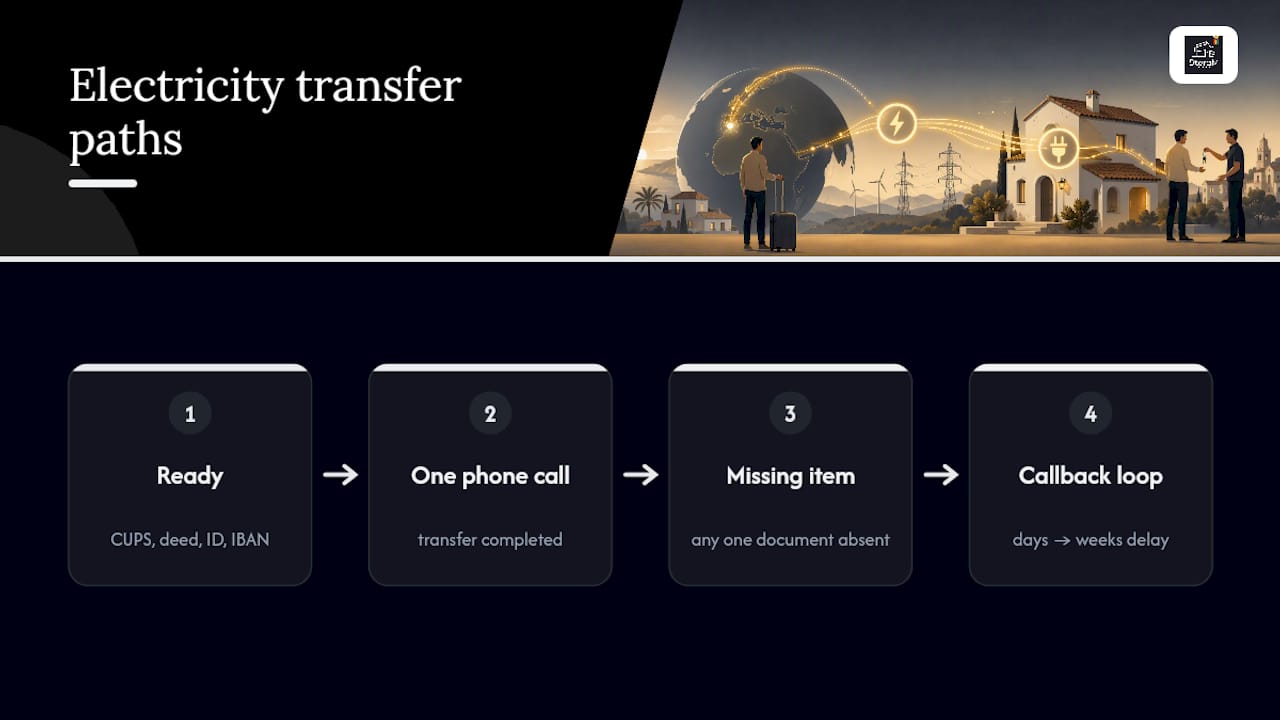
What gets overrated in most checklists is the idea that timing is the hard part. It isn’t. Documentation is. A buyer who shows up with the CUPS code, the deed, ID, and IBAN in hand can often finish an electricity transfer in one phone call. A buyer missing even one of those items ends up in a callback loop that stretches days into weeks.
What deserves more attention than it gets: the tariff audit. Most buyers treat subrogation as the default because it’s the path of least resistance, but a traspaso at the point of purchase is the cheapest moment to fix an inherited bad deal. You’re already making the call anyway.
Prioritize the meter reading first, the documents second, and the tariff decision third. In that order, almost nothing goes wrong.
— YellowRock
Let Steramflats Handle the Handover Paperwork for You
Buyers can opt for professional assistance to avoid chasing providers solo, especially if they’re non-residents who cannot be present at the meter on closing day. Such support may include document verification before contacting providers, liaising directly with commercializadoras, taking manual meter readings at handover, and notifying the community administrator to update building records promptly.

This matters most for international and multilingual buyers who don’t want to navigate Spanish-language provider phone lines while also unpacking boxes. It also matters if your seller is slow to respond. Having someone already coordinating your purchase paperwork means the utility transfer is one more task handled inside the same process, not a separate scramble after the notary signs off.
If you’re finalizing a purchase and want the transition managed end to end, take a look at Steramflats’ full range of services and get a quote on handover support before your closing date arrives.
Sources
- Endesa — Cambiar el titular del contrato
- Naturgy — ¿Cómo hacer un cambio de titular de luz o gas?
- Repsol — Cómo cambiar el titular de la luz
FAQ
What happens if the new owner never changes the utilities?
The previous holder stays legally responsible for the account, which can lead to disputes over who owes what, especially if consumption climbs after the sale without a formal handoff.
Who is responsible for requesting the change of ownership on supplies?
The buyer, not the seller, must initiate the change with each provider. Electricity and gas companies will not transfer accounts automatically just because a property sale closed.
What do I need to change the electricity account into my name?
You need your DNI, NIE, or passport, the CUPS code from a recent bill, the deed or purchase contract, and an IBAN for direct debit setup.
How much does a change of ownership cost on a home’s utilities?
The holder change itself is generally free. The main exception is a distributor technical visit, which commonly costs around €12 when a physical inspection is required.
Can I change tariffs at the same time as the ownership transfer?
Yes. Choosing a traspaso instead of subrogation lets you switch provider or tariff at the same moment you take over the account, which is often the cheapest time to fix an overpriced plan.