Yes. Spain places no nationality restriction on property ownership, and foreigners buy homes here on the same legal footing as Spanish citizens. The real work is procedural, not legal permission: get your NIE, open a Spanish bank account with clean, traceable funds, and hire an independent lawyer before you sign anything. Do those three things in order and the rest of the purchase follows a predictable script.
TL;DR:
- Foreign buyers can purchase in Spain without restrictions, but must obtain an NIE, open a Spanish bank account, and hire a lawyer before signing any documents.
- Getting an NIE in Spain typically takes one to four weeks, while opening a bank account is also essential for processing payments and financing.
- A mortgage for non-residents usually covers 60% to 70% of the property value, with bank assessments taking three to six weeks.
- Budget at least 10% to 15% of the purchase price for taxes, fees, and legal costs, with regional variations significantly affecting these expenses.
- It is possible to buy remotely using a notarized power of attorney, but you should still engage an independent lawyer to handle due diligence and legal checks.
Table of Contents
- Comprar Casa Extranjero España: The Full Roadmap
- How Do You Get an NIE as a Foreign Buyer?
- Do You Need a Spanish Bank Account to Buy Property?
- What Happens During the Reservation and Arras Contract?
- What Due Diligence Should Your Lawyer Run Before Closing?
- What Mortgage Options Exist for Non-Resident Buyers?
- What Taxes and Closing Costs Should You Budget For?
- Can You Buy a Property in Spain Without Traveling?
- What’s a Realistic Timeline and Checklist for Buyers?
- How SteraM Flats Supports Foreign Buyers Through Every Step
- What I’d Tell Any Foreign Buyer Before They Sign
- Ready to Start Your Purchase With Local Support?
- Sources
- FAQ
Comprar Casa Extranjero España: The Full Roadmap
Buying property in Spain as a foreign national follows a fairly fixed sequence, and knowing which steps can happen before you ever board a flight saves weeks. Some tasks, like getting your NIE or opening a bank account, can run in parallel with your property search. Others, like the notary signing, almost always need either your physical presence or a power of attorney.
- Get your NIE (1 to 4 weeks, consulate or in Spain).
- Open a Spanish bank account and move funds early (1 to 3 weeks).
- Search and make an offer, working with an agent (timeline varies).
- Sign the reserva or arras contract with a 10% deposit (days, not weeks).
- Run legal due diligence on the property (1 to 2 weeks).
- Arrange mortgage pre-approval if financing (3 to 6 weeks, per Buvivo’s guide).
- Sign the escritura at the notary and pay closing costs.
- Register the deed at the Land Registry (weeks after signing).
Your lawyer or gestoría can handle steps 5 through 8 largely without you, provided you have granted power of attorney.
How Do You Get an NIE as a Foreign Buyer?
The Número de Identidad de Extranjero, or NIE, is the tax and identification number every foreign buyer needs before a notary, bank, or the Agencia Tributaria will process a property transaction. Without it, you cannot open a Spanish account tied to the purchase, pay the transfer tax, or sign the deed. The Ministry of the Interior confirms three legitimate routes to get one.
- In Spain: apply in person at a Comisaría using model EX-15, usually the fastest route.
- At a Spanish consulate in your home country before you travel.
- Through a representative holding power of attorney, which lawyers use constantly for remote buyers.
You will also pay the small model 790 fee at a bank once the NIE is approved. If applying from abroad, expect to need certified translations and, in some cases, apostilled copies of your passport. Our NIE versus NIF guide breaks down which number you need for different transaction types.
Do You Need a Spanish Bank Account to Buy Property?
Practically, yes. Spanish notaries and sellers expect payment through Spanish channels, and most lenders and agencies will not proceed without one. Banks vet foreign applicants closely under anti-money-laundering rules, so plan for paperwork rather than a same-day account opening.
- Passport and NIE
- Proof of income (payslips, tax returns, or pension statements)
- Proof of address in your home country
- Source-of-funds documentation for large deposits (sale of a previous home, savings statements, inheritance records)
Some banks run international desks, similar to CaixaBank’s foreign-buyer service, that let you start the account opening and even mortgage pre-approval remotely before you set foot in Spain. Notaries generally prefer a bankers’ draft or a confirmed same-day transfer over a personal check, since either creates a clean paper trail auditors can follow.
Pro Tip: Wire your deposit funds into your Spanish account at least two weeks before the arras signing. Same-day transfers sometimes get flagged by AML filters and delayed, which can jeopardize a tight contract deadline.
What Happens During the Reservation and Arras Contract?
A reserva is a short, low-stakes holding agreement, usually backed by a modest fee, that takes the property off the market while you complete due diligence. The contrato de arras that follows is the contract that actually matters: it typically requires a 10% deposit and carries real financial consequences if either side walks away.
- If you, the buyer, back out, you generally lose the deposit.
- If the seller backs out, they typically owe double the deposit back.
- The arras should include a mortgage contingency clause if you’re financing the purchase.
- It should set clear deadlines for due diligence and a firm delivery condition for the property.
Never sign an arras without an independent lawyer reviewing it first. Agencies and sellers’ representatives can draft favorable language that looks routine but leaves you exposed if financing falls through or the property has undisclosed debts. Keep every deposit payment on a traceable bank transfer, never cash.
What Due Diligence Should Your Lawyer Run Before Closing?
This is where a rushed purchase turns expensive. An independent lawyer, ideally one registered with a regional Colegio de Abogados, should pull a full set of checks before you get anywhere near a notary.
- Request the nota simple from the Land Registry to confirm ownership and reveal any cargas, mortgages, or embargos attached to the property, a service detailed in the registradores.org buying guide.
- Confirm the seller’s name matches the registered titular exactly.
- Verify urbanistic and planning status at the local ayuntamiento, including whether required licences exist.
- Check outstanding IBI (property tax), community fees, and the certificate of habitability plus the energy performance certificate.
Pro Tip: Unpaid community fees follow the property, not the seller. A nota simple won’t always show them, so ask your lawyer to request a written statement from the community administrator directly.
What Mortgage Options Exist for Non-Resident Buyers?
Financing as a non-resident works, but expect tighter terms than a Spanish resident would get. Non-EU buyers typically see loan-to-value offers around 60% to 70%, EU nationals closer to 65% to 75%, and Spanish tax residents can often secure higher, per Buvivo’s breakdown of foreign-buyer mortgages. Banks lend against their own valuation, or tasación, not your purchase price, and that assessment plus underwriting can take three to six weeks.
- Payslips or pension statements for the last several months
- Tax returns from the past one to two years
- Recent bank statements, translated and apostilled if issued outside Spain
- Proof of any existing debts or other property ownership
Build a financing contingency into your arras contract if the purchase depends on loan approval. If a bank withdraws its offer late, that clause is what protects your deposit instead of losing it. Our non-resident mortgage guide covers lender-by-lender documentation quirks in more detail.
What Taxes and Closing Costs Should You Budget For?
Plan on roughly 10% to 15% of the purchase price in taxes and fees on top of the sale price, according to Seeki’s 2026 buyer guide. Where you fall in that range depends heavily on the region and whether the property is new or resale.
- ITP (transfer tax) on resale homes ranges roughly 6% to 13% depending on the autonomous community.
- New builds carry VAT and AJD stamp duties instead of ITP, with rates that vary by region.
- Notary and Land Registry fees, plus gestoría or lawyer fees, also add extra costs that vary by case.
Budgeting 10% to 15% on top of the purchase price isn’t a worst-case estimate. It’s the realistic middle for most resale transactions once ITP, notary, registry, and legal fees are added up.
Catalonia’s ITP has shifted to a progressive scale since June 2025, one example of how regional reform can change your math mid-search, per Seeki. Once the deed is signed, register it promptly at the Land Registry, switch utilities into your name, and set up payment for annual IBI and any non-resident income tax obligations. Our property tax guide walks through the regional breakdown region by region.
Can You Buy a Property in Spain Without Traveling?
Yes, and it’s routine. A notarized power of attorney lets your lawyer sign the arras and the escritura on your behalf, a practice confirmed by Basa Abogados as standard for remote buyers. The POA should specifically authorize property purchase, tax payment, and deed registration, not just generic representation.
- Grant the POA at a consulate or notarize it locally with an apostille attached.
- Keep an independent lawyer overseeing every payment and document, separate from the seller’s agent.
- Watch for the most common failure points: missing apostilles, banks refusing international transfers, or a POA written too vaguely to cover the actual signing.
Our guide on buying with a power of attorney covers the exact wording lawyers use to avoid a rejected document at the notary’s office.
What’s a Realistic Timeline and Checklist for Buyers?
Purchases can take several weeks from offer to completion, with timelines varying if financing or remote coordination are involved. Overlap tasks wherever you can: start your NIE and bank account while you’re still house hunting.
- Before you offer: NIE, bank account, mortgage pre-approval if needed, and an independent lawyer on retainer.
- After the offer: arras signing, due diligence, and tasación if financing.
- Final stretch: notary date, fund transfer confirmation, deed registration.
Keep ready: passport, NIE, proof of income, recent bank statements, and documented proof of funds. Missing any one of these is the single most common reason notary appointments get rebooked.
How SteraM Flats Supports Foreign Buyers Through Every Step
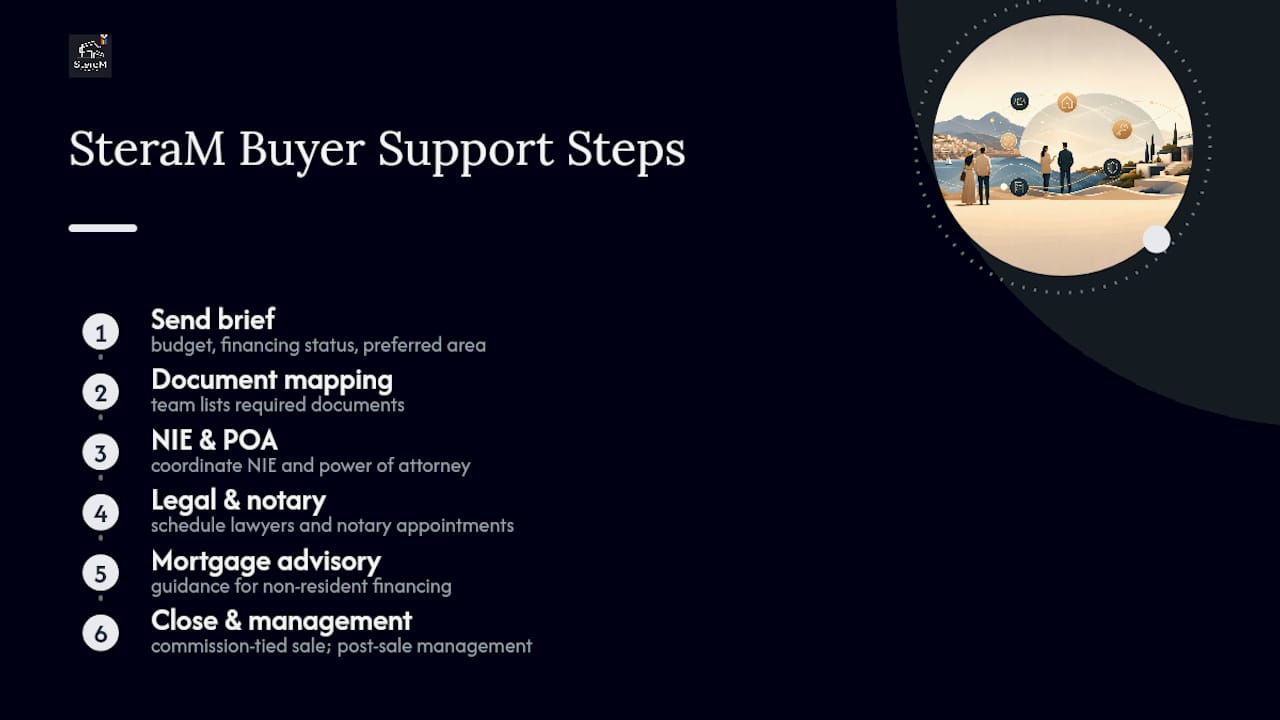
SteraM Flats works with international buyers on exactly the steps above: NIE coordination, power of attorney handling, legal and notary scheduling, mortgage advisory for non-residents, and property management once you close. Most engagements run on a commission tied to the completed sale rather than upfront fees for basic buyer support.
To start, send your target budget, financing status, and preferred area, and the team maps out which documents you need first. If you’re weighing whether to hold the property as a rental afterward, the vacation rental management page outlines what that side of the business involves.
What I’d Tell Any Foreign Buyer Before They Sign
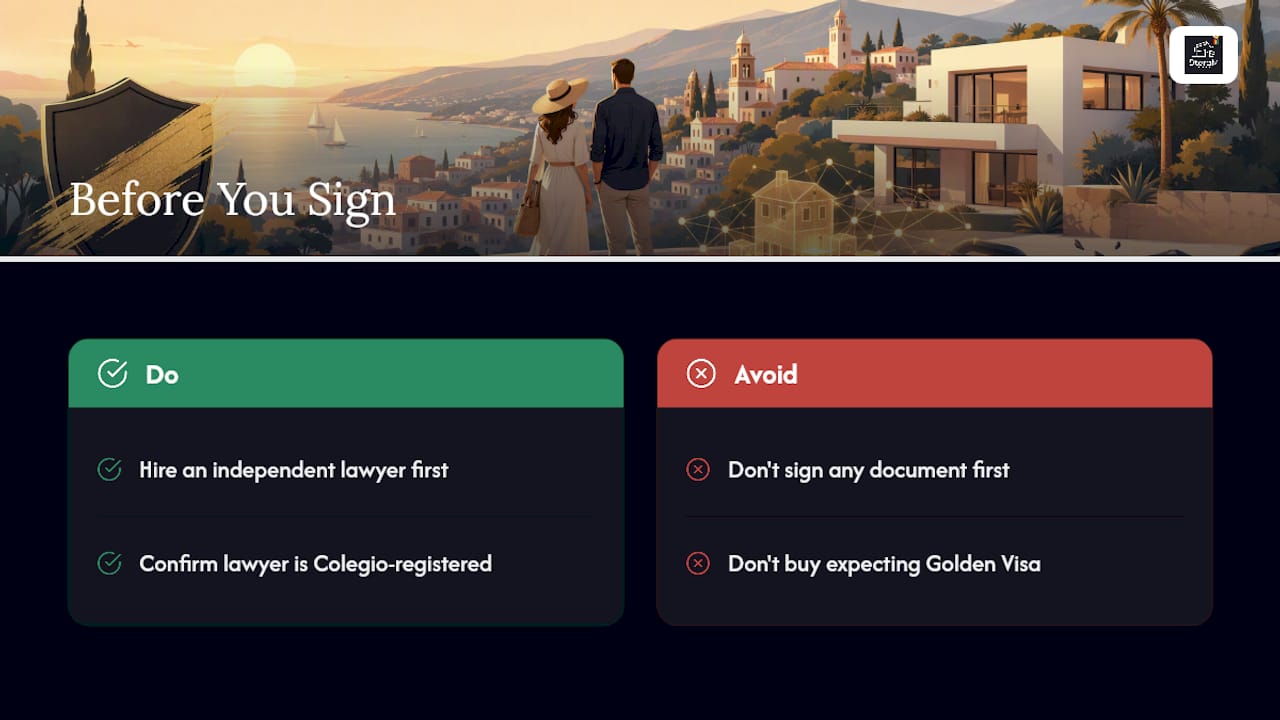
Hire an independent lawyer before you sign a single document, not after. Agencies and sellers have their own interests, and a lawyer registered with a Colegio de Abogados is the one person in the transaction working strictly for you.
One more thing worth saying plainly: buying property no longer buys you residency. The Golden Visa route tied to real estate investment was abolished on April 3, 2025, so don’t structure your purchase around a residency outcome it can no longer deliver.
— YellowRock
Ready to Start Your Purchase With Local Support?
Most foreign buyers don’t need another portal to scroll listings. They need someone local who already knows which lawyers respond fast, which banks actually process non-resident mortgages without dragging it out for months, and which notaries have open slots this quarter. That’s the gap SteraM Flats fills for buyers in the Torremolinos area and along the Costa del Sol.

Support is available to coordinate NIE application, set up power of attorney for remote buying, run legal due diligence with an independent lawyer, and advise on non-resident financing before the notary appointment. The fee structure includes commission paid on completed sales, with no upfront retainer for basic buyer coordination. Send your budget, financing situation, and target area to get a first consultation, or browse the full range of property and investment services to see what fits your situation.
Sources
Keep these on hand while you work through your purchase; they cover the forms and registries you’ll actually use.
Check your specific region’s ITP rate before signing anything. It shifts your total budget more than any other single variable.
FAQ
What Does a Foreigner Need to Buy a House in Spain?
You need an NIE, a Spanish bank account with documented funds, and an independent lawyer to run due diligence and review the arras contract before you sign.
Can I Buy a Home in Spain From Abroad Without Traveling?
Yes. A notarized power of attorney lets your lawyer sign the arras and escritura on your behalf, a common arrangement for remote buyers coordinated through firms like SteraM Flats.