Getting an energy certificate in Andalucía costs two separate things: a fixed RCEA registration fee of €14.69 for properties up to 250 m² and €56.31 above that, plus a technician’s fee that typically runs €80 to €150 for an apartment or €200 to €350 for a larger single-family home. Most quotes quietly bundle the two together, which is exactly why comparing them gets confusing. The registration fee is a mandatory administrative charge, non-negotiable and payable through the Junta’s own system, while the technician’s fee reflects the actual work of visiting your property and writing the report.
TL;DR:
- The fixed Andalucía registration fee is either €14.69 for properties up to 250 m² or €56.31 for larger spaces, depending on surface area.
- Technician fees typically range from €80 to €150 for apartments and €200 to €350 for larger homes, with VAT and possible travel surcharges added.
- On-site inspections are mandatory and included in legitimate quotes, making suspiciously low offers likely to skip this essential step.
- Verify that all four elements—registration number, energy label, signed certificate, and XML file—are delivered to ensure proper registration and compliance.
- Coordinating with a reputable service simplifies fee confirmation, registration, and documentation, reducing the risk of invalid certificates during sale or rental processes.
Table of Contents
- What Does a Certificado Energético Cost in Andalucía?
- How Do You Register an Energy Certificate in Andalucía?
- What Makes One Quote More Expensive Than Another?
- What Should You Ask Before Hiring a Technician?
- How SteraM Flats Handles Energy Certification
- Why the Cheapest Quote Is Rarely the Right One
- Get Your Energy Certificate Handled Without the Runaround
- Sources
- FAQ
What Does a Certificado Energético Cost in Andalucía?
The confusion around certificado energético andalucía precio almost always comes from the same mistake: comparing a price that includes the registration fee against one that doesn’t. Once you separate the two charges, the math gets a lot clearer.
The RCEA registration fee is fixed by regional rule and paid via Modelo 046, the Junta de Andalucía’s standard payment form for administrative services. For a home under 250 m², that’s €14.69; above that threshold, it rises to €56.31. This tier structure means most apartments and townhouses fall into the cheaper bracket, while larger single-family homes or commercial spaces land in the higher one.
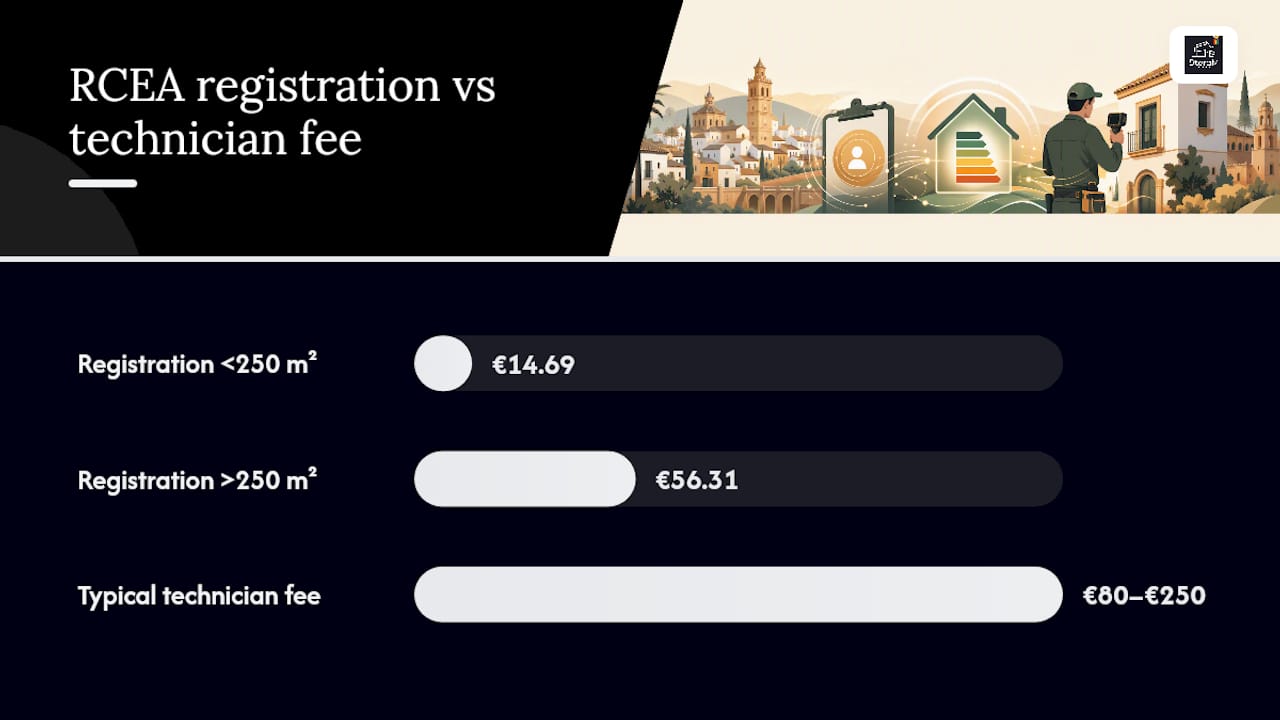
The technician’s fee is where the real variation happens. According to market data on residential energy certification, most cases fall between €80 and €250, depending on the property’s size and complexity.
A typical breakdown looks like this:
- 80 to 100 m² apartment: roughly €80 to €150 in technician fees, plus the €14.69 registration fee, landing the total near €95 to €165.
- 150 m² single-family home: roughly €200 to €350 in technician fees, plus €56.31 in registration (if the property exceeds 250 m², otherwise €14.69), pushing the total to somewhere between €215 and €405.
- VAT: technicians who operate as freelancers or firms typically add 21% VAT on top of their professional fee, though this varies by how the invoice is structured.
- Travel or rush fees: rural properties or same-week requests sometimes carry a supplement, especially outside major cities.
Some technicians fold the registration fee into their quoted price and list it as one line. Others itemize it separately, which is actually the more transparent practice since it shows you exactly what’s a fixed government charge versus what’s their labor. Either way, ask which model you’re getting before you sign anything.
How Do You Register an Energy Certificate in Andalucía?
The technician does the heavy lifting here, not you. Once the report is finished, they submit it electronically to the Registro de Certificados Energéticos Andaluces using the mandatory XML format required for validation.
Here’s the sequence most owners go through:
- On-site visit. Real Decreto 390/2021 requires the certifying technician to physically inspect the property. This is not optional, and it’s the biggest tell that separates a legitimate quote from a shortcut.
- Report drafting and payment. The technician prepares the certificate, calculates the energy rating, and typically handles the Modelo 046 payment as part of the registration process.
- Electronic submission to RCEA. The signed report and XML file go to the regional register.
- Provisional documentation. Many owners receive a preliminary receipt almost immediately, which can be used in a sale or rental negotiation while the formal registration processes.
- Definitive registration. This can take anywhere from a few days to a couple of weeks depending on the province, with Seville and Málaga generally processing faster due to higher registration volume.
What you should end up with: a registration number, the official energy label, the underlying XML file, and a technician-signed certificate. If any of those four pieces is missing, the job isn’t finished.
What Makes One Quote More Expensive Than Another?
Surface area is the obvious driver: a 200 m² house takes longer to inspect and document than a 70 m² flat, so the technician fee scales up accordingly. But size isn’t the only variable.
Province matters too. Denser markets like Seville and Málaga tend to have more technicians competing for work, which usually keeps prices tighter and more consistent. Smaller provinces or rural areas often mean fewer available technicians, longer wait times, and sometimes a travel surcharge tacked onto the base fee.
Technical complexity adds cost regardless of size. A property with an unusual layout, multiple heating or cooling systems, solar panels, or missing building documentation takes longer to assess and report on. That extra time shows up in the final price.
- Larger surface area: more inspection time, higher fee.
- Rural or low-competition areas: possible travel supplements.
- Complex systems (multiple HVAC zones, renewables): more technical work to document.
- Missing or outdated building plans: extra time reconciling records.
Pro Tip: If a quote comes in dramatically under €80 for a full residential certificate, ask directly whether the on-site visit is included. RD 390/2021 makes that visit mandatory, and a price that low usually means someone is skipping it, which invalidates the certificate.
What Should You Ask Before Hiring a Technician?
A written quote should answer every one of these before you commit to anything:
- Is the RCEA registration fee included, and at what amount? It should match either €14.69 or €56.31 depending on your property’s surface area.
- Is VAT included in the quoted price, or added afterward?
- Are there travel or rush fees, and under what conditions do they apply?
- Will you receive the registration number and registered label upon completion, and within what timeframe?
- What is the technician’s professional qualification? Architects, technical architects, and certain engineers are all authorized to issue residential certificates in Spain.
A few red flags are worth watching for. A quote well under €50 that claims to include an in-person visit deserves scrutiny. A technician who won’t confirm they’ll hand over a registration number is another warning sign, and so is anyone suggesting registration is optional for a sale or rental. It isn’t. Once the certificate is issued, you can verify its registered status by checking the number against the Andalusian registry, which every properly filed certificate carries.
How SteraM Flats Handles Energy Certification
When energy certificates are coordinated for property owners, the process starts with sourcing a qualified technician and confirming upfront exactly how the registration fee gets handled, whether it’s itemized separately or folded into the quoted price. Reputable providers are transparent about whether the Modelo 046 payment is included, and they hand over the registration number the moment the certificate clears RCEA. That clarity is what separates a managed service from a loose arrangement where nobody’s quite sure what’s been paid or filed.
Why the Cheapest Quote Is Rarely the Right One
The conventional advice on energy certificates tends to obsess over finding the lowest number, and that’s backwards. The registration fee is fixed by regulation, so there’s no negotiating €14.69 down to €10. The only variable that actually moves is the technician’s fee, and chasing the bottom of that range usually means chasing someone willing to skip the on-site visit that RD 390/2021 requires.
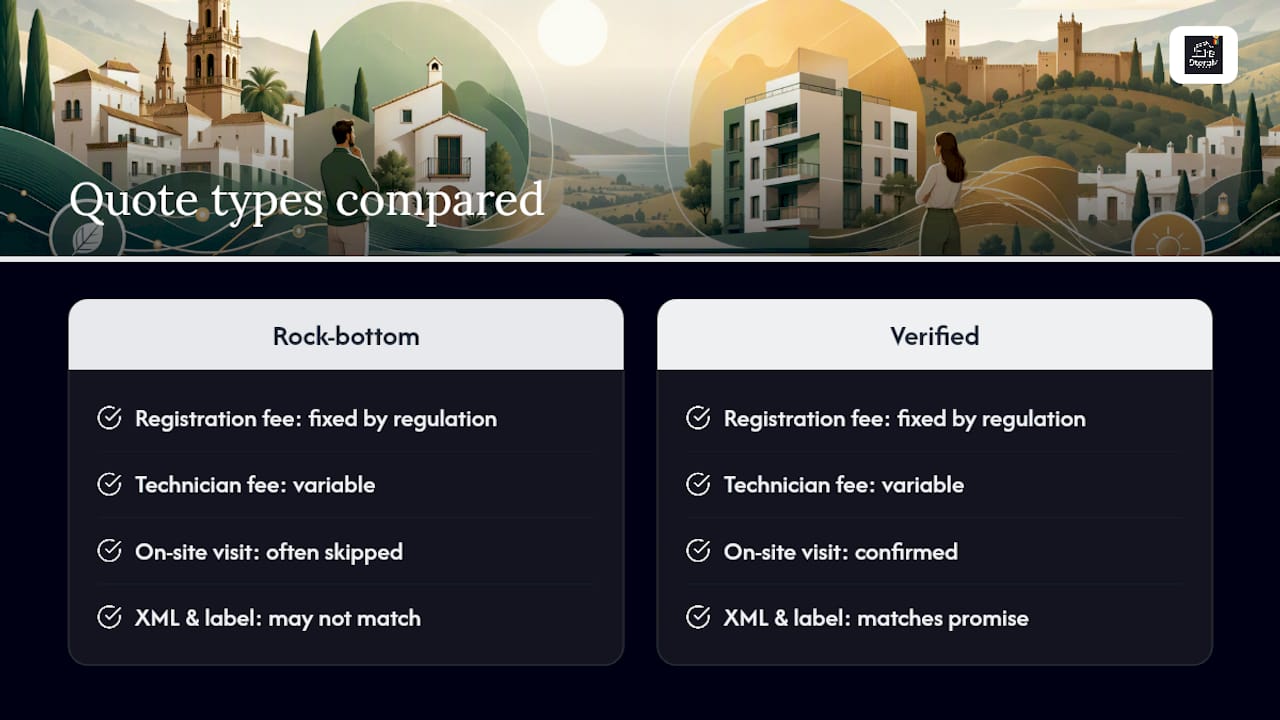
What matters more than price is verification. Ask for the registration number. Confirm the visit happened. Check that the XML file and label match what was promised. An owner who does that spends maybe €20 more than the rock-bottom online offer and walks away with a certificate that actually holds up during a sale, a mortgage application, or a rental listing. The certificates that cause problems later almost always trace back to a shortcut taken at the quote stage, not a fair price paid for real work.
Andalucía’s registration system is genuinely simple once you separate the fixed fee from the variable one. The mistake most owners make isn’t overpaying. It’s not knowing which part of the bill they’re even looking at.
— YellowRock
Get Your Energy Certificate Handled Without the Runaround
Coordinating a technician, confirming fee structures, and chasing registration numbers is the kind of administrative friction that can be removed by property service providers. For owners preparing to sell or rent in Andalucía, a service can arrange a qualified technician, confirm upfront whether the RCEA registration fee is included in your quote, handle the Modelo 046 submission, and deliver your registration number and official energy label directly, avoiding the need for you to chase paperwork on your own.

The scope is straightforward: we source the technician, verify the on-site visit happens, and make sure your final documents are complete and registered before we call the job done. If you’re preparing a property for sale, our seller’s guide to real estate agreements covers the other documentation you’ll need alongside your energy certificate.
Ready to move forward? Request a quote, share your property’s surface area and location, and we’ll schedule the visit and walk you through how a real estate agent supports both buyers and sellers through the rest of the transaction.
Sources
Verify the rules directly rather than taking any guide’s word for it, including this one:
- Real Decreto 390/2021, 1 June 2021 (BOE)
- Precio del certificado energético 2026: cuánto cuesta y qué pagas exactamente (GuiaReformas)
- Junta de Andalucía – Modelo 046 payment (regional public models)
FAQ
How much does an energy certificate cost in Andalucía?
Expect to pay the RCEA registration fee of €14.69 (properties up to 250 m²) or €56.31 (above that), plus a technician’s fee that typically runs €80 to €150 for an apartment or €200 to €350 for a larger single-family home.
How much does an energy certificate usually cost overall?
Across Spain, most residential certificates fall between €80 and €250 in technician fees alone, before adding the separate regional registration charge.
How do I get an energy certificate for my home in Andalucía?
Hire a qualified technician (architect, technical architect, or authorized engineer) who conducts the mandatory on-site visit, prepares the report, and submits it electronically to the RCEA using the required XML file; SteraM Flats can coordinate this entire process for you if you’d rather not manage it directly.
How much does an architect charge for an energy certificate?
Architects and technical architects generally charge within the same €80 to €350 range as other authorized technicians, with the final figure depending on property size, location, and complexity rather than the professional’s specific title.
How long does an energy certificate stay valid in Andalucía?
Certificates are valid for up to 10 years, except for properties rated ‘G’, which may carry a shorter 5-year validity under Article 13.1 of RD 390/2021.