Yes, an FNMT digital certificate or DNIe covers most online property tasks in Spain, from checking cadastral records to filing tax forms. Get the free FNMT “persona física” certificate if you’re acting on your own behalf. For formal Registro de la Propiedad inscriptions, though, you often need a notary’s electronic authorized copy with a qualified signature instead, and if you’re signing for a company, request a representative or legal-entity certificate instead of the standard citizen one.
TL;DR:
- Most property-related procedures can be done with an FNMT citizen certificate, but formal registry inscriptions often require a notary’s electronic authorized copy with a qualified signature.
- You must prepare your device, request the certificate with your DNI or NIE, and complete identity verification either via video or in person to successfully download it.
- Using the correct certificate type is crucial, with individual owners needing a persona física certificate, while companies or entities may require representative or juridical certificates.
- Digital certificate failures most often stem from switching devices mid-process, not backing up the
.p12file, or using outdated browsers.- For official property filings, coordinate with your notary to ensure they issue an electronic authorized copy, as plain digital scans may be rejected by the Registro de la Propiedad.
Table of Contents
- What Real Estate Tasks Accept a Certificado Digital?
- How Do You Get an FNMT Digital Certificate for Property Use?
- Which Certificate Type Fits Your Real Estate Role?
- Common Pitfalls When Using a Certificate for Property Paperwork
- Why Does the Registro de la Propiedad Sometimes Reject Digital Submissions?
- SteramFlats’ Checklist: When to Handle It Yourself and When to Delegate
- Let SteramFlats Handle the Paperwork So You Don’t Have To
- Where to Verify the Latest Rules
- Sources
- FAQ
What Real Estate Tasks Accept a Certificado Digital?
A certificado digital trámites inmobiliarios situation almost always starts with one of three government portals. Knowing which one applies to your task saves a wasted afternoon.
- Catastro Virtual: download cadastral certificates, check boundaries, and pull property data records, often free once you’re identified with a certificate or DNIe.
- Agencia Tributaria (AEAT): file property-related tax declarations, submit Modelo forms tied to a sale or rental, and check your tax history before a transaction.
- Municipal sedes electrónicas: request building licenses, empadronamiento certificates, and permits for renovation work.
- Registro de la Propiedad: pull registry information and, in limited cases, submit telematic filings, though many inscriptions require a notary’s electronic copy rather than a personal certificate.
- Sede electrónica notarial: request electronic authorized copies of deeds or send signed documents directly to a notary’s office online.
Each portal has its own acceptance rules, so the certificate that works for one may be rejected by another.
How Do You Get an FNMT Digital Certificate for Property Use?
Getting the FNMT citizen certificate takes four stages, and skipping the order is the most common reason people have to start over.
- Prepare your device. Pick the computer and browser you’ll finish the whole process on. Install the FNMT configuration software first, and don’t switch machines or user profiles until you’ve downloaded the final certificate.
- Submit the request. Fill out the form at Sede using your DNI or NIE. FNMT sends you a request code, which you’ll need for the next step.
- Accredit your identity. You have four routes: video identification from home, an in-person visit to one of the more than 2,400 Oficinas de Acreditación nationwide, using your DNIe to self-accredit, or a mobile app option where available. Video ID is the fastest for residents, but non-residents abroad often need a consular appointment or a representative acting on their behalf.
- Download and back it up. Return to the same computer, download the certificate, and immediately export a
.p12backup file with a strong password. Store that file somewhere other than the machine you used, in case it fails.
Most citizen certificates are free. Video identification sometimes carries a small fee depending on the provider. Certificates are generally valid for multiple years, with some categories having shorter validity, and renewal follows the same portal before expiration.
Pro Tip: If you lose your request code before finishing the download, don’t restart from scratch. Log back into the FNMT portal on the same device first. A surprising number of “lost code” cases are actually browser cache issues, not a genuine restart.
Which Certificate Type Fits Your Real Estate Role?
Not every certificate does the same job, and using the wrong one is a fast way to get a submission bounced.
- Persona física (citizen certificate): right for individuals doing personal queries, filing their own tax forms, or downloading cadastral data. This covers most buyers, sellers, and landlords managing their own paperwork.
- Representative certificates: needed if you’re acting for a company, a community of owners, or another person, and require proof of representation filed alongside the request.
- Persona jurídica certificates: for entities presenting on their own behalf, which usually means extra documentation checked against the Mercantil registry.
- DNIe: a convenient built-in alternative to the FNMT certificate for residents, though it needs a card reader or NFC-capable phone, which some older setups lack.
Before starting any procedure, check the specific sede electrónica you’re using. Requirements differ between AEAT, Catastro, and municipal portals, and a certificate that’s accepted on one can be rejected on another.
Common Pitfalls When Using a Certificate for Property Paperwork
Most certificate failures trace back to a handful of avoidable mistakes.
- Switching computers mid-process. The FNMT request and download must happen on the same machine and browser profile; changing either forces you to restart the entire request.
- Skipping the backup. Export your
.p12file the moment the download finishes, not later. A crashed hard drive with no backup means reapplying from zero. - Outdated browsers. Some sedes electrónicas still have compatibility quirks with certain browser versions, so update before you start, not mid-submission.
- Confusing “identify” with “sign.” A standard certificate proves who you are online. It doesn’t automatically carry the qualified electronic signature that some legal documents require, a distinction explained in more depth at Firmaelectronica.
Pro Tip: If a submission gets rejected, don’t resubmit blindly. Call your gestoría or notary first. Half the time the fix is a document format issue, not a certificate problem.
Why Does the Registro de la Propiedad Sometimes Reject Digital Submissions?
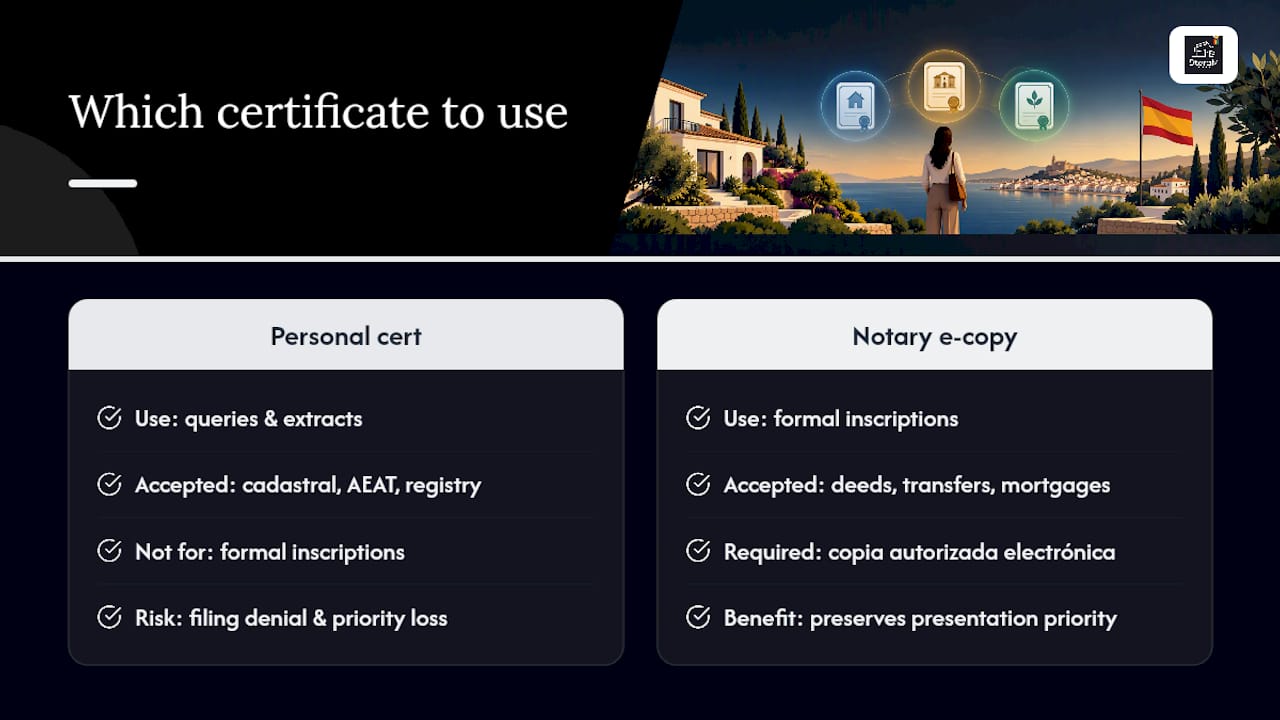
A plain PDF or scanned copy of a notarial deed is often not enough for a Registro de la Propiedad filing, even when it carries a valid digital certificate; understanding certificate of title processes can help clarify such requirements. Registrars increasingly require a notary’s copia autorizada electrónica, an electronic authorized copy carrying a qualified notarial signature, distinct from your personal FNMT certificate.
A May 2026 resolution confirmed registrars can deny telematic submissions that don’t meet this standard, and the consequences go beyond a simple resubmission. A denied filing can lose its presentation priority, pushing your entry date back behind competing filings, a real risk if there’s a lien or a second buyer in the mix. Recurso exprés appeal windows for correcting a denial are also tight, so delays compound fast.
The practical rule: a standard FNMT or DNIe certificate is fine for pulling cadastral extracts, checking AEAT records, or querying registry information. The moment you need to formally inscribe a deed, transfer, or mortgage, coordinate with your notary in advance so they issue the electronic authorized copy through the sede electrónica notarial rather than a plain digital scan.
SteramFlats’ Checklist: When to Handle It Yourself and When to Delegate
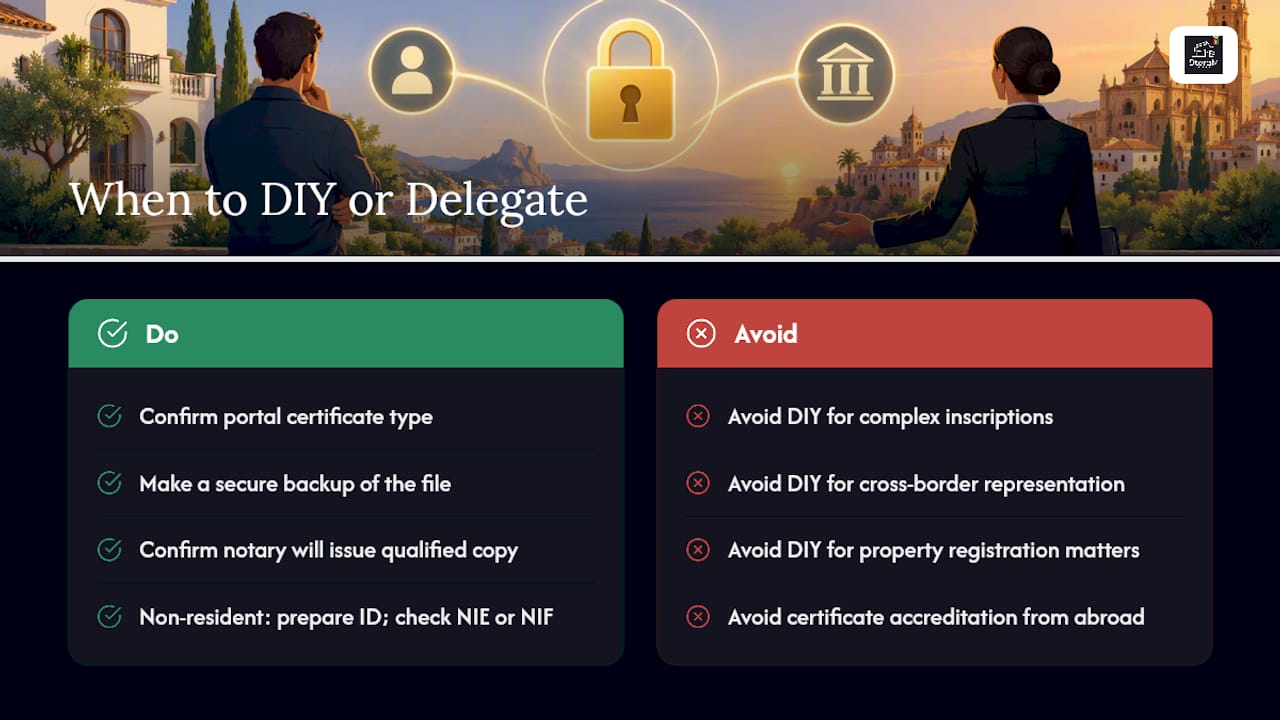
Before presenting any document telematically, confirm three things: the correct certificate type for the portal, a secure backup of your .p12 file, and, for registry filings, written confirmation from your notary that they’re issuing the qualified electronic copy, not a plain scan.
Steramflats recommends delegating when a transaction involves a complex inscription, cross-border representation, or any situation touching property registration procedures. Non-resident owners should prepare identity documentation early, confirm whether they need a NIE or NIF, and consider a power of attorney rather than juggling certificate accreditation from abroad.
— YellowRock
Let SteramFlats Handle the Paperwork So You Don’t Have To
Managing certificates, notary appointments, and Registro requirements can be complex. Coordinating a copia autorizada electrónica, confirming which certificate a given sede electrónica accepts, and tracking a submission’s presentation priority are important documentation tasks often handled by professionals for buyers, sellers, and non-resident owners in southern Spain.
That includes gestoría coordination, notary liaison, licence and cédula management, and certification support such as the certificado energético required before most rentals. Steramflats is upfront about limits too: some steps still require you to appear in person or grant formal legal representation, and its team will tell you when that’s the case rather than pretending otherwise. If your transaction involves any registry filing, tax paperwork, or licence request, start with the full service list and request a quote before you touch the sede electrónica yourself.
Where to Verify the Latest Rules
Confirm current forms and office locations directly through FNMT’s citizen certificate page, the Agencia Tributaria portal, and your notary’s sede electrónica before filing anything.
Sources
- Cert. Electrónico Ciudadano – Sede
- Solicitud certificado persona física (FNMT) – procedural doc (PDF)
- Registro Property: denial of non‑notarial electronic copies (2026 resolution)
FAQ
How Can I Get a Digital Certificate in Spain?
Apply through the FNMT sede electrónica with a valid DNI or NIE, choose an identity accreditation method such as video ID or an in-person office visit, then download the certificate on the same device you used to request it. Most citizen certificates carry no cost.
What Procedures Can I Complete With a Digital Certificate?
You can download cadastral certificates from Catastro Virtual, file property-related tax forms with Agencia Tributaria, request municipal licenses and permits, and check Registro de la Propiedad information online. Formal registry inscriptions of deeds typically still need a notary’s qualified electronic copy rather than your personal certificate.
Who Is Required to Have a Digital Certificate?
Anyone dealing regularly with Spanish tax authorities, businesses, and certain administrative filings benefits from having one, and some entities, including most companies, are legally required to use electronic means for tax and administrative communication. Individual property owners aren’t obligated but gain significant convenience from holding one.
What Type of Digital Certificate Does a Comunidad de Bienes Need?
A comunidad de bienes generally needs a representative certificate tied to whoever holds authority to act on the entity’s behalf, filed with proof of that representation. This differs from a simple persona física certificate and should be confirmed on the specific sede electrónica before applying.