
Andalucía does not issue the traditional cédula de habitabilidad. It hasn’t for decades. The municipal Licencia de Primera Ocupación (LPO) and related town-hall procedures now serve the purpose that document once did, and if you’re buying, selling, or renting in this region, the LPO (not the cédula) is what actually matters.
That changes what you check before signing anything. Here’s what it means in practice:
- Buyer due diligence: ask for the LPO, not a cédula, when reviewing a property’s paperwork.
- Utilities: many suppliers in Andalucía still ask for proof of first-occupation licensing before connecting water or electricity to a new build.
- Notary checks: notaries handling a first transmission will typically request the LPO file before closing.
If you’re unsure whether a property has one, the place to check first is the urbanismo or planning department at your local ayuntamiento.
TL;DR:
- In Andalucía, the LPO now replaces the traditional cédula de habitabilidad, which the region abolished in 1987 to simplify housing certification.
- Buyers should verify the presence of the LPO through the municipal urbanism department before signing a property deal or arranging utility connections.
- The process of obtaining an LPO varies by town, typically involving architect certification and municipal review times ranging from weeks to several months.
- Properties built before current standards may lack an LPO but can often be regularized through DAFO/AFO procedures, though this extends the timeline and costs.
- Steramflats offers end-to-end management of municipal records, architect coordination, and license applications to resolve habitability gaps efficiently.
Table of Contents
- Cédula de habitabilidad andalucía: the history behind the confusion
- The legal basis: Decreto 283/1987 and who checks habitability today
- Cédula vs. Licencia de Primera Ocupación: what actually differs
- How to get the Licencia de Primera Ocupación in Andalucía
- What if the property has no LPO? Your regularization options
- How Steramflats helps you resolve LPO and habitability gaps
- The single most important thing about habitability status in Andalucía is that Decreto 283/1987 replaced a regional certificate with a municipal one, and municipal practice varies enough that no two towns handle it identically.
- Why the habitability conversation in Andalucía gets muddled
- Get your Andalucía property’s paperwork sorted with Steramflats
Cédula de habitabilidad andalucía: the history behind the confusion
The cédula de habitabilidad was, historically, a certificate confirming a dwelling met minimum conditions for safe, legal occupation: structural soundness, ventilation, sanitation, and basic services. Spain never centralized this. Each autonomous community decides its own housing-certification process, and that’s why the term still circulates even where the document itself disappeared.
- Catalonia, Valencia, and the Balearic Islands still issue a cédula, generally with a fixed validity period that requires renewal.
- Andalucía dropped the cédula system outright rather than keep two parallel layers of paperwork.
- The stated goal was administrative simplification: one municipal procedure instead of a regional certificate plus a local license covering overlapping ground.
The result is that a buyer moving from Barcelona to Málaga has to unlearn a document that simply doesn’t exist on this side of the map.
The legal basis: Decreto 283/1987 and who checks habitability today
Decreto 283/1987, published in the BOJA, suppressed the cédula de habitabilidad in Andalucía and shifted the job of verifying habitability to municipal licensing procedures. That’s the single legal reference every practical guide to this topic in Andalucía eventually points back to.
The Junta de Andalucía hasn’t stepped away from housing standards generally, but the day-to-day enforcement tool for a specific property is the town hall, not a regional certificate. The practical effect: your ayuntamiento’s urbanism department, not the Junta directly, is where habitability gets confirmed for an individual dwelling.
If you want to verify any of this yourself, two sources matter: the BOJA text of the decree itself, and your specific municipal planning office, since local interpretation and paperwork requirements vary town to town.
Cédula vs. Licencia de Primera Ocupación: what actually differs
The functional gap between these two documents trips up a lot of buyers who’ve owned property elsewhere in Spain. A cédula in Catalonia or the Balearics usually comes with an expiration date and a renewal process. The Andalusian LPO, once granted, is generally treated as permanent for that building.
- Where the cédula still applies: regions like Catalonia and the Balearics, subject to periodic renewal under their own housing codes.
- Where the LPO applies: Andalucía, typically issued once for new construction and certain first transmissions of ownership.
- When it’s strictly required: new builds almost always need one before first occupation; second-hand property sales are handled more case by case, with notaries and municipal records sometimes substituting for a fresh LPO application.
- Consequences of skipping it: utility connection delays, notary friction at signing, and complications for buyers seeking a mortgage on the property.
If you’re comparing offers on an older Andalusian home versus a resale in Valencia, don’t assume the paperwork checklist is the same. It isn’t.
How to get the Licencia de Primera Ocupación in Andalucía
Getting an LPO issued isn’t complicated in theory, but the actual timeline depends heavily on which town hall you’re dealing with. Here’s the sequence that applies in most Andalusian municipalities:
- Hire an arquitecto técnico to prepare the file. This professional issues the certificado final de obra, confirming the building matches its approved plans and meets construction standards.
- Gather the core documents: the certificado final de obra, the original licencia de obras (building permit), the certificado energético (energy performance certificate), proof of ICIO payment (the local construction tax), and, where applicable, ten-year (decenal) insurance coverage on the build.
- Submit the application to the ayuntamiento’s urbanism or planning department, typically alongside the architect’s declaration.
- Expect a municipal inspection or file review. Processing windows vary enormously by town. Smaller coastal municipalities like Estepona can move in a matter of weeks, while larger cities such as Málaga capital have been known to take several months for a full review.
- Address any deficiencies flagged during review before the license is granted. Minor issues (missing certificates, incomplete plans) are the most common cause of delay.
Some municipalities now accept a declaración responsable signed by the architect in place of a full inspection cycle for certain projects, which can shorten the process considerably when it applies.
Pro Tip: Call your specific ayuntamiento before you start gathering documents. Requirements and processing order shift from one Andalusian town to the next, and a five-minute phone call can save weeks of resubmission.
What if the property has no LPO? Your regularization options
A missing LPO isn’t automatically a dead end, but it does complicate a sale or rental listing. Older constructions, especially those built before current planning codes tightened up, sometimes never went through the formal first-occupation process at all.
- DAFO/AFO (a municipal declaration of assimilated out-of-planning status) offers a regularization route for older buildings that can’t meet current LPO standards but aren’t illegal outright. It doesn’t grant full LPO status, but it can unlock utility connections and some transactions.
- Retroactive LPO applications require a technical report from an architect, a search through municipal archives for any historical building permits, and sometimes a declaration confirming the structure’s actual condition matches habitability standards.
- Cost and timeline for regularization runs higher than a standard LPO application, since it usually involves extra surveys and paperwork searches. Buyers and tenants should expect this to affect negotiating leverage on price or lease terms.
How Steramflats helps you resolve LPO and habitability gaps
Chasing down decades-old permits at a Spanish town hall isn’t most people’s idea of a productive afternoon. Steramflats coordinates the pieces that regularization actually requires: searching municipal and Catastro records for prior permits, bringing in an architect for the technical reports DAFO or a retroactive LPO application needs, and managing the license submission itself.
- Document searches through municipal archives and property registration records.
- Architect coordination for certificado final de obra, energy certificates, and technical reports.
- Direct handling of LPO applications and DAFO/AFO regularization filings with the ayuntamiento.
A DIY approach works fine for a straightforward, recently built property with clean paperwork. It’s the older buildings, missing permits, or inherited properties with no clear file that usually justify bringing in help.
Pro Tip: Before reaching out for assistance, pull together whatever you already have: the property’s Catastro reference, any prior licenses, and the deed of sale. Even a partial file speeds up the search considerably.
The single most important thing about habitability status in Andalucía is that Decreto 283/1987 replaced a regional certificate with a municipal one, and municipal practice varies enough that no two towns handle it identically.
| Point | Details |
|---|---|
| No cédula in Andalucía | Decreto 283/1987 abolished it; the LPO is the operative document for habitability now. |
| Check the ayuntamiento first | Municipal urbanism departments, not the Junta directly, control LPO issuance and inspections. |
| Timelines vary by town | Expect anywhere from a few weeks in smaller coastal towns to several months in larger cities. |
| Missing LPO isn’t fatal | DAFO/AFO and retroactive applications offer regularization paths for older properties. |
| Steramflats manages the paperwork | Document searches, architect coordination, and LPO/DAFO filings handled directly for owners and buyers. |
Sources worth checking before you act
- Decreto 283/1987 (BOJA) — the original legal text suppressing the cédula in Andalucía.
- Licencia de Primera Ocupación en Andalucía: a legal breakdown of LPO requirements and documents.
- Licencia de Primera Ocupación Spain: Full Guide: municipal timeline ranges across different Andalusian towns.
Why the habitability conversation in Andalucía gets muddled
Most articles on this topic either quote the 1987 decree and stop there, or list documents without explaining why the terminology confuses people in the first place. The real issue isn’t legal complexity. It’s that “cédula de habitabilidad” survives as a search term and a conversational habit decades after Andalucía retired the document itself, while other Spanish regions kept using it, so buyers arrive with the wrong mental model.
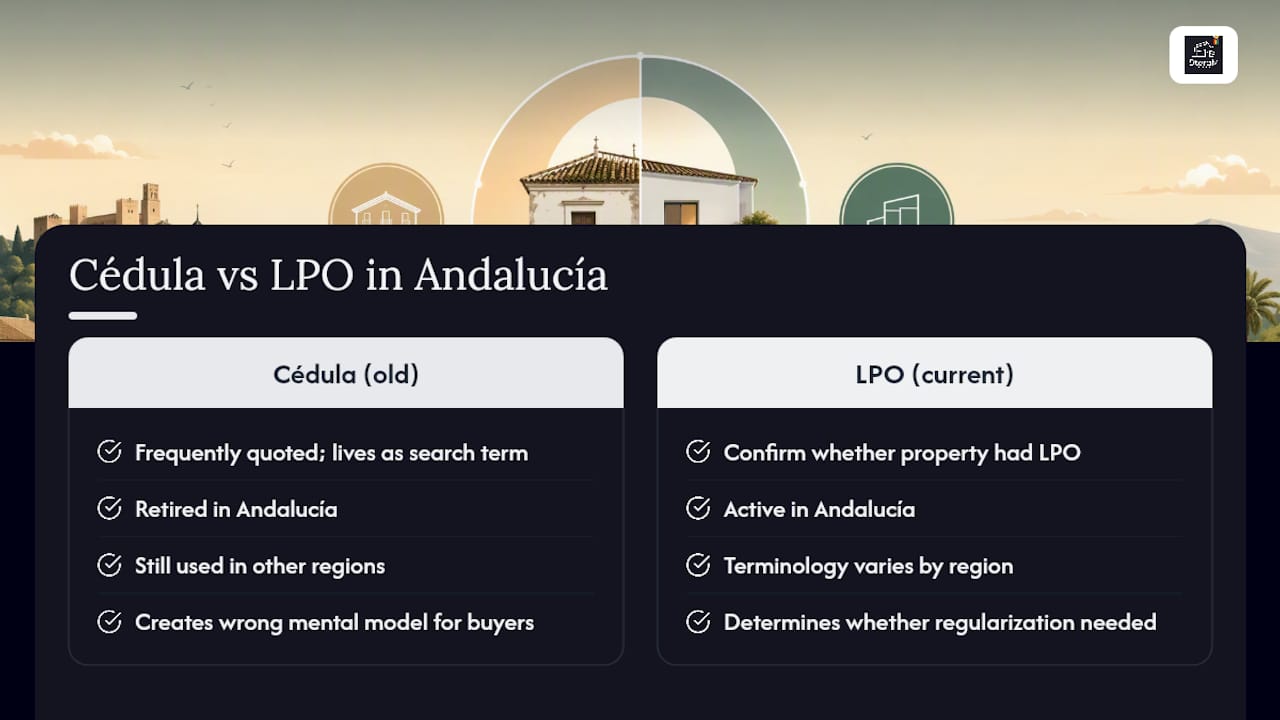
The advice that actually holds up under scrutiny is narrower than most guides suggest: confirm whether a specific property ever went through first-occupation licensing, and if it didn’t, treat DAFO or a retroactive application as a real project with its own timeline, not an afterthought to tack onto a sale. Where conventional guidance falls short is timeline expectations. Generic checklists rarely mention that Málaga capital can take months longer than a town like Estepona for the same paperwork.
If there’s one priority worth acting on first, it’s calling the ayuntamiento before assuming anything about your property’s status. That single call determines whether you’re looking at a routine LPO file or a longer regularization process.
— YellowRock
Get your Andalucía property’s paperwork sorted with Steramflats
Chasing municipal records and coordinating architects on your own eats time you probably don’t have, especially if you’re managing this from outside Spain. Steramflats handles the LPO and DAFO process end to end for owners across southern Spain, coordinating the project and license management work directly instead of leaving you to track down separate architects, municipal clerks, and energy certificate providers on your own.
That matters most if you’re preparing a property for sale, bringing an inherited home up to standard, or listing a unit for holiday rental where compliance gets checked more closely. Steramflats also works with international and LGBTQ+ clients navigating Spanish property paperwork for the first time, and can advise on financing and legal steps alongside the licensing work itself.
If your property’s LPO status is unclear, the practical next step is a property review: reach out to Steramflats with your Catastro reference and any existing licenses, and get a clear read on what regularization would involve before you list, sell, or rent.
Buyers preparing for a purchase can also review what to expect from a real estate agent throughout the transaction, including how habitability checks factor into the closing process. For a broader look at due diligence steps before making an offer, this buyer’s guide to purchasing in Spain covers what to verify before you commit.