To remove a paid off mortgage from your property’s title, you need your bank’s certificado de deuda cero, a notarized cancellation deed, and an inscription at the Registro de la Propiedad. The certificate itself is free. Notary and registry fees normally apply. You can either ask the bank to coordinate the paperwork or handle it yourself to keep costs down.
TL;DR:
- The certificate of zero debt is free and must be requested from the bank after fully settling the mortgage, with a turnaround of one to two weeks.
- The notary appointment requires the bank’s authorized representative and the certificate, with notarial fees depending on the original loan amount.
- Filing the model 600 tax form is mandatory to document the exemption from the mortgage cancellation tax, even though no payment is due.
- The final registry inscription of the canceled mortgage typically takes a few days to a couple of weeks, depending on workload and processing times.
- Costs mainly involve notary and registry fees, with some cases requiring legal review if the original loan agreement places disproportionate cancellation charges on the borrower.
Table of Contents
- Cancelación Registral de Hipoteca: A Quick-Start Checklist
- What Happens at Each Step of the Cancellation Process
- Who Pays for Mortgage Cancellation, and What It Costs
- How Long Does the Whole Process Take?
- What If the Bank Delays, Merges, or Refuses to Cooperate?
- Why a Clean Title Matters More Than Most Owners Realize
- Let Steramflats Handle the Cancellation Paperwork for You
- Where to Verify These Steps Yourself
- Sources
Cancelación Registral de Hipoteca: A Quick-Start Checklist
Here’s the sequence, in order, from paid off loan to a clean title.
- Request the certificado de deuda cero from your lender, either at a branch or through online banking. Banks must issue this at no charge once the debt is fully settled, though it can take a couple of weeks to land.
- Book a notary appointment and tell your bank which notary you’ve chosen, so it can send its apoderado (the representative authorized to sign on the bank’s behalf).
- File model 600 (IAJD) with your autonomous community’s tax office to record the exemption, even though the cancellation itself doesn’t generate tax owed.
- Present the signed deed at the Registro de la Propiedad and request an updated nota simple once the inscription clears.
Each step depends on the one before it, so getting the certificate early is what keeps the rest of the timeline on track.
What Happens at Each Step of the Cancellation Process
Getting the certificado de deuda cero
Start by calling your mortgage servicing department or logging into your online banking portal. Most Spanish banks post a direct request form for the certificado de deuda cero, and by regulation, issuing it does not have a cost to you. The document has to state that the loan balance is zero and that the bank consents to cancellation. Some lenders, including Santander’s dedicated request page, let you submit the request digitally and track its status without a branch visit.
Pro Tip: Ask the bank to include the exact registry reference (finca number) and the name of the apoderado who will sign at the notary, right when it hands you the certificate. That single request avoids a scramble on signing day, when notaries sometimes discover the paperwork lists the wrong representative.
Signing the deed before a notary
Once you have the certificate, you and the bank’s apoderado sign the escritura pública de cancelación together. You are free to choose any notary in Spain, not necessarily the one who handled your original mortgage. The notary will ask for your ID, the original mortgage deed if you have it, and the certificado de deuda cero. Notarial fees are regulated and generally depend on the amount of the original loan, with the notary providing a quotation before you sign.
Handling the IAJD (model 600) even though it’s exempt
The cancellation deed still has to pass through your region’s tax office as model 600, the Impuesto sobre Actos Jurídicos Documentados. This step confuses a lot of homeowners because the operation is exempt from actually paying the tax. You still must present the form and get a stamped receipt proving that exemption, because the Registro de la Propiedad won’t accept the deed without it. Some regions, like Aragón’s tax portal, now process this online with an immediate electronic receipt, which shaves real time off the whole process compared to an in-person filing.
- Keep the notarized deed, your ID, and the certificado de deuda cero together in one folder before you go to the tax office.
- Ask for a physical or digital stamp confirming presentation, not just a submission confirmation.
- File this step before, not after, taking the deed to the registry, since the registrar checks for it.
Presenting the deed at the Registro de la Propiedad
The final stop is the Land Registry covering your property. You submit the notarized deed along with proof of the IAJD presentation, and the registrar reviews both before inscribing the cancellation. Registry fees, known as aranceles, follow a regulated table tied loosely to the original loan amount rather than a flat rate. Once the registrar completes the inscription, request an updated nota simple right away. That document is your proof, in writing, that the mortgage no longer appears against the property, and it’s the single piece of paper future buyers and lenders will ask to see.
Who Pays for Mortgage Cancellation, and What It Costs
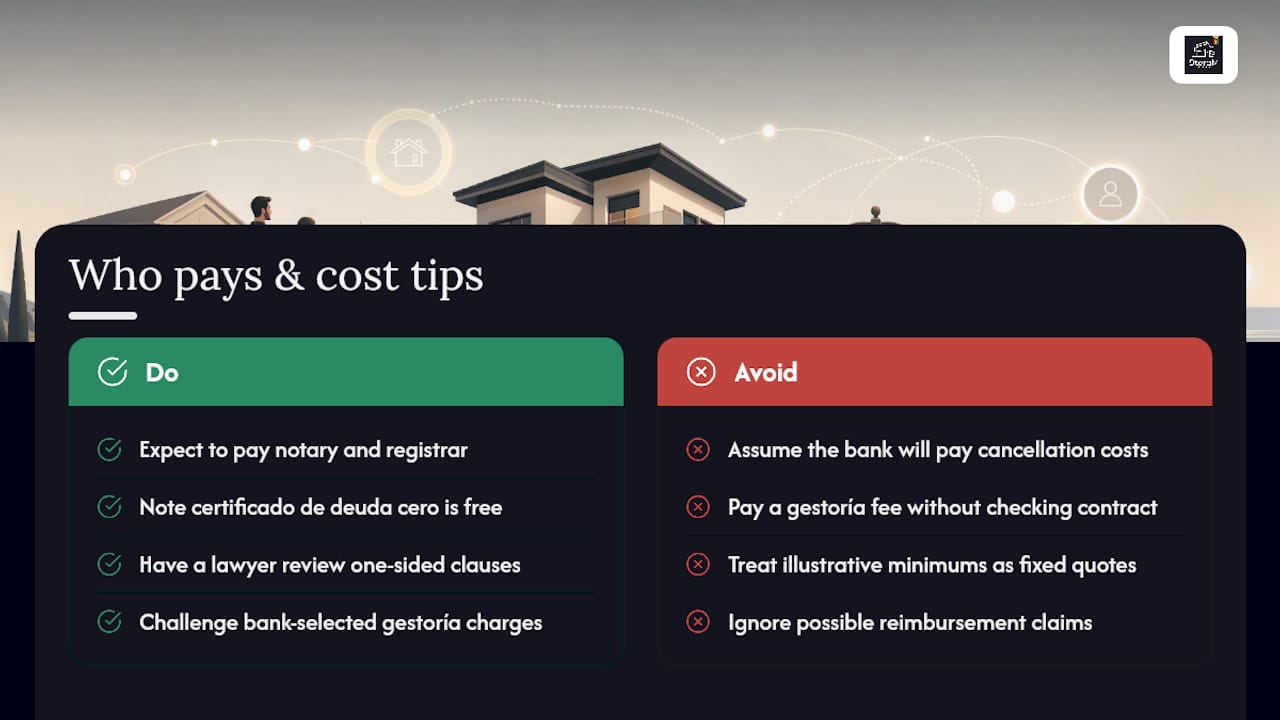
The certificado de deuda cero costs nothing, and the IAJD exemption itself carries no tax bill. What you do pay for are the notary and the registrar, and sometimes a gestoría if you hire one to run the errands for you.
Spanish courts and consumer protection practice generally place these cancellation costs on the homeowner, not the bank, since you’re the one benefiting from clearing the charge. That said, some older mortgage contracts forced borrowers to use a bank-selected gestoría at inflated rates, and those charges have been successfully challenged and reclaimed in individual cases. If your original loan contract from years back assigned cancellation costs entirely to you under a clause that looks one-sided, it’s worth having a lawyer review it before you pay anything.
Those notary and registry minimums are illustrative examples pulled from consumer finance coverage, and your actual bill depends on your loan amount and region, so treat them as a floor rather than a quote.
How Long Does the Whole Process Take?
Budget several weeks from your first call to the bank to a finished registry entry, according to practical timing estimates from mortgage advisory sources.
- Certificate issuance: may take about one to two weeks.
- Notary scheduling: anywhere from a few days to a couple of weeks, depending on availability.
- IAJD processing: often same day when filed electronically, up to a few days for in-person filings.
- Registry inscription: timing varies depending on workload, generally within days to a couple of weeks.
The biggest delays tend to come from internal bank processing, tracking down an original mortgage deed that’s gone missing in a drawer somewhere, or a busy registry office during peak filing season. Filing model 600 online where your region allows it, and confirming the notary’s appointment with the bank’s apoderado well ahead of time, both cut real days off the wait.
What If the Bank Delays, Merges, or Refuses to Cooperate?
Spanish banking has gone through a wave of mergers over the past decade, and if your original lender no longer exists under that name, the registrar will need documentation proving succession before accepting the cancellation deed.
- Ask the surviving bank for a certificate that explicitly states it absorbed or succeeded the original lender, since registrars want that link documented, not assumed.
- If a bank drags its feet on issuing the certificado de deuda cero, file a complaint with Banco de España before escalating further.
- When cooperation completely breaks down, a lawyer can pursue judicial cancellation through the courts rather than the notarial route.
- Article 82 of the Ley Hipotecaria also allows cancellation by caducidad, a prescriptive route available after a long statutory period has passed since the mortgage term expired, though this path carries its own conditions and isn’t a shortcut for a recently paid loan.
Why a Clean Title Matters More Than Most Owners Realize
Most homeowners treat mortgage cancellation as paperwork they’ll “get to eventually.” That instinct is understandable but costly. A mortgage inscription left sitting on your title, even years after you paid it off, is the kind of thing that surfaces at the worst possible moment: mid-negotiation on a sale, or when a buyer’s bank runs its own registry check and stalls the whole transaction.
We’ve seen how a stale registry entry can add weeks to a closing that should have taken days, simply because nobody flagged it until a notary caught it during the sale process. For non-resident owners or anyone managing this from abroad, the notary and bank apoderado coordination gets harder, not easier, which is exactly when outside help earns its keep. If your documents are missing, your original lender has been absorbed twice over, or you simply can’t be in Spain for the notary appointment, that’s the point where bringing in support from mortgage protection insurance in Spain makes the difference between a two-week fix and a two-month headache.
— YellowRock
Let Steramflats Handle the Cancellation Paperwork for You
Steramflats is the alternative to chasing three separate offices yourself: instead of coordinating your bank, a notary, and the Registro de la Propiedad on your own schedule, we run all three in parallel for you, especially useful if you’re selling soon or living outside Spain.

Our team requests the certificado de deuda cero on your behalf, schedules the notary and confirms the bank’s apoderado in advance, files the model 600 exemption with your regional tax office, and follows up at the registry until the updated nota simple is in hand. For owners who can’t attend in person, we also arrange power of attorney so the process moves without you needing to fly back. If your original mortgage deed is missing or your lender has changed names through a merger, we track down the documentation registrars require before it becomes a bottleneck.
Before reaching out, gather your loan account number, the bank branch that services it, and roughly when you made your final payment. Then check our property marketing checklist if a sale is the reason you’re clearing the title, and get in touch to start the paperwork this week.

Where to Verify These Steps Yourself
For the certificate and cancellation overview, check Banco de España’s Cliente Bancario guidance. For registry submission requirements, Registradores.org lays out what registrars need. Bookmark your model 600 receipt and the final nota simple; you’ll need both again if you ever sell or refinance.
This article is general information, not a substitute for advice from a qualified financial advisor. Consult a qualified financial professional about your own circumstances before acting on anything here.
Sources
- Cancelación registral de la hipoteca – Cliente Bancario, Banco de España
- ¿Cómo se inscribe una cancelación de hipoteca? – Registradores
- Solicitud del certificado de deuda cero – Santander