
If your rental contract was signed before May 26, 2023, you apply the IPC for the annual update; if it was signed on or after that date, you apply the IRAV, which stood at 2.49% in July 2026. Before sending any notice, check your contract’s update clause and confirm the current figure and any active legal cap using the official indices from the INE and the Ministry’s calculator.
TL;DR:
- Rent updates before May 26, 2023, follow the Consumer Price Index, while contracts signed on or after that date must use the IRAV, which typically runs below the IPC during high inflation periods.
- The IRAV is calculated as the lowest of three metrics, including the general IPC, a core index excluding volatile items, and a 24-month rolling average, affecting how much rent can be increased.
- Temporary caps and legal exceptions, such as those applying to large landlords or stressed market zones, may override the IRAV or IPC, so verifying current BOE decrees is essential.
- Accurate rent increases require checking the contract’s update clause, using the index closest to the anniversary date, and providing written notice at least 30 days before the change.
- Missed updates can still be applied with proper notice, but future increases must respect the specific annual caps and cannot be backdated.
Table of Contents
- Actualización renta alquiler: which index applies, IPC or IRAV?
- Legal caps and temporary measures affecting the 2026 to 2027 updates
- Step by step: how to check and apply a rent update legally
- Worked examples: calculating the new rent under IPC and IRAV
- Missed updates: how far back can a landlord go?
- Where to check the official numbers: INE, the Ministry calculator, and SERPAVI
- What can a tenant do about an unlawful rent increase?
- SteraM Flats’ checklist for applying a compliant rent update
- Balancing a lawful update with keeping a good tenant
- Let SteraM Flats handle your rent update and tenant notices
- Sources
Actualización renta alquiler: which index applies, IPC or IRAV?
The dividing line is a single date: May 26, 2023, when Law 12/2023 on the right to housing came into force and changed how rent updates work under the LAU (Ley de Arrendamientos Urbanos). Any actualización renta alquiler for a contract signed before that date still runs on the standard Consumer Price Index. Contracts signed on or after it must use the new Índice de Referencia para la Actualización de los contratos de Arrendamiento de Vivienda, or IRAV.
The IPC is simple: it tracks the average change in prices of goods and services households buy, published monthly by the INE. The IRAV works differently. It’s built to smooth out inflation spikes that hurt tenants, so the INE calculates it as the lowest of three separate metrics: the general IPC, a core IPC that strips out volatile items like energy and fresh food, and a rolling average of the last 24 months. Whichever of those three comes out lowest becomes that month’s IRAV.
That structure matters. During periods of high inflation, the IRAV tends to run below the raw IPC, which caps how much landlords can raise rent even without a separate legal ceiling.
Timing trips up a lot of landlords. The index isn’t published the same month you apply it. A few things to keep straight:
- Use the index value published for the month closest to your contract’s anniversary date, not the month you happen to send the notice.
- INE releases the previous month’s figures roughly two weeks into the following month, so there’s a built-in lag.
- Contracts signed before May 26, 2023, that later get novated or substantially modified may fall under IRAV rules. Check with a professional if your contract has been amended.
- The rental agreement itself should specify which index applies. If it’s silent, the legal default kicks in based on signing date.
Legal caps and temporary measures affecting the 2026 to 2027 updates
The IRAV isn’t the only ceiling landlords face. Spain has repeatedly layered temporary caps on top of the ordinary index during periods of housing-market stress, and 2026 is no exception. BOE resolutions periodically update the IRAV methodology and its territorial application, and separate decrees have imposed hard percentage limits that override the index entirely when the index would otherwise produce a higher number.
News coverage of Real Decreto-ley 8/2026 describes a cap context extending certain limits through December 2027, though the exact scope, duration, and which landlords it binds depend on the decree’s convalidation status in Congress. That status can change, so treat any cap figure as provisional until you’ve confirmed it against the current BOE text.
Where a temporary cap of a lower percentage is in force for a given period, landlords must apply whichever figure is lower, the index or the cap, never the higher one.*
Key distinctions that decide whether a cap touches your update:
- Some caps apply specifically to “large holders” (owners with ten or more urban properties, or a defined threshold depending on the decree), leaving smaller landlords under the ordinary IRAV or IPC rules.
- Caps tied to declared “stressed market areas” only bind properties inside those zones, not nationwide.
- A cap’s duration is fixed by the decree, not indefinite, so a limit active in 2026 may expire or convert to ordinary rules in 2027.
Always check the BOE text for the decree in force at your anniversary date rather than relying on a headline percentage from a news article.
Step by step: how to check and apply a rent update legally
Getting the actualización renta alquiler right is a sequence, not a single calculation. Skipping a step is usually what turns a lawful increase into a legal dispute.
- Read the update clause in your contract. No clause means no automatic right to increase rent at all, regardless of what the index shows.
- Confirm the signing date and habitual-residence status. Rules differ for habitual residences versus other uses, and the IPC/IRAV split hinges on that date.
- Look up the correct published index value. Use the INE’s IPC/IRAV pages for the month tied to your anniversary, not the current calendar month.
- Run the number through the Ministry’s rent calculator to cross-check your math against the official simulator before sending anything.
- Calculate the new rent and confirm you’re updating once per twelve-month period, never more frequently.
- Give written notice at least 30 days before the new rent takes effect. Verbal notice or a text message doesn’t meet the legal standard most tenants and courts expect.
- Archive everything. Save a screenshot or PDF of the official index page you used, and keep a copy of the written notice with delivery confirmation.
Pro Tip: Send the notice by a method that generates a paper trail, certified mail, a registered email service, or a signed receipt. If the update is ever disputed, the burden of proving you gave proper notice on time falls on you.
Landlords managing several properties often find the timing and documentation step is where things slip. Building a simple annual calendar around each contract’s anniversary date prevents scrambling in the final week.
Worked examples: calculating the new rent under IPC and IRAV
The formula is the same regardless of which index applies:
New rent = current rent × (1 + index% ÷ 100)
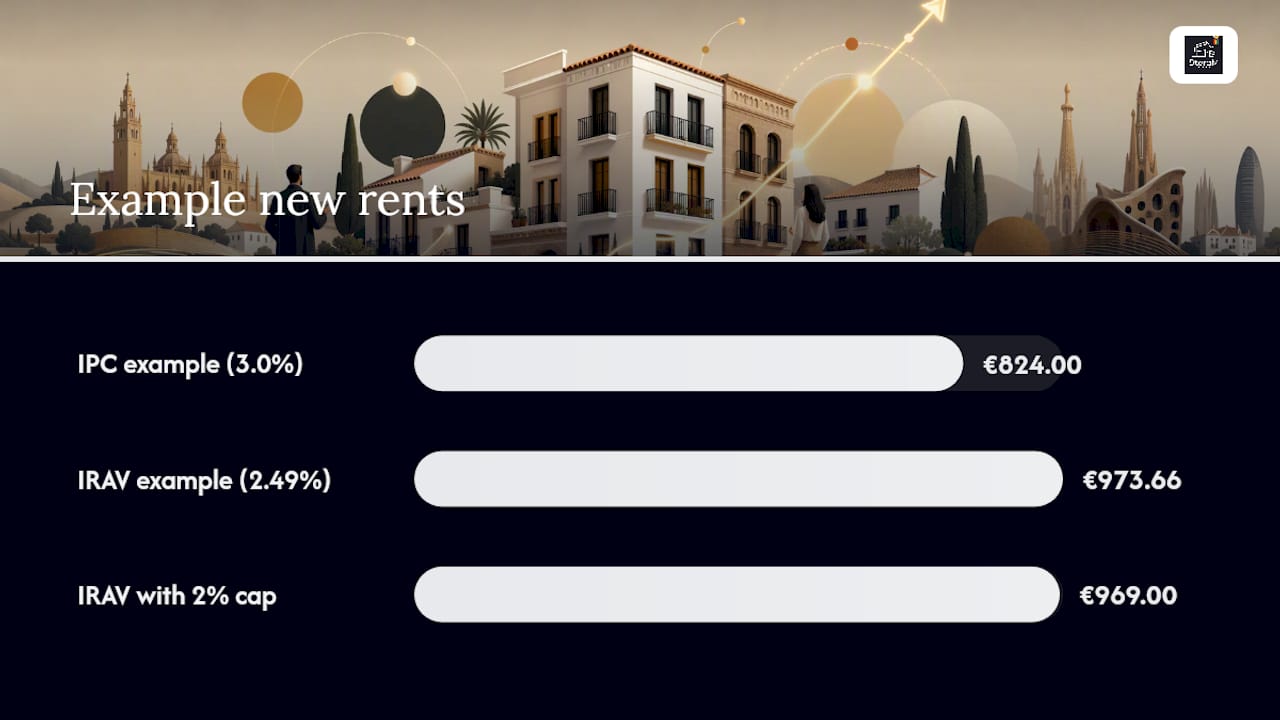
- IPC example: A contract signed in 2021 pays €800 a month. Say the applicable IPC figure for the anniversary month is 3.0%. New rent = €800 × 1.03 = €824.00.
- IRAV example: A contract signed in September 2023 pays €950 a month. Using the July 2026 IRAV of 2.49%, new rent = €950 × 1.0249 = €973.66.
- If a temporary cap of, say, 2% were in force and lower than the IRAV figure, the landlord would apply 2%, not 2.49%, producing €969.00 instead.
Remember the publication lag: the figure you use is usually from one or two months before your actual anniversary date, since INE needs that time to compile and release each month’s data. Calculating a few weeks ahead of the deadline avoids a last-minute scramble for a number that hasn’t been published yet.
Missed updates: how far back can a landlord go?
Landlords who forgot to update rent for a year or two can still catch up, but not by demanding retroactive back pay for the months that passed. Coverage of this issue in the sector press confirms that owners can apply accumulated increases going forward once they finally send proper notice, but each missed year’s percentage still has to respect that specific year’s legal cap.
- Compute each missed year’s applicable index or cap separately, not a blended average.
- Multiply the yearly factors together to get the combined increase applied from the notice date forward.
- No tenant owes back rent for the unupdated months; the increase only applies to future payments after 30 days’ notice.
New rent = old rent × 1.02 × 1.03, applied starting 30 days after notice, not retroactively.
Where to check the official numbers: INE, the Ministry calculator, and SERPAVI
Three tools serve three different jobs, and mixing them up is a common and costly mistake.
- INE publishes the raw monthly IPC and IRAV figures. This is where the actual percentage for your calculation comes from.
- MIVAU’s rent calculator lets you plug in your contract date and current rent to get the maximum lawful update, cross-checking your own math against the ministry’s formula.
- SERPAVI, the state reference-price system, sets price ranges for new contracts in declared stressed zones. It has nothing to do with annual updates on existing leases. Using SERPAVI figures to calculate a yearly increase is a mistake that shows up more often than it should.
What can a tenant do about an unlawful rent increase?
Not every increase a landlord sends is enforceable. Several defects make an update invalid on its face, and tenants have real leverage when they spot one.
- Check for a missing clause. If the contract has no update clause, the landlord cannot impose an increase unilaterally, full stop.
- Check the index used. An IPC increase applied to a post-May 2023 contract, or vice versa, is a calculation error that invalidates the notice.
- Check the notice period. Anything less than 30 days’ written notice fails to meet the legal standard.
- Refuse in writing if the increase fails any of the above. State the specific defect and keep a copy of your response.
- Contact OMIC (the local consumer information office) or a consumer association for a free initial review of the situation, as OCU’s guidance explains.
- Escalate to legal advice if the landlord persists, since unresolved disputes can end in a civil claim or a negotiated settlement between both parties.
SteraM Flats’ checklist for applying a compliant rent update
Property managers who handle dozens of leases use a version of this sequence for every anniversary date: verify the clause and signing date, confirm the correct index, run the calculation, prepare a written notice with a saved copy of the official index page attached as evidence, then deliver it and archive everything.
- Confirm the rental agreement actually contains an update clause before doing anything else.
- Cross-reference the contract duration to make sure you’re not updating mid-term outside the annual window.
- Work through a rental management checklist that covers documentation, notice delivery, and record-keeping in one place.
Getting one step wrong, wrong index, late notice, missing documentation, can turn a routine update into a dispute that costs more in time and legal fees than the increase itself was worth.
Balancing a lawful update with keeping a good tenant
Sending a rent increase notice is never just a math exercise. A landlord who explains the number, points to the published INE figure, and gives real notice tends to keep tenants who stay put and pay on time. One who springs a surprise increase or gets the index wrong invites disputes that cost far more than the extra rent recovers.
Offering a phased increase, or simply explaining the calculation clearly, often defuses friction before it starts. When a portfolio grows past a couple of units, or a dispute starts looking likely, handing the update process to a property manager or lawyer usually pays for itself.
— YellowRock
Let SteraM Flats handle your rent update and tenant notices
Chasing down the right INE figure, checking whether a temporary cap overrides it, and drafting a notice that holds up if a tenant pushes back takes real time, time most landlords don’t have between other jobs. SteraM Flats reviews your contract’s update clause, calculates the correct increase, and prepares compliant written notices so you’re not the one guessing whether May 2023 or a BOE resolution applies to your lease.

Beyond update calculations, SteraM Flats’ property management service covers the full tenant relationship, from lease renewals to documentation storage, so nothing slips through when it’s time for the next anniversary. If you’d rather not track index publication dates yourself, request a contract review and get a clear answer on what you can legally charge before your next notice is due.
Sources
- INE — IPC / IRAV information
- Ministerio de Vivienda y Agenda Urbana — rent calculator
- BOE — Resolución de 16 de abril de 2026 (system of reference indices)
- OCU — How rent updates work and tenant protections