Yes, banks in Spain will finance a second home, but expect tighter terms than your first mortgage. A firm like Steramflats can help you map out those numbers before you make an offer.
TL;DR:
- LTV for second homes typically ranges from 60% to 75 percent, requiring larger down payments due to higher perceived risk.
- Alternative financing options include cash-out refinancing, personal loans, and portfolio loans, depending on your equity, income stability, and risk profile.
- Lenders want extensive documentation proving sufficient income after debt payments, clear savings for the down payment, and proof of the property’s valuation.
- Annual costs beyond the mortgage include property taxes, community fees, insurance, maintenance, and potential taxes on imputed rental income.
- Negotiation leverage lies in offering larger down payments, establishing relationship products, and obtaining multiple quotes before committing.
Table of Contents
- How Much Will a Spanish Bank Actually Lend You for a Second Home?
- What Are Your Financing Routes Beyond a Standard Mortgage?
- What Documents Do Spanish Lenders Actually Want to See?
- What Will Owning a Second Home Cost You in Taxes Every Year?
- What Does the Buying Process Actually Look Like Step by Step?
- What If You Already Have a Mortgage on Your Primary Home?
- How Steramflats Helps Spanish Buyers Navigate Second-Home Financing
- How Does Your Credit Score Affect Approval and Terms?
- What’s the Real Total Cost of Financing a Second Home?
- Should You Borrow From a Bank or a Private Lender?
- Fixed or Variable Rate: Which Fits a Second Home Better?
- How Do You Actually Negotiate Better Mortgage Terms?
- A Word of Caution From Someone Who’s Seen This Go Sideways
- Sources
How Much Will a Spanish Bank Actually Lend You for a Second Home?
Loan-to-value, or LTV, is calculated against whichever number is lower: the price you agreed to pay or the bank’s own valuation, the tasación. Second homes are a different animal.
Banc Sabadell’s guidance on second-home mortgages puts the common range at 60% to 75%. That means you’re financing a smaller share and covering a bigger chunk in cash upfront.
Why the gap? Banks treat vacation and secondary properties as higher risk. If a borrower’s finances get tight, the primary home is the one that keeps a roof over their family; the second one is the one that gets sold or defaulted on first. That risk shows up in three places:
- Lower LTV, meaning a bigger down payment out of your pocket
- Higher interest margins compared to a first-home mortgage, according to Banco Santander’s advice for second-home buyers
- Shorter maximum amortization periods, which pushes up the monthly payment even at a similar rate
A few things can nudge the LTV upward: a strong, stable income relative to the loan, a spotless credit history, existing accounts or products with the same bank, or a low debt load on your primary residence.
What Are Your Financing Routes Beyond a Standard Mortgage?
A conventional mortgage isn’t the only door into a second property, and depending on your situation, it might not be the cheapest one. PNC’s overview of second-home financing lays out the main categories, and they translate reasonably well to the Spanish market.
- New mortgage on the second property. While straightforward, expect a notably larger down payment due to lower LTV limits, along with thorough underwriting of income, debts, and reserves.
- Cash-out refinance or second mortgage on your primary home. This approach taps equity in your existing home to fund the second purchase or down payment. It might offer a blended rate advantage but consolidates risk on one asset.
- Personal or family loans may offer speed and less paperwork but typically have higher rates and shorter terms, which can strain monthly finances.
- Portfolio or specialty loans cater to self-employed, foreign income earners, or those with atypical profiles, offering flexibility but often at higher cost.
The right choice depends on how much equity sits in your current home, how stable your income documentation looks on paper, and whether you’d rather keep debt separated across two loans or consolidated into one.
What Documents Do Spanish Lenders Actually Want to See?
Lenders aren’t just checking whether you earn enough. They’re checking whether your income, minus existing debt, comfortably covers a new payment with room to spare, and whether you have cash reserves sitting behind you in case something goes wrong. Sotions’ 2026 strategy guide notes that banks increasingly want a clear paper trail showing exactly where your down payment came from, not just that you have it.
Here’s what to have ready before you apply:
- NIE (foreigner ID number) or DNI, plus passport if you’re a non-resident
- Recent payslips or, if self-employed, two years of tax returns
- Bank statements covering the last three to six months, showing both income flow and reserve savings
- Proof of the down payment’s origin, especially if it came from a sale, inheritance, or gift
- The property’s tasación, usually ordered by the bank itself once you’re under application
- Proof of current employment status or, for autónomos, registration and activity history
Pro Tip: Pay down or consolidate any high-interest debt before you apply. Lenders weigh your debt-to-income ratio heavily, and a car loan or credit card balance you could clear beforehand often buys you a better rate or a slightly higher LTV.
If you plan to rent the property out, bringing a simple projected rental income document can help, though banks typically only count a portion of it toward your qualifying income.
What Will Owning a Second Home Cost You in Taxes Every Year?
Buying is just the first bill. A resale property triggers ITP (Impuesto de Transmisiones Patrimoniales), a transfer tax that varies by autonomous community, so check your region’s exact rate before budgeting. A new-build purchase instead carries IVA at 10% plus AJD (stamp duty), a combination Fotocasa Life’s tax breakdown walks through in detail, and Steramflats covers the mechanics further in its guide to IVA on new homes in Spain.
The ongoing tax picture doesn’t stop at the closing table. If your second home sits empty for part of the year, TaxDown’s guide to declaring a second residence explains that you must declare renta inmobiliaria imputada, a notional income the tax authority assumes you’re benefiting from simply by owning the property. Rent it out instead, and you switch to declaring actual rental income rather than the imputed figure.
Beyond taxes, factor in the costs that quietly shape whether a bank thinks you can afford the loan in the first place:
- IBI (the local property tax), billed annually by the town hall
- Community fees if the property sits in a shared building or urbanization
- Home insurance, often required as a mortgage condition
- Routine maintenance, especially for coastal or vacation properties exposed to salt air and seasonal wear
Lenders factor all of this into their affordability math, not just the mortgage payment itself.
What Does the Buying Process Actually Look Like Step by Step?
The path from browsing listings to holding keys follows a fairly predictable sequence, and Monserrate Inmobiliaria’s guide for non-resident buyers lays out a timeline that typically runs anywhere from a few weeks for simple cash cases to one or two months when a mortgage is involved.
- Run a mortgage simulator and get pre-approved. This tells you your realistic budget before you fall in love with a property you can’t finance.
- Make a formal offer and sign the arras contract. This reservation agreement usually involves a deposit, typically 10% of the price.
- Order the tasación. The bank arranges this independent valuation, which sets your actual LTV.
- Submit the full mortgage application with the documents outlined earlier.
- Wait for formal approval, then schedule the notary signing.
- Pay transfer taxes and register the property with the Land Registry.
Having your documentation organized before step 4 is the single biggest lever for shortening this whole process. Steramflats’s own foreign buyer guide to purchasing property in Spain walks through the paperwork side in more depth.
What If You Already Have a Mortgage on Your Primary Home?
Owning a home already changes your options rather than closing them off. Three routes come up most often:
- Keep both mortgages separate. Reasonable if your income comfortably covers both payments and your debt-to-income ratio stays healthy. The downside is carrying two sets of obligations, insurance, and closing costs simultaneously.
- Novación, folding the second property into your existing mortgage structure. Some banks allow this, and it can simplify servicing, though it usually comes with administrative fees and requires the bank’s approval of the new combined risk.
- Rehipotecar, or refinancing to pull equity out of your primary home to fund the second purchase. This can secure a lower blended rate than a fresh second mortgage, but it increases the debt tied to the home you actually live in, which raises the stakes if your finances shift.
Each path trades flexibility for either simplicity or cost, so the right one depends heavily on how much equity sits in your current property.
How Steramflats Helps Spanish Buyers Navigate Second-Home Financing
Getting the paperwork and timing right is where most second-home purchases stall, not the search itself. Steramflats supports buyers through the practical parts of the process:
- Organizing and reviewing documentation before submission to lenders
- Coordinating tasación scheduling with valuation professionals
- Liaising on tax questions around ITP, IVA, and imputed rental income
- Advising on realistic timelines so financing and notary dates line up
For a deeper look at the tax side specifically, Steramflats’s breakdown of IVA on new homes in Spain covers scenarios that come up often with second-home buyers. Reach out for an appointment or run an online simulation to see where your numbers land before making an offer.
How Does Your Credit Score Affect Approval and Terms?
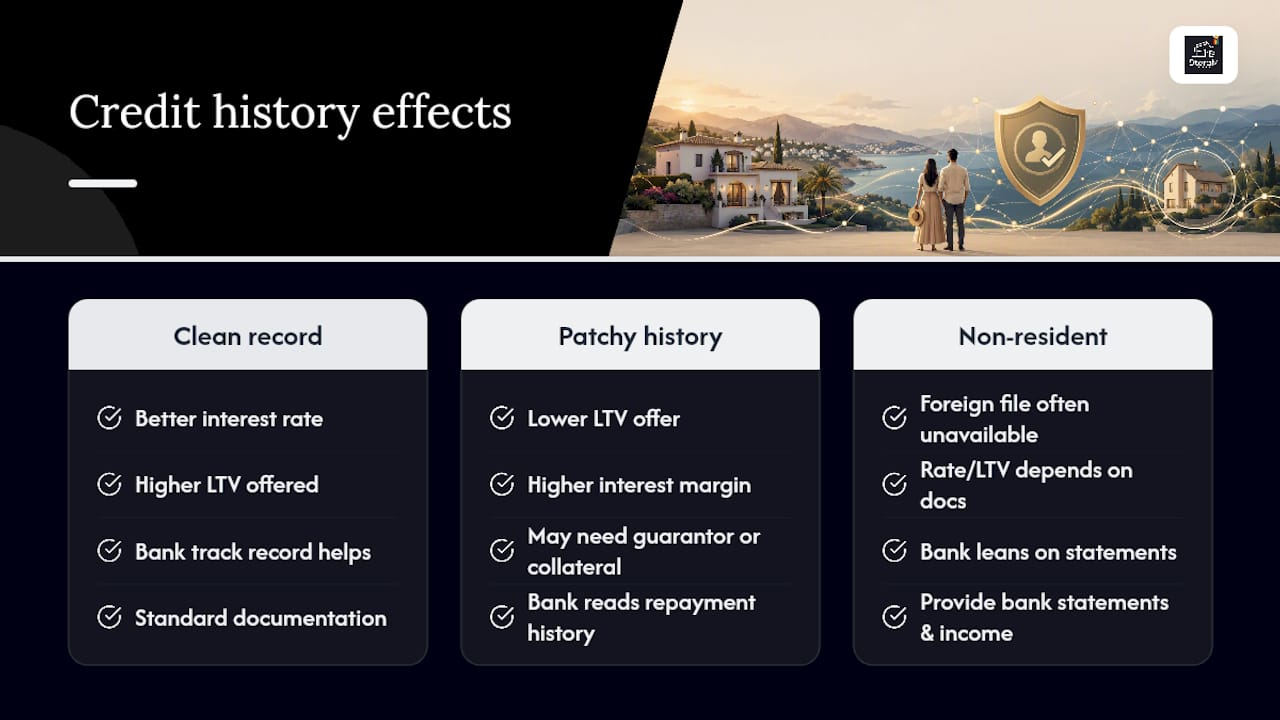
Spanish lenders pull credit history through files maintained by credit bureaus and internal risk-scoring systems, and for a second home, that history gets scrutinized harder than it would for a first mortgage. A clean record, no missed payments, low existing debt, and a track record with your bank all push you toward the better end of the rate range and the higher end of the LTV range.
A patchy credit history doesn’t automatically disqualify you, but it usually means one of three outcomes: a lower LTV offer, a higher interest margin, or a request for a guarantor or additional collateral. Banks read repayment history as the clearest evidence of future behavior, so someone who paid off a car loan or a previous mortgage without incident looks materially safer than someone applying for the first time with no track record at all.
For non-resident applicants, this gets trickier since Spanish banks often can’t pull a foreign credit file directly. That usually shifts the emphasis onto income documentation, bank statements from your home country, and sometimes reference letters from your existing bank. Steramflats’s guide on mortgages for non-resident buyers covers this angle in more detail.
If your credit history has a blemish, small delinquencies or a missed payment from years ago, address it before applying rather than hoping it slips past. Paying off outstanding negative marks and waiting a few months for your file to reflect the resolution often changes the offer you receive.
What’s the Real Total Cost of Financing a Second Home?
The mortgage payment is only one line in a longer bill. Add up the numbers before you commit, because the gap between “the sticker price” and “what you’ll actually spend” is where budgets break.
On the acquisition side, you’re looking at the down payment itself (25% to 40% given typical LTV limits), notary fees, Land Registry fees, and either ITP or IVA plus AJD depending on whether the property is resale or new-build, all of which Fotocasa Life details for second residences. Mortgage arrangement can also carry a bank opening fee, though these have become less common as competition among lenders has pushed some fees toward zero.
On the recurring side, you’ve got the mortgage payment itself, annual IBI, community fees if applicable, home insurance (often mandatory when there’s a mortgage attached), and maintenance. If the property sits empty part of the year, you’ll also owe tax on the imputed rental income described earlier; if you rent it, you’ll declare and pay tax on the real income instead.
None of these costs are optional add-ons. Lenders factor several of them directly into their affordability assessment, since a mortgage payment you can technically afford but that leaves nothing for IBI and insurance isn’t actually affordable in practice.
Should You Borrow From a Bank or a Private Lender?
Traditional banks remain the default choice for most second-home buyers in Spain, and for good reason: regulated rates, standardized terms, and the lower interest margins that come with a heavily competitive lending market. The tradeoff is a slower, document-heavy underwriting process and firm LTV ceilings that don’t bend easily.
Private lenders, sometimes bridging finance providers or smaller specialty lenders, fill a narrower niche. They move faster, ask fewer questions, and sometimes lend against profiles a traditional bank would reject outright, a foreign income stream that’s hard to verify, or a purchase timeline too tight for standard underwriting. That speed and flexibility comes at a real cost: markedly higher interest rates, shorter repayment windows, and sometimes fees that dwarf what a bank would charge for the same loan amount.
For most buyers, a private lender makes sense only as a bridge, covering the gap while a traditional mortgage or a property sale closes, rather than as the long-term financing structure. HouseGoodbye’s analysis of the financial risk of carrying two homes is worth reading if you’re weighing whether a faster, pricier loan is worth the trade against a slower bank process. If your finances are straightforward and your documentation is in order, a bank almost always ends up cheaper over the life of the loan.
Fixed or Variable Rate: Which Fits a Second Home Better?
Spain’s mortgage market offers both fixed and variable rates, and the choice matters more for a second home than it might for your primary residence, mainly because the margins are already higher to begin with.
A fixed rate locks in your payment for the life of the loan, or a substantial portion of it. That predictability is valuable when you’re already stretching to cover a second set of ongoing costs, IBI, community fees, insurance, since you don’t want your mortgage payment to be the variable that spikes when rates rise.
A variable rate, typically tied to Euríbor plus a margin, tends to start lower than the fixed equivalent. If rates fall, you benefit; if they climb, your payment climbs with them. Given that second-home mortgages already carry a higher margin than primary-home loans, riding a variable rate means compounding two sources of payment uncertainty at once, the base rate and the fact that lenders reprice second-home risk more aggressively during volatile periods.
Some banks also offer mixed products, fixed for an initial period, then variable afterward, which can be a reasonable middle ground if you expect your finances or plans for the property to change within a few years.
How Do You Actually Negotiate Better Mortgage Terms?
Negotiating a second-home mortgage isn’t about haggling over a number in a single conversation. It’s about showing up with leverage before you ever sit down with a loan officer.
Sotions’ negotiation research points to product linking as one of the most consistent levers: agreeing to route your salary through the lender’s accounts, buy home insurance through them, or maintain a savings product can shave real basis points off your margin. Banks price in the profitability of the whole relationship, not just the loan.
A bigger down payment is the other lever that consistently moves the needle. Offering 35% or 40% instead of the bare minimum signals lower risk and often unlocks a better rate than the LTV math alone would suggest.
Beyond that, a few practical moves help:
- Get quotes from more than one lender before committing. Even informal simulations give you comparison leverage.
- Ask specifically about early repayment penalties, since second-home borrowers sometimes pay down principal faster than expected if they sell or refinance.
- Time your application when your financial documentation looks strongest, right after a raise or a debt payoff, rather than during a lean stretch.
A Word of Caution From Someone Who’s Seen This Go Sideways
Buyers consistently underestimate how much cash reserve a bank wants to see sitting untouched, separate from the down payment itself. That gap is what derails approvals late in the process, after an offer’s already been made. Before you fall for a property, run a mortgage simulator and pull together your last six months of bank statements and your most recent tax return. Those two documents tell you more about your real borrowing power than any listing price ever will.
— YellowRock
Sources
- Así son las hipotecas para segundas viviendas — Banc Sabadell
- Consejos para adquirir una segunda vivienda — Banco Santander
- Cómo declarar tu segunda vivienda en la declaración de la renta — TaxDown
- Segunda residencia: ¿qué impuestos tienes que pagar? — Fotocasa Life
- Estrategias 2026: Cómo conseguir la mejor hipoteca para segunda vivienda habitual — Sotions