
Managing a rental property feels straightforward until it isn’t. Midnight maintenance calls, tenant disputes, local compliance updates, and the relentless cycle of screening and onboarding new occupants eat hours you do not have. For real estate investors looking to scale, the question of why outsource property management is less about comfort and more about strategy. The decision affects your bottom line, your time, and the long-term quality of your portfolio. This guide cuts through the noise and gives you the real reasons to outsource, how to do it right, and what to watch out for along the way.
Table of Contents
- Key Takeaways
- Why outsource property management: what it actually covers
- Real benefits that move the needle
- Common concerns and how to address them
- Self-management vs. outsourcing: a direct comparison
- How to get started with outsourcing
- My take on outsourcing as a growth strategy
- How Steramflats makes outsourcing work for you
- FAQ
Key Takeaways
| Point | Details |
|---|---|
| Outsourcing cuts real costs | Professional firms secure 20-30% vendor discounts that offset their management fees. |
| Time reclaimed drives growth | Outsourcing frees 10-20 hours weekly per manager, creating capacity for portfolio expansion. |
| Control is not sacrificed | Dashboards and clear reporting standards let you stay informed without doing the daily work. |
| Compliance is a major risk | Nearly 90% of property management firms already outsource compliance tasks to reduce liability. |
| Start with a pain-point audit | Identify your highest-friction tasks first and outsource those before delegating everything at once. |
Why outsource property management: what it actually covers
Most owners picture outsourcing as handing a set of keys to a stranger and hoping for the best. That picture is wrong. When structured well, outsourcing property management is a precisely defined transfer of specific operational tasks to specialists who do those tasks every single day.
At its core, outsourcing typically covers:
- Tenant screening and placement: Background checks, income verification, rental history review, and lease execution
- Rent collection and accounting: Automated collection, late-fee enforcement, financial reporting, and tax documentation
- Maintenance coordination: Vendor sourcing, work order tracking, emergency response, and quality checks
- Legal and regulatory compliance: Local ordinances, safety certifications, tenancy law updates, and eviction procedures
- Marketing and vacancy management: Listing creation, pricing strategy, platform distribution, and showing coordination
Beyond those core functions, more sophisticated providers offer bookkeeping support, IT infrastructure for property management software, and even resident satisfaction programs. Multifamily operators are now combining offshore data teams with on-site staff to build resilience against labor turnover. That kind of hybrid model is no longer reserved for large institutional landlords.
Pro Tip: Before signing any outsourcing agreement, map out every task you currently perform in a week. You will likely find at least three recurring tasks that a professional firm could handle faster and cheaper than you do today.
The right outsourcing arrangement aligns with your specific investment goals. If you own vacation rentals in Spain, for instance, the vacation rental management requirements are fundamentally different from long-term residential properties. A good provider structures its services around your portfolio type, not a one-size-fits-all checklist.
Real benefits that move the needle
Here is where most conversations about outsourcing get shallow. People say “it saves time and money” and stop there. Let’s go deeper.
1. Cost savings that actually compound
Property management firms charge 8-12% of monthly rent but use their vendor networks to deliver 20-30% below-market rates on maintenance and repairs. For an owner spending $20,000 annually on maintenance, that discount alone can outweigh the management fee entirely.
2. Time recovery at scale
Self-managing landlords spend 10 or more hours weekly on rent-related administration alone. Multiply that across five properties and you have a part-time job you never hired yourself for. Firms using systematic outsourcing recover 10-20 hours per week per manager, which translates directly into capacity for portfolio growth.
3. Labor cost reduction at the operational level
Outsourcing reduces property management labor costs by 50-70% while simultaneously improving service delivery. That is not a trade-off. It is a structural advantage built on specialization and volume.

4. Compliance protection
Nearly 90% of property management firms outsource compliance tasks in 2026. That figure tells you something: the regulatory environment in most markets has grown too complex for a single owner to track reliably. For Spanish property owners specifically, understanding legal support for real estate is not optional. Fines, disputes, and licensing failures hit owners who try to manage compliance on their own.
5. Tenant quality and retention
Effective tenant screening reduces eviction rates and turnover costs substantially. Professional firms run more thorough checks than most independent landlords and respond to maintenance requests faster. Both of those factors directly influence how long a good tenant stays.
6. Scalability without the payroll burden
Outsourcing shifts management from fixed to variable costs, letting you scale your portfolio without hiring, training, and managing in-house staff. You add properties. You do not add headcount.
“Successful property managers use outsourcing as a strategic growth tool, not just cost-cutting, shifting focus toward leadership and client relationships rather than daily administration.”
Common concerns and how to address them
Fear of losing control stops many investors from outsourcing. It is a reasonable concern. It is also solvable.
The biggest shift outsourcing requires is a governance shift. You stop doing the work and start monitoring the results. The owners who struggle are those who hand off operations without building any oversight structure. The ones who succeed are those who implement dashboards and clear performance standards from day one.
Common concerns and how to address each one:
- “I will lose visibility into my properties.” Require weekly reporting with vacancy rates, maintenance status, and rent collection summaries. Most professional firms offer owner portals with real-time data.
- “Communication will fall apart.” Set defined response time expectations in your service agreement. A 24-hour response window for non-emergency inquiries and 4-hour for urgent matters is standard.
- “Quality will drop.” Establish documented service standards for maintenance, tenant communication, and property inspections. Review them quarterly.
- “I’m not ready to outsource everything.” You don’t have to. Hybrid models let you retain direct tenant relationships or handle your own leasing while outsourcing maintenance coordination or bookkeeping.
Pro Tip: Treat your first 90 days with any outsourced provider as a trial period. Set a 30, 60, and 90-day review schedule to catch process gaps before they become expensive habits.
Selecting the right partner matters more than the decision to outsource at all. Look for providers with documented operational systems, technology infrastructure, and transparent reporting. Well-documented vendor management and maintenance tracking distinguish top-tier firms from those that will create more problems than they solve.
Self-management vs. outsourcing: a direct comparison
The question of whether to outsource or manage property yourself comes down to three variables: cost, time, and quality consistency. Here is how they stack up.
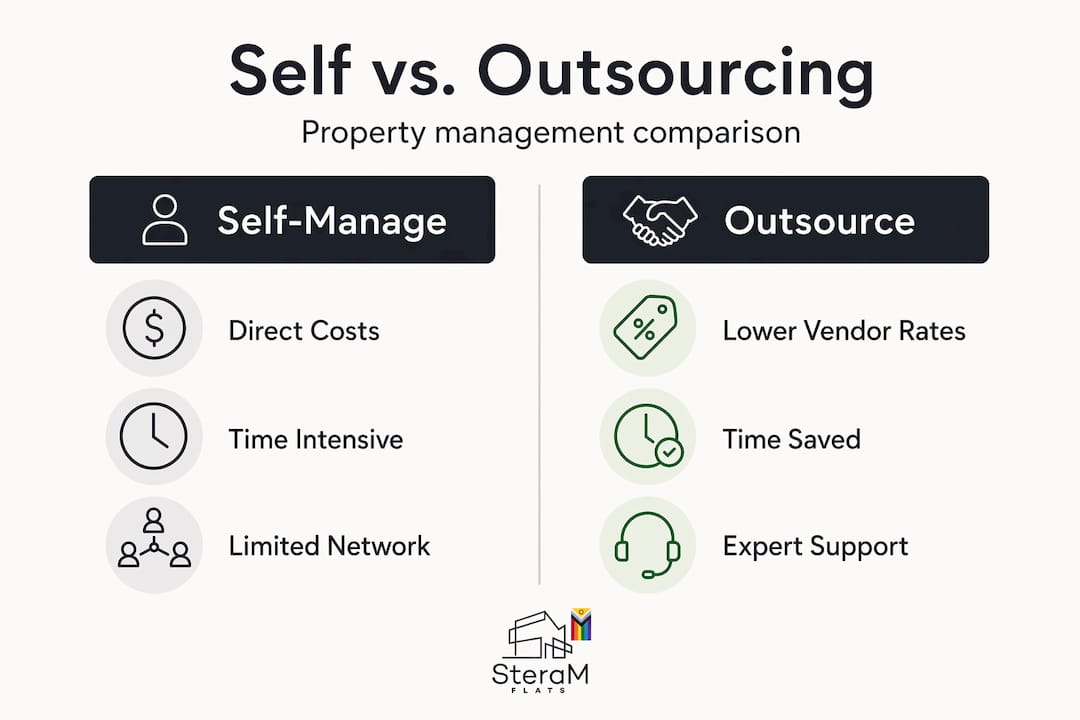
| Factor | Self-management | Outsourced management |
|---|---|---|
| Monthly cost | No management fee; all expenses absorbed individually | 8-12% of rent; offset by vendor discounts of 20-30% |
| Weekly time investment | 10+ hours per property on average | Near zero operational hours for the owner |
| Vendor pricing | Market rate or higher | Bulk-rate discounts through established contractor networks |
| Compliance risk | Fully on the owner; easy to miss updates | Handled by specialists with current regulatory knowledge |
| Tenant response time | Variable depending on owner availability | Typically faster via dedicated staff and after-hours coverage |
| Scalability | Grows harder with each property added | Scales without proportional increase in owner workload |
| Vacancy management | Depends on individual marketing effort | Professional listing, pricing strategy, and platform distribution |
The math shifts in outsourcing’s favor faster than most owners expect. The efficiency of outsourced property management becomes especially clear when you factor in the hidden cost of tenant turnover. A vacancy that stretches two weeks longer than necessary because of slow marketing or delayed screening can easily cost more than three months of management fees.
If you own a holiday rental in a market like Torremolinos, the calculus looks even more favorable. Understanding how holiday rentals boost investment returns requires consistent pricing, occupancy optimization, and platform expertise that most individual owners simply do not have time to maintain.
How to get started with outsourcing
Getting outsourcing right is a process, not an event. Jumping in without preparation is how investors end up frustrated and blaming the model when the problem was the execution.
Follow this sequence:
- Audit your current workload. Track every property-related task for two weeks. Note the time spent, the frequency, and your level of expertise in each area. This tells you what to outsource first.
- Identify your highest-friction tasks. Maintenance coordination and compliance are almost always the right starting point. They consume disproportionate time and carry the most risk if mishandled.
- Define what oversight looks like for you. Decide in advance how you want to receive reporting, how often you want check-ins, and what performance metrics matter most to your portfolio goals.
- Evaluate providers against documented criteria. Ask for client references, sample reporting templates, and proof of vendor networks. Request clarity on how they handle emergency maintenance and tenant disputes specifically.
- Structure a service agreement with exit provisions. Your contract should include performance benchmarks, communication standards, and a clear termination process if expectations are not met.
- Integrate with your existing systems. If you use property management software, confirm that your provider can work within it or migrate data cleanly. Operational continuity matters on day one.
Pro Tip: Ask any prospective property management firm how they handled their last maintenance emergency after hours. The specificity and confidence of their answer tells you more than any brochure will.
Using a rental management checklist as a baseline during your provider evaluation helps you verify that key landlord responsibilities are clearly assigned and not falling into a gap between what you think they do and what they actually do.
My take on outsourcing as a growth strategy
I have watched property owners approach outsourcing from two fundamentally different mindsets. The first group sees it as a reluctant concession, a sign that managing their own properties became too hard. The second group sees it as a deliberate upgrade, a way to operate at a higher level without burning out.
In my experience, the second group builds bigger portfolios. Every time.
What separates successful outsourcing arrangements from frustrated ones is almost never the provider. It is the owner’s willingness to shift from operator to investor. When you stop spending Saturday mornings fielding plumbing calls and start spending them analyzing acquisition opportunities, the return on your portfolio changes fundamentally. Outsourcing administrative and repetitive tasks is not a retreat from ownership. It is the clearest signal that you are taking ownership seriously.
The biggest mistake I see is investors outsourcing reactively, only after something goes wrong, and then blaming the outsourcing when the real problem was a chaotic handoff with no systems behind it. Outsourcing without documentation is just delegation without accountability. You will get chaos either way.
Start with one task category. Build the oversight process. Prove it works. Then expand. That disciplined approach is what separates investors who scale from those who get stuck managing the same two properties for a decade.
— Steramflats
How Steramflats makes outsourcing work for you
If you have been weighing the reasons to outsource property management and you own or invest in Spanish real estate, Steramflats is built specifically for your situation. The team understands the local regulatory environment, the vendor networks, and the specific demands of both long-term rentals and vacation properties in southern Spain.

Steramflats handles tenant screening, maintenance coordination, compliance documentation, and marketing through a single point of contact, with transparent reporting so you always know where your investment stands. Whether you are managing a single apartment in Torremolinos or a multi-unit portfolio along the Costa del Sol, Steramflats gives you the efficiency of professional management without surrendering visibility. Explore vacation rental and real estate services or list your property today to see how the right partner changes what your portfolio can do.
FAQ
What does outsourcing property management typically cost?
Most professional property management firms charge 8-12% of monthly rent. Vendor discounts of 20-30% through established contractor networks frequently offset that fee entirely.
Will I lose control of my property if I outsource?
No. A well-structured outsourcing arrangement includes regular reporting, owner dashboards, and clear performance standards that keep you informed without requiring you to manage daily operations.
What tasks should I outsource first?
Start with maintenance coordination and compliance. Both consume significant time and carry serious financial risk when handled inconsistently by owners without specialist knowledge.
How does outsourcing affect tenant quality?
Professional firms run more thorough tenant screening processes and respond to maintenance issues faster, which reduces eviction rates and improves long-term tenant retention.
Is outsourcing property management right for small portfolios?
Yes, even single-property owners benefit. The time savings, vendor discounts, and compliance protection deliver real value regardless of portfolio size, and the structure makes growth much easier when you are ready to scale.
Recommended
- SteraM Flats | Essential property maintenance guide for Spanish homeowners
- SteraM Flats | Rental management checklist: Essential steps for landlords in Spain
- SteraM Flats | How to manage vacation rentals in Spain for maximum returns
- SteraM Flats | Long-term vs Holiday Rentals: Smarter Choices for Spanish Property