A tourist license is the official permit required to legally rent out a furnished property for short-term tourist stays in Spain. Known formally as the Vivienda de Uso Turístico (VUT), this authorization operates under a layered regulatory framework that spans autonomous communities, municipal governments, and a national registration system. Without it, you cannot legally list your property on platforms like Airbnb or Booking.com, and you risk fines, forced delisting, and legal action. For anyone planning to invest in or operate vacation rentals in Spain, understanding this permit is the first and most critical step.
What is a tourist license and why does it matter in Spain?
A tourist license, or VUT, is a regional authorization that permits property owners to rent furnished homes to tourists for short periods, typically fewer than 31 consecutive days. Spain does not have a single national tourist license. Each of the 17 autonomous communities writes its own rules, which means the tourist license requirements in Andalucía differ substantially from those in Cataluña, Madrid, or the Canary Islands.
This matters because the regulatory landscape is not just one permit. It involves approvals from regional tourism authorities, municipal urban planning departments, and in apartment buildings, the community of owners. Even a property that clears every regional and municipal hurdle can still be blocked from operating if the building’s homeowners association votes to prohibit tourist rentals. That veto power is real and legally binding.

The consequences of skipping this process are severe. Spain’s Ministry of Housing, the Ministerio de Vivienda, has integrated its registration database directly with major rental platforms. From 2026, over 86,000 illegal listings have already been removed from platforms after failing registration verification. That number signals how aggressively enforcement has scaled, and it will only increase.
What are the tourist license requirements across Spain’s regions?
Tourist license requirements vary by autonomous community, but several core elements appear consistently across regions. Before applying anywhere, you need to verify three things: the regional rules for your property type, the municipal zoning classification of your address, and whether your building’s community of owners permits tourist rentals.
Here is what the requirements typically cover across Spain’s main regions:
- Property habitability certificate: The property must meet minimum habitability standards, including adequate ventilation, heating, and sanitation.
- Minimum size and occupancy limits: Madrid’s 2026 updates introduced mandatory equipment standards and occupancy caps tied to floor area.
- Declaration by the holder, not just the owner: Madrid now requires the license holder, who may be a tenant or manager rather than the property owner, to submit the declaration. This is a significant shift from previous rules.
- Community of owners approval: In apartment complexes, the building’s statutes or a qualified majority vote can prohibit tourist rental activity entirely.
- Municipal zoning compliance: Some city centers, particularly in Barcelona and Palma de Mallorca, have imposed moratoriums or outright bans on new tourist licenses in certain zones.
Aragón uses a declaración responsable model, where you declare compliance upfront and can begin operating immediately. However, authorities have up to three months to inspect the property and can prohibit activity if it does not meet standards. This is not a rubber stamp. It is a conditional green light that can be revoked.
Pro Tip: Before purchasing a property specifically for tourist rental, commission a legal check on the building’s community statutes and the municipal zoning classification. Discovering a prohibition after purchase is an expensive mistake that no license application can fix.
How does the national registration number system work?
Spain’s national registration layer sits on top of regional licenses and is managed through the Ventanilla Única Digital, the digital single window operated by the Colegio de Registradores (Land Registry). Every short-term rental property must obtain a Número de Registro, a unique registration number issued by the Land Registry, before listing on any platform.
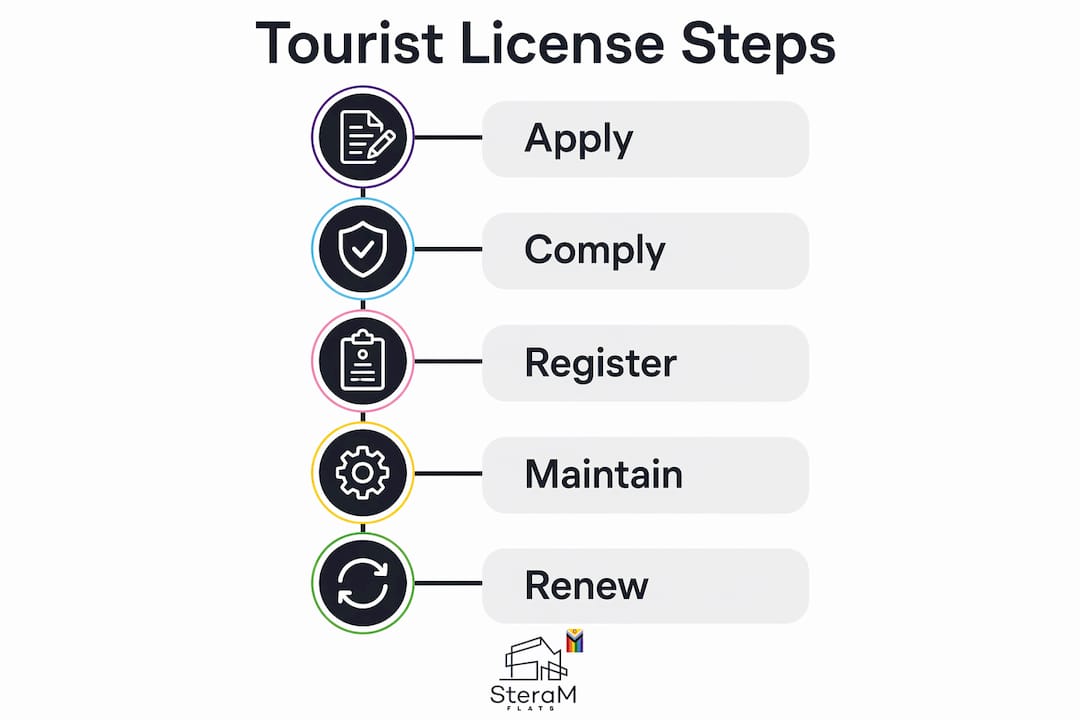
Here is how the process works in sequence:
- Obtain your regional tourist license or VUT authorization from your autonomous community’s tourism department.
- Register with the Land Registry through the Ventanilla Única Digital portal to receive your Número de Registro.
- Display the registration number on every online listing across all platforms, including Airbnb, Booking.com, Vrbo, and any direct booking website.
- Platforms verify the number against the national database when you submit or update a listing. Invalid or missing numbers trigger removal requests from the Ministry of Housing.
- Keep your registration current. If your regional license lapses or is suspended, your national registration number becomes invalid, and platforms will delist your property automatically.
The national registration number creates a real-time compliance mechanism. Platforms are not just checking a box. They are querying a live database, and any discrepancy between your listing and the registry triggers an automated flag. This is why property owners who list first and apply later face immediate forced delistings and potential fines. The system is built to catch exactly that behavior.
What steps should investors follow to obtain and maintain a tourist license?
Getting a tourist license is a process, not a single form submission. The steps below apply broadly across Spain, though specific documentation requirements differ by region. Treat this as your operational checklist, not a shortcut.
- Step 1: Confirm eligibility. Check municipal zoning maps and your building’s community statutes before spending time or money on an application. A property in a prohibited zone or building cannot be licensed regardless of how well it meets other criteria.
- Step 2: Prepare your property. Meet all habitability, equipment, and safety requirements for your region. Madrid’s 2026 rules, for example, specify mandatory furnishings, appliances, and emergency contact information displayed inside the property.
- Step 3: Submit your declaration or application. In regions using the declaración responsable model, like Aragón, you submit a self-declaration and can begin operating. In other regions, you wait for formal approval before accepting guests.
- Step 4: Register nationally. Once your regional authorization is in place, complete the Ventanilla Única Digital registration to obtain your Número de Registro.
- Step 5: List with your registration number. Add the number to every platform listing. Platforms will verify it against the national database.
- Step 6: Monitor compliance continuously. Licensing is an ongoing operational commitment, not a one-time formality. Authorities can inspect at any time and suspend activity if conditions fall below current standards.
Pro Tip: Set a calendar reminder to review your regional license conditions annually. Regions like Madrid update their requirements, and a license issued under 2024 rules may not automatically comply with 2026 standards without modifications to your property or documentation.
The most common pitfall investors encounter is treating the declaración responsable as final approval. It is not. It initiates your operation but triggers an audit window. Properties that begin operating without meeting all stated conditions face closure orders, not just warnings.
How do tourist license rules affect your platform listings?
The connection between tourist licenses and platform visibility is now direct and automated. Spain’s Ministry of Housing notifies platforms of listings that lack valid registration numbers, and platforms are legally required to remove them. This is not a theoretical risk. It is the mechanism that produced the removal of 86,000 listings in early 2026 alone.
| Scenario | Platform outcome | Legal risk |
|---|---|---|
| Valid regional license and national registration number | Listing remains active and visible | Minimal, subject to ongoing compliance |
| Regional license obtained but no national registration number | Listing flagged and removed by platform | Fines and forced delisting |
| No regional license, no registration number | Immediate removal upon detection | Fines, legal penalties, potential prosecution |
| License suspended due to failed inspection | Registration number invalidated, listing removed | Fines and suspension of rental activity |
The compliance feedback loop between the national registry and rental platforms means that any gap in your licensing chain translates directly into lost bookings and lost revenue. A property generating €2,000 per month in rental income loses that income the moment it is delisted, and reinstatement requires resolving the underlying compliance issue first.
Staying visible on platforms requires maintaining both layers: the regional VUT and the national registration number. Losing either one breaks the chain. For investors managing multiple properties, a rental management checklist that tracks license expiry dates and inspection schedules is not optional. It is the difference between a performing asset and a liability.
Key takeaways
A tourist license in Spain requires both a regional VUT authorization and a national registration number, and losing either one results in automatic platform delisting and legal penalties.
| Point | Details |
|---|---|
| Two-layer licensing requirement | Every property needs a regional VUT and a national Número de Registro to operate legally. |
| Regional rules vary significantly | Madrid, Aragón, Andalucía, and other communities each set their own equipment, size, and occupancy standards. |
| Community of owners can block rentals | Building statutes or a qualified majority vote can prohibit tourist rentals regardless of other approvals. |
| Platform enforcement is automated | Spain’s Ministry of Housing flags non-compliant listings in real time, triggering automatic removal. |
| Licensing is ongoing, not one-time | Inspections can suspend licenses post-issuance if properties fall below current compliance standards. |
Why the “get licensed once, forget it” mindset will cost you
Most articles about tourist licenses in Spain treat the application as the finish line. From working with property investors in southern Spain, I can tell you that the application is the starting gun.
The declaración responsable model used in Aragón and other regions is genuinely useful. It lets you start generating revenue while your paperwork is reviewed. But I have seen investors treat that initial declaration as permanent authorization, only to receive a closure order three months later because their property did not meet the equipment standards they self-declared. The declaration does not protect you. Actual compliance does.
What surprises most investors is the community of owners layer. You can have a perfect regional license and a valid national registration number, and a single building vote can shut down your operation. I always recommend checking the building statutes before any purchase, not after. That one step has saved clients from buying properties that were legally unlicensable from day one.
The competitive advantage in Spain’s regulated rental market now belongs to operators who treat compliance as a business function, not a bureaucratic hurdle. Properties with clean licensing histories, documented inspection records, and current registration numbers command better platform visibility and higher guest trust. That translates directly into occupancy rates and revenue. Legal compliance is not just a legal obligation. It is a commercial asset.
— YellowRock
How Steramflats can help you get licensed and stay compliant
Obtaining a tourist license in Spain involves regional applications, national registration, platform compliance, and ongoing inspections. Steramflats specializes in exactly this process for property owners and investors in southern Spain, particularly in Torremolinos and the Costa del Sol.
Steramflats handles the full licensing workflow, from verifying municipal zoning and community statutes to submitting your regional VUT application and registering your property through the Ventanilla Única Digital. The team also provides ongoing compliance monitoring so your listings stay active and your investment keeps generating returns. If you are ready to move forward, explore Steramflats’ vacation rental services or read the step-by-step licensing guide to understand exactly what the process involves before you begin.
FAQ
What is a tourist license in Spain?
A tourist license, formally called a Vivienda de Uso Turístico (VUT), is a regional authorization that permits property owners to rent furnished homes to tourists for short stays. It is issued by Spain’s autonomous communities and must be complemented by a national registration number from the Land Registry.
How do I get a tourist license in Spain?
You apply through your autonomous community’s tourism department, meet regional habitability and equipment standards, and then register with the Ventanilla Única Digital to obtain your national Número de Registro. The exact steps and documentation vary by region.
Can a building’s community of owners block a tourist license?
Yes. Even with a valid regional license and national registration number, a building’s community of owners can prohibit tourist rental activity through its statutes or a qualified majority vote. This block is legally enforceable and cannot be overridden by individual license holders.
What happens if I list my property without a valid tourist license?
Spain’s Ministry of Housing notifies platforms of listings without valid registration numbers, and platforms are required to remove them. You also face fines and potential legal penalties. In 2026, over 86,000 listings were removed through this enforcement mechanism.
Do tourist license requirements change after the license is issued?
Yes. Authorities can inspect licensed properties at any time and suspend activity if the property no longer meets current standards. Madrid’s 2026 rule updates, for example, introduced new equipment and occupancy requirements that existing license holders must now satisfy.